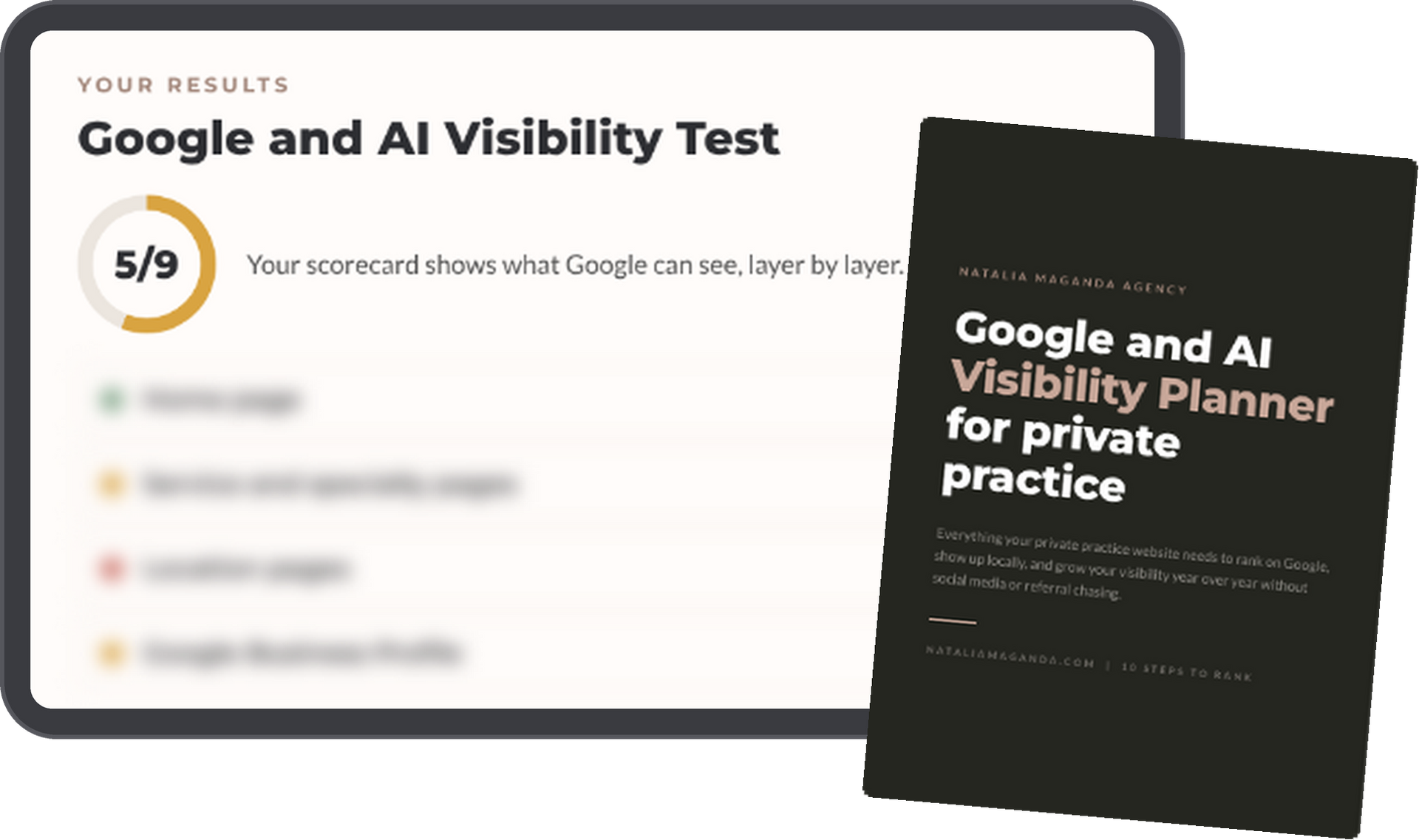

SEO Services for Therapists | Best SEO Agency to Get Found on Google and AI
Your website exists. It is live, it is accurate, and it says you are accepting new clients. And when someone in your city types exactly what you treat into Google at 11 at night, or asks ChatGPT who to call, a different practice is the one that shows up.
That says nothing about how good you are at your job. Nobody told you a website is a job, and nobody was ever assigned to hold it. SEO services for therapists fix that by giving your visibility an owner. The structure of your site, your local presence, your content, the links and mentions that prove your practice is real, and the way AI tools find and describe you all get handled together.
Below is how holistic SEO works for therapists and private practices, what is included, how to tell a strong SEO agency from a risky one, and how we take the whole job off your desk.
What SEO services for therapists are
SEO services for therapists are the ongoing work of making your practice easy for Google and for AI tools to find, understand, and trust. That comes down to five parts working together: a site structure with a dedicated page for every specialty and location, local SEO including an active Google Business Profile, content that builds topical authority, link building and digital PR that earn trusted mentions of your practice across the web, and AI search visibility, so tools like ChatGPT and Google's AI answers can describe who you help.
Most agencies sell one piece of this. A keyword report. A few blog posts. A directory cleanup. Each piece helps a little, and none of them moves the needle alone, because Google and AI tools judge your practice on all of it at once. That is why we treat SEO as a job that sits inside your website management, not a task list handed to you after launch. To see how the two fit together, start with what website management actually includes, and read how I work as a therapist website designer who also runs the SEO.
Why most therapist websites don't get clients
- One page trying to do everything: anxiety, trauma, couples, and grief all compressed into a single services page, so none of it ranks for anything specific.
- The location problem: your city gets mentioned once on the homepage instead of built into your titles, headings, and page content.
- A neglected Google Business Profile: the biggest lever for local search sits untouched since the day it was created.
- Nobody is assigned to it: the site launched once and nothing has been added or updated since, while Google keeps rewarding sites that stay active.
- No other site vouches for you: Google and AI tools look at who else mentions your practice. If your only presence outside your own website is a directory listing every other therapist has too, you are easy to skip.
Most of these trace back to the same structural problems. We break down each one, and how to tell which applies to you, in why your therapist website is not getting clients.
Signs your SEO needs the whole system
- If you search your specialty plus your city in an incognito window, does your website appear anywhere on the first page?
- Do you have a dedicated page for each specialty you treat, or one page trying to cover all of them?
- When was the last time you posted anything to your Google Business Profile?
- Are new inquiries still coming almost entirely from referrals, with almost nothing from search?
- If you ask ChatGPT or Google's AI who to see for your specialty in your city, is your practice named?
- If you search your practice name, does any site besides your own and a directory mention you?
That gap usually comes down to fundamentals more than anything mysterious, the same ones we cover in the most common private practice website mistakes.
Who this is for, from solo therapists to group practices and niches
This is a strong fit if you:
- Are a licensed therapist or private practice owner whose website exists but rarely brings in a new inquiry
- Have specialties or a niche that your current site does not clearly reflect
- Want your visibility to come from search and AI recommendations instead of the same few referral relationships
- Want the job of SEO off your desk permanently, not patched for another season
This may not be the best fit if you:
- Are looking for SEO as its own standalone project. We do not sell it that way, and the FAQ below explains why
- Need results guaranteed within a set number of weeks, since SEO does not work on a fixed timeline
- Need to approve every word and pixel yourself rather than trusting a strategy you have signed off on
Own a group practice with a team to fill? Start with SEO for group practices. Looking for SEO built around your license or niche? We have dedicated pages for psychologists, psychiatrists, counselors, clinics, holistic practitioners, chiropractors, healers, life coaches, and dietitians.
Our holistic SEO approach for therapists
We do not treat SEO as one tactic. When we build or manage your site, six pieces get planned together, so each one strengthens the others instead of competing with them.
Keywords and search intent
We start with the words your clients actually type, not the clinical terms you use with colleagues. Someone searching "anxiety therapist near me" is ready to book. Someone searching "why do I feel anxious at night" is not ready yet, and needs a helpful post that earns their trust first. We sort every keyword by that intent and decide which page owns it, so two of your pages never compete for the same search.
You can see how that sorting works in 50 mental health keywords your clients are searching, grouped by what the searcher is ready to do.
Specialty pages that rank
Four or five pages cannot compete for local searches against a practice running thirty. Every specialty you treat gets its own page, written in your voice and built around the exact search a client types, whether that is a specific concern, a modality, or a combination of the two. That is how Google learns what you treat, and how a visitor knows they are in the right place.
What each of those pages needs is laid out in what to include on a therapy specialty page.
Content and topical authority
Google rewards sites that cover a topic completely. A single blog post on anxiety does very little. A connected set of posts, each answering a different question a client asks and each linking back to your anxiety specialty page, tells Google your site is a trusted source on the subject. We plan that content, write it in your voice, and publish it on a steady rhythm. You review a batch and approve it.
The full reasoning is in topical authority and blogging for therapists.
Local SEO and your Google Business Profile
Most people looking for a therapist want one near them, and the map results at the top of Google often decide who gets the call. An active Google Business Profile, the same name, address, and phone number everywhere your practice is listed, and reviews gathered in a way that respects confidentiality and your licensing board all feed those results. A profile created once and forgotten works against you.
Start with local SEO for therapists, then read how to rank your practice higher on Google Maps.
Multiple cities and locations
If you serve more than one city or neighborhood, your homepage cannot rank for all of them at once. A dedicated page for each place you genuinely serve usually outperforms one generic page, because it answers the local search directly. We build those pages one at a time, so each reads as its own page and not a copy of the last.
Location pages, the secret SEO strategy for therapy practices explains why this works.
AI search visibility
ChatGPT, Google's AI answers, and similar tools pull from the same web that SEO builds: clear pages, consistent business details, reviews, and mentions on sites they already trust. We structure your pages so a tool can pull a clean answer about who you help and where, and we track whether your practice is actually being named. One of our clients was recommended by ChatGPT without ever setting up a profile for it.
The details are in how to get recommended on ChatGPT and AI platforms.
How it works:
Strategy call: your specialties, your city, and your ideal client
We open with a strategy call. We map the specialties you treat, the city or cities you serve, and the client you most want to reach. That becomes the foundation of your whole SEO plan, and you do not need to arrive with a list of keywords.
We build the site and the authority around it
We build your 20 plus page website with SEO structured into every page, then start earning the links and mentions that tell Google and AI your practice is real. You review and approve. You do not write or produce any of it.
We manage it. You approve a blog batch.
You see clients. We handle ongoing content, your Google Business Profile, link building, and monthly reporting. You review a blog batch, approve it, and get back to your life. That is the whole assignment.
Meet your private practice website manager - Natalia Maganda

With more than 7 years in business and 100+ clients served, Natalia Maganda builds websites and SEO systems that help therapists get found on Google and AI. Her boutique agency currently manages 30+ sites.
Her focus is specific: a brand identity and voice that match the practice you have grown into, not the one you started with. A website manager in your life, so marketing never becomes your full time job again.
What our SEO services include, from your website to your rankings
- Keyword and specialty research built around your actual practice, not generic therapy terms
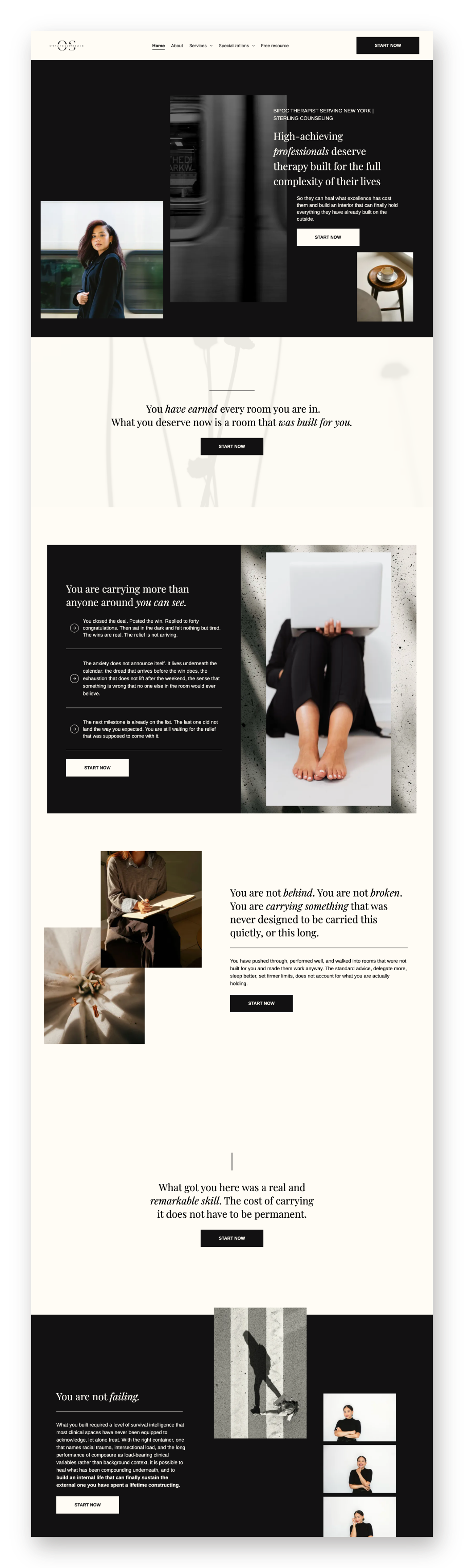
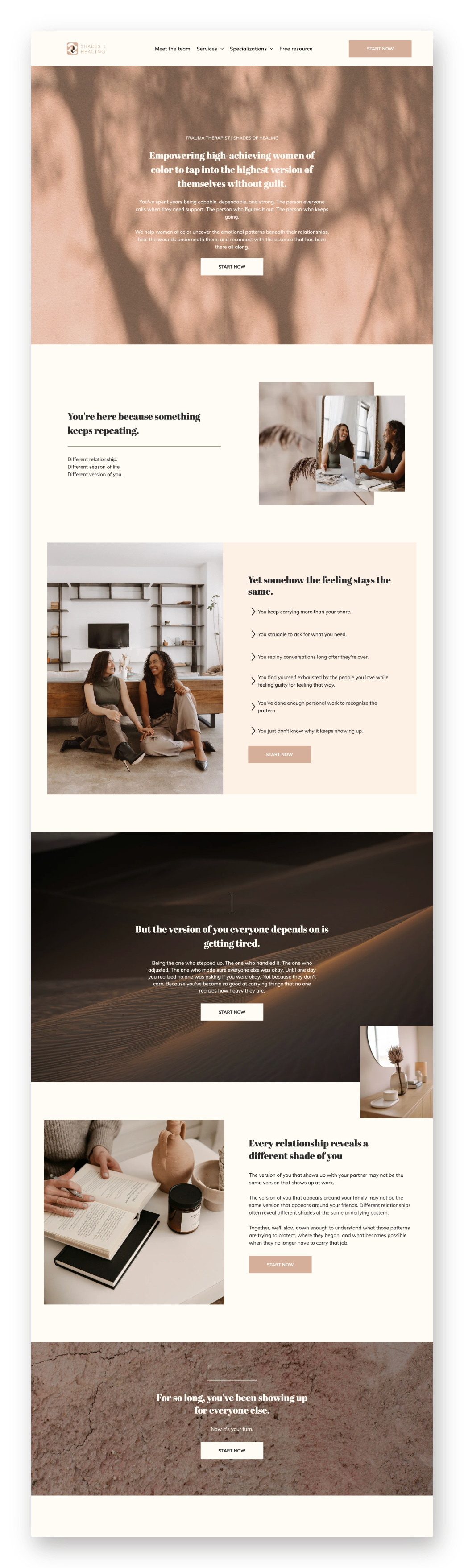
- A 20 plus page website designed to rank from launch, with a dedicated, fully optimized page for every specialty you treat
- Location pages for the cities you serve
- Google Business Profile setup and ongoing management
- Ongoing content, published on a regular rhythm and tied back into your specialty pages
- Yearly link building and digital PR to earn trusted mentions of your practice
- Citation and directory setup, so your name, address, and phone number match everywhere
- AI search visibility work weaved into your content strategy
- Technical SEO: site speed, mobile, indexing, and structured data
- Reporting dashboard
Because your website and your SEO come from the same engagement, everything launches already working to get you found.
Link building and digital PR: why Google and AI need other sites to vouch for you
Your website can be built perfectly and still stay quiet if nobody else on the internet is talking about it. Google has treated links from trusted sites as a vote of confidence for a long time. AI tools lean on something similar. They tend to recommend practices and brands that are named across the web, not only the ones with the most pages.
The data points that way. In an Ahrefs study of 75,000 brands, how often a brand was mentioned across the web correlated with its visibility in Google's AI Overviews at 0.664, and branded link anchors at 0.527. The raw number of backlinks correlated at only 0.218. Ahrefs is clear that this shows a relationship, not proof of cause. A Semrush study of nearly 4,000 AI answer appearances found that comparison questions, the "who is the best" kind, named brands 43.3 percent of the time, against 18 percent for informational questions.
So link building is no longer about collecting as many backlinks as possible. It is about being named, in the right places, by sources Google and AI already trust.
Inside our SEO services for therapists, link building and digital PR means earning relevant features and mentions: press opportunities in the therapy and private practice space, expert quotes in publications, local and professional directories with consistent business details, and case studies other sites can cite.
No link schemes. No buying links from a spreadsheet. Slow, relevant, and written to sound like you, because a mention only helps when it is real. And you do not have to pitch anyone. Exhale. Someone else is holding it now.
How to choose the best SEO agency for therapists
Whoever you hire, ask these questions first. Ask us too.
- Who actually does the work? Find out whether you will work with the people doing your SEO or with a sales team, and who writes your pages.
- What do they report? Look for search positions, impressions in Google Search Console, and inquiries tied to specific pages. A single traffic number tells you almost nothing.
- How do they build links? Ask for examples. If the answer is buying links, a link network, or a link count with no mention of relevance, walk away.
- Do they treat AI search as part of the work? Ask how they track whether ChatGPT or Google's AI names your practice.
- Do they understand confidentiality and ethics? Reviews, testimonials, and content for therapists come with rules, and they should know them.
- Is it one coordinated system? Your pages, local presence, content, and links should be planned together, not sold as separate add ons.
- What do you own if you leave? Your website, content, Google Business Profile, and accounts should always be yours.
- How do they talk about timelines? Anyone who guarantees a ranking by a certain date is guessing.
We would rather you choose with all the information.

hello! i'm natalia maganda
The website manager for therapists and private practice you didn't know existed
We build and manage the 20+ page website that ranks in your city, reflects the depth of your work and books cash-pay clients with ease.
A done for you website management system that lets your practice grow without costing you your energy, your weekends, or your nervous system.
THE 10 THINGS NO ONE IS DOING FOR YOU RIGHT NOW
Your website exists. It is just not the one Google or AI shows when someone in your city searches at 11 at night.
What your next 12 months can look like
One of these comes with a to do list. The other comes with a website manager.You become the web designer, copywriter and SEO
One monthly price. Everything handled.
$597/mo for 12 months, then $350/mo Year 1 price goes up in 2027Lock in current pricing


Client results we're obsessed with...
61 inquiries 27% from Google & AI year 1 of SEO
37 inquiries 51% from Google & AI year 2 of SEO
28 leads in 6 months with a 60+ page custom site re-launch
Multi state ranking & 100%+ traffic increase after 12 months of SEO
96 inquiries 35% from Google & AI + 532% traffic increase first 6 months of SEO (Squarespace re-launch)

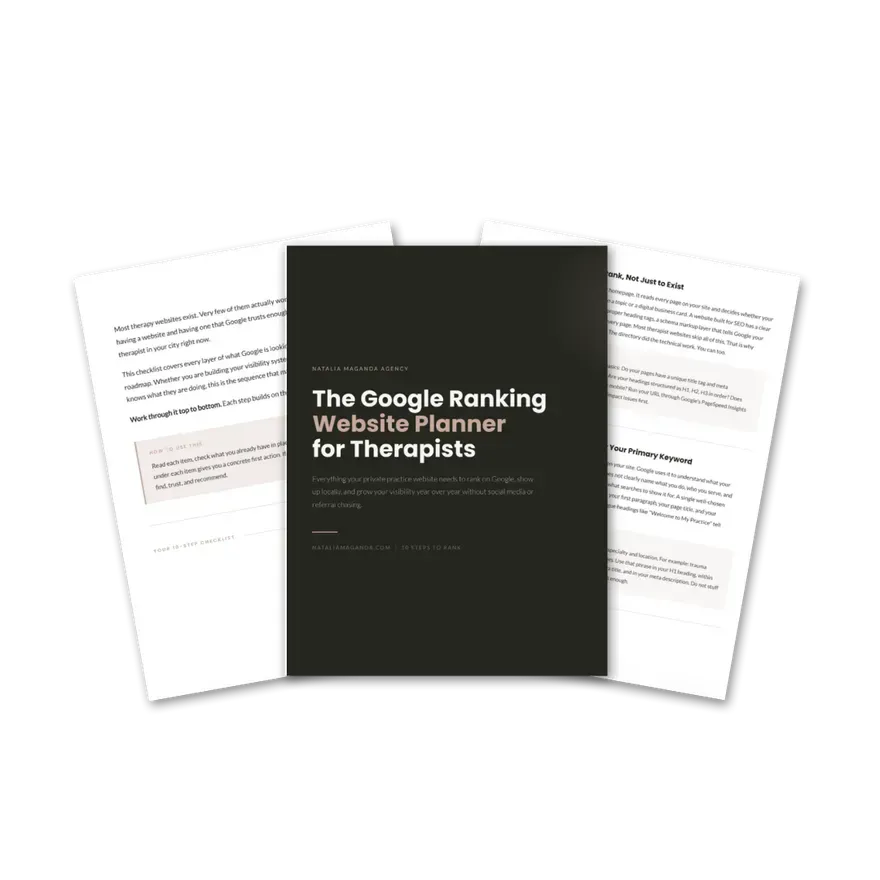
For a limited time claim a custom 12-month private practice SEO roadmap by Natalia Maganda valued at
$97 for FREE
Tell me about your practice and I'll build you a custom PDF roadmap, your local keyword opportunities, a content batching rhythm, and quick wins specific to your niche and location. I build this by hand and walk you through it live on a 20-min call, and you keep the document either way.
We manage 30+ websites and we're ready for your practice to be the next one
Frequently Asked Questions
How long does SEO take to show results?
The honest answer is it really depends. We have had clients 8 months in and still haven't gotten their first inquiry, while others had a very different result in their first 6 months. One strategy is not fundamentally different than the other. There are many factors Google and AI consider when recommending your site: in most cases it's demand in the local area, niche, specialty, competition, domain authority, domain age, relevance, and more. As someone who's been doing SEO for almost a decade, I will always encourage you to start. The sooner you start, the faster you can start watering your SEO garden. Starting is better than waiting while other practices catch the traffic that could be yours.
How much do SEO services for therapists cost?
Prices vary widely, and a number only means something next to what it covers: who does the work, whether it includes your website, content, local SEO, and link building, and what gets reported back to you. With us, SEO comes inside a website management engagement. Year one is $597 a month, including the website build in the first 90 days, and $350 a month from year two. When you compare quotes, ask what is included, who does the work, and what they report.
Is SEO being phased out by AI search?
No. People still start with Google, and AI tools pull from the same web that SEO builds: clear pages, consistent business details, reviews, and mentions on trusted sites. What changed is the goal. It is no longer only ranking, it is being recommended. That is why this service covers Google and AI together, and why link building and digital PR matter more than they used to. A website with no other voices vouching for it gets skipped by both.
Do I need a new website to work with you?
Yes. We do not work on existing websites or offer SEO as a standalone service. If your website is not performing, it is rarely just an SEO issue. It usually requires stronger copy, better design, and a clear strategy to help you get found in your area and convert visitors into inquiries. Because of this, all clients start with a new website built as part of the process. Your website will be built and hosted on the Duda.co platform, and all inquiries will be managed through a HIPAA compliant CRM called Go HighLevel. And if for some reason you wish to be offboarded from the agency we require a 90 day notice after the first year investment.
Who is the best SEO agency for therapists?
The honest answer depends on what you need, and no list can decide that for you. A strong fit does the work for you, reports on positions and inquiries, builds links ethically, and understands therapy practices. Use the questions in the section above on how to choose the best SEO agency for therapists to compare any agency, including us. If you want us to hold the whole job, apply for a strategy call below.
Ready to get this off your desk?
If you want your website working for you on Google and in AI search, SEO services for therapists come as part of a full website management engagement: the site, the strategy, the link building, and the ongoing work that keeps you visible in your city. If you are ready to hand that off, we invite you to apply for a strategy call.
If you would like to see what that includes first, you are welcome to read more about what website management actually includes before you reach out.