

Branding for Psychologists | NM Agency
A logo cannot say "PhD" on its own, but the brand around it can still fail to communicate that a doctoral-level clinician is behind the practice. Most psychologist brands read identically to a master's-level therapist's, which quietly undersells years of additional training in testing, diagnosis, and assessment.
Branding for psychologists means building an identity that separates testing and evaluation work from ongoing therapy, visually and verbally, so a referring school or pediatrician can tell at a glance that assessment is a real part of what you do, not an afterthought buried in a bio. The identity has to carry both the warmth of a therapy practice and the authority of a diagnostic one.
Below, we look at where most psychologist brands blur that distinction, and how the fix connects to a website built for testing and therapy alike.
What branding for psychologists actually means
For most practice owners, branding starts as a conversation about color and font. For a psychologist, it has to start somewhere else, with scope. A referring pediatrician searching for someone to conduct an ADHD evaluation and a prospective client searching for a therapist to help with anxiety are looking for two different outcomes, and your brand is the first signal that tells each of them they are in the right place. That means your name, your homepage language, and the way your services are organized need to make an immediate distinction between assessment and testing, ongoing therapy, or both, rather than asking a visitor to dig through a services page to figure out what you actually do.
It also means treating your credentials as a real brand asset instead of a footnote. A doctorate, board certifications, and specialized training in a testing instrument are often the exact reasons a referral source or a client chooses you over a masters level counselor, and they deserve to be reflected in how your practice looks and reads, not buried in a bio paragraph. Branding for psychologists is the discipline of making sure the visual and written identity of your practice carries the actual weight of the training behind it.
Why most psychologist brands undersell what they offer
- Testing and therapy blur into one voice. Many psychologist websites use identical language for both service lines, so a visitor cannot tell within a few seconds whether they have landed on a testing practice, a therapy practice, or both.
- The doctorate gets lost in the layout. Credentials often appear as a small credential string after a name, in a font too small to register, when for a doctoral level practice they are part of the actual value proposition.
- Language borrowed from general counseling sites. Soft, generalist phrasing works for many therapists, but it can flatten the precision that assessment work in particular requires, and it does little to signal a methodical, evidence grounded approach.
- No visual separation between service lines. When testing and therapy share one undifferentiated page, referral sources such as schools, pediatricians, and attorneys often cannot quickly confirm that testing is even offered.
- Referral relationships are treated as an afterthought. A psychologist brand built only with individual clients in mind often ignores the professional audience, other clinicians, schools, courts, who also need a fast, credible read on your qualifications.
For a longer look at how these gaps show up across therapy websites generally, see the most common private practice website mistakes.
Signs your brand isn't pulling its weight
- Can a first time visitor tell, within a few seconds of landing on your homepage, whether you offer therapy, testing, or both?
- Does your site currently make it obvious which services require a doctorate and specialized training, versus which are more general?
- Would a referring physician, school, or attorney find enough on your site to feel confident sending you an assessment referral?
- When you compare your site to a colleague with a similar caseload and similar credentials, does yours read as more established, or less?
Who this is for
Strong fit if you:
- Hold a doctorate and offer assessment or testing services alongside, or instead of, ongoing therapy, and want your site to reflect the difference clearly.
- Are ready to hire a website manager for a new site and are open to a brand refresh being part of that same project.
- Rely, at least in part, on referrals from other professionals who need to quickly confirm your scope and credentials.
- Want your practice to read as methodical and credential driven rather than generic or overly casual.
May not be the best fit if you:
- Are only looking for standalone branding work with no new website involved. We do not offer branding as its own service; it comes bundled with a website management engagement.
- Need something delivered in a matter of days rather than built properly over a full engagement.
- Prefer to manage every visual and strategic decision yourself rather than working with a website manager on an ongoing basis.
How we approach branding for psychologists
The first step is always understanding scope before aesthetics. Before a single color or font is discussed, we map out exactly what you do: therapy, assessment and testing, or both, who each service is for, and how a stranger should be able to tell the difference within seconds of arriving on your site. For a doctoral level practice, this mapping matters more than it does elsewhere, because the wrong framing can quietly cost you the referrals that depend on precision.
From there, we build a brand that reflects your actual credentials rather than hiding them. Your doctorate, your specific testing certifications, your areas of postdoctoral training, these become part of how your practice is positioned, not an aside. The goal is a brand that a referring pediatrician, school psychologist, or attorney can glance at and immediately trust, while still feeling warm and human to an individual client browsing on their own.
Importantly, this brand work never arrives as a separate quote or a separate invoice. It happens inside the same engagement as your website build, on the same timeline, as one coordinated project rather than two. You are not asked to hire a branding agency and then a web agency and hope the two efforts agree with each other.
The result is a site and a brand that were designed together from the start, built specifically for a psychologist whose work spans more than one kind of service. You can see the fuller scope of what that website engagement includes here: website.
How it works:
Onboarding, strategy, copy, design, tech and foundational SEO
We start by learning your practice in detail, your assessment services, your therapy services, your credentials, and your ideal referral sources, then translate that into a strategy, written copy, and a visual direction, all backed by the technical and search foundations your site needs from day one.
A full website launch with copy that reflects your depth and design that draws in the right clients
Your site launches as a substantial, multi page presence, often twenty or more pages, with language precise enough to satisfy a doctoral level audience and a design built to attract the clients and referral sources you actually want, without overselling.
Transition to management. Review a batch of content. Approve it. Get back to your practice.
Once the site is live, your role becomes simple. We prepare ongoing content in batches, you review and approve it, and you return to seeing clients and conducting evaluations. That is the whole assignment on your end.
Meet your private practice website manager - Natalia Maganda

Natalia Maganda has built more than 100 websites and manages SEO for more than 30 therapy and wellness practices. She has spent almost a decade in this exact space, and her focus is specific: a brand identity and voice that actually match the practice you have grown into, not the one you started with. A website manager in your life, so marketing never becomes your full-time job again.
What this includes
- Visual identity, including logo, color palette, and typography built around your actual credentials and services.
- Messaging that separates assessment and testing language from therapy language wherever both are offered.
- A full brand system your team can apply consistently across the site, forms, and any printed materials.
- Positioning that speaks credibly to referral sources as well as to individual clients.
- A website built with foundational SEO from the start, not added on afterward.
- Ongoing consistency review, so your brand does not drift once the site is live.
- Reporting tied to search visibility and inquiries, never to follower counts or vanity metrics.
What working together looks like
Working together starts with a strategy conversation about your actual practice, not a template questionnaire. From there, the engagement moves through brand and messaging work, a full website build, and foundational SEO, all under one roof and one point of contact. Once your site is live, the relationship does not end. You move into ongoing management, where Natalia and her team continue to look after your search visibility, your content, and the consistency of your brand, so the practice you built stays sharp instead of quietly drifting out of date.
And if you want a closer look at the ongoing SEO behind all of this, see SEO for psychologists.
Tips while you get started
- Before anything else gets designed, sit with what your practice name actually communicates about your scope. If a rename or renaming conversation is on the table, this is worth reading first: defining a name that attracts and connects.
- Think about how a logo can visually hint at precision and credibility without feeling cold or overly clinical. For inspiration before your own comes together, browse these modern logo ideas.
- A doctoral level practice benefits from a headshot that reads as approachable and credible at once. If yours needs an update, start with headshot and photoshoot ideas.
- If referral sources still expect something physical to hand a colleague or leave with a school, take a look at business card design ideas before your brand assets are finalized.

hello! i'm natalia maganda
The website manager for therapists and private practice you didn't know existed
We build and manage the 20+ page website that ranks in your city, reflects the depth of your work and books cash-pay clients with ease.
A done for you website management system that lets your practice grow without costing you your energy, your weekends, or your nervous system.
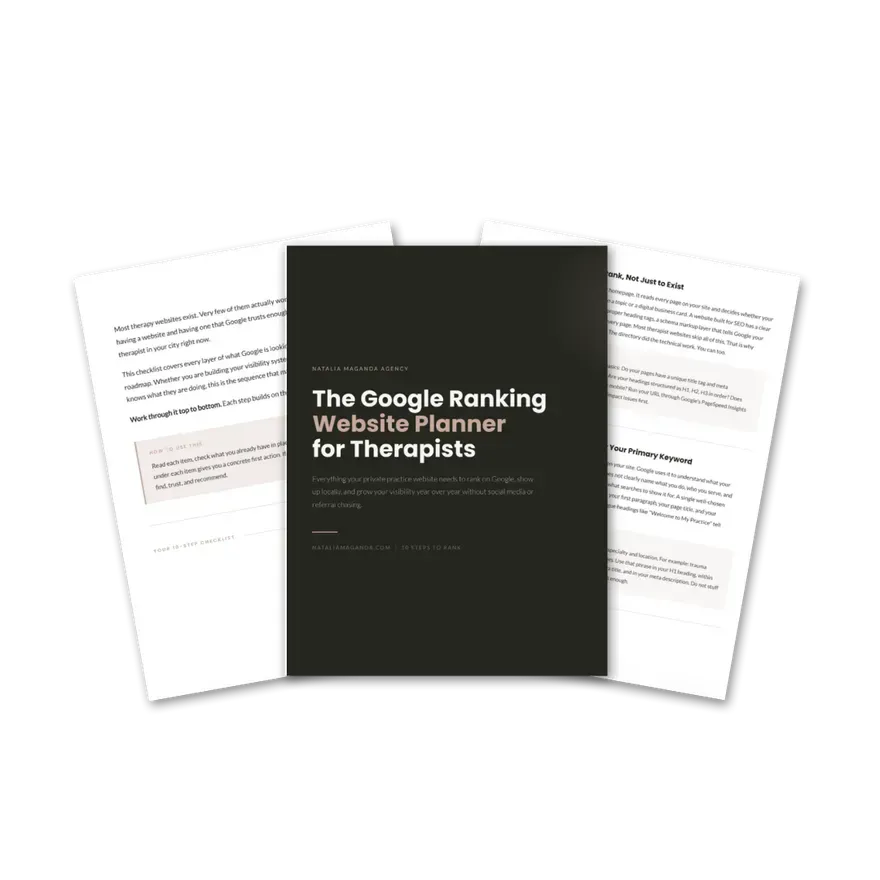
THE 10 THINGS NO ONE IS DOING FOR YOU RIGHT NOW
Your website exists. It is just not the one Google or AI shows when someone in your city searches at 11 at night.
What your next 12 months can look like
One of these comes with a to do list. The other comes with a website manager.You become the web designer, copywriter and SEO
One monthly price. Everything handled.
$597/mo for 12 months, then $350/mo Year 1 price goes up in 2027Lock in current pricing


Client results we're obsessed with...
61 inquiries 27% from Google & AI year 1 of SEO
37 inquiries 51% from Google & AI year 2 of SEO
28 leads in 6 months with a 60+ page custom site re-launch
Multi state ranking & 100%+ traffic increase after 12 months of SEO
96 inquiries 35% from Google & AI + 532% traffic increase first 6 months of SEO (Squarespace re-launch)

For a limited time claim a custom 12-month private practice SEO roadmap by Natalia Maganda valued at
$97 for FREE
Tell me about your practice and I'll build you a custom PDF roadmap, your local keyword opportunities, a content batching rhythm, and quick wins specific to your niche and location. I build this by hand and walk you through it live on a 20-min call, and you keep the document either way.
We manage 30+ websites and we're ready for your practice to be the next one
Frequently Asked Questions
How much do brand identity designers charge?
We cannot answer that as its own number, because we do not offer branding as its own service. When your brand needs a refresh, it comes with a new website management engagement add on.
Is $500 too much to pay for a logo?
For a doctoral level practice that depends on referrals and credibility, a logo is rarely the right thing to evaluate in isolation. The number that matters more is whether your entire visual identity, including the logo, communicates the training and precision behind your work. A logo alone, priced on its own, tends to solve a much smaller problem than the one most psychologists actually have.
Do I always own the logo if I pay someone to design it?
Ownership depends entirely on the agreement you sign, so it is worth reading closely rather than assuming. In our engagements, usage rights are built in from the start, so there is no ambiguity later about what you can do with your own brand assets.
How much does rebranding usually cost?
A standalone rebrand, purchased on its own from a branding agency, typically runs well into four figures or more once strategy, design, and a full asset set are accounted for. Because our brand work is bundled into a website management engagement rather than sold separately, it is never billed to you as its own line item or its own project.
Why do rebrands fail?
Most rebrands fail because a new logo and color palette launch while the underlying strategy, messaging, and website stay exactly the same. For a psychologist, this shows up as a fresh visual identity sitting on top of a site that still blurs assessment work and therapy work together. A rebrand holds up when the strategy, the language, and the visuals launch together, as one coordinated project, rather than a surface level refresh applied on its own.
Ready to get this off your desk?
Branding is never something we sell on its own. It comes as part of a full website management engagement, built specifically around the way you practice, whether that is assessment, therapy, or both. If you are ready to have a brand and a website that finally reflect the training behind your work, apply for a strategy call.
If you would rather learn more first, you can read more about what website management actually includes.