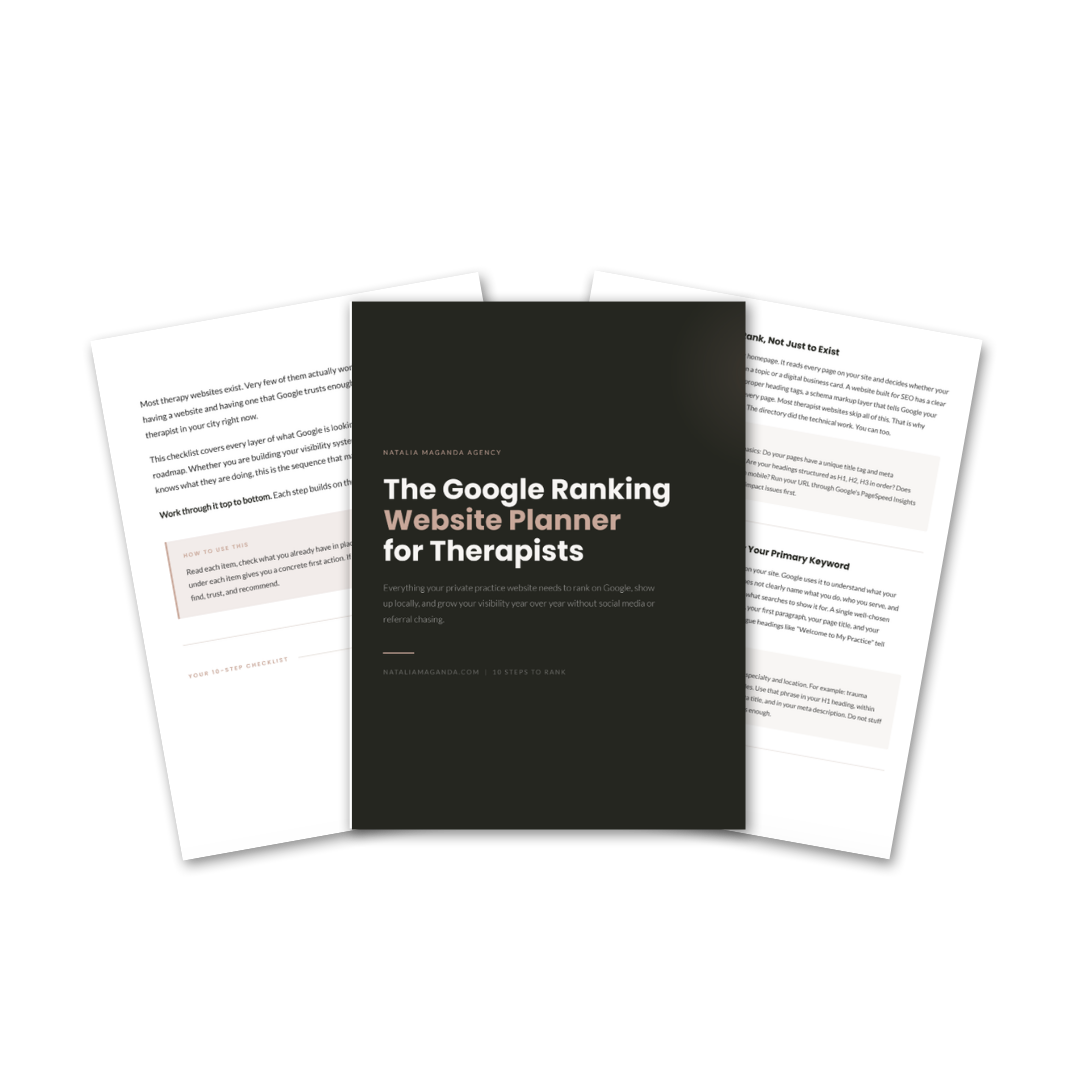

Therapist branding: the complete guide to building your private practice brand
What is therapist branding and why is it more than a logo?
Therapist branding is the complete system of decisions, strategic, verbal, and visual, that shapes how your practice is perceived by the people you most want to serve. It is not a single element. It is not your logo, your Instagram feed, or the font you chose for your email signature. It is the sum of every impression your practice makes, from the moment someone finds your name in a search result to the moment they walk into your office for the first time. When branding is done well, it creates an experience of coherence. Everything feels like it belongs together. The words on your website sound like the person in the room. The colors on your homepage feel like the candles in your office. The way you describe your approach in your bio matches the way you actually show up in session. That coherence is what builds trust before a potential client has ever spoken to you. And trust is what converts a website visitor into a booked consultation.What does a complete therapist brand actually include?
A complete therapist brand includes four interconnected layers. The first is your brand strategy, the written document that defines your niche, your ideal client, your positioning, your voice, and your core messaging. The second is your brand kit, the visual system that includes your logo suite, color palette, typography, and aesthetic imagery. The third is your website, the digital home where your strategy and your kit come together into a living, converting experience. And the fourth is your physical environment, the office space, the decor, the textures and details that extend your brand into the in-person experience of working with you. Most therapists have fragments of some of these. Very few have all four working together as a cohesive system. That gap is almost always the reason their marketing feels inconsistent and their growth feels unpredictable.Is branding the same as marketing for therapists?
Branding and marketing are related but they are not the same thing, and confusing them is one of the most expensive mistakes a private practice owner can make. Your brand is the foundation. Who you are, what you stand for, who you serve, and how you communicate all of that. Your marketing is what you build on top of that foundation to get your brand in front of the right people. When you market without a brand, you are building on sand. You might get some traffic, some inquiries, maybe even some clients. But the results will be inconsistent because there is no coherent identity underneath the activity. When your brand is solid, your marketing becomes more effective, more efficient, and significantly less exhausting because everything you create is rooted in the same clear foundation.How does your brand determine whether a potential client books or bounces?
Potential clients are making an emotional decision, not a rational one, when they choose a therapist. They are not evaluating your credentials in a spreadsheet. They are scanning your website and asking themselves one question: does this feel like the right person for me? Your brand answers that question before they have read a single paragraph of your clinical bio. A brand that feels generic, templated, or misaligned with who you actually are sends a quiet signal that something is off, even if the potential client cannot articulate what it is. A brand that feels specific, grounded, and coherent makes them feel seen before they have introduced themselves. That feeling is the difference between a bounce and a booking.What is a brand strategy document and why does every therapist need one?
A brand strategy document is the written foundation of your entire brand. It is a living document, typically between five and fifteen pages, that captures everything a writer, designer, or marketing professional needs to represent your practice accurately and consistently. It is the single source of truth for your brand, and without it, every piece of content you create or outsource risks drifting away from who you actually are. Think of it this way. If you hired a copywriter to write your website, what would they need to know to write in a way that actually sounds like you and speaks to your ideal client? If you worked with a designer on your brand kit, what would they need to understand about your identity, your values, and your aesthetic direction before they opened a single design file? The brand strategy document answers all of those questions before they are ever asked, which means every vendor, collaborator, or AI tool you work with is starting from a position of clarity rather than guesswork.What goes inside a brand strategy document for a private practice?
A complete brand strategy document for a therapist in private practice typically includes the following. Your brand story, which captures why you do this work, what shaped your clinical identity, and what drives your approach. Your mission and vision, which define what your practice exists to do and what it is building toward. Your ideal client profile, a detailed description of the person you most want to serve, including their emotional experience, their fears, their desires, and the transformation they are seeking. Your niche and positioning, the specific intersection of population, specialty, and approach that makes your practice distinct. Your core messaging pillars, the three to five central ideas that every piece of content you create should reinforce. And your brand voice guidelines, the tone, language, and stylistic rules that make your communication feel consistent across every touchpoint. This document does not need to be beautiful. It needs to be honest, specific, and complete. It is not a marketing piece. It is an internal operating document that keeps your brand coherent as your practice grows.How does your brand strategy guide your website copy, blog posts, and messaging?
Your brand strategy document is what separates copy that sounds like you from copy that sounds like a generic therapist. When a copywriter or content strategist has your brand strategy in hand, they know exactly who they are writing for, what emotional experience they are trying to create, what language resonates with your ideal client, and what your practice stands for beyond the clinical modalities you are trained in. The result is content that feels cohesive across your homepage, your about page, your service descriptions, your blog posts, and even your email responses to inquiries. Without a brand strategy document, every piece of content becomes a guessing game. The words on your website might not match the energy of your social media. Your blog posts might not reinforce your positioning. Your about page might describe your credentials without ever making your ideal client feel seen. The strategy document is what ties it all together and gives your messaging a spine.How do you define your niche, ideal client, and unique positioning in your brand strategy?
Defining your niche starts with getting honest about who you do your best work with. Not who you can work with. Who you genuinely light up for. The clients who make you feel most effective, most alive, and most aligned with why you chose this profession. That is your niche, and it is the gravitational center of your entire brand strategy. Your ideal client profile goes deeper than demographics. Yes, it includes age range, life stage, and perhaps presenting concerns. But more importantly, it captures the internal emotional experience of that person. What are they afraid of? What do they want more than anything? What has kept them from seeking support until now? What does transformation look like for them six months into working with you? The more precisely you can answer these questions, the more specifically your brand can speak directly to that person. And specificity is what converts. Your unique positioning is what makes you the right choice among all the therapists in your market who serve a similar population. It might be your specific modality combination, your lived experience, your approach to the therapeutic relationship, your cultural lens, or your particular area of expertise within a specialty. Whatever it is, it needs to be named clearly in your brand strategy so it can inform every piece of communication your practice produces.What is brand voice and how do you find yours as a therapist?
Brand voice is the personality of your communication. It is the quality that makes your writing feel distinctly like you rather than like a generic wellness brand. Your brand voice might be warm and nurturing, or direct and no-nonsense, or intellectually rigorous and deeply empathetic, or grounded and gently spiritual. It is not one-dimensional, but it does have a consistent emotional register that a reader would recognize across different pieces of content. Finding your brand voice starts with listening to how you actually talk about your work. Record yourself explaining what you do to a friend who is not in the mental health field. Read through the emails you have written to clients that felt natural and true. Notice the language that comes most easily when you are describing what you do and why it matters. That is where your voice lives. A strong brand strategy document captures that voice in written guidelines, including words you use, words you avoid, the level of formality in your tone, and the emotional quality you want your reader to feel after engaging with your content.What is a brand kit and what does it include for therapists?
If your brand strategy document is the verbal foundation of your brand, your brand kit is the visual one. It is the collection of design assets and guidelines that govern every visual element of your practice, your website, your social media graphics, your email headers, your printed materials, and anything else that carries your practice name. A complete brand kit ensures that every visual touchpoint feels like it belongs to the same practice, which creates the kind of professional coherence that builds trust at a glance. A well-designed brand kit is not just a folder of pretty files. It is a decision-making tool. When your designer, your web developer, or your virtual assistant needs to create something visual on your behalf, the brand kit tells them exactly what colors to use, which fonts are approved, how your logo should and should not appear, and what the overall aesthetic of your practice looks and feels like. Without it, visual inconsistency creeps in. And visual inconsistency quietly erodes the trust your brand is working to build.What is a logo suite and why do therapists need more than one logo version?
A logo suite is a collection of logo variations designed to work across different contexts and applications. At minimum, a complete logo suite for a private practice includes a primary logo, which is the full version used on your website header and main marketing materials. A secondary logo, which is a simplified or rearranged version for contexts where the primary does not fit. A submark or icon, which is a small, simplified version of your brand mark used for social media profile images, favicons, and small-scale applications. And a wordmark, which is a text-only version of your practice name in your brand typography. The reason therapists need more than one version is purely practical. Your full primary logo might look stunning on your website header but become illegible as a small favicon. Your submark might work perfectly on a social media profile image where your full logo would feel crowded. Having a suite of options means your brand always looks intentional and polished regardless of where it appears, rather than stretched, cropped, or pixelated into something that undermines your credibility.How do you choose a color palette that communicates your clinical identity?
Color is one of the most powerful and least conscious communication tools in your brand kit. People form emotional associations with color before they process any verbal information, which means your palette is sending a message about your practice before a single word is read. Choosing a color palette is not about what colors you personally like. It is about what emotional experience you want your ideal client to have when they encounter your brand. Warm earth tones like terracotta, sand, and warm taupe communicate groundedness, safety, and warmth. Deep jewel tones like forest green, navy, and burgundy communicate depth, luxury, and intellectual rigor. Soft neutrals like warm white, blush, and sage communicate calm, clarity, and a gentle therapeutic presence. Cool blues and greens communicate trust, clarity, and professional competence. Your palette should include a primary color that anchors the brand, one or two secondary colors that complement it, and a neutral that gives the design room to breathe. The most effective therapy brand palettes feel specific enough to be recognizable and versatile enough to work across a website, printed materials, social graphics, and office decor.What role do typography and fonts play in your therapy brand?
Typography is the second most powerful visual element in your brand kit after color, and it is one of the most commonly underestimated. The fonts you choose communicate personality before the words in them are read. A serif font with elegant proportions communicates sophistication, tradition, and depth. A clean, modern sans-serif communicates clarity, accessibility, and contemporary professionalism. A softly rounded font communicates warmth and approachability. A bold display font communicates confidence and authority. A complete brand typography system for a therapist typically includes a heading font that carries the personality and weight of the brand, a body font that is highly readable and supports long-form content, and sometimes an accent font used sparingly for pull quotes or decorative elements. The key is that these fonts work together harmoniously and reinforce the same emotional message as your color palette. When your typography and your colors are aligned, the visual experience of your brand becomes cohesive in a way that feels effortless to the viewer, even though it required significant intentionality to create.What are brand aesthetic visuals and how do they set the tone for your entire online presence?
Brand aesthetic visuals are the curated collection of imagery, textures, patterns, and graphic elements that define the visual world of your brand beyond the logo and color palette. They include the style of photography used on your website, whether that is warm lifestyle imagery, editorial portraiture, abstract textures, or atmospheric interiors. They include any illustrative or graphic elements that appear consistently across your materials. And they include the overall visual mood that a visitor experiences when they spend time in your digital space. Your brand aesthetic visuals are what make your Instagram feed feel cohesive, your website feel atmospheric, and your PDF resources feel polished. They are also what prevent your brand from feeling generic. A logo and a color palette alone can look like many other practices. A fully realized visual aesthetic, with a specific photographic style, a curated set of textures and elements, and a consistent mood across all imagery, creates a brand environment that feels genuinely singular and intentional.How does your brand vibe translate beyond the screen and into your therapy office?
One of the most overlooked dimensions of therapist branding is the physical space where the work actually happens. Your office is a brand touchpoint. For clients who see you in person, it is often the most intimate and memorable brand experience they will have. And when it feels disconnected from the rest of your brand, it creates a subtle but real sense of incongruence that affects the therapeutic container itself. When your brand vibe is fully realized, walking into your office should feel like an extension of landing on your website. The emotional experience should be continuous. If your brand communicates warmth, groundedness, and a sense of luxurious ease, your physical space should reinforce all of that through every sensory detail. And those details do not require a renovation or a significant budget. They require intentionality and alignment with the brand identity you have already defined.How do your office colors, textures, and decor reflect your brand identity?
Your office colors do not need to match your brand palette exactly, but they should exist in the same emotional family. If your brand palette is built around warm earth tones and soft neutrals, your office walls, soft furnishings, and decorative objects should carry that same warmth. If your brand leans into deep, moody jewel tones and an atmosphere of depth and sophistication, your office can reflect that through textured fabrics, layered lighting, and richer tones in the soft furnishings and art you choose. Textures carry enormous brand weight in a physical space. Linen, velvet, natural wood, woven baskets, ceramic vessels — these all communicate different things about the experience of being in your space. A therapy office with smooth, cool surfaces and minimal ornamentation communicates something very different from one with layered textiles, warm lighting, and plants. Neither is wrong. Both are brand decisions. And the most effective offices are the ones where those decisions were made consciously, in alignment with the identity the therapist has built across their entire brand.Why the in-person client experience should feel like an extension of your website
When a client books with you after spending time on your website, they have already formed an expectation of what working with you will feel like. Your website created an emotional impression of warmth, professionalism, depth, and safety. Your office needs to meet that impression when they arrive. If there is a gap between the two experiences, it introduces doubt, even if the client cannot name exactly what feels off. The therapists who create the most coherent brand experiences are the ones who have thought carefully about the full arc of a client's journey, from the first Google search to the first session, and made intentional decisions at every step. The website attracts and converts. The office confirms and deepens. When both feel like they belong to the same world, the therapeutic relationship starts with a foundation of trust that is built before a word has been spoken in session.What details in your physical space quietly communicate your brand to every client who walks in?
The details matter more than most therapists realize. The scent in your office, whether that is a diffuser with a signature oil, fresh flowers, or simply clean air, creates an immediate sensory impression. The quality of your lighting and whether it is warm and ambient or harsh and overhead communicates something about the emotional safety of the space. The art you choose and whether it feels intentional or decorative by default. The materials on your surfaces and whether they feel considered or assembled. Even the quality of the tissues on your side table is a brand detail. None of these details need to be expensive. They need to be intentional. A brand that has been fully thought through at the strategic and visual level provides the compass for making all of these physical decisions with clarity and coherence rather than guesswork.Therapist branding examples — what does a complete brand system look like in real life?
Understanding the theory of therapist branding is useful. Seeing it executed well is transformative. When you look at private practice brands that are working, genuinely attracting aligned clients, converting website visitors into booked consultations, and reflecting the depth of the clinical work being done, certain qualities become immediately apparent. The brand feels specific. It does not try to speak to everyone. It speaks to one person so precisely that that person feels immediately understood. The copy does not lead with credentials. It leads with the emotional experience of the ideal client. It names the exact struggle, the exact longing, the exact fear that brought that person to Google in the first place. The design does not feel assembled from free templates. It feels considered, intentional, and reflective of a specific clinical identity. And everything, the words, the visuals, the structure of the website, the photography, the color palette, feels like it belongs to the same practice and tells the same story.What separates a generic therapy website from one that converts?
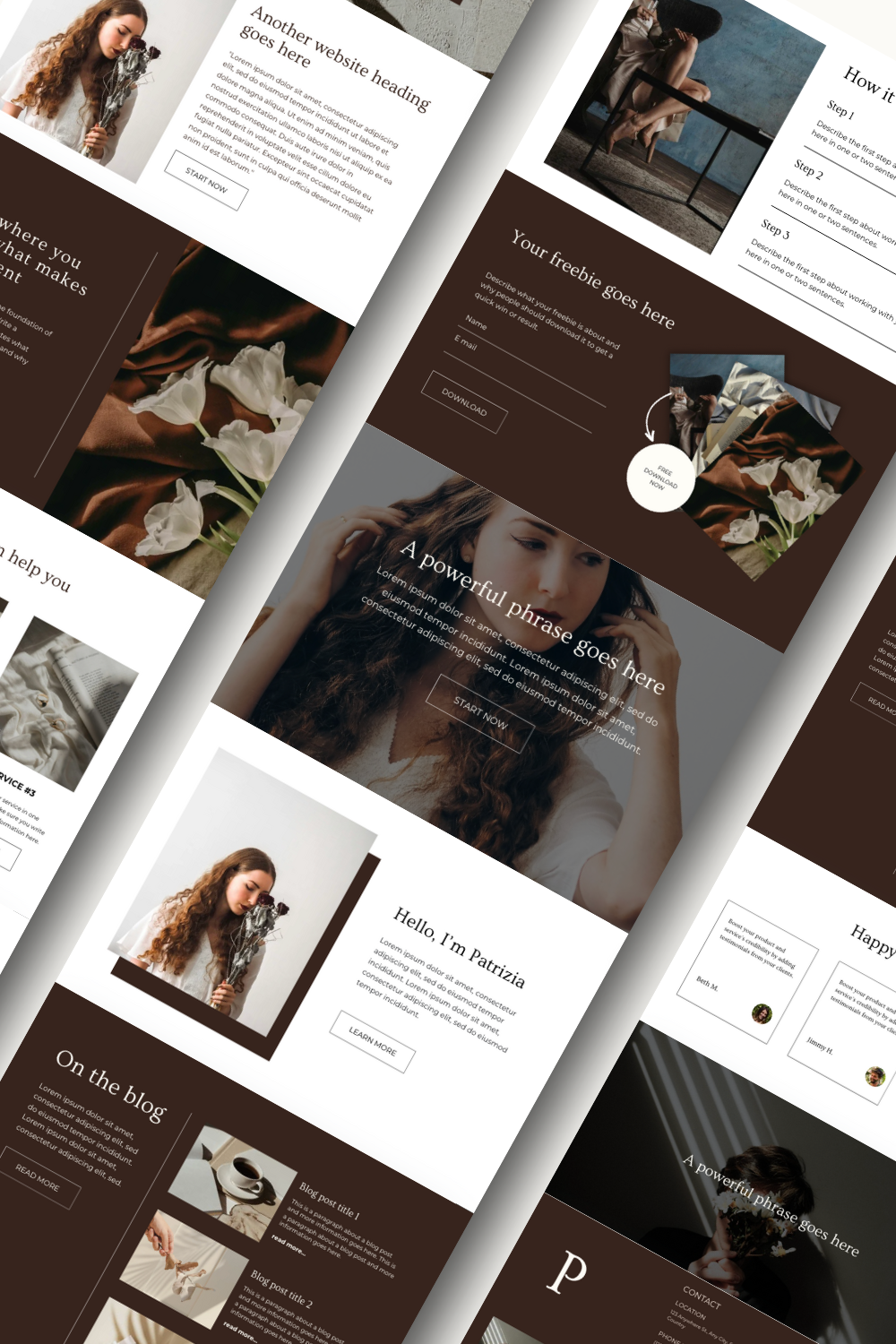
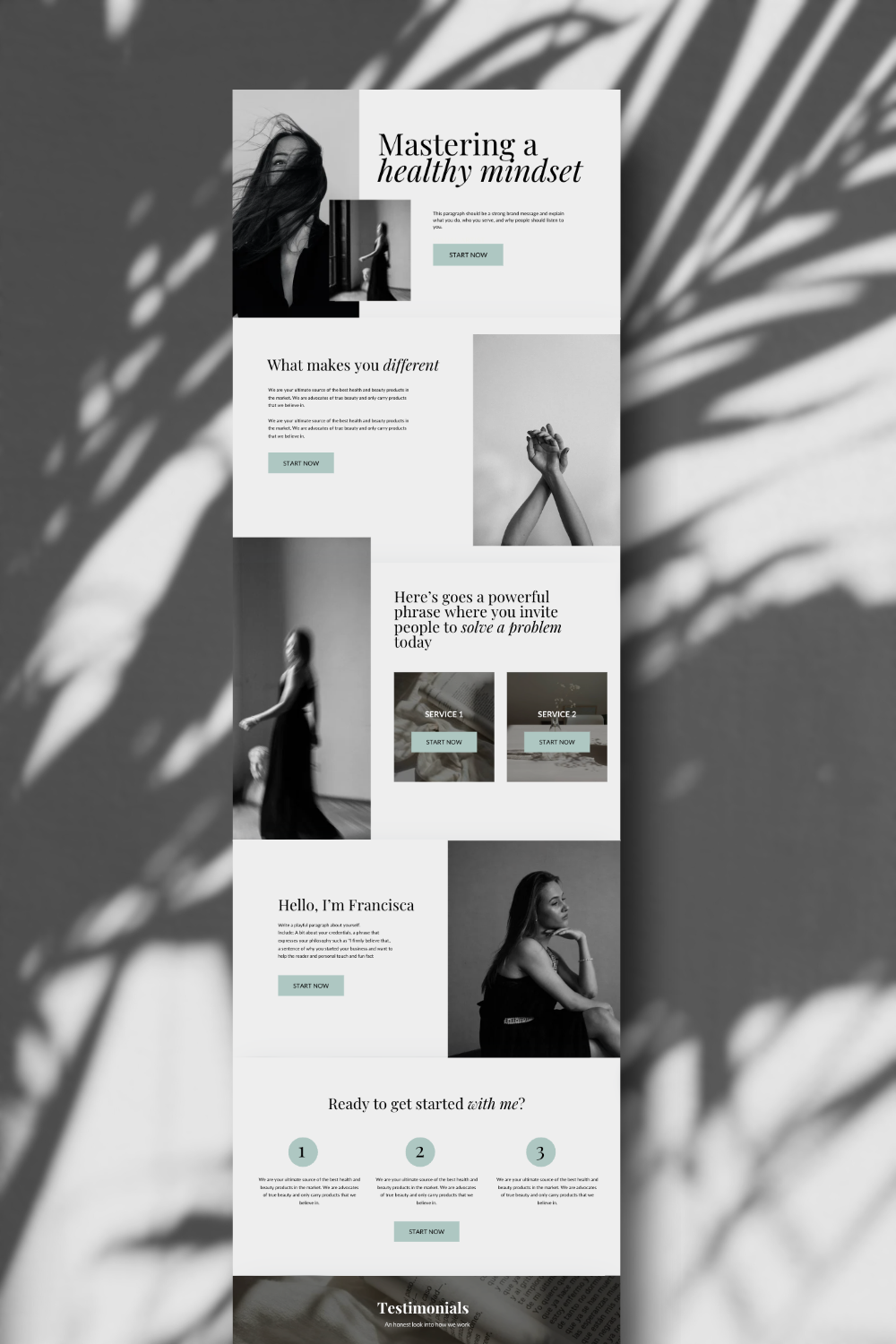
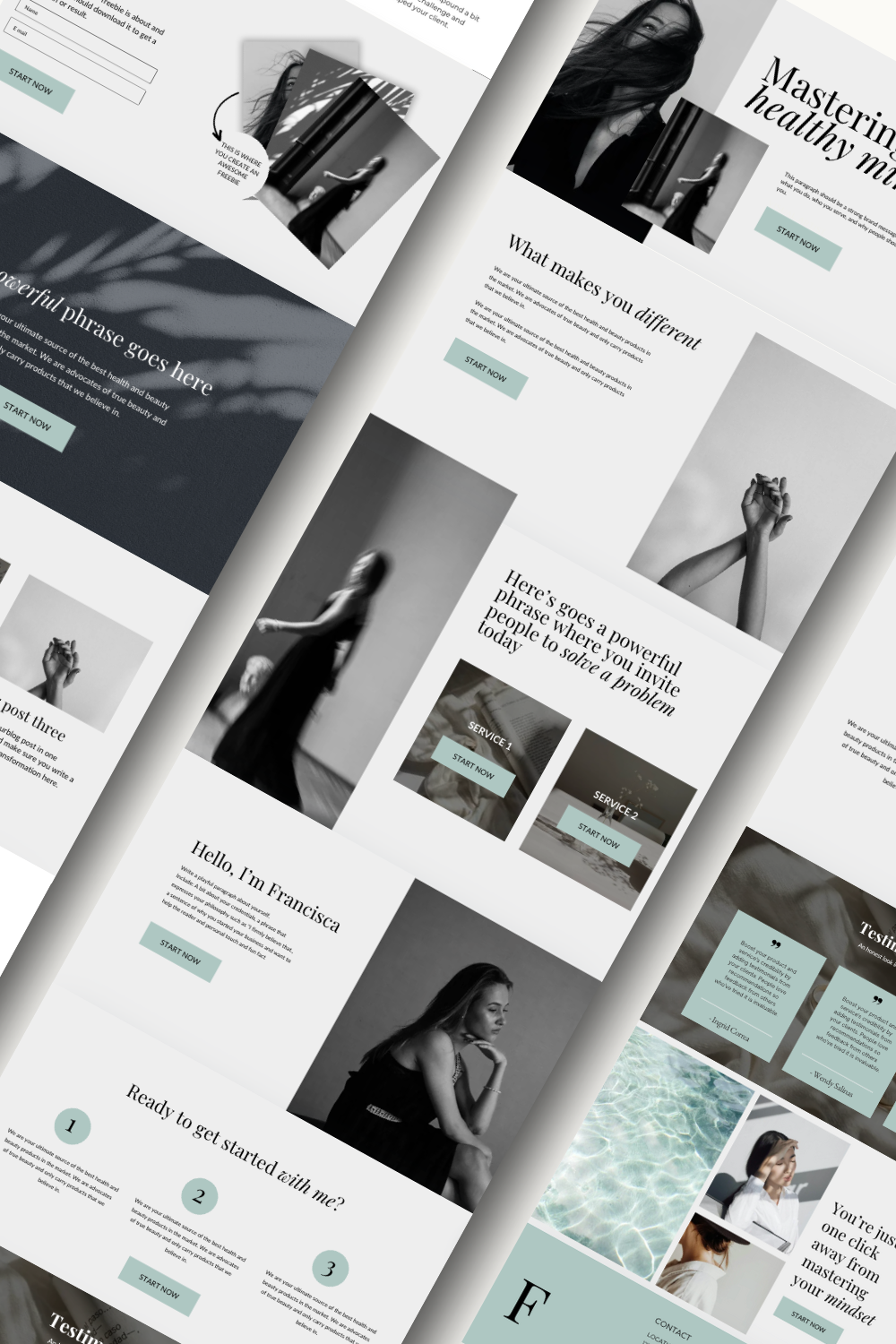
The single biggest differentiator between a therapy website that gets traffic and one that consistently converts that traffic into booked consultations is specificity in the messaging, rooted in a completed brand strategy. Generic websites list modalities, demographics, and insurance information. Converting websites make a specific person feel like they have finally found the right place. They do that because the brand strategy document told the copywriter exactly who that person is and what they need to hear, and the brand kit told the designer exactly what visual experience would make that person feel safe enough to reach out. The second differentiator is design quality in service of the brand, not design for its own sake. A website can be visually stunning and still fail to convert if the design does not support the messaging and the user experience is not built around the client's decision-making journey. The most effective therapy websites are the ones where strategy, copy, and design were developed in alignment with each other rather than in isolation. If you want to see what this looks like across a range of practices, explore our therapist branding examples and see how real clinicians have translated their brand strategy and kit into websites that work.How does your brand strategy come to life on your therapy website?
Your website is the primary environment where your brand strategy and your brand kit meet the public. It is where your written positioning, your core messaging, your voice guidelines, your color palette, your typography, your logo suite, and your aesthetic imagery all converge into a single, cohesive experience that either earns a potential client's trust or loses it within seconds. No other marketing channel carries this much brand weight. A website that is built without a completed brand strategy and brand kit is a website that is making visual and verbal decisions in a vacuum. The copy may be well-written but disconnected from the brand voice. The design may be attractive but misaligned with the emotional experience the brand is trying to create. The result is a website that feels generic, even when individual elements of it are executed well.Why your website is where your brand strategy and brand kit meet
Think of your brand strategy document as the architectural blueprint and your brand kit as the building materials. Your website is the structure that gets built when those two things are combined by a skilled team that understands both. Without the blueprint, the materials get assembled without a plan. Without the materials, the blueprint has no way to become real. This is why the sequence matters. Brand strategy first. Brand kit second. Website design third. When these steps are done in order, every design decision on your website has a reason rooted in strategy. The color of your call to action button is not arbitrary. It comes from your palette. The tone of your homepage headline is not guesswork. It comes from your voice guidelines. The imagery feels cohesive because it was selected against your brand aesthetic. The result is a website that feels entirely intentional, because it is.Which pages carry the most brand weight and need the most strategic attention?
Every page of your website is a brand touchpoint, but some do more conversion work than others and deserve the most strategic investment. Your homepage is your first impression and must communicate your niche, your value, and the emotional experience of your brand within the first few seconds of a visit. Your about page is statistically the most visited page on most therapy websites and is where the decision to reach out is most often made. It must feel human, specific, and deeply aligned with your brand voice. Your services pages are where clinical credibility meets emotional resonance and where the specificity of your approach needs to be most clearly expressed. Your blog, when it exists and is updated consistently, extends your brand voice into educational content that continues to build trust and attract potential clients through search over time. Even your contact page is a brand moment. The language, the warmth, and the clarity of that page either reinforces the experience the rest of your site created or quietly undermines it. For therapists who are ready to invest in a website where every one of these pages is doing its full brand and conversion work, our web design for therapists services are built specifically for that level of strategic execution.How does a strong brand help you get found online without posting every day?
This is the question that lives underneath almost every conversation I have with therapists about their marketing. You did not become a clinician to become a content creator. The pressure to post consistently, to show up on stories, to produce reels that perform, none of that is why you went to graduate school. And for most therapists, it is not a sustainable visibility strategy. The good news is that it does not have to be your strategy at all. The most sustainable and effective visibility systems for private practice are built on SEO, strategic website content, and in competitive markets, Google Ads. These systems require intentional investment upfront, in your brand, your website, and your search optimization. But once they are built, they continue generating visibility and qualified inquiries without requiring your daily attention. Your brand becomes the engine. Your website becomes the vehicle. And your SEO or paid search strategy becomes the fuel that keeps new potential clients finding you while you are living your life.How SEO amplifies your brand so the right clients find you organically
Search engine optimization is the process of building and maintaining your website so that it appears when your ideal clients are actively searching for the support you provide. When someone types "therapist for anxiety in Denver" or "EMDR therapist for trauma" into Google, SEO is what determines whether your website is on the first page of results or invisible to everyone searching. A brand that is well-defined makes SEO significantly more effective because the specificity of your positioning aligns naturally with the specificity of the searches your ideal client is making. SEO is a long-term investment, not a quick fix, but it is one of the most powerful compounding assets a private practice can build. Every blog post written in your brand voice and optimized for your ideal client's search behavior adds to an archive of content that continues generating visibility for months and years after it is published. Our SEO for therapists services are built around the real search behavior of people looking for mental health support, so every optimization decision is rooted in what your ideal client is actually typing into Google.How Google Ads accelerate visibility when paired with a strong brand
In markets where organic SEO takes time to build traction, or where the competition for top search positions is particularly high, Google Ads can place your practice at the top of search results immediately. Unlike social media advertising, which interrupts people who were not looking for therapy, Google Ads target people who are actively searching for the exact support you provide. The intent is already present. Your ad simply ensures that they find you first. The reason brand strength matters so much in a paid search strategy is that the ad brings the click, but your brand and your website determine whether that click becomes a booked consultation. A strong brand strategy and a well-executed website dramatically increase the conversion rate of every ad dollar you spend, because the experience a visitor arrives to is coherent, trust-building, and emotionally aligned with what they were searching for.Why "therapist near me" searches reward clarity and brand specificity
The search term "therapist near me" generates 450,000 searches per month. Those searches represent real people in real moments of readiness, not passive scrollers, not people who stumbled onto an ad they did not ask for, but people who have decided they need support and are actively looking for the right person. These are the highest-intent potential clients on the internet. And the practices that show up consistently in those results are the ones whose brand clarity, SEO foundation, and website experience are all working in alignment. Showing up for high-intent searches like this is where brand and SEO become genuinely inseparable. Your SEO strategy gets your name in front of the search. Your brand specificity makes you the obvious choice among everyone else on the results page. And your website converts that moment of recognition into a booked consultation.What are the signs your current brand is holding your practice back?
Sometimes the most important step in building a stronger brand is being honest about the fact that your current one is no longer serving you. This can be uncomfortable to acknowledge, particularly if you invested time or money into what you have. But a brand that reflected you three years ago may be actively misrepresenting you today. The cost of staying with something that does not fit shows up in ways that are very real. Inconsistent inquiries, clients who are not quite the right fit, a caseload that fills and empties unpredictably, and a persistent low-level discomfort with how your practice shows up online.You cringe when you open your own website — what that feeling is telling you
That cringe is not vanity. It is data. It is your intuition telling you that there is a meaningful gap between the depth and quality of your clinical work and the way your practice is currently presenting itself to the world. Most of the therapists I work with have been carrying that feeling for months, sometimes years, before they finally decide to act on it. They tell themselves they will update the website when things slow down, or that it is good enough for now, or that they are not sure it is really worth the investment. Every month you spend with a brand that does not reflect who you are is a month of potential clients who found someone else because your online presence did not give them a compelling reason to stay. The cringe is worth listening to.Your caseload is inconsistent — could your brand be the reason?
Inconsistent caseload is one of the most common and most misunderstood symptoms of a brand that is not doing its job. When your brand is not clearly communicating who you are, who you serve, and why you are the right choice, your visibility becomes unreliable. Some months feel full. Others feel slow. The variability does not track with how good you are at your work, because it is not about your clinical skill. It is about whether your brand is generating a consistent pipeline of aligned inquiries or relying on luck and referrals to fill the gaps. A brand built on a completed strategy document, a cohesive visual kit, and a strategically optimized website creates a visibility system that produces inquiries with far more consistency than any other approach, because it is not dependent on your energy, your posting frequency, or your personal network on any given week.How do you know when it is time to rebrand your therapy practice?
There are several clear signals that a rebrand is not just warranted but overdue. You have evolved significantly as a clinician and your current brand reflects an earlier version of your focus, your fees, or your identity. You are consistently attracting clients who are not quite the right fit and turning down the work that lights you up. You are charging meaningfully more than your website and brand presence suggest. You have expanded your practice, launched a group, or shifted your specialty in a direction your current brand does not reflect. Or you simply feel a persistent and undeniable disconnect between who you are in the therapy room and how you are showing up online. Rebranding is not starting from zero. It is the act of catching your external presence up to the version of your practice that already exists. It is giving your work the brand it has always deserved.Your practice deserves a brand that holds it the way you hold your clients
You show up fully for every client, every session, every week. You hold space with precision, care, and depth. The question is whether your brand is doing the same work for your practice when you are not in the room. A complete therapist brand, built on a strategic foundation, expressed through a cohesive visual identity, brought to life on a website that converts, and extended into the physical space where your work happens, is not a luxury. It is the infrastructure that makes sustainable, aligned growth possible. When your brand is working as a system, you stop wondering where your next client is coming from. You stop second-guessing your rates. You stop forcing yourself to post content that drains you. You start attracting clients who already value what you offer before they reach out. You start receiving, rather than chasing. If you are ready to build a brand that truly reflects the depth of your work and creates a visibility system that supports your practice while you live your life, I would love to be part of that process. Explore what is possible, see the work we have done for practices like yours, and let us build something together that finally holds you the way you hold others.







* AI Disclosure: This content may contain sections generated with AI with the purpose of providing you with condensed helpful and relevant content, however all personal opinions are 100% human made as well as the blog post structure, outline and key takeaways.
* Affiliate Disclosure: Some of the links on www.nataliamaganda.com may contain affiliate links meaning that I will get a commission for recommending products at no extra cost to you.

hello! i'm natalia maganda
The go-to website designer and SEO manager for therapists and private practice professionals that you didn't know existed
After designing 100+ websites for women in many industries, I ended up in the healing world because I believe in the power of emotional work and in supporting the people who support everyone else. Now, I’ve built an online presence that allows me to have more
time to spend with my family, more
income working with fewer clients and
less stress with sustainable marketing systems! And that’s exactly what I want for you. We manage 20+ websites and I’m ready for you to be the next one.