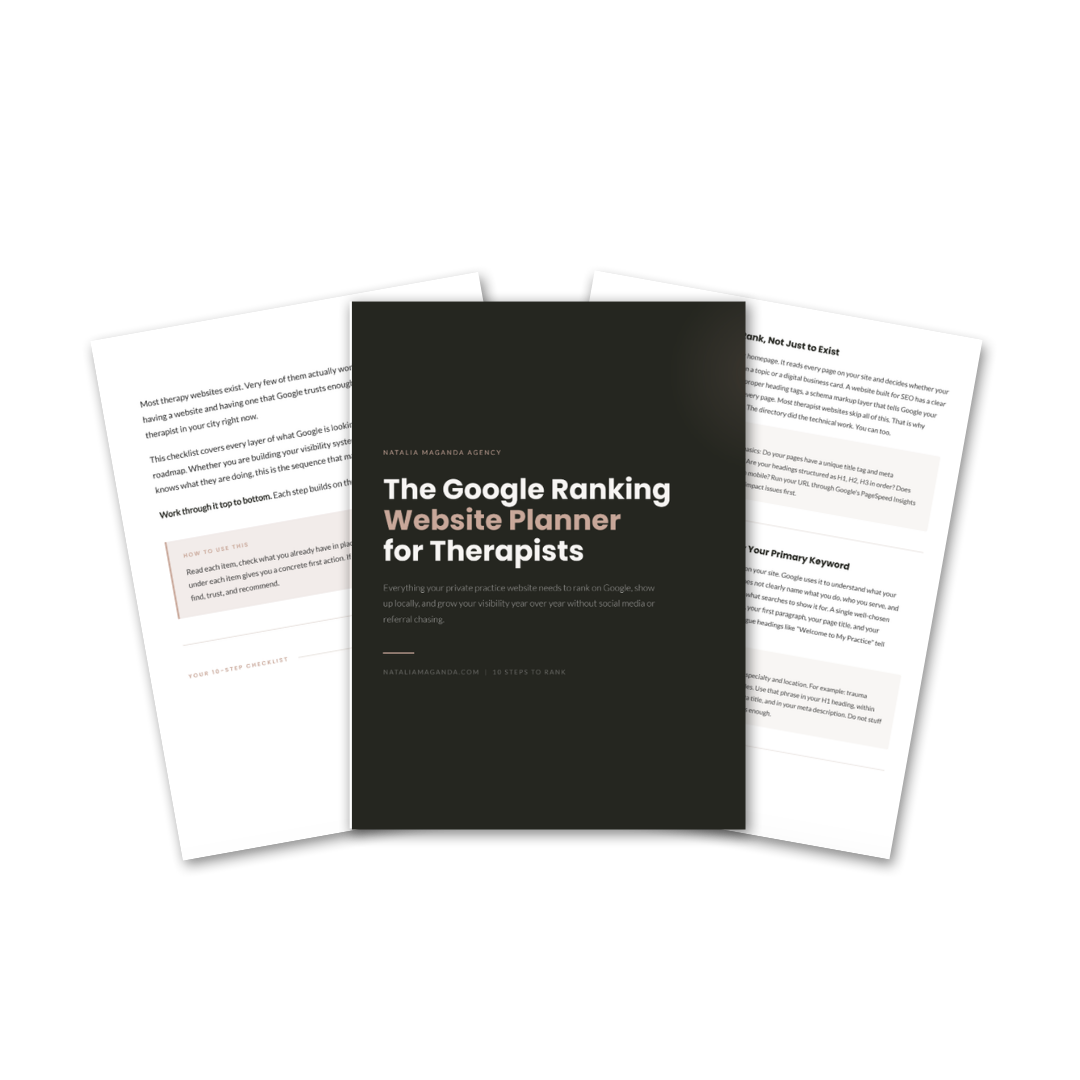

Therapist Website Design Checklist: The Ultimate Planner You Need to Rank on Page 1
If your website is not bringing you clients, it is almost never a traffic problem. It is a foundation problem. The site was not set up to be understood by Google, found by the right people, or trusted enough to convert once someone lands on it.
I am Natalia Maganda, a web designer and SEO strategist who works exclusively with therapists and private practice owners. After launching over 100 websites and managing 20-plus private practice sites, I can tell you that the practices that grow through organic search share a specific, repeatable foundation. This checklist covers every layer of that foundation so you can audit your current site — or plan a new one from scratch.
To rank on page one, Google needs three things from your website: clarity, depth, and trust. Most therapy websites are missing at least one of them, often all three.
Layer One: Clarity
Google needs to understand exactly who you help, what you help them with, and where you are located. If your website is too broad or too vague on any of these three points, Google does not know when to show it and defaults to not showing it at all.
The test for clarity is simple: can someone read the first paragraph of your homepage and answer who you are, who you help, and where you practice, in one sentence? If the answer is no, Google cannot answer it either.
A therapy website with clarity looks like this: a homepage that opens with the specific problem your clients are experiencing, names the population you work with, and anchors your practice to a specific city or geography. Not "I provide compassionate support for people of all backgrounds." That tells Google nothing. "Anxiety therapy for women in Chicago" gives Google something to work with.
Clarity checklist:
Your homepage clearly states who you help, what you help them with, and where you practice. Your primary specialty is evident within the first two sentences. Your ideal client can see themselves in your copy within five seconds of landing on the page. Your city and state appear naturally in your homepage headline or first section. Every page on your site has a unique headline written for a specific audience, not copy-pasted from another page.
Layer Two: Depth
Google does not rank websites. It ranks individual pages. The more specific, relevant pages your site has, the more opportunities Google has to show your practice to the right person at the right moment.
Most therapy websites have four or five pages. A homepage, an about page, a services page, and a contact page. That structure gives Google four ranking opportunities. A well-built therapy website has twenty or more, and each one is targeting a specific search that a real client is making right now.
The depth a therapy website needs comes from two types of pages that most therapists have never built.
Specialty pages: one page per specialty. If you offer anxiety therapy, trauma therapy, EMDR, couples counseling, and postpartum support, those are five separate pages, not five bullet points on a single services page. Each specialty page targets the specific search terms someone experiencing that issue would type into Google. A person searching for trauma therapy is not searching "therapy services." They are searching "trauma therapist in [their city]." A page built around that search ranks for it. A catch-all services page does not.
Location pages: one page per geography you serve. Your homepage ranks for your main city. Every other city, suburb, and neighborhood where your clients live and search requires its own dedicated page. A therapist in Denver who serves clients from Aurora, Littleton, and Centennial needs location pages for each of those areas. Without them, those searches do not reach the practice, even though the practice is 15 minutes away. For virtual practices, location pages cover every major city in the state, turning a single-location practice into a statewide presence.
Depth checklist:
Your site has 20 or more total pages. Each major specialty has its own dedicated page, not a section on a shared services page. Each specialty page targets a specific search term, written the way a client would actually search for it. Location pages exist for every city, suburb, or neighborhood you realistically serve. No single page is trying to rank for multiple unrelated topics. Your blog publishes consistently, at least twice per month, with posts that link back to your specialty and location pages.
Layer Three: Trust and Authority
Once Google understands your website and sees that it has enough depth, it asks one more question: can I trust this site? Trust signals tell Google that your practice is real, active, and credible. Without them, even a clear and deep website struggles to rank in competitive local searches.
Trust is built through what happens both on your website and outside of it.
Technical signals that build trust: Your city and state appear naturally in your page titles and headings, not just in the footer. Each page has a unique page title and meta description, not duplicated text across pages. Your website loads in under three seconds on a phone. There are no broken links or crawl errors that prevent Google from reading your pages. Your contact information is consistent and easy to find on every page.
Local signals that build trust: Your Google Business Profile is claimed, complete, and connected to your website. Your practice name, address, and phone number are listed identically across every directory where your practice appears: Psychology Today, TherapyDen, Alma, Zencare, Yelp, and others. Inconsistencies in how your practice is listed create trust gaps that weaken your local ranking signals.
Off-page signals that build trust: External websites linking to yours are one of the strongest trust signals Google uses. Directory listings count as backlinks. Client websites that link to yours count. Guest posts on mental health or private practice blogs count. Two link building campaigns per year, focused on earning credible external links, build the domain authority that determines how competitive your site can be over time.
Trust checklist:
Your Google Business Profile is claimed, complete, and linked to your website. Your NAP is consistent across all directories. Each page has a unique title tag and meta description. Your site loads quickly on mobile. Your city and state appear naturally in your page titles and headings. External websites link to your site from credible sources. No single page is trying to rank for multiple unrelated topics. Every page has a clear call to action.
Putting It Together: The Foundation That Can Actually Rank
A therapy website that has all three layers in place is one that Google can understand, trust, and show to the right people. Remove any one of the layers and the others underperform. Clarity without depth means few ranking opportunities. Depth without clarity means Google does not know when to show the pages it finds. Clarity and depth without trust means Google sees a site it does not yet have reason to trust over established competitors.
The practices that consistently appear on page one have all three working together. They have a homepage that makes their specialty and geography immediately clear. They have 20 or more pages covering their specialties and geographic footprint. They have strong local signals, consistent citations, and off-page authority building over time.
And if you want the full system built for you — copy, design, SEO architecture, citations, blog, and link building — the web design for therapists and private practice owners page covers exactly what that looks like. The SEO services for therapists and private practice owners page covers the ongoing strategy that keeps it compounding after launch.
* AI Disclosure: This content may contain sections generated with AI with the purpose of providing you with condensed helpful and relevant content, however all personal opinions are 100% human made as well as the blog post structure, outline and key takeaways.
* Affiliate Disclosure: Some of the links on www.nataliamaganda.com may contain affiliate links meaning that I will get a commission for recommending products at no extra cost to you.

hello! i'm natalia maganda
The go-to website designer and SEO manager for therapists and private practice professionals that you didn't know existed
After designing 100+ websites for women in many industries, I ended up in the healing world because I believe in the power of emotional work and in supporting the people who support everyone else. Now, I’ve built an online presence that allows me to have more
time to spend with my family, more
income working with fewer clients and
less stress with sustainable marketing systems! And that’s exactly what I want for you. We manage 20+ websites and I’m ready for you to be the next one.