
How many pages does a therapy website need to rank? The full and honest breakdown
A therapy website needs 20 to 30 pages of services, specialties and locations to start competing, and 40 to 60 or more in a competitive market. That 20 to 30 page site, with no blog content at all, is the bare minimum I launch with, and I learned it the hard way.
If we haven't crossed paths before, I'm Natalia, the founder of a boutique web design and SEO agency for therapists and private practice owners across the US. My mission is to help your website work as a 24/7 referral engine, so you can log off and still wake up to new inquiries. I've been in business for over 7 years, served 100+ clients, and managed over 900 URLs for other people's practices. I also built 2 websites of my own and got them wrong before I understood how SEO works, which is why page count is a question I take seriously.
You have probably Googled yourself and found a practice with a dated site sitting above you. Your own site has a handful of pages, and everyone keeps telling you to blog every week. This post gives you the numbers to plan around, by practice type, by competitors and by market size.
Key takeaways
- The bare minimum I launch with is 20 to 30 pages covering services, specialties and locations, with no blog content.
- Companies with 40+ website landing pages lead to 500% conversions (according to a Hubspot 2021 study) but that doesn't mean all those pages are blog posts because not all blog content on the internet is built with commercial intent and this my friends is the honest secret to SEO that took me almost a decade to learn. I share more in detail exactly what that means below.
- My planning targets go up from there: 30 to 40 pages with several specialties, 40 to 60 for a group practice, and 60 or more in a large, competitive metro.
- A city name on every specialty page only pays off when your city has the search traffic to justify it. In a town of 5k people it can hide your site from everyone outside that town.
- Your competitors set your real number, so count the specialty and location pages of the 5 practices that rank for your main phrase.
- A 60 page launch in a competitive Los Angeles market now brings that practice 5 to 10 leads a month from SEO and AI, and no blog posts have been published yet.
How many pages does a therapy website need to rank?
Start with 20 to 30 pages and grow toward 60 or more when your market is crowded. Google and AI tools read the structure of your whole site to decide what you are an authority on, before they read a sentence of your writing. A site with 5 pages gives them 5 things to understand. A site with 60 pages gives them 60.
Core pages
Revenue Driver pages
Specialty pages
Location pages
Blog posts
What the data shows
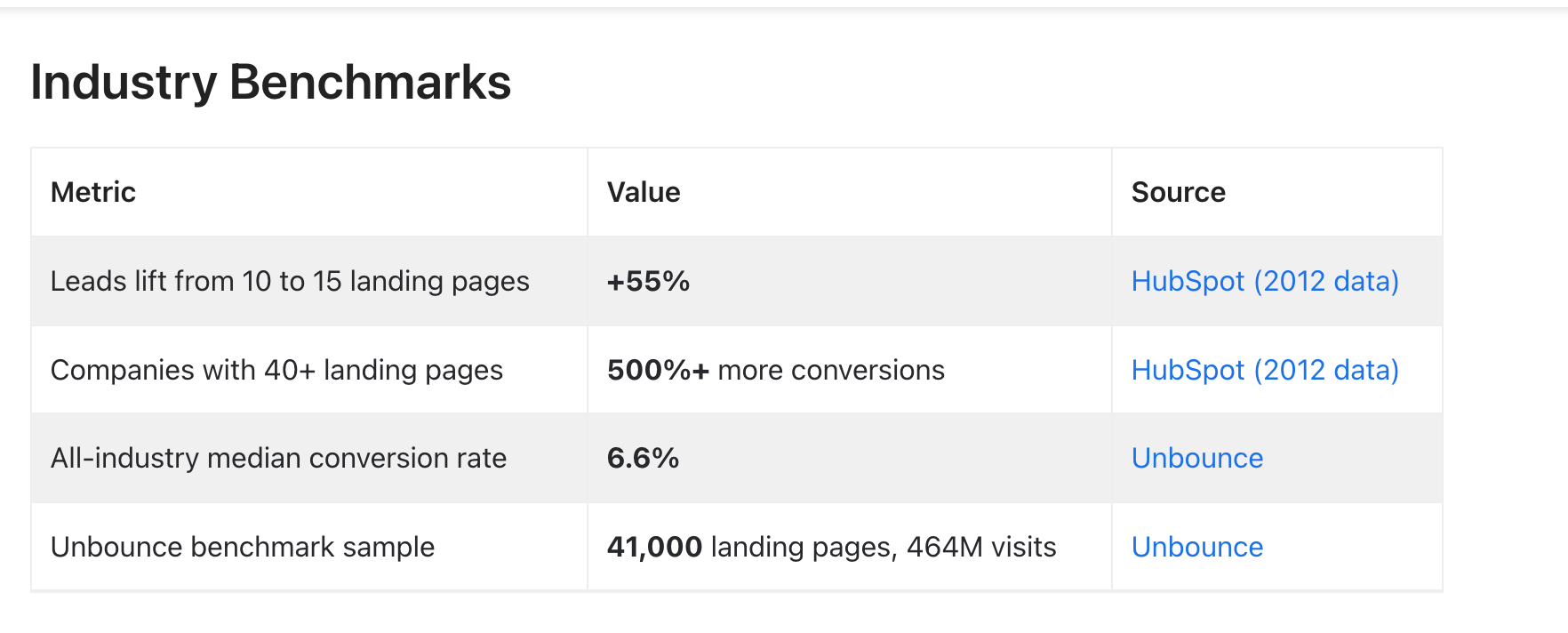
An old study from Hubspot shared by Colorlib.com shares this interesting table that sumarizes lead growth vs amount of website pages. Companies with 40+ website landing pages lead to 500% conversions but that doesn't mean all those pages are blog posts because not all blog content on the internet is built with commercial intent and this my friends is the honest secret to SEO that took me almost a decade to learn.
How many pages does my type of practice need?
These are planning targets I build toward, and they are my judgment calls. Nobody publishes a reliable industry average for therapy websites, so treat the numbers as a starting range and adjust them with the competitor count below.
Solo therapist
Group practice
If you want to count your own pages first, start with your sitemap, meaning the list of pages your site needs and the main phrase each one targets. I made a free planner for exactly this.
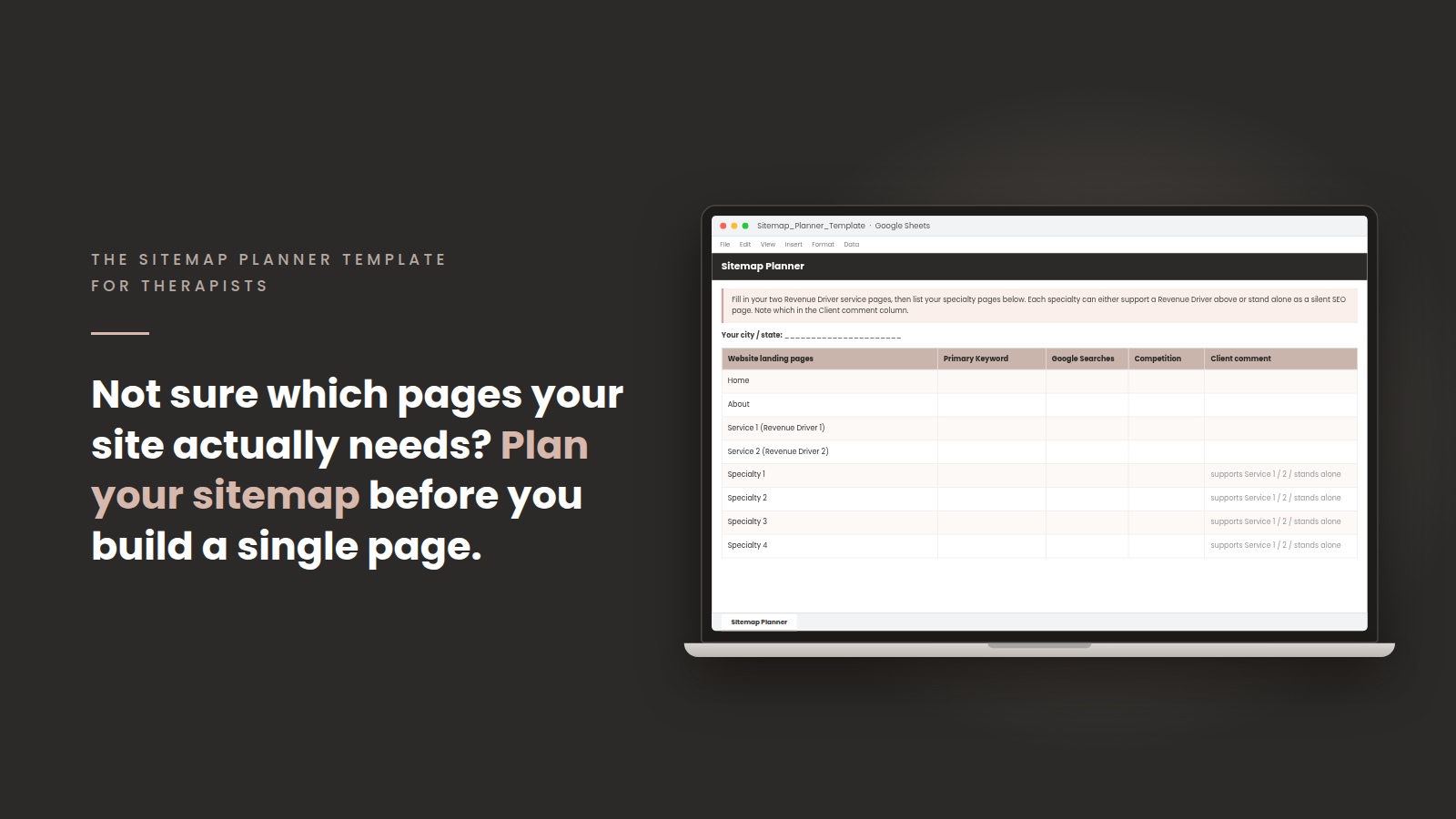
Get my free sitemap spreadsheet planner, list the pages you have today, and see how many gaps show up.
Should I put my city name on every specialty page?
Only when your city has enough search traffic to justify it. Some therapists are told to add their location to every specialty. In a decent city or neighborhood with a decent population and competition, that can be a sweet spot. In a town of 5k people, a fully localized site and fully localized specialties can be found by almost nobody beyond the people in that town, because a town that size has very little search traffic.
This may contrast with a lot of the advice you hear. I told a therapist exactly this on a discovery call. She already had a site with her town name built into it, was not getting any inquiries after already having invested on a website redesign and SEO basics, and no one had told her that her town would never drive substantial traffic.
That is why I never skip keyword research. A trusted SEO professional can tell you the size of the traffic in your market and build a cleaner structure, so your specialties can rank apart from your small town.
How does local SEO work for virtual therapists and practices with an office?
You get to choose where you want to rank. With virtual services, you can be strategic about the markets you target, and I covered how that works in how a telehealth therapist can rank in multiple cities and states. With a physical office, your Google Business Profile does the heavy lifting around that address, and location pages get you found beyond your office.
How do I use my competitors to set my page count?
Count what the practices above you have built, then plan to match or beat it at launch. This takes about an hour and gives you a number tied to your market.
- Search your main phrase, such as "anxiety therapist" plus your city, and write down the 5 practices that rank.
- Type site:theirdomain.com into Google to see roughly how many pages they have indexed. The count is an estimate, and it is still useful.
- Open their sitemap, usually at theirdomain.com/sitemap.xml, and count specialty and location pages separately from blog posts.
- Set your target at or above their average for specialty and location pages.
Here is a made up example. Say the 5 practices ranking above you have 18, 25, 30, 40 and 55 pages, for an average of about 34. Building a site with 40 to 45 pages puts you ahead of that average on day one.
How does my market size change the number?
The bigger the market, the more pages you need at launch and the longer results take. In my SEO Challenge I put it this way: with little local competition a site could land on page one in the first 90 days, sometimes 6 months, while a bigger metro puts you up against practice owners who have been doing this for years.
Small town
Mid size city
Large metro
Should I launch every page at once or build in phases?
Launch the structure at once. I know this because I tested it three ways with real clients.
Experiment 1: core pages and specialties year 1, location and blogs until year 2
My first SEO clients launched without specialty and location pages. They waited 1 full year for specialty pages to drop 2 per month, a second year for location pages to match with their blogs, and until year 3 before we started doubling down on blogging. I used to feel bad about those results because it felt like it was taking forever, or like I was doing something wrong. I wasn't. I just wasn't seeing the whole picture. Local SEO mentors then told me the entire structure needs to be built from day one.
Experiment 2: 20 to 30 page launches
I pivoted to 20 page launches, which was a big improvement. Then I learned the hard way that the bare minimum is 20 to 30 pages of services, specialties and locations, and that a competitive market asks for more.
Experiment 3: A 60 page launch in Los Angeles
I built my biggest site ever for a practice in one of the most competitive areas of Los Angeles. It has 60 or more pages, with 3 major areas of practice, and each one has about 10 or more subspecialties under the dominant services that drive revenue in their business. We built out the umbrella term for each specialty and every subspecialty beneath it, so each page ties authority back to the core service.
- We haven't started blogging yet
- The site structure alone has the practice highly recommended in ChatGPT, AI search and Google.
- They get 5 to 10 leads a month from SEO and AI alone, and 100% of their leads come from Google and AI.
- When they ran Google Ads, they had to spend $40 to $100 a day to compete in their market.
- They’re not running Google ads anymore and strategic SEO is doing the heavy lifting now.
They fast forwarded about 3 years of SEO into their launch and had a steady flow of leads in the first 6 months. They still have room to grow, since their Google Business Profile has only 6 reviews. If they matched the review count of their competitors, I expect the lead numbers to climb a lot higher, and I'm behind them helping them get there.
When should I stop adding content to my website?
Never. But more content doesn’t mean volume, the more keywords you build that produce unique helpful content help build your authority and SEO real estate in your niche and area. The issue here is that you need to be strategic with your keyword selections so you avoid thin repetitive content. Sites that mass produce content without quality end up having 200 or more URLS with no commercial intent clicks.
Frequently asked questions
Can a 5 page therapy website rank?
A 5 page site can show up for your practice name and a few very specific phrases. Competitive phrases such as "anxiety therapist" plus a city need specialty and location pages behind them, and I plan for at least 20 to 30.
How long do new pages take to rank?
It depends on local competition. With little competition a site could reach page one in the first 90 days, sometimes 6 months. A bigger metro takes longer, and impressions without clicks and page 6 rankings mean the site is starting to get picked up.
Should I add pages before I write blog posts?
Yes. Build the services, specialties and locations first and add blogging once they are live. The 60 page practice above shows what the structure can do on its own.
What if my competitors have far more pages than I do?
Count their specialty and location pages and plan to match or beat that number at launch. Build toward the larger structure in a single push so you can skip catching up one page at a time for years.
Want this off your plate?
Everything in this post is something you can do yourself, and it competes with your caseload, your family and your time. Having a website is a job, and most practice owners did not sign up for it.
As a therapist website designer who also runs the SEO, I build the full structure from day one and handle the ongoing website management, so your site keeps working while you see clients. The SEO side covers both SEO for therapists and SEO for private practices, from the sitemap through the reviews and directories that build your authority.
If you would like help, apply to work with me. No pressure, just a conversation about what would take the most weight off your desk.

* AI Disclosure: This content may contain sections generated with AI with the purpose of providing you with condensed helpful and relevant content, however all personal opinions are 100% human made as well as the blog post structure, outline and key takeaways.
* Affiliate Disclosure: Some of the links on www.nataliamaganda.com may contain affiliate links meaning that I will get a commission for recommending products at no extra cost to you.

hello! i'm natalia maganda
The website manager for therapists and private practices that you didn't know existed.
We build and manage the 20+ page website that ranks in your city, reflects the depth of your work and books cash-pay clients with ease.
A done for you website management system that lets your practice grow without costing you your energy, your weekends, or your nervous system.