
How to rank in 2 or more cities as a telehealth therapist without faking a local office
A telehealth therapist ranks in more than one city or state by giving each place its own real page on the website, built around what a client searching from that place actually needs, and by keeping the Google Business Profile honest about the one area it can cover. An office in every city is optional. A page for every city or state you want clients from is the real requirement, and each page has to earn its spot with real local knowledge.
If we haven't crossed paths before, I'm Natalia, the founder of a boutique web design and SEO agency for therapists and private practice owners across the US. My mission is to help your website work as a 24/7 referral engine, so you can log off and still wake up to new inquiries. Over 7 years in business and 100+ clients later, I've managed over 900 URLs for other people's practices, and the full multi area location strategy is the build I run for my retainer clients.
You are probably here because you are licensed in 2 or 3 states, or your group practice added clinicians who live somewhere else. Your website says "online therapy" and Google has no idea where to show it.
Key takeaways
- Google ranks individual pages. If you want to show up in Austin and Houston, you need a page that is clearly about Austin and a page that is clearly about Houston.
- Licensing sets the map. Your location pages can only cover places where you are legally allowed to see clients, and that is a state question before it is a city question.
- A Google Business Profile for a service area business can hide your address and, per Google's service area help page, list up to 20 service areas within about 2 hours of driving from where you are based. It covers 1 metro and nothing beyond it.
- Google's spam policies name pages "targeted at specific regions or cities that funnel users to one page" as doorway abuse. Same copy with a new city name is exactly that.
- You can localize your existing sitemap for 1 core city, or build a full multi area strategy that covers every area you want clients from. Location pages carry real local knowledge or they do not rank.
Can a telehealth therapist actually rank in more than one city?
Yes, and the therapists who pull it off treat each city like its own small website inside the main one. Google does not read "we serve clients across Texas" and quietly file you under every Texas city. It reads a page, decides what it is about, and matches it to a search. If your site has no page about online therapy in Houston, someone else's page wins that search.
The first filter is your license, before any SEO work starts. You can only see clients where you are legally allowed to practice, so your map starts with the states on your wall. Psychologists have PSYPACT, and the PSYPACT map shows which states have enacted it. Counselors have the Counseling Compact, and the Counseling Compact map lists member states and says privileges are live so far for licensees in Arizona, Minnesota, and Ohio. Check your own board before you build anything, because a page for a state you cannot practice in generates inquiries you have to turn away.
Should I localize my sitemap for one city or build location pages for several?
In my experience there are 2 real options, and the mistake is trying to do a half version of both. You can localize the sitemap you already have for 1 core city, or you can build a full multi area location strategy that covers every area you want new clients to find you in.
Localizing for 1 city means your home page, your top service pages, and your specialty pages all point to the same metro. Your anxiety therapy page becomes anxiety therapy in Denver, and your Google Business Profile lists Denver and the suburbs around it. For a solo therapist with 1 revenue driver and 1 metro it is usually enough.
The full multi area strategy adds a location section to the sitemap. Each city or state you want clients from gets a dedicated page, and those pages link to and from your service pages so Google reads the whole structure as one practice with several fronts. This is the build that lets a group practice with clinicians in 4 states show up in all 4.
Here is how I decide which one a practice needs.
| Question | Localize for 1 city | Full multi area strategy |
|---|---|---|
| Where do most inquiries come from today? | 1 metro | 2 or more metros or states |
| How many clinicians and where are they licensed? | 1 to 2, same state | Several, or several states |
| What is the revenue driver? | 1 service in 1 place | The same service in several places, or different services per place |
| How much can you publish per year? | A few service and specialty pages | A location page per area plus supporting content |
| Where does the Google Business Profile sit? | The core metro | The core metro, with location pages carrying the rest |
The sitemap decision comes before the copy. I built 2 websites of my own and got it wrong both times before I understood what structure Google was reading. A sitemap of service pages and specialty pages, with location pages layered on top, matters more than any amount of blogging, and I have managed sites where that foundational sitemap alone, with no blog published yet, beat local competition for real commercial keywords.
If you are choosing between 1 core city and a full location strategy, start by listing every page your site needs and the place each one targets. I made a free planner for exactly this.
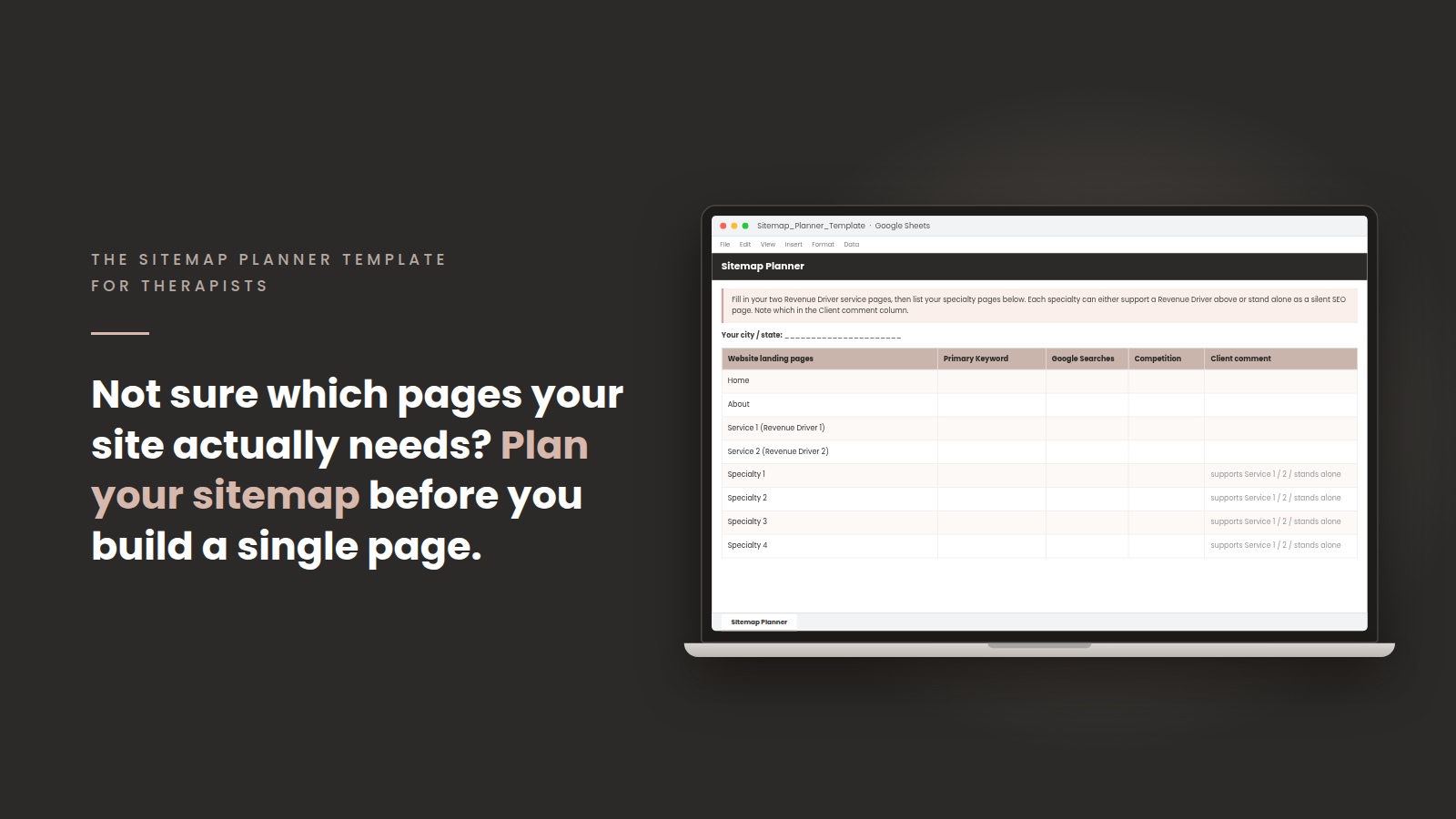
Get my free sitemap spreadsheet planner, add a row for every city or state you want clients from, and see how many pages you are really signing up for. I also cover the full local SEO guide for therapists what it is, what you need and where to start.
What goes on a location page so Google does not treat it as a doorway page?
A location page has to carry real local knowledge, or Google has a name for it. Google's spam policies list doorway abuse as pages "created to rank for specific, similar search queries" and give the example of "multiple domain names or pages targeted at specific regions or cities that funnel users to one page." Swapping "Austin" for "Dallas" in the same 600 words is the textbook case.
Here is what I put on a location page for a telehealth practice. None of it can be reused from city to city.
- Who in this place searches for you. A therapist licensed in Utah and Colorado is not writing the same page twice. A Salt Lake City page speaks to clients in a community where faith often shapes how people think about therapy. A Denver page speaks to transplants and the outdoors identity.
- The licensing sentence, in plain words. "I'm licensed in Texas, so I can see you on video anywhere in the state, from El Paso to Beaumont." This answers the question clients actually type, and it also confirms to Google that the page is about a real service area.
- How telehealth works in that state. Insurance panels and what happens if the client travels. This changes per state, and that is the point.
- Local references that are true. Neighborhoods, the university, the hospital system that refers out. If you have never been there, interview a clinician who has.
- A real reason to choose video from this city. Commute time, waitlists at the big practices, privacy in a small town.
I wrote a full breakdown of the structure in my post on why location pages are the secret SEO strategy for therapy practices. The short version is that every location page needs its own primary phrase, its own meta title, and its own reason to exist.
One more opinion, stated plainly. In my sitemap categories the location page is a specialty page. It needs to match the exact words a searcher in that city types, it needs to be true, and it needs to link back to the service page that makes you money.
How does Google Business Profile work when I have no office?
You set it up as a service area business, hide your address, and let it cover 1 metro. That profile is real and it matters, and it will never cover your second state, so the location pages have to.
Google's guidelines for representing your business say service area businesses "should hide your business address from customers," and the service area help page says "you can have up to 20 service areas" and that "the boundaries of your overall area shouldn't be more than about 2 hours of driving time from where your business is based."
A profile based in Chicago can list Oak Park, Naperville, and a good spread of suburbs. It cannot list Milwaukee and Indianapolis and stay inside the rules. So the profile does the map pack work for 1 metro, and your website does the organic work for every other place.
I go through categories, photos, and the ethical review approach in my post on Google Business Profile for therapists. For a multi city telehealth practice, the extra step is choosing the home base carefully. Pick the metro that produces the most inquiries today, and keep the name, address, and phone identical on the profile, the website, and every directory. Do not open a second profile with a coworking address in another city. A suspended profile takes weeks to recover.
How do I rank in a second state as a telehealth therapist?
Build 1 state page first, then add city pages inside that state only where the search volume and your caseload justify them. The state page catches the searches that use the state name and becomes the parent your city pages sit under. The order I use:
- Confirm the license and any compact privilege, and write that sentence on the page.
- Research the keywords for that state. "Online therapy Colorado" and "Colorado telehealth therapist" are different searches with different competition, and 1 of them is usually the one worth building on.
- Publish the state page with the local knowledge above, linked from the main navigation or the locations hub, and linked to the revenue driver service page.
- Add city pages only for the 1 to 3 metros where you actually see clients or want to. Each gets its own research, its own copy, its own references.
- Support the state with 2 to 3 blog posts a client there would search for, linked to the state page, then track impressions and clicks in Search Console and reassess in 6 to 12 months.
Timelines depend on local competition. With little competition a state page can start pulling impressions within the first 90 days. In a metro where group practices have been publishing for years, expect the slow build and choose lower competition phrases with real commercial intent.
Frequently asked questions
Can I rank in a city where I do not live if I am licensed in that state?
Yes. A page built with real local knowledge for a city you are licensed to serve can rank without you living there. The Google Business Profile stays tied to your home base, so rankings for the far city come from the website, and that is a local SEO job more than a general SEO job. I break down the difference in SEO vs local SEO for therapists.
How many location pages can a telehealth therapist have?
As many as you can make genuinely different and keep updated. We like to build 10 or more location pages for clients and monitor closely.
Is a state page or a city page better for online therapy?
Start with the state page, because that is the phrase telehealth clients use when they know they can see anyone in the state. Add city pages when a metro has enough searches and enough of your caseload to justify a page that is truly about that city.
Want this off your plate?
Everything in this post is doable on your own. You can plan the sitemap, research each state, write the location pages, and check Search Console every month. It also competes with your caseload, your family, and the hour you were going to spend not working.
As a therapist website designer who also runs the SEO, I build the location strategy into the sitemap from day one, so a practice licensed in 3 states launches with the structure Google needs to read all 3. My website management keeps those pages updated as licenses, clinicians, and cities change, and my SEO for therapists and SEO for private practices work is where the state pages, city pages, and supporting posts get researched, written, and tracked over the year.
If you would rather hand the whole map to someone who has built it before, apply to work with me. No pressure, just a conversation about which cities are worth a page and what would take the most weight off your desk.
* AI Disclosure: This content may contain sections generated with AI with the purpose of providing you with condensed helpful and relevant content, however all personal opinions are 100% human made as well as the blog post structure, outline and key takeaways.
* Affiliate Disclosure: Some of the links on www.nataliamaganda.com may contain affiliate links meaning that I will get a commission for recommending products at no extra cost to you.

hello! i'm natalia maganda
The website manager for therapists and private practices that you didn't know existed.
We build and manage the 20+ page website that ranks in your city, reflects the depth of your work and books cash-pay clients with ease.
A done for you website management system that lets your practice grow without costing you your energy, your weekends, or your nervous system.