
Local SEO for therapists: what it is, what you need, and where to start
Local SEO for therapists is the work that gets your practice in front of people searching for help in a specific place, whether they type "therapist near me," "anxiety therapist in Austin," or just "therapist" from a phone in your city. It covers 2 kinds of results, the map results at the top of the page and the regular website results below them, and it rests on 6 pieces: a Google Business Profile, consistent business details everywhere online, listings in the right directories, reviews, pages on your site that name your city, and a plan for every other city you serve.
If we haven't crossed paths before, I'm Natalia, the founder of a boutique web design and SEO agency for therapists and private practice owners across the US. My mission is to help your website work as a 24/7 referral engine, so you can log off and still wake up to new inquiries. I have been in business for over 7 years and have served 100+ clients, and I have managed over 900 URLs for other people's practices, which means I have set up the pieces below more times than I can count.
If you have heard the term local SEO and nodded along without knowing exactly what it asks of you, this page is the plain language version. Each piece gets its own explanation here, and I link to the deeper guide once, so you can go further only on the part your practice is missing.
Key takeaways
- Local SEO and SEO are different jobs. SEO gets your pages to rank for a topic. Local SEO gets your practice to rank for a topic in a place, and it adds a second set of results, the map pack, that regular SEO leaves alone.
- Google says local results are mainly based on relevance, distance, and prominence, and that there is no way to request or pay for a better local ranking.
- NAP consistency means your practice name, address, and phone number read exactly the same on every site that mentions you. It is the floor of local SEO, and a surprising number of practices fail it.
- You can do local SEO without an office. A telehealth or home based practice hides its address on its profile and still competes for its city.
- In my experience, the pieces that move the most are the ones most owners skip: the right primary category on the profile, and a page on the site for each city they want clients from.
What is local SEO, and how is it different from SEO?
SEO is the work of getting a page to rank for a search. Local SEO is the work of getting a practice to rank for a search in a place. The difference sounds small until you look at the results page. Search "anxiety therapist in Austin" and you get 2 sets of results: 3 map listings with pins at the top, then the normal list of websites below. The map listings come from Google Business Profiles. The website results come from pages. Regular SEO only ever works on the second set.
Google explains the map side in its own words. Local results are mainly based on relevance, distance, and prominence: how well your profile matches the search, how far you are from the person searching, and how well known your practice is, including links to your site and your reviews. You cannot change distance. Everything else on this page works on the other 2. I wrote a longer comparison of the 2 disciplines, and which one a practice needs first, in SEO vs local SEO for therapists.
Every piece below starts with the same move: getting your practice listed, correctly, in the places Google already trusts. I made a free directory list for exactly this.
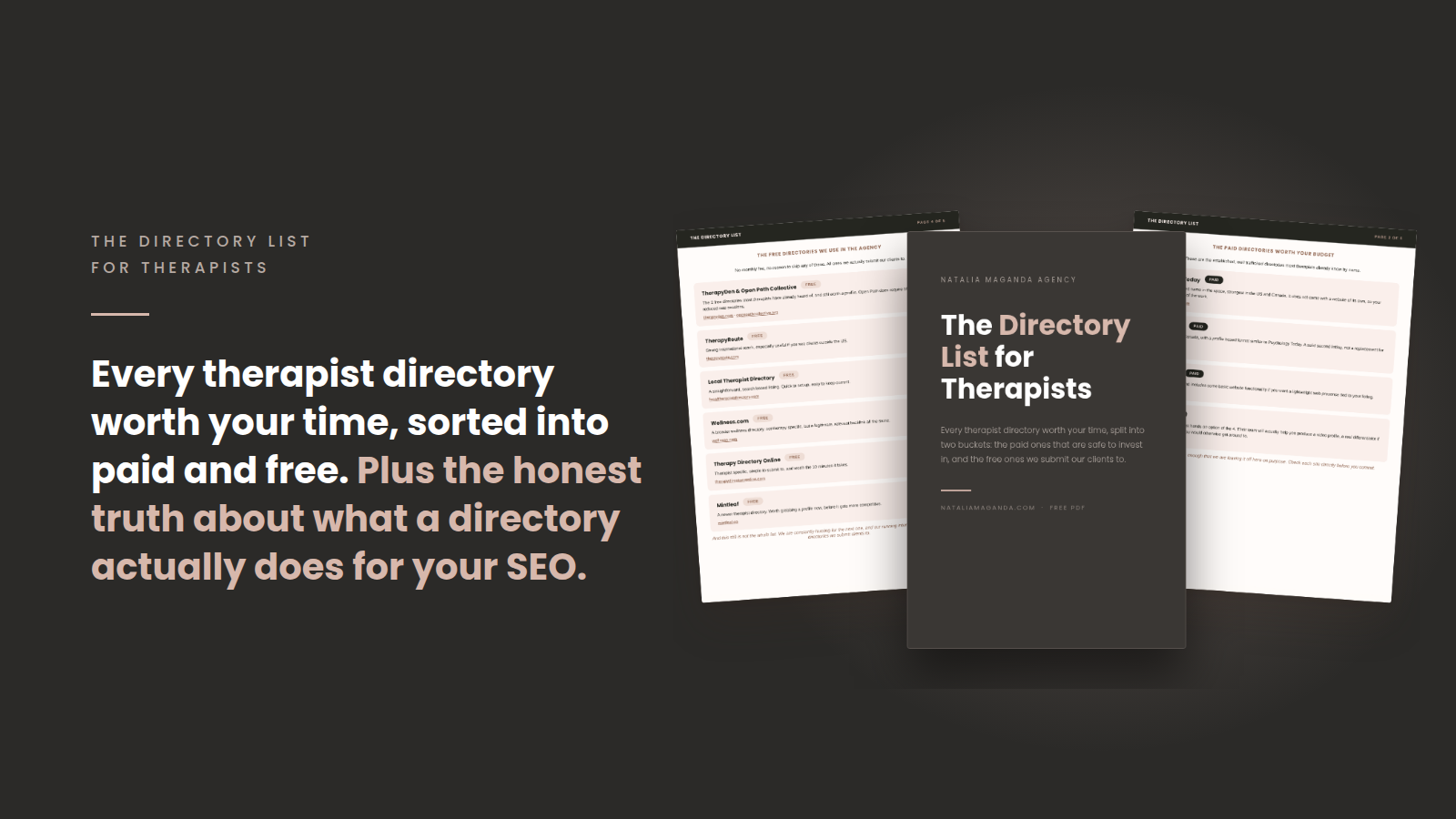
Get my free directory list for therapists, submit your practice to 3 of them this week, and use the exact same name, address, and phone number on each one.
What do you need for local SEO as a therapist?
Six things, and they build on each other. The first 4 feed the map results. The last 2 feed the website results. A practice with only the profile shows up on the map and nowhere else. A practice with only the pages shows up in the list and never on the map. Most practices I audit have half of each.
A Google Business Profile with the right primary category
Your Google Business Profile is the listing that appears on the map, and it is the single biggest lever in local SEO. It is free, it works for a practice with no physical office, and the field that matters most is one most owners set in a hurry: the primary category. Google reads that category before it reads anything else on the profile, so a practice filed under a generic category competes with every counselor in the city for every search.
After the category, fill every section: services, description, attributes, hours, and real photos beyond the logo. A service based practice can hide its address completely and still run a full profile. Post an update every so often, because Google rewards profiles that stay active. The field by field setup, including which categories fit which kind of practice, is in my guide to the Google Business Profile for therapists.
NAP consistency: the same name, address, and phone number everywhere
NAP stands for name, address, and phone number, and NAP consistency means those 3 details read exactly the same on every site that mentions your practice: your website footer, your profile, Psychology Today, your state board listing, and every directory. "Suite 200" on one and "Ste. 200" on another, an old phone number on a listing you forgot you made, a practice name with "LLC" in one place and without it in another. Each mismatch is a small reason for Google to doubt that these listings describe the same business.
In my opinion NAP is a floor. Fixing it will not shoot you up the map pack, and leaving it broken quietly holds everything else down. A telehealth practice handles it by choosing one version of its name and phone, hiding the address on the profile, and leaving the address off every listing that allows it. The 5 mistakes I find most often, and the fix for each, are in NAP consistency for therapy practices.
Listings in the directories Google already trusts
Directories are where NAP consistency gets its test. Each listing is a citation, a mention of your practice on another site, and citations are one of the ways Google confirms that a practice exists where it says it does. Free directories are a should do for every practice, with no exceptions. Paid directories are a budget decision: they build your domain authority slowly and will not hand you a spike in leads.
Submit to the free ones first, a few at a time, with the same details on each. Two practices in the same city running the same strategy can get different results if one has the bigger online footprint, and listings are the cheapest part of that footprint to build. I keep a running list of the ones worth the form in the best therapist directories to list your private practice.
Reviews from professional peers
Reviews feed prominence, the third of Google's 3 local factors, and they feed the human reading your profile at 11 at night. Most therapists stop here, because asking a client for a public review feels wrong, and that caution is reasonable. The answer is to ask different people. Professional peers, colleagues, and referral partners can speak to your work without touching anything client related.
I have my own clients aim for 1 to 2 authentic reviews a month from that circle, with a recurring reminder on the calendar, and never a review exchange, because Google catches reciprocal reviews and removes them. What is actually allowed, and how to word the ask, is in Google reviews for therapists: what's actually allowed.
Pages on your website that name your city
The map results come from your profile. The website results come from your pages, and Google cannot rank a page for a city that the page never mentions. This is where local SEO meets the structure of your site. Your top service pages, the 1 or 2 Revenue Driver pages that earn the most, carry your core city in their titles and copy. Your specialty pages do the same for the clinical phrases a researched client types.
For a practice in one city, localizing the pages you already have is enough. For a practice that wants clients from several areas, each area gets a location page of its own, and here is the rule that decides whether those pages help or hurt: every one has to carry real local knowledge, the neighborhoods, the commute, the way people in that place talk about getting help. One page copied 5 times with a new city name is thin content, and Google treats it that way. How to build them is in location pages for therapy practices.
A plan for every other city or state you serve
Telehealth changed what "local" means. A licensed therapist can see clients across a whole state, and across several states under the compacts, with no office in any of them. Google still ranks by place, so a telehealth practice needs a page for each city or state it wants clients from, built the way the previous section describes, plus a profile set up as a service based business with a hidden address.
My position is that you localize first for one core city, and expand to a full multi area strategy once that city is working. The expansion is the same work repeated with real knowledge of each new place, which is slower than copying and the only version that ranks. The licensing filter, the profile setup, and the order to add cities in are in how a telehealth therapist ranks in more than one city or state.
How do you know which piece is missing?
Search your main phrase from your phone and look at both sets of results. If you are missing from the map pack, the gap is in the first 4 pieces: the profile, NAP, listings, or reviews. The most common cause is the primary category, followed by a profile that was never verified. I walk through the 5 reasons in order of likelihood in why your Google Business Profile is missing from "therapist near me".
If you are in the map pack and missing from the website results, the gap is in the last 2 pieces: your pages do not name the city, or you have 5 pages where you need 20. If you are missing from both, start with the profile, because it is free and fast, then move to the pages. Climbing within the map pack once you are in it is its own job, covered in how to rank your therapy practice higher on Google Maps.
Where should a therapist start with local SEO?
Start with the pieces that are free and fast, and that remove the most problems at once. That means the profile first, with the category chosen carefully, because it takes an afternoon and it is the biggest single factor. Then NAP, because fixing it is tedious and it protects everything you build after. Then 3 free directory listings, which is an hour.
Reviews come next, as a monthly habit: 1 to 2 a month from peers, for as long as you run the practice. Then the pages. Localizing your top service pages is a copy job you can do in a week. Location pages for other areas are the slowest piece, because each one needs real knowledge of the place, and they come last for that reason.
Timelines depend on your competition. With little local competition you could reach page one in your first 90 days, sometimes 6 months. In a bigger metro you are up against practice owners who have done this for years, which calls for sharper, lower competition phrases and more of the authority work. I ranked the tactics for that situation in the best local SEO tactics for a therapist in a competitive city.
Frequently asked questions
What is local SEO for therapists?
Local SEO is the work of getting a therapy practice to show up when someone searches for help in a specific place. It covers the map results, which come from your Google Business Profile, and the regular results, which come from pages on your website that name your city.
Do I need a Google Business Profile if I only offer telehealth?
Yes. You can set the profile up as a service based business and hide your address completely. The profile is what puts you in the map results for your city, and it sends a trust signal to Google and to the AI tools that pull from search results.
Do therapists need a separate location page for each city?
Only when you want clients from more than 1 area, and only if each page carries real local knowledge. Copying one page with a new city name creates thin duplicate content. I set out the conditions that decide it in do therapists need a location page for every city.
How long does local SEO take to work?
Months, and it depends on your competition. Profile changes can show within weeks. With little local competition, page one in 90 days to 6 months is realistic. A bigger metro takes longer, and Google states there is no way to request or pay for a better local ranking.
Want this off your plate?
Everything on this page is something you can do yourself, and the linked guides show you how. It also competes with your caseload, your family, and the evenings you would like back. Having a website is a job, and it is probably one you never signed up for.
This is the work I do every day. As a therapist website designer who also runs the SEO, I build the city into your pages from the first draft, so the website side of local SEO is done before launch. Our website management keeps those pages current, and SEO for therapists and SEO for private practices cover the profile, the listings, and the slow authority work on the map side. We submit every client to directories as part of that.
If you would rather hand this to someone who has served 100+ clients, apply to work with me and we can talk about your practice. No pressure, just a conversation about what would take the most weight off your desk.
* AI Disclosure: This content may contain sections generated with AI with the purpose of providing you with condensed helpful and relevant content, however all personal opinions are 100% human made as well as the blog post structure, outline and key takeaways.
* Affiliate Disclosure: Some of the links on www.nataliamaganda.com may contain affiliate links meaning that I will get a commission for recommending products at no extra cost to you.

hello! i'm natalia maganda
The website manager for therapists and private practices that you didn't know existed.
We build and manage the 20+ page website that ranks in your city, reflects the depth of your work and books cash-pay clients with ease.
A done for you website management system that lets your practice grow without costing you your energy, your weekends, or your nervous system.