
8 local SEO tactics that get a therapist found in a competitive city (ranked)
The best local SEO tactics for a therapist in a competitive city are the ones that stop matching what bigger practices already do and start owning what they skipped: sharper commercial intent phrases, a page for every one of them, a Google Business Profile built around the right primary category, and a slow drip of peer reviews and real backlinks. Ranked below by how much competition each one actually beats.
If we haven't crossed paths before, I'm Natalia, the founder of a boutique web design and SEO agency for therapists and private practice owners across the US. My mission is to help your website work as a 24/7 referral engine, so you can log off and still wake up to new inquiries. I have been doing this for over 7 years, I have served 100+ clients, and I have managed over 900 URLs for other people's practices, many of them in metros where the first page was already full of group practices that started years earlier.
You know the feeling. You Google "therapist in [your city]" and scroll past 3 group practices, 2 directories, and a hospital system before you find anyone your size. The generic advice says post more and get more reviews. In a big metro that is table stakes.
Key takeaways
- In a competitive city, the fastest wins come from phrases the established practices never targeted: specialty plus neighborhood, specialty plus modality, specialty plus client type.
- Whitespark's 2026 Local Search Ranking Factors survey lists your primary Google Business Profile category as the number 1 factor for map pack rankings, ahead of proximity and keywords in the business name.
- BrightLocal's 2026 Local Consumer Review Survey found that 97% of consumers read reviews for local businesses, and 47% will not use a business with fewer than 20 reviews.
- Specialty pages and location pages beat blog posts in a metro, because they target the commercial phrases people type with their wallet out.
- Authority is the quiet variable. Two practices running the same strategy in the same city get different results if one has the bigger online reputation.
- A bigger metro takes longer. Reassess your numbers every 6 to 12 months instead of every 6 weeks.
Why does local SEO work differently in a big metro?
Because you are competing against practice owners who have been doing exactly this for years, and Google already trusts them. In a smaller market I have watched a foundational sitemap alone, service pages and specialty pages with no blog published yet, beat the local competition and rank for real commercial keywords. In Chicago or Houston the same sitemap gets you into the conversation, and the older sites still outrank you because they have more pages, more links, and more reviews. So the job changes. You are trying to be the obvious answer for a narrower set of searches than anyone else claimed.
How did I rank these local SEO tactics?
I used 3 criteria, and the weighting is my opinion after 900+ URLs.
- How much competition it beats. Does it open a lane the big practices left empty?
- How much of it you control. Reviews depend on other people. Page copy depends on you.
- How fast it compounds. Some tactics pay once. Others pay every month for years.
| Rank | Tactic | Beats competition | In your control | Compounds |
|---|---|---|---|---|
| 1 | Sharper commercial intent phrases | High | High | High |
| 2 | A specialty page for each phrase | High | High | High |
| 3 | Neighborhood level location pages | High | High | Medium |
| 4 | GBP primary category and full profile | Medium | High | Medium |
| 5 | 1 to 2 peer reviews a month | Medium | Medium | High |
| 6 | Real backlinks, PR, and podcasts | High | Low | High |
| 7 | Interlinking and on page hygiene | Low | High | Medium |
| 8 | KPI tracking on a 6 to 12 month cycle | Low | High | Low |
1. Target sharper commercial intent phrases nobody else owns
The single best move in a competitive city is to stop chasing "therapist in [city]" and start collecting the phrases underneath it. "EMDR therapist in [city]" has a fraction of the volume and a fraction of the competition, and the person typing it has usually done their research and is close to booking. Add a client type and it gets sharper: "perinatal therapist near [neighborhood]," "OCD treatment for teens in [city]."
I think about phrases in 3 buckets: commercial intent (close to booking), educational (builds trust but will not convert today), and topical authority (shows Google you know the space). In a big metro, lower competition commercial intent phrases are the ones that make money, and finding them is the artistic part of SEO that autoblogging tools skip. I built 2 websites of my own and got it wrong both times, with more than 80 keyword selections for each, before I understood which bucket a phrase belongs in. The method is in my post on keyword research for therapists.
2. Build a specialty page for every phrase before you blog
Once you have 6 to 10 sharp commercial phrases, each one needs its own full page, with its own URL, rather than a paragraph on the services page. Most established practices skipped this, because they ranked for the broad terms years ago and never needed to go narrower.
I split pages into 2 categories. Revenue Driver pages are your top 1 to 2 services, and they deserve real, story driven copy because ranking gets the click and the words get the reply. Specialty pages are everything else. They stay lean and keyword forward, they are allowed to use the clinical phrase a researched client types ("EMDR for trauma," "ERP for OCD"), and each one either supports a Revenue Driver page or stands alone as a quiet SEO page. A practice with 12 specialty pages is showing Google 12 specific answers. A competitor with 3 broad pages and 40 blog posts is showing Google a lot of words.
If you are staring at a first page full of group practices, the smartest place to start is your sitemap, meaning the list of pages your site needs and the sharper phrase each one targets. I made a free planner for exactly this.
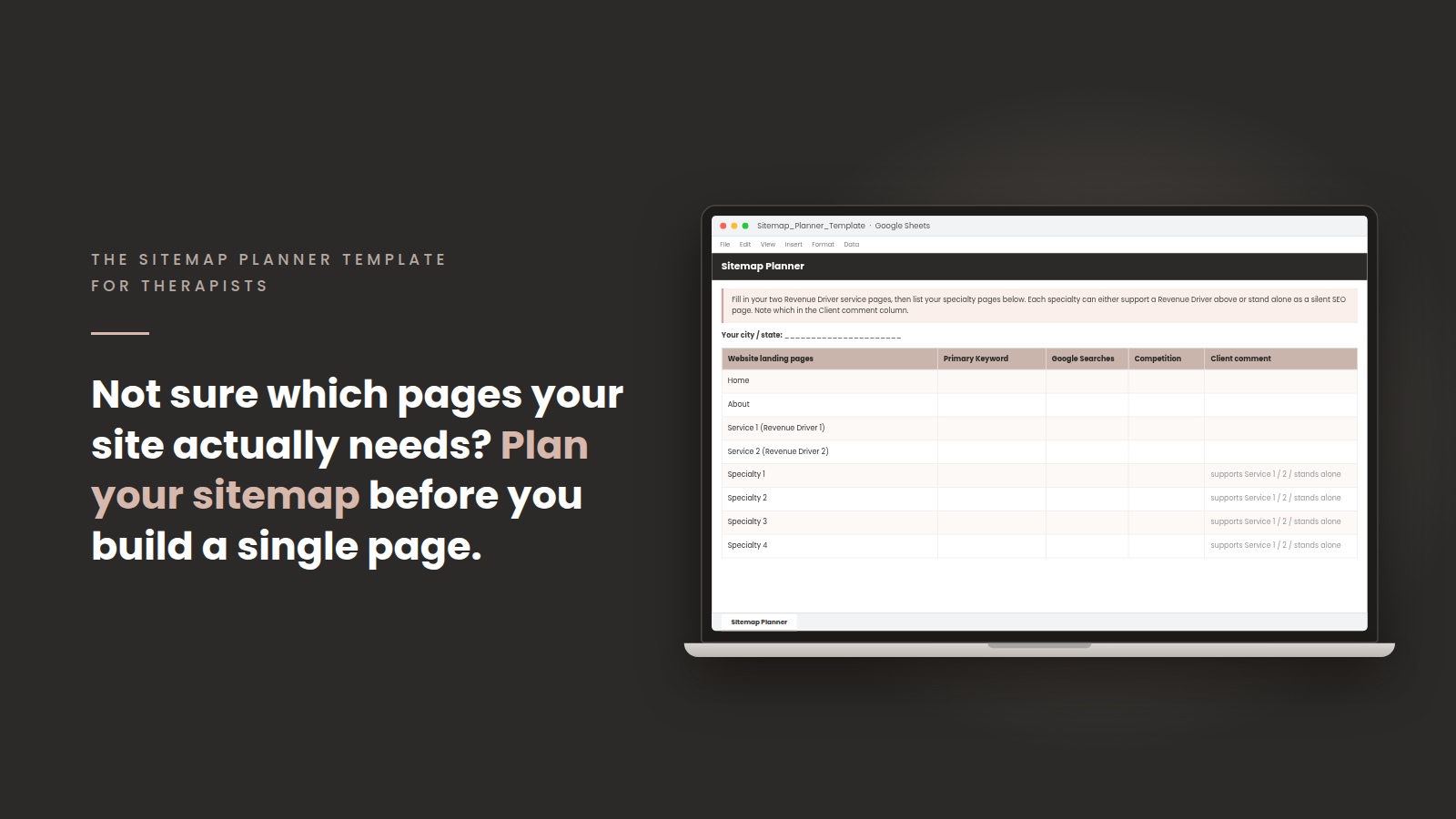
Get my free sitemap spreadsheet planner, list your Revenue Driver pages and specialty pages, and see how many phrases you can claim that nobody in your city has a page for. I also cover the full local SEO guide for therapists what it is, what you need and where to start.
3. Go one level below the city with location pages
The city page is the crowded room. The neighborhoods still have space. A practice in Houston can build pages for the Heights, Montrose, Katy, and Sugar Land, and each one competes with a handful of practices instead of hundreds. People also search near where they live or work, and Whitespark's 2026 Local Search Ranking Factors survey lists proximity of the address to the searcher as the number 2 map pack factor.
You cannot move your office. You can tell Google, in plain page copy, which neighborhoods you serve. I cover the structure in my post on location pages as an SEO strategy for therapy practices. One warning: 5 location pages with the same paragraph and a swapped neighborhood name do nothing. Each page needs something only true of that area.
What matters most on a Google Business Profile in a competitive city?
The primary category, then completeness, then activity. According to Whitespark's 2026 Local Search Ranking Factors, the primary GBP category is the number 1 ranking factor for the map pack, keywords in the business title are number 3, and whether the business is open at the time of the search has climbed to number 5.
4. Pick the right primary category and fill every section
This is where a lot of practices in big cities quietly lose. They pick "Mental health service" as the primary category because it feels safe, while the group practice 3 blocks away picked "Psychotherapist" and set secondary categories to match its specialties. In my experience the specific category wins. Then fill everything: services, description, attributes, hours, real photos, and a short post every few weeks so the profile stays active.
Keep the name, address, and phone number identical everywhere online, including the free directories. In a competitive city, a mismatched suite number across 6 listings is the kind of small inconsistency that lets a cleaner profile outrank you.
5. Ask peers for 1 to 2 reviews a month, forever
Reviews are the tactic you control the least and need the most. BrightLocal's 2026 Local Consumer Review Survey found that 97% of consumers read reviews for local businesses, 47% will not use a business with fewer than 20 reviews, and 74% look for reviews written in the last 3 months. In a big metro your competitors have 40 reviews, and yours are 2 years old.
You cannot ask clients, and I would not want you to. Ask professional peers, supervisors, colleagues, and referral partners who can speak to your work without touching anything client related. Aim for 1 to 2 real reviews a month, put it on a recurring reminder, and never do a review exchange, because Google catches reciprocal reviews and removes them. The slow drip beats the burst.
How does a small practice build authority against practices that started years earlier?
Slowly, and on purpose, because authority explains most of the gap. Two practices in the same city, running the exact same on page strategy, get different results when one has the bigger online reputation. She has simply been investing in her brand longer.
6. Earn real backlinks, PR mentions, and podcast spots
Free directories are a should do, every time, and they are only the entry point. The bigger moves are guest posts, press mentions, and podcast interviews on shows your ideal client or referral partners listen to. I once paid $1,000 for a feature placement that moved my domain authority from about 12 to 20. It did not bring clients directly from that feature. It added to my trustworthiness and to being recommended by AI tools to therapists who now book discovery calls with me. Many of my clients start at a domain authority of 0 and grow to 6 to 8 within their first year, and in a metro that first year is what turns page 4 into page 1 for the sharper phrases from tactic 1.
After writing 80 blogs of my own, I was still stuck on page 6 with barely 100 clicks a month, because the site had not earned enough trust yet. If you are blogging hard in a big city and nothing moves, this is usually why.
7. Interlink your pages so Google can walk the building
Interlinking is the hallway between rooms. Your Revenue Driver page links to every specialty page that supports it, each specialty page links back up, and each location page links to the specialties you offer there. A page with no links pointing to it can sit there finished and invisible. The practices you compete with have years of accidental interlinking, so yours has to be deliberate. On Duda, where I build every agency site, schema markup, the robots file, and image compression generate on their own, so this pass is mostly copy and links.
8. Track 4 numbers and reassess every 6 to 12 months
Impressions, clicks, click through rate, and leads. Those 4 correlate with each other, and that correlation tells you more than any single number. Impressions without clicks means Google is starting to pick you up. With little local competition a site can reach page 1 in the first 90 days, sometimes 6 months. In a bigger metro it takes longer, and slow progress usually means you should have started years ago. Review the numbers on a 6 to 12 month cycle and adjust the phrases before you scrap the strategy.
Frequently asked questions
Can a solo therapist outrank a group practice in a big city?
Yes, for the sharper phrases. A solo therapist rarely wins "therapist in Chicago" against a 12 clinician group, and rarely needs to. A specialty page for "EMDR therapist in Lincoln Park" plus a correctly categorized Google Business Profile can own that search while the group practice stays generic.
How many reviews does a therapist need to compete in a competitive city?
Enough to be in the same range as the practices next to you, then a steady trickle after that. BrightLocal's 2026 survey found 47% of consumers will not use a business with fewer than 20 reviews, so 20 is a reasonable first milestone, earned 1 to 2 peer reviews at a time.
Do I need a Google Business Profile if I am fully telehealth?
Yes. Set it up as a service based business, hide the address, and choose the primary category carefully. I walk through every section in my post on Google Business Profile for therapists.
Want this off your plate?
Everything in this post is doable on your own. It also competes with your caseload, your family, and the hours you would rather not spend in a spreadsheet on a Saturday, and in a competitive city the work does not stop after the first round.
As a therapist website designer who also runs the SEO, I build the sitemap, the specialty pages, and the location pages for practices in big metros, then keep them moving through website management that handles the updates, the interlinking, and the on page hygiene every month. The SEO for therapists and SEO for private practices work covers the harder half: the keyword judgment calls, the Google Business Profile, directory submissions, and the PR and podcast placements that build the authority a crowded city demands.
If you would like to talk through what that would look like for your practice, you can apply to work with me. No pressure, just a conversation about what would take the most weight off your desk.
* AI Disclosure: This content may contain sections generated with AI with the purpose of providing you with condensed helpful and relevant content, however all personal opinions are 100% human made as well as the blog post structure, outline and key takeaways.
* Affiliate Disclosure: Some of the links on www.nataliamaganda.com may contain affiliate links meaning that I will get a commission for recommending products at no extra cost to you.

hello! i'm natalia maganda
The website manager for therapists and private practices that you didn't know existed.
We build and manage the 20+ page website that ranks in your city, reflects the depth of your work and books cash-pay clients with ease.
A done for you website management system that lets your practice grow without costing you your energy, your weekends, or your nervous system.