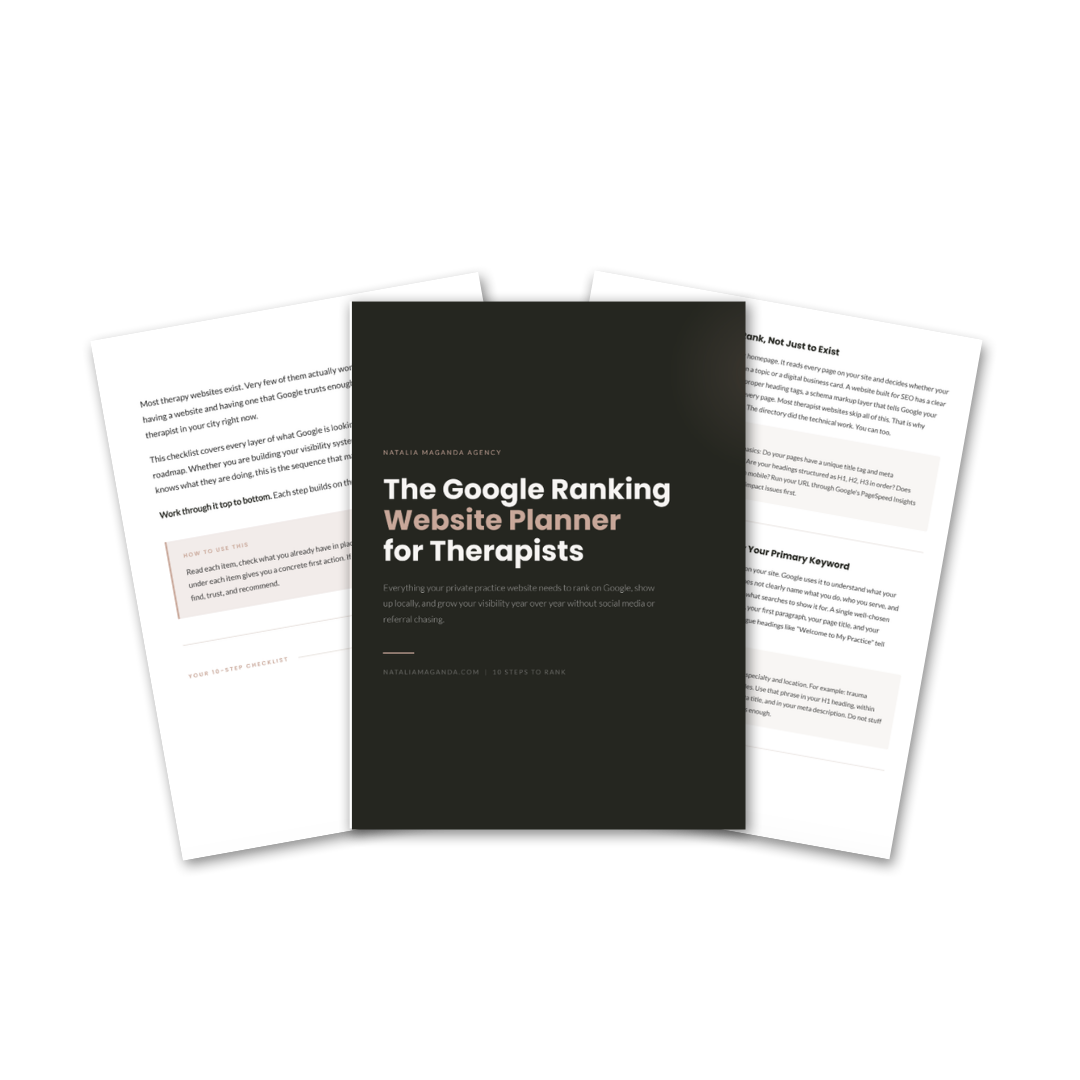

5 reasons your Google Business Profile is missing from "therapist near me" (and the fix)
Your Google Business Profile is usually missing from "therapist near me" for 1 of 5 reasons: it is not verified (or got suspended), the primary category is wrong, the person searching is too far from your pinned address, the profile is half empty, or the practices around you simply have more reviews than you do. Google says it ranks local results on relevance, distance, and prominence, and every fix below maps back to 1 of those 3.
If we haven't crossed paths before, I'm Natalia, the founder of a boutique web design and SEO agency for therapists and private practice owners across the US. My mission is to help your website work as a 24/7 referral engine, so you can log off and still wake up to new inquiries. I have been doing this for over 7 years, have served 100+ clients, and have managed over 900 URLs for other people's practices, so the diagnosis below is the one I run when a new client tells me "I Googled myself and I'm not there."
You probably set the profile up during a slow week and went back to seeing clients. Now Psychology Today is quieter, you typed "therapist near me" from your phone, and 3 practices you have never heard of came up while yours did not.
Key takeaways
- Google's help center says local ranking comes down to relevance, distance, and prominence, and that there is no way to pay for a better local ranking.
- In the 2026 Local Search Ranking Factors report from Whitespark, the primary Google Business Profile category is the number 1 map pack factor and proximity to the searcher is number 2.
- An unverified or suspended profile, or a service area business showing a home address, can be hidden from results entirely.
- Reviews from professional peers, at 1 to 2 a month, are the review strategy I give my own clients, and never a review exchange.
How does Google decide which therapists show up for "therapist near me"?
Google fills the 3 map pack spots by asking how well a business matches the search, how close it is to the searcher, and how well known it is. Those are the 3 local ranking factors Google publishes, and it describes prominence as including links to the business and how many reviews it has.
"Therapist near me" has almost no words in it, so Google cannot match it to your specialties or your lovely about page. It matches your category, your pin, and your reputation. That is why the Whitespark 2026 Local Search Ranking Factors report ranks the primary category as the single most important map pack factor, with proximity right behind it and "business is open at time of search" at number 5.
Is your profile even eligible to show up?
If your profile is unverified, suspended, or set up in a way that breaks Google's guidelines, it can be hidden from search entirely, and no optimizing helps until that is fixed.
Log in and look for a "Get verified" button. Google's verification help page lists phone, email, video recording, live video call, and postcard as options, and notes that most postcard codes arrive within 14 days.
Then check for a suspension notice. In this niche, suspensions almost always come from the address, because a lot of practice owners moved to telehealth and kept a home address on the profile. Google's guidelines for representing your business say a service area business should hide its address, and that a visible address needs to be staffed and able to receive clients during listed hours.
The fix is to set the profile up as a service area business, hide the address, and set the service area to the cities you serve, which per the same guidelines should not extend farther than about 2 hours of driving time from your base. You can still rank in the map pack with a hidden address. I set this up for telehealth clients regularly.
Once your profile passes the eligibility check, the next thing Google looks at is whether anyone vouches for you, and the fastest ethical way to get there is reviews from professional peers. I made a free swipe file for exactly this.
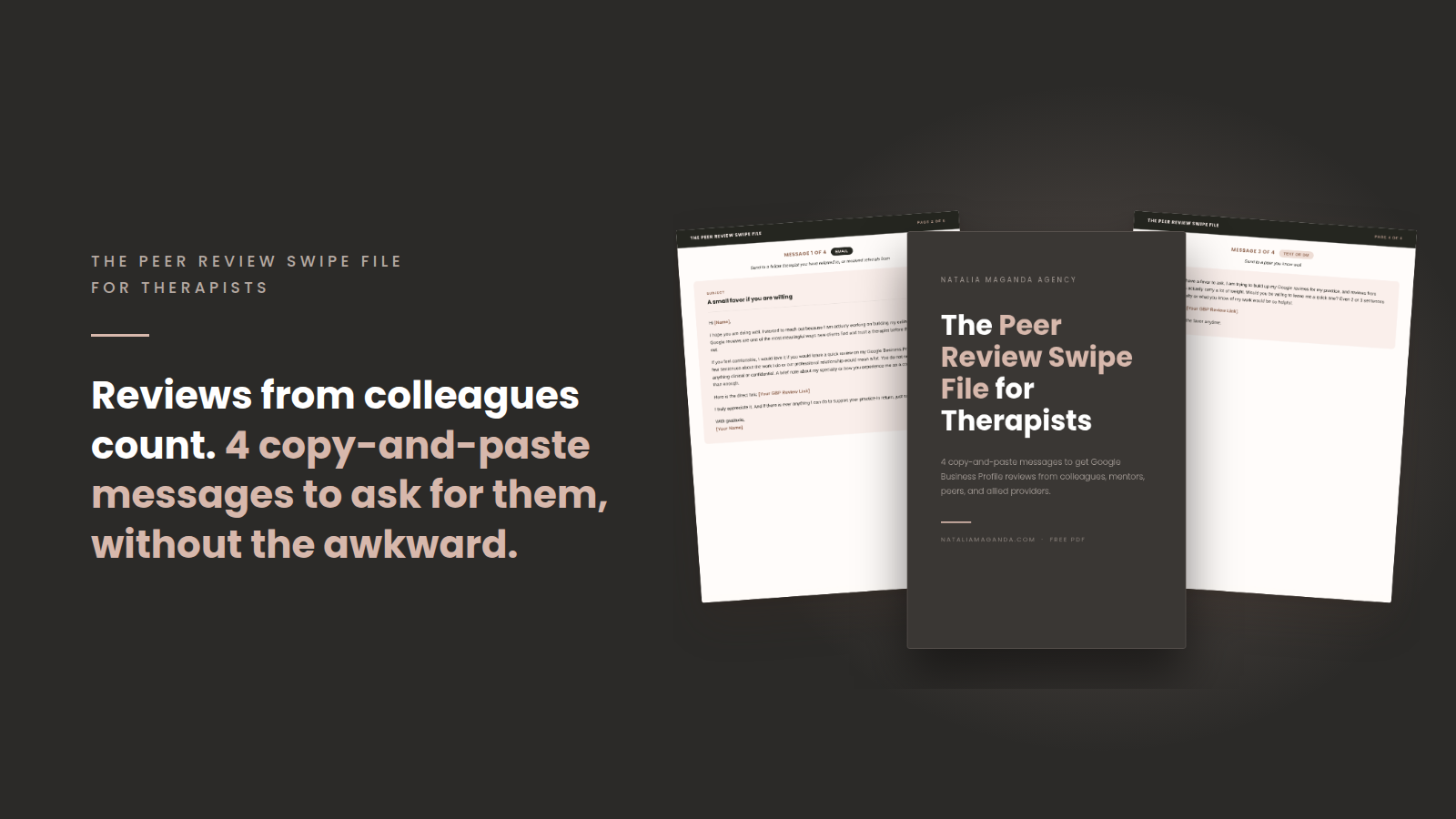
Get my free peer review swipe file, pick 2 colleagues who genuinely know your work, and send the first request this week. I also cover the full local SEO guide for therapists what it is, what you need and where to start.
Which primary category should a therapist pick?
Pick the single category that describes where most of your revenue comes from, and treat everything else as secondary. Primary category is the top ranked map pack factor in the Whitespark 2026 report, so this one dropdown matters more than anything else you edit today.
The mistake I see constantly: a group practice picks "Mental health service" because it feels safe, or a solo LMFT picks "Counselor" because that is the license. Broad categories put you in a pool with clinics and community agencies. Specific categories put you in the pool Google actually pulls from for "therapist near me," and in my opinion Psychotherapist or Counselor is the right primary for most solo and small group practices.
| Your practice | Primary category | Secondary categories worth adding |
|---|---|---|
| Solo therapist, mostly individual adults | Psychotherapist | Counselor, Mental health service |
| Couples focused practice | Marriage or relationship counselor | Psychotherapist, Family counselor |
| Group practice with several clinicians | Mental health clinic or Psychotherapist, whichever your revenue driver page says | Counselor, Family counselor |
| Licensed psychologist doing testing and therapy | Psychologist | Psychotherapist, Mental health service |
My rule is that the primary category matches the Revenue Driver page on your website, meaning the 1 or 2 service pages that make you the most money. When the profile says "Mental health service" and the site leads with couples counseling, you have split your own relevance signal in half. I walk through the full setup order in my post on Google Business Profile for therapists.
Why does my profile show up in one neighborhood and vanish 3 miles away?
Because "near me" means near the searcher, and Google measures the distance from their phone to your pin, and your service area does not change that math. Distance is the second factor on Google's local ranking page, and it is the one you cannot optimize your way out of.
You search from your office and you are in the top 3. Your friend searches from her house across town and you are nowhere. A hidden address still has a pin, too, because Google uses the address you verified with even when the public cannot see it. If you verified with a home address in a suburb while your office is downtown, your invisible pin is in the wrong place.
What you can do about it:
- Verify with the address closest to the people you want to reach.
- Ask 3 colleagues in different parts of the metro to search "therapist near me" and screenshot what they see. That is your real coverage area.
- Stop expecting the map pack to cover a whole metro. The way I cover multiple areas for retainer clients is on the website, with a location page for each city or neighborhood, which ranks in the organic results where distance is not the deciding factor. The profile covers your radius, the site covers the rest.
Do reviews really decide who shows up?
Reviews are a big part of prominence, and prominence is a third of the equation. Google says on its local ranking factors page that more reviews and positive ratings can help a business's local ranking. In the Whitespark 2026 report, high numerical Google ratings and the quantity of native Google reviews both sit in the top 10 map pack factors, and the report notes that review signals grew in importance this year.
Here is where therapists get stuck. You cannot ask clients for reviews, and you are right to be careful. But you still need reviews, and they can come from people who are not your clients. What I have my own clients do is ask professional peers, colleagues, consultation group members, and referral partners, people who can honestly speak to your work without touching anything client related. The pace is 1 to 2 authentic reviews a month, that is it. Put it on your calendar and keep going until your count is in the same range as the practices currently outranking you.
No review exchanges, ever. Google's review content policy prohibits content that is not based on a real experience and prohibits offering anything in exchange for a review, and reciprocal reviews get caught and removed. I cover what is and is not allowed in my post on Google reviews for therapists.
In my experience, prominence beats design in the map pack every time. Google cannot see your fonts, and a plain profile with a steady trickle of real reviews will keep sitting above a beautiful one with 2.
What does a half empty profile cost you?
A thin profile loses on relevance, because Google has less to match against, and it loses clicks even when it shows, because a searcher comparing 3 profiles picks the one with photos and hours. "Business is open at time of search" is a top 5 factor in the Whitespark 2026 report, so missing hours alone can pull you out of the pack at 7 pm on a Tuesday, which is exactly when people search for a therapist.
What complete looks like, in my experience:
- Every section filled: description, services (1 per specialty page on your site), attributes, hours, and the appointment link.
- Real photos of the office and the team, added regularly, beyond the logo.
- A post on the profile every so often, because Google rewards profiles that stay active.
- Name, address, and phone identical everywhere, from the profile to your website footer to every directory listing.
I cover the ongoing side, meaning what to keep doing after setup so the profile keeps climbing, in my post on how to rank your therapy practice higher on Google Maps.
How do I find out which of the 5 reasons is mine?
Search "therapist near me" from your phone outside your office, then from home, then have a colleague across town do the same, and match what you see to this table.
| What you see | Most likely cause | Fix |
|---|---|---|
| Profile does not appear even when you search your practice name | Unverified or suspended | Finish verification, hide the address if you are a service area business, appeal with matching documents |
| Appears for your name and stays missing for "therapist near me" | Wrong or broad primary category | Set the primary category to match your revenue driver page |
| Appears near the office, gone across town | Distance | Accept the radius, verify from the best address, build location pages for other areas |
| Appears below 3 practices with more reviews | Prominence | Start the 1 to 2 peer reviews a month routine, submit to free directories |
| Appears in the morning, gone in the evening | Hours missing or wrong | Add accurate hours, including evening availability |
Fix relevance first, because it is fast. Prominence second, because it compounds. And stop fighting distance.
Frequently asked questions
Does a telehealth only therapist need a Google Business Profile?
Yes. Set it up as a service area business, hide your address, and set the service area to the cities you serve. It can still show in the map pack for people near your verified address.
How long after fixing my profile will it show up for "therapist near me"?
Category and hours changes usually show within days. Prominence takes months, because you are building reviews and directory listings, and the timeline depends on how many established practices surround you. In a smaller metro I have seen movement inside 90 days. In a bigger one, plan on longer.
Can each clinician in my group practice have their own profile?
Practitioner profiles are allowed, but in my experience they compete with the practice profile for the same searches. I recommend 1 strong practice profile per staffed office, with every review pointed at it, unless a clinician has a distinct specialty worth ranking separately.
Want this off your plate?
Everything in this post is something you can do yourself. Verify the profile, fix the category, fill in every section, and send 2 review requests a month. The honest part is that it competes with your caseload, your family, and your time, and a profile that gets set up once and forgotten slides right back out of the map pack.
As a therapist website designer who also runs the SEO, I build the profile and the website to say the same thing, so the primary category, the services, and the pages Google lands on reinforce each other. My website management keeps the profile active, keeps the name, address, and phone consistent across every directory, and keeps the peer review routine going while you are in session. And my SEO for therapists and SEO for private practices work covers what the profile cannot, meaning the location pages and specialty pages that get you found across the whole metro, well beyond your pin's radius.
If you would rather hand this to someone, apply to work with me. No pressure, just a conversation about what would take the most weight off your desk.
* AI Disclosure: This content may contain sections generated with AI with the purpose of providing you with condensed helpful and relevant content, however all personal opinions are 100% human made as well as the blog post structure, outline and key takeaways.
* Affiliate Disclosure: Some of the links on www.nataliamaganda.com may contain affiliate links meaning that I will get a commission for recommending products at no extra cost to you.

hello! i'm natalia maganda
The website manager for therapists and private practices that you didn't know existed.
We build and manage the 20+ page website that ranks in your city, reflects the depth of your work and books cash-pay clients with ease.
A done for you website management system that lets your practice grow without costing you your energy, your weekends, or your nervous system.