
5 NAP consistency mistakes that keep therapy practices out of Google Maps (and the fix)
NAP consistency means your practice name, address, and phone number appear exactly the same way everywhere they show up online, from your Google Business Profile to your website to every directory that lists you. It matters for a therapy practice because Google and AI tools compare those listings against each other to decide whether you are a real, trustworthy business in a specific place, and a mismatch gives them a reason to trust you a little less.
If we haven't crossed paths before, I'm Natalia, the founder of a boutique web design and SEO agency for therapists and private practice owners across the US. My mission is to help your website work as a 24/7 referral engine, so you can log off and still wake up to new inquiries. I've been doing this for over 7 years and have served 100+ clients, and my team submits every one of them to directories as part of their SEO, so I have cleaned up more mismatched phone numbers and old office addresses than I can count.
You probably landed here because you moved offices, added a suite number, or went fully telehealth, and now you are not sure what Google thinks your practice looks like.
Key takeaways
- NAP stands for name, address, phone. Consistency means the same spelling and format on your Google Business Profile, your website, and every directory.
- Google's own guidelines ask for your real world business name, a local phone number, and a hidden address if you serve clients somewhere other than your office.
- In the 2026 Local Search Ranking Factors report from Whitespark, 3 of the top 5 AI search visibility factors are citation factors, so listings now feed AI answers as well as Google Maps.
- Per the 2023 Local Business Discovery and Trust Report from BrightLocal, 62% of consumers would avoid a business after finding incorrect information online.
- A telehealth or home based practice can and should hide its address. Consistency then lives in the name, the phone, the service area, and the website.
What does NAP consistency actually mean for a therapy practice?
NAP consistency means that if I pulled up your practice on Google, Psychology Today, your own contact page, and your state licensing board, I would see the same name, the same address written the same way, and the same phone number on all 4. Each of those listings is a citation, and NAP is the part that has to line up.
Google builds a picture of your practice from every mention it finds. When one listing says "Riverside Counseling Group," another says "Riverside Counseling Group, LLC, Jane Smith LCSW," and a third has the phone number from your old office, the picture gets blurry, and blurry businesses get shown less.
The Google Business Profile guidelines set the standard. Your name should reflect your real world business name, the one used consistently on your website, your stationery, and with clients. Google also asks for a local phone number whenever possible, and it does not allow numbers that redirect anywhere other than the actual business.
Why does it matter more for therapists than for most local businesses?
It matters more because therapy is a trust decision, and the person searching is often anxious, tired, and looking for a reason to close the tab. In the 2023 Local Business Discovery and Trust Report from BrightLocal, a survey of 1,138 US consumers, 62% said they would avoid a business if they found incorrect information online, and 56% said they run into incorrect business information at least once every few months. An incorrect address made 46% lose trust, and an incorrect phone number made 45% lose trust. For you, that is someone who finally worked up the nerve to reach out, called a disconnected number, and decided it was a sign.
Then there is the ranking side. In the 2026 Local Search Ranking Factors report from Whitespark, "Address Is Showing on GBP" ranks number 7 for the local pack, and whether the name, address, and phone on your website match your profile is scored as its own factor. Whitespark also notes that citation signals as a group "lost about half a percentage point" in that survey, continuing a slow decline.
Here is what changed my mind about how much attention to give it. The same report says "3 of the top 5 AI Search visibility factors are citation factors," and puts it plainly: in AI SEO, mentions are the new link. When someone asks ChatGPT or an AI Overview for a trauma therapist in their city, those tools pull from the same directories Google has read for years, and inconsistent listings are how they learn to skip you.
So my position, stated plainly. NAP consistency will not rank you on its own. It is a floor. A practice with a strong profile, a real sitemap of service and specialty pages, and a few peer reviews will outrank a practice with 200 perfect citations and nothing else. But a messy NAP quietly caps everything else you do, and that cap is cheap to remove.
Citations start with directories, and I keep a running list of the free ones that actually accept therapists. I made a free directory list for exactly this.
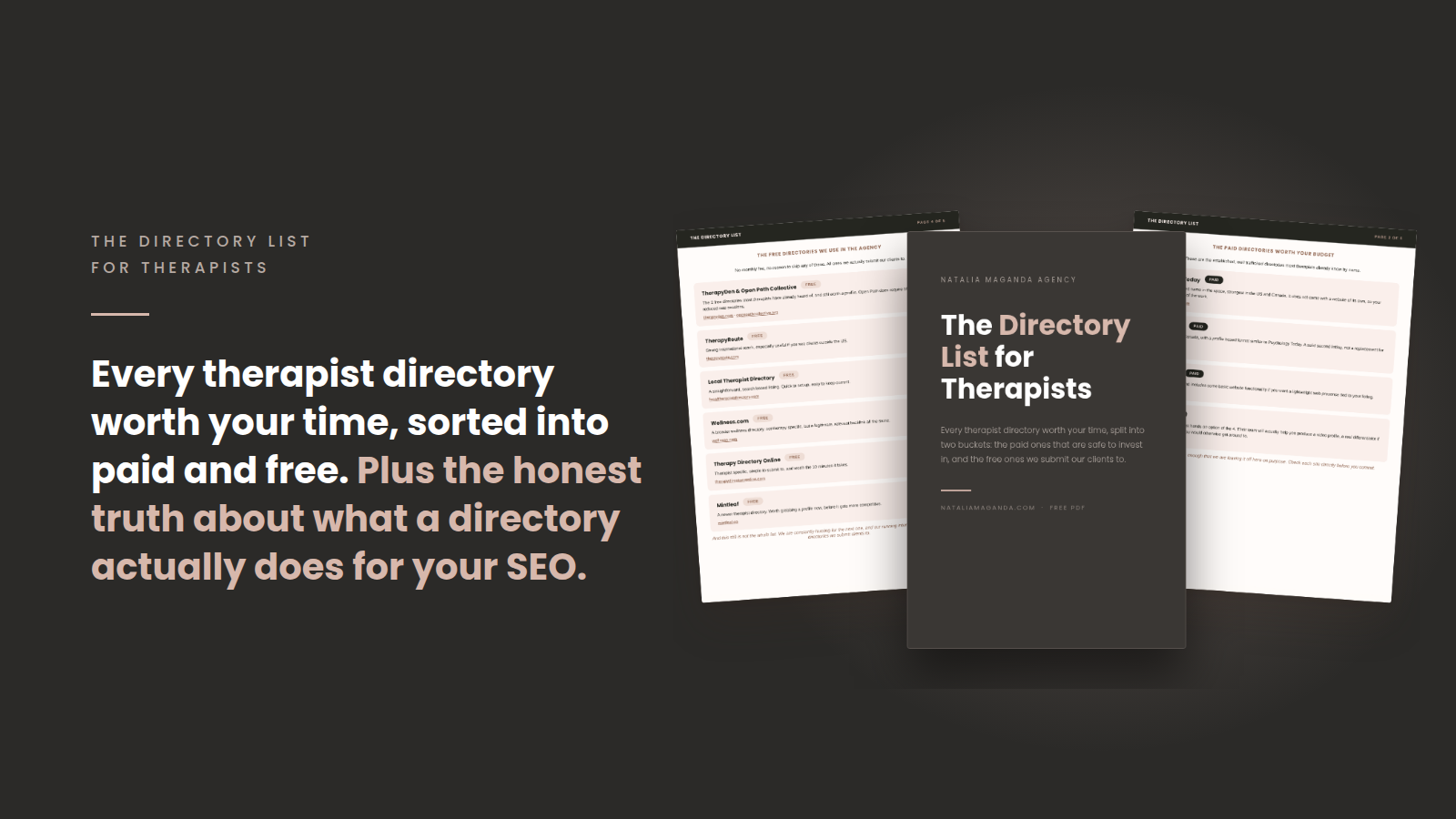
Get my free directory list for therapists, work through it with your NAP copied straight from your Google Business Profile, and you will have a clean set of citations by the end of the week.
What are the 5 NAP mistakes I see most in therapy practices?
The 5 mistakes are an old office address that never got updated, a practice name that changes from listing to listing, a phone number that differs between your website and your profile, a home address that should have been hidden, and a website with no written address or phone at all. Fix them where they live, in this order: your profile first (my post on Google Business Profile for therapists covers the rest of the setup), your website second, then the directories that actually send therapists clients, which I compare in the best therapist directories to list your private practice. Then stop. 10 accurate listings beat 60 you cannot maintain, and that is an opinion I hold firmly.
1. The office you moved out of is still listed somewhere
You moved, updated Google and your website, and forgot the 6 directories you signed up for in your first year. Now Google sees 2 addresses and has to guess. The fix is a citation audit: search your practice name, your phone number, and your old address in quotes, then log in to every listing that comes up and update it.
2. Your practice name keeps shifting
"Bloom Therapy," "Bloom Therapy PLLC," "Bloom Therapy | Anxiety Counseling in Denver," and "Dr. Sarah Lee, Bloom Therapy" are 4 different businesses to a machine. Pick the name on your website header and your paperwork and use it exactly that way everywhere. Adding keywords or a city to your profile name violates Google's guidelines and creates a mismatch with every other listing you own.
3. Your website phone number does not match your profile
This happens when a practice adds a call tracking number or a new front desk line and updates one place but not the other. Keep one main practice number, put it on the profile and in the footer of every page, and keep any secondary line out of a NAP position.
4. Your home address is public when it should be hidden
If you see clients over video from your living room, or rent a room a few days a week, Google's guidelines say to hide your address, and I say the same for safety and for consistency. More on this below, because it is the question I get asked most.
5. Your website has no NAP at all
Some therapist sites have a contact form and nothing else, which leaves Google nothing to match your profile against. Put your practice name, your phone, and either your office address or your service area in the footer as real text, not an image, and repeat it on the contact page.
| Where your NAP lives | What to check | How often |
|---|---|---|
| Google Business Profile | Name, address or hidden address, phone, service area, categories | Every quarter and after any move |
| Website footer and contact page | Same name and phone as the profile, address or service area in real text | After any change |
| Psychology Today and therapist directories | Name, phone, office or telehealth status | Twice a year |
| General directories (Bing, Apple, Yelp, the free list) | Name, address, phone, website link | Once a year |
How does a telehealth or home based practice handle NAP with a hidden address?
A telehealth or home based practice sets up its Google Business Profile as a service area business, clears the address so it does not display, and keeps everything else consistent: the same practice name and phone everywhere, the same service area on the profile and the website, and a written city or region on the site in place of a street address. Hiding the address is allowed and expected. The Google Business Profile guidelines say a service area business should hide its address from customers, and use the example of someone running a business from a residential address, telling them to clear the address from the profile.
Here is how I set it up for a fully virtual practice.
- Enter a real address, then hide it. Google needs a base location to verify you and to decide what service area you can claim. You enter your home address during setup and turn off the option to show it. Google's guidelines say your service area should not stretch more than about 2 hours of driving time from where you are based.
- Set your service area to where you are licensed and want clients. This becomes the "A" in your NAP for every listing that asks for a location.
- Use one practice name and one phone number everywhere. With no address to match on, the name and phone do more of the work.
- Put a city and state on your website, not a street. Your footer can read "Online therapy for adults in Illinois, based in Chicago." That gives Google and AI tools a location without exposing your home.
- Make the same choice on every directory. If a directory offers a "do not display" or "telehealth only" option, use it. If it forces a street address, use a business mailing address you are comfortable making public, or skip it. Never publish your home address on one site and hide it on another.
One honest caveat. Whitespark's 2026 Local Search Ranking Factors report ranks "Address Is Showing on GBP" at number 7, and the author calls it contentious because participants believe removing the address costs rankings. In my experience, a hidden address practice does rank in Google Maps for its home city, especially in a smaller metro. What it does not do is rank you in 5 cities at once, because Google anchors a service area business to where it is based. For that, the work moves to your website, which I cover in how to rank a therapy practice higher in Google Maps.
Frequently asked questions
Does NAP consistency still matter for SEO in 2027?
Yes, though its weight has shifted. Citation signals have been slowly declining in local ranking surveys, but the 2026 Local Search Ranking Factors report from Whitespark found that 3 of the top 5 AI search visibility factors are citation factors. NAP consistency now matters less as a direct Google Maps lever and more as the way AI tools confirm your practice is real and where it is.
Do small formatting differences like St. versus Street hurt my rankings?
Generally no. Google can reconcile abbreviations and suite formatting. What hurts is a different phone number, an old address, or a practice name that changes from listing to listing. Aim for identical when you can.
Should a telehealth therapist put any address on their website?
Put a city and state, or a service area, in real text, and skip the street address. Make sure the city matches the base location on your hidden address Google Business Profile so the 2 agree.
Want this off your plate?
Everything in this post is doable on your own. The honest part is that it competes with your caseload, your family, and the hour you were going to use for something other than a spreadsheet of directories.
As a therapist website designer who also runs the SEO, I build the site with your name, phone, and service area in the right places from day one, and my website management keeps them that way when you move offices or add a location. On the SEO side, my SEO for therapists and SEO for private practices work includes the directory submissions and citation cleanup most practices never get around to, so your listings agree with each other and Google and AI tools have no reason to doubt you.
If that sounds like weight you would rather not carry, you can apply to work with me. No pressure, just a conversation about what would take the most off your desk.
* AI Disclosure: This content may contain sections generated with AI with the purpose of providing you with condensed helpful and relevant content, however all personal opinions are 100% human made as well as the blog post structure, outline and key takeaways.
* Affiliate Disclosure: Some of the links on www.nataliamaganda.com may contain affiliate links meaning that I will get a commission for recommending products at no extra cost to you.

hello! i'm natalia maganda
The website manager for therapists and private practices that you didn't know existed.
We build and manage the 20+ page website that ranks in your city, reflects the depth of your work and books cash-pay clients with ease.
A done for you website management system that lets your practice grow without costing you your energy, your weekends, or your nervous system.