
Do therapists need a location page for every city? 4 checks
Yes, if you want clients from more than 1 area, you need a separate location page for each city, and each one has to say something real about that place. If you only serve 1 city, or you plan to copy 1 page and swap the city name, the answer is no, because that second version does more harm than good.
If we haven't crossed paths before, I'm Natalia, the founder of a boutique web design and SEO agency for therapists and private practice owners across the US. My mission is to help your website work as a 24/7 referral engine, so you can log off and still wake up to new inquiries. I have been doing this for over 7 years, I have served 100+ clients, and I have managed over 900 URLs for other people's practices, which means I have built, ranked, and occasionally cleaned up a lot of location pages, including the multi area location strategy I build for my retainer clients.
You are probably here because your practice already pulls clients from 2 or 3 places, maybe an office in 1 suburb plus a telehealth caseload across the state. Someone told you to build "a page for every city," and you are wondering whether Google will punish you for 12 nearly identical pages.
Key takeaways
- 1 city, 1 page. If every client comes from the same area, your home page and Google Business Profile carry the location signal and a separate city page adds nothing.
- 2 or more real service areas earn 1 page each, but only when each page can describe local knowledge that the others cannot.
- Google's spam policies name "multiple domain names or pages targeted at specific regions or cities that funnel users to one page" as an example of doorway abuse.
- When 2 pages are near duplicates, Google picks 1 as the canonical version and quietly ignores the other, per its guidance on canonical URLs. Copying and pasting a city page usually costs you the ranking you built it for.
- Local results are ranked on relevance, distance, and prominence, per Google's explanation of how local ranking works. A city page can only influence relevance and, over time, prominence.
When does a therapist actually need more than 1 location page?
You need more than 1 when you want new clients from more than 1 distinct area, and the areas are far enough apart that a person searching in 1 of them would not think of the other as "near me." Before I add a city page to any client's sitemap, I run 4 checks:
- 1. Do you actually want clients from this city, or could you just serve it if someone asked?
- 2. Would a searcher in this city consider your main office "near me," or is it a separate search?
- 3. Can you write at least 4 of the 5 local layers below without guessing?
- 4. Will this page be different enough from your other city pages that Google would not merge them?
4 yes answers means build it. 1 no means wait.
Here is how I sort it with my own clients. If you have a single office in Austin and 95% of your caseload lives within 20 minutes of it, your home page already says Austin, your Google Business Profile says Austin, and 1 more page saying Austin is repetition. But if you also see clients in Round Rock and take telehealth clients in Houston because a former colleague keeps referring them, you now have 3 areas with 3 different search behaviors. "Therapist in Round Rock" and "therapist in Houston" are not the same query, and Google will not rank 1 general page for both.
| Your situation | Separate location pages? | What I would build instead |
|---|---|---|
| 1 office, clients all local | No | Strong home page with the city named, plus your Google Business Profile |
| 1 office, clients from 2 or 3 nearby suburbs | Usually yes, 1 per suburb | 1 page for each suburb with real neighborhood detail |
| Telehealth across a whole state | Yes, for the 3 to 5 metros you want most | A page per metro, with a state page as the parent |
| Group practice with clinicians in different cities | Yes | 1 page per city, each naming the clinicians who serve it |
| 20 cities you could technically serve | No, not all 20 | Pages for the cities you can write about honestly, nothing for the rest |
If you are unsure which of your cities deserve a page, the answer usually shows up when you list every page your site needs and the phrase each one targets. I made a free planner for exactly this.
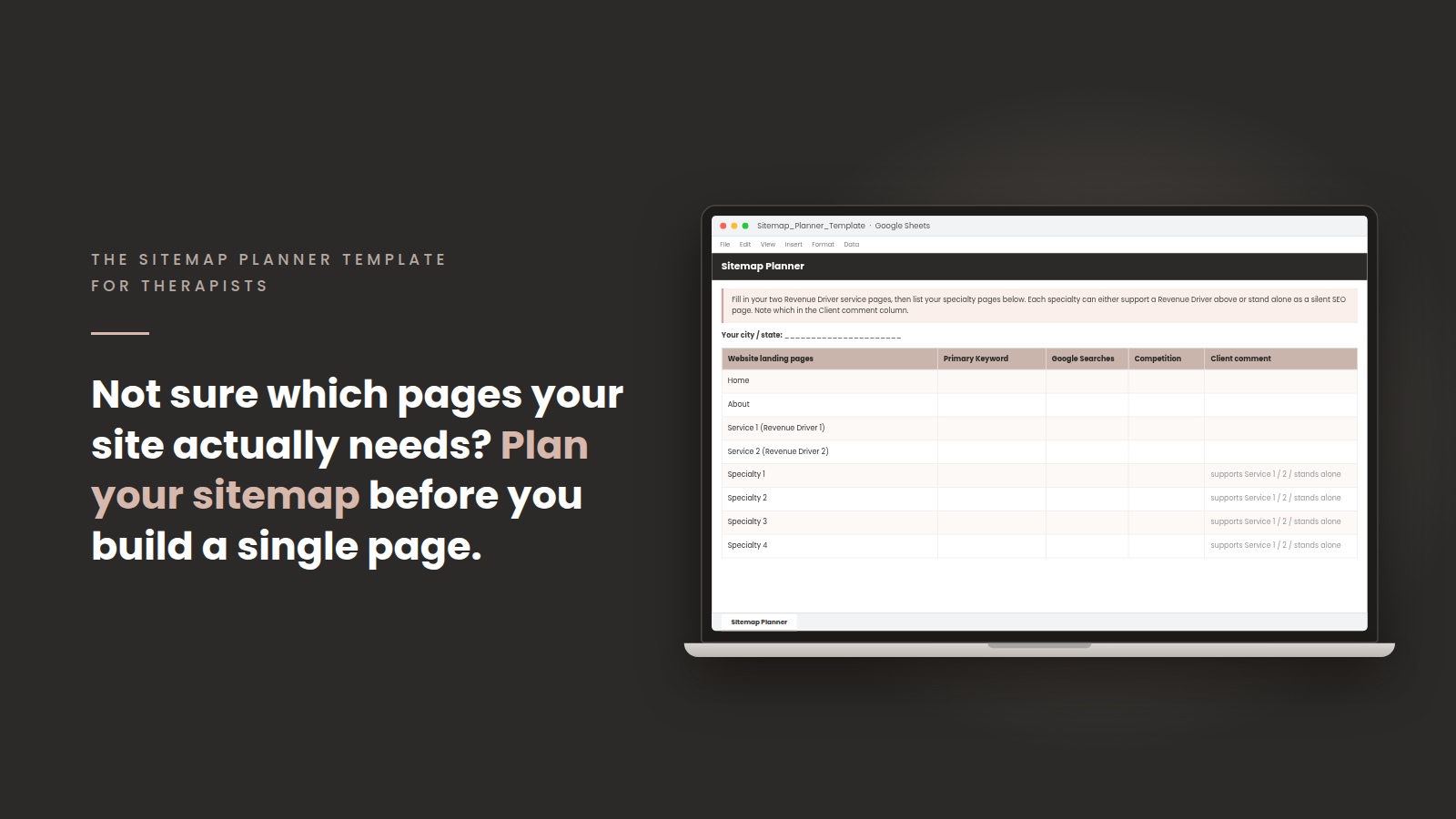
Get my free sitemap spreadsheet planner, add a row for each city you are considering, and notice which ones you can actually write something specific about. I also cover the full local SEO guide for therapists what it is, what you need and where to start.
What has to be on each page so it is not a duplicate?
Each location page needs content that only makes sense for that city. If you could lift a paragraph, change the city name, and paste it onto another location page without anyone noticing, that paragraph is not doing local work.
I think about it as 5 layers, and I want at least 4 of them on every page I publish:
- 1. The specific offer for that city. Which clinician sees clients there, in person or online, and which specialties are actually available in that location. A group practice with an EMDR specialist in Seattle and a perinatal specialist in Tacoma should not list both on both pages.
- 2. How people get there, or how telehealth works in that state. Parking, the building, the neighborhood. For telehealth, the license you hold for that state and what a first session looks like.
- 3. The people in that city. What clients from that area tend to bring to therapy, in your experience. Tech workers in 1 metro, military families near a base, commuters in a far suburb.
- 4. Local referral context. The hospitals, universities, employers, or community groups you work alongside there.
- 5. Proof you have been there. A photo of the actual office, the local professional groups you belong to, or a line about why you chose to serve that area.
When a page has those layers it reads like a therapist who knows the place, and Google's own spam policies draw the line exactly there. The doorway abuse section describes "creating substantially similar pages that are closer to search results than a clearly defined, browseable hierarchy" as spam. A page built on the 5 layers above is the opposite of that, and I walk through how that hierarchy fits your site in my post on why location pages are the quiet SEO advantage for therapy practices.
What happens if you copy 1 page and change the city name?
You usually lose both pages, or at least the second one. Google does not need to hand out a penalty for this to hurt you. It simply treats near identical pages as duplicates, chooses 1 as the canonical version, and drops the rest from the results.
Google's documentation on consolidating duplicate URLs says it plainly: when a site has duplicate content, Google chooses the canonical URL, and if you do not say which one you prefer, it decides for you. So you write 6 city pages, Google decides they are the same page, and only 1 of them ever appears.
And if the copying is done at scale, meaning you generate 30 pages with a tool and a find and replace, it moves into what the same spam policies call scaled content abuse, described as generating "many pages for the primary purpose of manipulating search rankings and not helping users." I have seen therapist sites do this with good intentions, usually because a template came with a "city pages" module. Cleaning those up is more work than never building them.
Here is my honest opinion, and it goes against a lot of common advice. Fewer, deeper location pages beat a full map of thin ones every time. I would rather publish 3 city pages that read like you live there than 15 that read like a mail merge.
How is a location page different from your home page and your Google Business Profile?
They do 3 different jobs. Your Google Business Profile wins the map pack for the city where your listing lives. Your home page tells Google what your practice is and where it is based. Location pages cover every other place you want to be found in the organic results.
Google explains local ranking as a mix of relevance, distance, and prominence, and it states there is no way to request or pay for a better local ranking. Distance is the part you cannot write your way around. If your office is in Chicago, a searcher in Naperville sees Naperville practices in the map pack first. A Naperville location page is how you show up in the regular results underneath that map, where your site's relevance and prominence can do the work. If the difference between those 2 layers of the results is still fuzzy, my post on SEO versus local SEO for therapists breaks it down.
How do you keep multiple location pages from competing with each other?
Give each page its own phrase, its own parent, and its own internal links. Competition between your own pages, sometimes called cannibalization, comes from 2 pages chasing the same query, and a little planning avoids it.
This is how I set it up:
- 1 phrase per page. The Houston page targets "therapist in Houston" and its variations. The Katy page targets Katy. Neither mentions the other city in its title or headings.
- A parent page for the region. A "Locations" page lists every city page with 1 or 2 sentences each and links to them. That gives Google the hierarchy the spam policy talks about.
- Links from the relevant service pages. If your couples counseling page says you see couples in Houston and Katy, link the city names to their pages. A location page with no links pointing to it can sit finished and invisible.
- Different proof on each page. Different photos, clinician bios, and referral partners. A Google review from a colleague in that city belongs on that page.
- A review every 6 to 12 months. Clinicians move and a page that was honest in 2026 may not be in 2027. I reassess location pages on the same cycle I use for the rest of a client's KPIs.
Frequently asked questions
How many location pages should a therapist have?
As many cities as you genuinely want clients from and can write about with real local detail, which for most practices is 2 to 6. Start with the areas that already send you clients, then add 1 page at a time.
Do location pages work for telehealth only practices?
Yes, and they matter more, because you have no office address to anchor the map pack. Build a page for each state you are licensed in, then pages for the 3 to 5 metros you most want to reach, each explaining how online sessions work there and what clients from that area tend to come to you for.
Do I still need location pages if I have a Google Business Profile?
If you serve 1 city, your profile plus your home page is usually enough. If you serve several, yes, because your profile only ranks in the map pack near its listed address. I cover how to set the profile up, including hiding your address as a service based practice, in my post on Google Business Profile for therapists.
Will Google penalize me for having several location pages?
Not for having them. The risk is in how they are written. Pages that are substantially similar with only the city name swapped fall under what Google's spam policies call doorway abuse, and even without a penalty, near duplicate pages get consolidated so only 1 shows.
Want this off your plate?
Everything in this post is something you can do yourself. You can list your cities, write 5 layers of local detail for each one, wire up the internal links, and review it again next year. It is also work that competes with your caseload, your family, and your evenings.
As a therapist website designer who also runs the SEO, I build the location strategy into the sitemap before a single page is written, so each city gets its own phrase, its own parent, and its own reason to exist. Then my website management covers the slow part, the updates and the 6 to 12 month reviews that keep those pages honest as your practice changes. If the pages already exist and you suspect they are competing with each other, my SEO for therapists and SEO for private practices work starts with sorting out which city pages should stay, merge, or go.
If that sounds like the kind of weight you would like off your desk, you can apply to work with me. No pressure, just a conversation about which cities your practice should be found in and what it would take to get there.
* AI Disclosure: This content may contain sections generated with AI with the purpose of providing you with condensed helpful and relevant content, however all personal opinions are 100% human made as well as the blog post structure, outline and key takeaways.
* Affiliate Disclosure: Some of the links on www.nataliamaganda.com may contain affiliate links meaning that I will get a commission for recommending products at no extra cost to you.

hello! i'm natalia maganda
The website manager for therapists and private practices that you didn't know existed.
We build and manage the 20+ page website that ranks in your city, reflects the depth of your work and books cash-pay clients with ease.
A done for you website management system that lets your practice grow without costing you your energy, your weekends, or your nervous system.