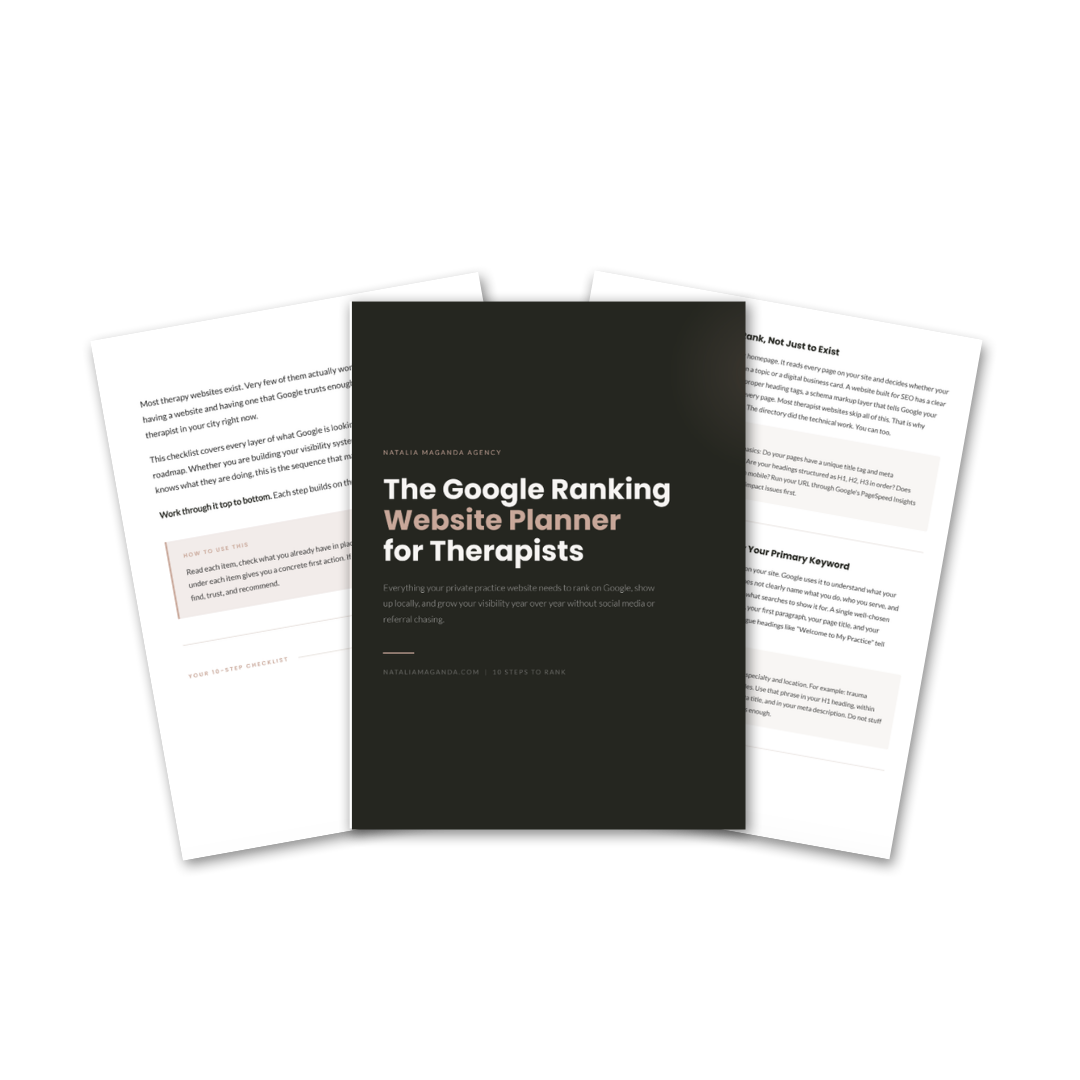

Why redesigning a therapy website that looks fine rarely brings in more clients
Redesigning a therapy website that already looks fine rarely brings in more clients, because a new design changes how your site looks and leaves untouched how it gets found. A gorgeous site with no SEO attached can stay static for years. The work that brings inquiries is local SEO, specialty pages, blog content with real depth, authority building, and ongoing management.
If we haven't crossed paths before, I'm Natalia, the founder of a boutique web design and SEO agency for therapists and private practice owners across the US. My mission is to help your website work as a 24/7 referral engine, so you can log off and still wake up to new inquiries. I have been in business for over 7 years and have served 100+ clients, and I design websites for a living, so this is an odd thing for me to say. I built 2 websites of my own and got it wrong both times, and I have managed over 900 URLs for other people's practices, so I have watched plenty of beautiful sites go nowhere.
If you are looking at a website you built years ago and wondering whether a fresh design would fix your quiet inbox, this post is for you. A redesign can feel like the responsible next step. Often it is the most expensive way to avoid the work that matters.
Key takeaways
- A redesign changes the look of a site. Rankings come from structure, helpful content, and authority, and most of that sits outside the design.
- Google says that site migrations and URL changes can cause ranking fluctuations, so a redesign can cost you ground before it earns any.
- A static site loses to a practice that keeps publishing. Google and AI search reward sites that keep showing up.
- In my experience, a practice site needs 20 or more pages to compete, and a redesign of 5 pages leaves you with a prettier 5 page site.
- Some redesigns are worth it, and the signs are usually about function: a broken mobile experience, confusing navigation, or a site you cannot edit.
Does redesigning a therapy website that looks fine actually bring in more clients?
Usually not, and the reason is what a redesign touches. A new design improves trust once someone lands on your site. It does little for the question that comes first, which is whether anyone lands there at all.
| What a redesign changes | What a redesign leaves untouched |
|---|---|
| Colors, fonts, and layout | How many pages you have and what each one targets |
| How polished you look to a visitor | Whether Google shows your pages for real searches |
| Mobile experience, if the old site was broken | Who links to you and vouches for you online |
| Ease of editing, on a better platform | Whether you publish anything new after launch |
Two practices in the same city can run the same strategy and get different results, and the practice with the bigger online reputation gets recommended first by Google and by AI tools. A new coat of paint does not change that.
If the real gap is depth, start with one post that answers a question your ideal client has. I made a free blog outline template for exactly this.
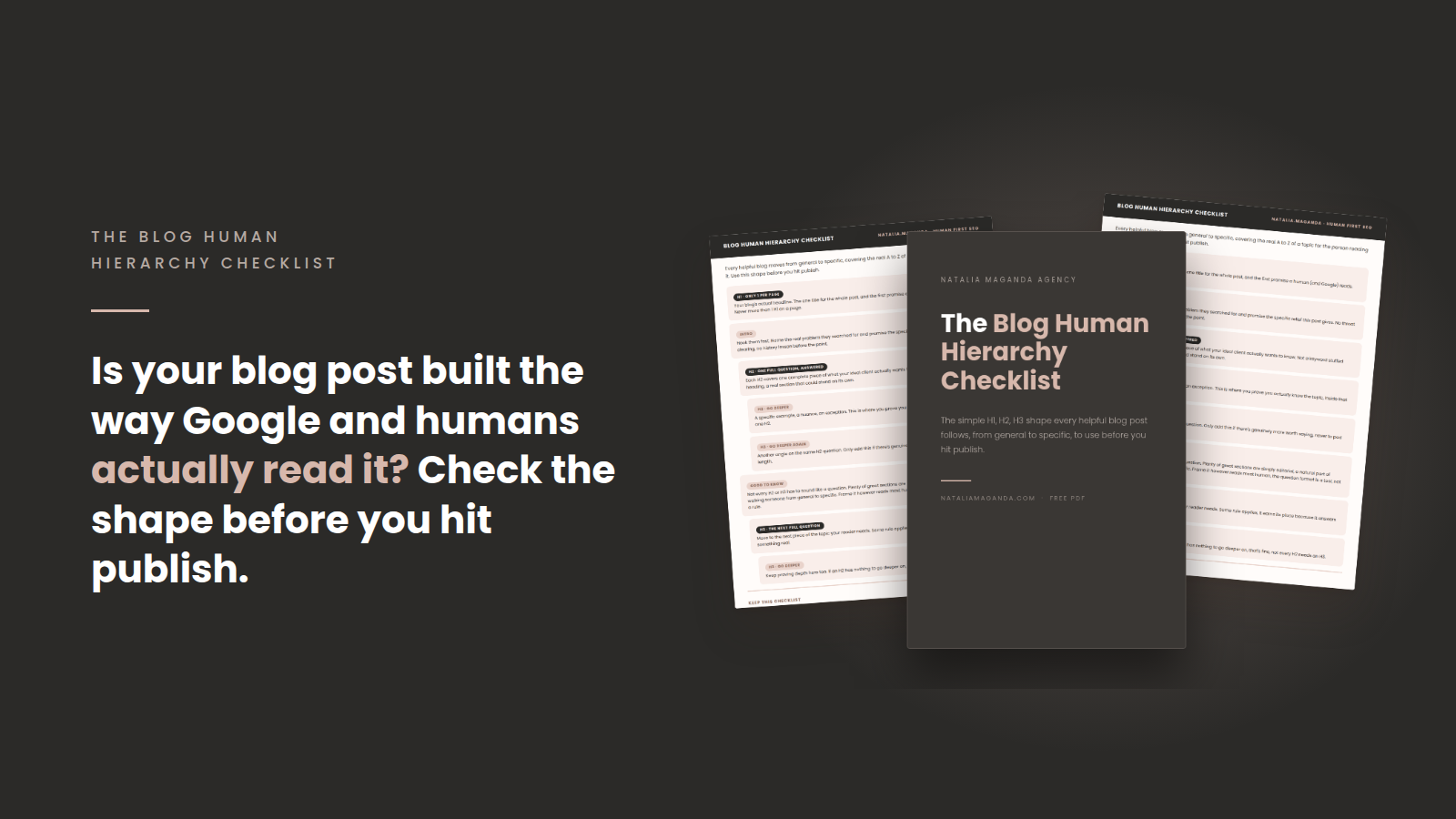
Get my free blog outline template and use it to plan your next post before you spend anything on a new design.
Why does a beautiful therapy website still stay invisible?
It stays invisible because Google and AI tools read the structure of your whole site to work out what you are an authority on, and a good looking site can have very little structure. A typical small site has a home page, an about page, one services page, a contact page, and maybe a blog with a couple of posts. That introduces you to people who already know your name. It gives Google little to match against the searches strangers type.
I have personally managed websites where the sitemap alone, with service pages and specialty pages and no blog published yet, beat local competition and ranked for real commercial keywords. Those sites were not prettier than the ones they beat. They had more pages, each with a specific job. I also wrote 80 blogs for my own site and still sat on page 6 with barely 100 clicks a month, because the site had not earned enough trust yet. Design was never the missing piece in either story.
What does a therapy website need besides a good design?
It needs 5 things that a design project rarely includes, and in my opinion these decide whether a website works as a marketing channel. Treat your site like any other marketing channel, which means it needs ongoing management and never finishes at launch.
Local SEO
Local results come from 2 places, the map results and the regular website results, and you need to work on both. Fill out your Google Business Profile completely, choose the right primary category, keep your name, address, and phone identical everywhere, and ask professional peers for 1 to 2 authentic reviews a month.
Specialty pages
A sitemap of Revenue Driver pages and Specialty pages gives each search its own page. Revenue Driver pages are your top 1 or 2 services and deserve story driven copy. Specialty pages are lean, keyword forward, and use the clinical phrases a researched client types. One services page covering every issue you treat cannot compete with a dedicated page for each.
Blog content with real depth
Blogging builds topical authority once the structure exists, and depth matters more than volume. Google says that creating content people find compelling and useful will likely influence your presence in search results. Blog in 3 buckets: commercial intent phrases close to booking, educational phrases that build trust, and topical authority phrases that show Google you know the space.
Authority building
Free directories are a should do, reviews from peers add trust, and real mentions from other sites help most. I once paid $1,000 for a feature placement that moved my domain authority from about 12 to 20. It did not bring clients directly, and it added to my trustworthiness and to being recommended by AI to therapists who now book discovery calls with me. Many of our clients start at a domain authority of 0 and reach 6 to 8 in their first year.
Ongoing management
The era of the static website is over. Someone has to publish, check what Google has indexed, fix what breaks, and track impressions, clicks, click through rate, and leads. My guide on what pages a therapist website should have is a good place to see the full structure.
Can a redesign hurt my Google rankings?
Yes, and it happens more often than owners expect. Google lists site migrations and URL changes among the causes of ranking fluctuations. If your page addresses change and the old ones are not redirected to the new ones, you can lose the little authority your pages have earned.
If you do redesign, protect what you have. Keep your URLs the same where you can, redirect any that change, keep your titles and descriptions unless you are improving them, and watch Search Console for a few weeks afterward. A traffic drop right after a redesign is one of the most common reasons owners think their SEO stopped working.
When is a therapy website redesign actually worth it?
A redesign is worth it when something about the site stops it from functioning. The signs are practical: the mobile version is broken or slow, visitors cannot find your contact form, you cannot edit the site without help, or your platform cannot support the pages your plan needs. My post on the signs your therapist website needs a redesign walks through them in detail.
If none of those apply and the site simply looks dated, put the first dollars into structure and content, and redesign later with a clear sitemap in hand. A redesign built around a proper sitemap gets the design and the SEO in one project, which is where the real return sits. For the wider picture of why therapy websites stall, I wrote a full breakdown in why your therapist website is not getting clients.
How long does it take for a therapy website to bring in clients?
It takes months, and it depends on your competition. Google says some changes might take effect in a few hours, while others could take several months. With little local competition you could reach page one in your first 90 days, sometimes 6 months. In a bigger metro you are up against practice owners who have done this for years, so it takes longer and your keyword choices need to be sharper. Reassess every 6 to 12 months. Impressions without clicks, or a page 6 ranking, means Google is starting to pick you up.
Frequently asked questions
Will a new website design get me more therapy clients?
Only if the old design was the thing stopping clients from contacting you. A new design improves how your site looks and feels. More clients come from being found, which depends on structure, content, and authority.
Should I redesign my therapy website or invest in SEO first?
Invest in structure and SEO first if your site works and looks acceptable. If you must redesign, build it around a sitemap of Revenue Driver and Specialty pages so design and SEO happen together.
Can redesigning my website lower my Google rankings?
Yes. Google says site migrations and URL changes can cause ranking fluctuations. Keep your URLs stable, redirect anything that changes, and check Search Console for a few weeks after launch.
How do I know if my therapy website needs a redesign?
Look for functional problems: a broken mobile experience, a contact form visitors cannot find, or a platform that blocks the pages you need. Looking dated is a weaker reason on its own.
Want this off your plate?
Everything in this post is something you can do yourself. It also competes with your caseload, your family, and the evenings you would like back. Having a website is a job, and it is probably one you never signed up for.
This is the work I do every day. As a therapist website designer who also runs the SEO, I build the design and the sitemap in the same project, so a redesign never ends as a pretty site nobody finds. Our website management handles the ongoing upkeep after launch, and SEO for therapists and SEO for private practices cover the local SEO, content, and authority building that bring the inquiries in.
If you would rather hand this to someone who has served 100+ clients, apply to work with me and we can talk about your practice. No pressure, just a conversation about what would take the most weight off your desk.
* AI Disclosure: This content may contain sections generated with AI with the purpose of providing you with condensed helpful and relevant content, however all personal opinions are 100% human made as well as the blog post structure, outline and key takeaways.
* Affiliate Disclosure: Some of the links on www.nataliamaganda.com may contain affiliate links meaning that I will get a commission for recommending products at no extra cost to you.

hello! i'm natalia maganda
The website manager for therapists and private practices that you didn't know existed.
We build and manage the 20+ page website that ranks in your city, reflects the depth of your work and books cash-pay clients with ease.
A done for you website management system that lets your practice grow without costing you your energy, your weekends, or your nervous system.