
How to Use AI to Market Your Private Practice: What It Can Do and Who Should Build It
You can use AI to market your private practice in 3 places: drafting and organizing the content that brings clients in, researching what your future clients search for, and running the repeat tasks that eat your week. Every one of them works best when a human approves anything a client sees. The bigger decision comes after that, and it is whether to learn the skills yourself, build your own AI system, or hand the setup to someone who already did.
If we haven't crossed paths before, I'm Natalia, the founder of a boutique web design and SEO agency for therapists and private practice owners across the US. My mission is to help your website work as a 24/7 referral engine, so you can log off and still wake up to new inquiries. I have spent over 7 years and 100+ clients inside therapist marketing, I manage 900+ URLs for other people's practices, and I now run my own agency through an AI command center I built myself, with 87 skills and 6 agents and a human approving anything a client sees.
You are probably in one of 2 places. You have heard that AI can write your emails and posts, and you want to see what is truly possible for a practice like yours. Or you opened ChatGPT, got something that sounded like a brochure, and closed the tab.
Key takeaways
- AI is strong at drafting, summarizing, organizing and researching, and a human still has to choose, approve and publish anything a client sees.
- In the APA 2025 Practitioner Pulse Survey, 44% of psychologists had never used AI at work, down from 71% the year before.
- ChatGPT and Claude can both carry most of your marketing writing, and the quality depends on the standing instructions you give them.
- Learning to use AI well yourself is a skill stack with its own curve, and it competes with your caseload.
- Building your own AI operating system is a real project that compounds, and it costs months of your attention.
- Outsourcing the setup gives you the result without you carrying the build, and the right choice depends on who you want holding the system.
- The outsourced version means 87 skills, 6 agents and a human team working behind your marketing, including a content agent that produces high quality work without you prompting a thing, plus a website and a HIPAA compliant CRM so no small task multiplies into 100.
- In my opinion, DIY marketing stops paying off as search and AI raise the bar for content, and I do not buy a DIY solution unless a human comes with it.
What AI can do for your practice marketing, and where it stops
AI tools like ChatGPT and Claude work by producing useful language from the instructions and context you hand them. That makes them strong at any task with a clear shape, like a first draft, a summary, a list of questions or a reorganized outline. They have no way to know your clients, your license, your ethics or your voice until you tell them, and they carry no responsibility for what gets published. Those 2 facts sort almost every marketing task into 2 piles.
AI drafts, summarizes and organizes faster than you can, and you decide what goes live
Think about the marketing jobs that eat your week. Outlining a blog post, turning a voice note into a first draft, rewriting an About page so it reads cleaner, sorting a keyword list into groups, drafting a reply to a question you answer every month. AI handles all of these quickly. Your peers have noticed: in the APA 2025 Practitioner Pulse Survey, 56% of psychologists said they had used AI to assist with their work at least once, and 52% reported using it for writing help, such as drafting emails.
The second pile is everything with a person attached. Clinical accuracy, your ethics, the tone of a message to someone who is hurting, deciding which clients you want, and anything that sets an expectation or spends money. In my own system, AI researches and drafts, and a human approves anything a client sees.
ChatGPT and Claude can both run your marketing writing, and the setup decides the result
ChatGPT and Claude can both draft your emails, outline your posts and brainstorm your page ideas. The gap between a draft that sounds like a brochure and a draft that sounds like you comes from the instructions sitting behind the request: who you serve, how you talk, which phrases you never use, and which facts are approved to mention. Without those, every tool hands you the same polite, generic copy that everyone else gets.
Give the tool standing instructions once, and it keeps using them. Keep client names, session details and anything identifiable out of these tools entirely. The APA 2025 Practitioner Pulse Survey found that 67% of psychologists are concerned about potential data breaches, and that concern belongs in your process from day one. I'm not a lawyer, so check each tool's terms against your own privacy obligations.
If you are going to start anywhere, start with who you serve, because every AI tool writes better when it knows her. I made a free AI prompt for exactly this.
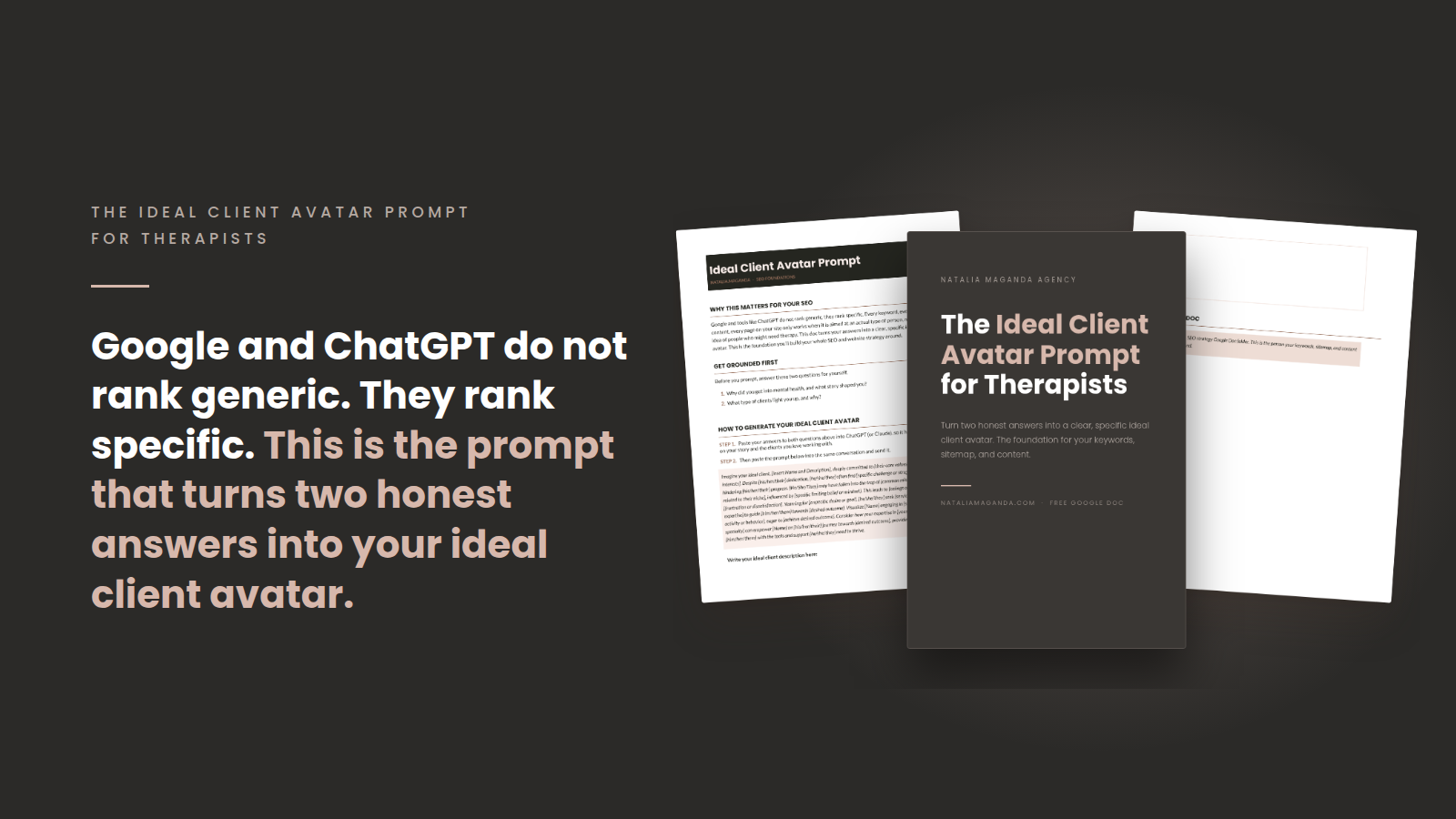
Get my free ideal client AI prompt, paste it into ChatGPT or Claude, and see how much sharper your next draft sounds.
Why running AI yourself turns into a second job
Every AI result depends on the instructions behind it. Good instructions come from practice: knowing your clients, your keywords, your voice and how to check the output. So using AI for marketing is really a stack of layers, from prompting and context to review, publishing and measuring. Each layer takes time that is currently going to clients, your family or your rest.
You can learn AI yourself, and the skills stack up faster than the tutorials admit
Here is what the learning route asks of you. You learn to prompt clearly and to give context. You learn to spot made up facts and flat copy. You learn enough SEO that what AI drafts can rank, which includes keywords, page structure and internal links. For a practice owner at the intermediate level, none of it is out of reach, and all of it takes hours.
In my opinion, learning it yourself is a fine choice when you enjoy the tinkering, because the curve becomes a hobby. When the learning does not interest you, it turns into one more unfinished project on your list.
How long did this AI team take me to build?
A working AI system takes months of attention, and it keeps needing care
One useful prompt takes minutes. A system is a different size of project. You write the rules once, build a skill for each recurring task, connect those skills to your tools, test them, add approval steps so nothing reaches a client unchecked, and then maintain the whole thing as your needs and the tools change. My own command center holds 87 skills and 6 agents today, and it is organized like an org chart so every task has an owner.
I count a first working version in weeks and a system that covers content, SEO checks, inbox and reporting in months. That is my view of the timeline, and your pace will depend on how many hours you protect each week.
Why the build or outsource decision matters more than the tool you pick
AI does not give your time back. A system gives it back, and a system needs someone to hold it. I firmly believe a website, or visibility, is a job, not a project, and an AI system carries the same truth. The question that matters is whether that somebody is you.
Whether you build or outsource comes down to who you want holding the system
Building your own AI operating system pays off when you want to be the owner. You have months of attention to spare, you want full control over every rule, and you enjoy seeing each new skill take a task off your list. The payoff compounds, because every skill you build keeps working after the build is done. I build mine because this is my business and the system is part of how I run it.
Outsourcing pays off when you want the result and your hours are already spoken for by clients. You describe your practice, someone who has built these systems sets up the structure, and you review and approve what matters.
The DIY rabbit hole vs the AI team
What does it look like to outsource 87 skills, 6 agents and a team of 3 humans?
Picture the version of this where you never open a prompt window. Instead of spending years learning marketing skills and then the AI skill set on top of them, you hire a team that already built the system, and the work simply gets done.
Your AI team has a COO, 5 managers and 87 skills, and a human approves what clients see
The command center works like an org chart. I sit at the top as CEO. Under me is a COO agent that routes the work, owns the approval queue and builds a daily brief. Under the COO sit the managers. A Project Manager watches every client project, triages the inbox and keeps website launches moving. A Content Manager runs each client's blog batches and website copy. A Design Manager owns visual assets, carousels and client deliverables, and a Client Ops manager drafts replies to client emails.
Each manager owns a group of skills, and a skill is one task done the same careful way every time. The whole system runs on one rule: AI drafts and humans decide. Anything a client sees waits in an approval queue until a person says yes, and 3 humans sit behind that queue, so a real person reads what you receive.
The content agent alone runs 26 skills
Project Manager
Content Manager
26 skillsMarketing and Sales Manager
Design Manager
The content agent writes exceptionally high quality work, and you never sit through the bad drafts
The biggest team in the system is the Content Manager, with 26 skills. It runs each client's blog batch from start to finish.
Each skill carries the rules that took time to learn. You skip the part where you slam your head against the keyboard, going back and forth with a tool that keeps handing you flat drafts. You skip the course, the prompt library and the weekend of improving your prompting until the outputs get good. Someone else already did that learning and saved it inside the skills, and a human still reviews before anything publishes.
Working with me also includes your website and a HIPAA compliant CRM, so no tiny task turns into 100
Marketing a private practice is never one task. A blog post needs a keyword, a page to live on, an internal link plan, a contact form and somewhere for the inquiry to land. Each of those splits into smaller jobs, and a single line on a to do list can quietly become 100.
When you work with me, the system includes the pieces around the marketing too: a 20+ page website built on Duda, the SEO and blog content that run through the agents above, and a HIPAA compliant CRM in GoHighLevel where your inquiries are managed.
Here is what you stop doing when the system is built for you
- You stop learning marketing skills and the AI skill set on top of them.
- You stop looking for the right course, collecting prompts and testing them against each other.
- You stop going back and forth with bad outputs and rewriting the instructions until they behave.
- You stop overthinking every tiny task, because each one already has an owner.
- You keep the part only you can do, which is your clinical work and your final yes on what represents your practice.
If you would rather keep building, the decision questions below help you choose.
Why I stopped buying DIY marketing, and what I would tell my past self
I have been an entrepreneur for almost a decade, and for a long time I was the person who chose the DIY route every time. Here is my honest opinion on DIY marketing versus done for you, and the rule it left me with.
DIY works for a while, and then the ground moves
DIY blogging can work for a couple of years. You publish, you learn, you see a little traffic, and the money you saved feels like a win. My opinion is that the ground is moving under that approach. AI has made it easy for everyone to publish something, so vague and generic content is everywhere, and I expect Google to keep getting better at telling that content apart from work by someone who knows the topic. That is my prediction from watching this space, and I am not quoting Google. If it plays out, competition only gets harder, and the practices building real SEO authority pull further ahead.
The cost of DIY shows up later, as a traffic drop and a lot of lost hours
Here is the scenario I would warn my past self about. You spend a couple of years building everything yourself, your traffic drops, and you are left frustrated by all the hours you invested in work an expert could have held for you. The biggest cost turns out to be the hours.
My rule is that I do not buy a DIY solution unless a human comes with it
A couple of years ago I made a shift that changed how I make decisions in my business. I do not invest in any DIY solution unless I get human support with it. That rule is how I run my business now. If a course, tool or template does not come with a person who helps me get the result, I pass.
How do you decide whether to learn it, build it or hand it off?
Start with 3 honest questions.
- First, do you enjoy tinkering with tools, or do you tolerate it? Enjoyment makes the learning curve a hobby, and tolerance makes it a chore that slips every time your caseload fills.
- Second, how many hours can you protect for the next few months, knowing those hours rarely stay protected?
- Third, what does it cost you if your marketing stays stalled while you figure this out?
If your answers are yes, plenty of hours and a low cost of waiting, you are a builder, and the learning route will reward you. If your answers are mixed, you might learn the drafting layer yourself, meaning ChatGPT or Claude with good standing instructions, and hand off the system layer, meaning the website structure, the SEO and the ongoing management. If your answers are no, few hours and a high cost of waiting, you are a delegator, and the sensible move is to hire the setup and keep your attention on clients.
What should you do first?
I rank first steps by 3 criteria: what a future client sees first, what is hardest to undo later, and what keeps paying off after you stop touching it. By those criteria, the order below holds for almost every practice I look at, and it applies whether you learn, build or outsource.
Your website comes first, because AI can only amplify what already exists. A thin site gives AI tools very little to cite and gives search engines very little to rank. If you are unsure whether your site has enough pages, I explain how many pages a therapy website needs, and I cover how AI search visibility works for therapists once the site is solid.
Second, write your standing instructions, which means who you serve, how you sound, the phrases you avoid and the facts you approve. This takes an afternoon and improves every draft you ever ask for. Third, choose one recurring task you dislike, such as a monthly email or replies to common questions, and let AI draft it while you approve it. Give that trial a few weeks and watch how it feels.
Only then decide whether you learn, build or outsource, with real evidence about what you enjoy and what your calendar allows.
Frequently asked questions
Is it safe to use AI for my private practice marketing?
It can be, with boundaries. Keep client names, session content and anything identifiable out of every tool. The APA 2025 Practitioner Pulse Survey found that 67% of psychologists are concerned about data breaches, so treat that concern as a rule. I'm not a lawyer, so read each tool's terms against your own obligations.
Does AI replace SEO for a private practice?
In my experience, AI tools draw on websites that are clear, specific and well structured, so your site and your SEO stay the base. A strong site gets found in Google and has the best shot at being recommended by AI tools. AI changes where people ask, and the website still answers.
Can I let AI write my blog posts?
AI can write a solid first draft. I add an editorial layer before anything publishes: is it helpful and human, does it answer every question your ideal client has, and is anything being avoided because it feels uncomfortable.
What is the best first marketing task to give AI?
Pick a recurring drafting task you dislike, such as a monthly email, replies to common client questions or blog outlines. Let AI write the first version and approve it yourself.
Want this off your plate?
Everything in this post can be done on your own. It also competes with your caseload, your family and your evenings. If you would rather hold the clients and let someone else hold the system, that is the job I do.
As a therapist website designer who also runs the SEO, I build the site that ranks in your city and set up the HIPAA compliant CRM where your inquiries are managed, and with website management services I keep it running every month so it never becomes your side project. The SEO is where visibility gets decided, which is why I focus on SEO for therapists and SEO for private practices. The AI command center I described above is how I run all of it behind the scenes, with a human approving anything a client sees.
If you are ready to hand it off, apply to work with me. No pressure, just a conversation about what would take the most weight off your desk.
* AI Disclosure: This content may contain sections generated with AI with the purpose of providing you with condensed helpful and relevant content, however all personal opinions are 100% human made as well as the blog post structure, outline and key takeaways.
* Affiliate Disclosure: Some of the links on www.nataliamaganda.com may contain affiliate links meaning that I will get a commission for recommending products at no extra cost to you.

hello! i'm natalia maganda
The website manager for therapists and private practices that you didn't know existed.
We build and manage the 20+ page website that ranks in your city, reflects the depth of your work and books cash-pay clients with ease.
A done for you website management system that lets your practice grow without costing you your energy, your weekends, or your nervous system.