
AI Search Visibility for Therapists: How to Get Recommended on ChatGPT and AI Platforms
AI search visibility means that when someone asks ChatGPT, Google AI Overviews or another AI tool for a therapist like you, your practice gets named, linked or described accurately. It starts with a website that gives those tools something credible, specific and citable to work with.
If we haven't crossed paths before, I'm Natalia, the founder of a boutique web design and SEO agency for therapists and private practice owners across the US. My mission is to help your website work as a 24/7 referral engine, so you can log off and still wake up to new inquiries. I have been in business for over 7 years, I have served 100+ clients, and I have managed over 900 URLs for other people's practices. I also built 2 websites of my own and got it wrong both times, so I read every AI visibility promise with a skeptical eye.
You will learn how AI search works, what the common terms mean and how to optimize your site in 10 steps, from your sitemap to a monthly check.
Why do two search engines send you clients?
For most of the internet's history, SEO meant one thing: rank well on Google. A potential client types "therapist near me," Google returns a list of websites and map results, and the people with well optimized pages get the clicks.
That model still works. A second system runs beside it and operates completely differently.
Picture someone asking ChatGPT, "Who is a good therapist for trauma in Austin?" The AI answers directly. It names practices, describes specialties and cites the sources it pulled from. The person reading that answer may open no website at all before deciding who to contact.
Google's AI Overviews follow the same pattern. Ask a question with informational intent and the first thing you may see is a generated summary at the top of the page, often with the answer fully inside it. The links sit below. In my experience many people never scroll down, and Pew Research Center found that users clicked a traditional result on 8% of visits with an AI summary, compared with 15% of visits without one (March 2025 data). I break down what changed and what stayed the same in is SEO dead with AI for therapists.
The therapists who show up in those AI responses have websites that gave the AI something credible, specific and citable to work with.
Here is the new standard for therapist SEO: build a digital presence that satisfies Google's ranking algorithm and gives AI models enough substance to recommend you by name.
How does AI search work?
Here is what happens in a few seconds when someone asks an AI tool for a therapist.
First, the person types a question. OpenAI says ChatGPT search typically rewrites the question into 1 or more targeted queries, and it may use an approximate location for local results.
Second, the tool looks for pages. OpenAI says its search sometimes partners with other search providers, and Google says AI Overviews and AI Mode may issue several related searches across subtopics and data sources.
Third, the tool reads what it finds and writes an answer with links to its sources. For Google, a page has to be indexed and eligible to show with a snippet to appear as a supporting link. For ChatGPT, OpenAI says OAI-SearchBot surfaces sites in ChatGPT search features and that sites opted out of it will not be shown in ChatGPT search answers.
So your pages need to be reachable by crawlers and indexes, clear enough to quote, backed by trust from outside your site and checked on a schedule. The 10 steps below follow that order.
How does ChatGPT decide who to recommend?
The practice of optimizing for AI tools has a name, GEO, which stands for generative engine optimization. It is a growing field and its principles are still developing. This framework is my own view, built from working on therapist websites.
In my view, AI tools recommend therapists whose digital presence signals 3 things: legitimacy, specificity and relevance to the question being asked.
Legitimacy means you exist and you are credible. Consistent directory listings, a professional website, a complete Google Business Profile and mentions in reputable sources all contribute.
Specificity means your content answers precise questions clearly. A page that says "I am a trauma therapist in Austin who specializes in EMDR for adults with childhood trauma" gives an AI answering "trauma therapist in Austin" a sentence it can quote. A line like "a warm, compassionate space for healing" gives a tool little to quote.
Relevance means your content matches the language the person used in their question. Write in your client's language, the words she uses to describe her experience, and an AI pulling from your content uses the language it found there.
Practically, your website needs clear specialty statements written the way clients think, FAQ sections that answer common questions directly, and service pages that name conditions and experiences alongside modality names.
What do LLMO, AIO, AEO and GEO mean?
These are the labels you are most likely to hear, in plain words.
- AI Overviews and AI Mode are Google's names for its AI answer features. AI Overviews give the gist of a topic with links to explore, and AI Mode handles questions that need reasoning or comparison.
- AEO is answer engine optimization, which means being the direct answer a search tool extracts.
- GEO is generative engine optimization, a term from a 2023 research paper on boosting visibility in generative engine responses.
- LLMO is large language model optimization, which means structuring content so language models can understand it.
- AIO is the label to watch, since one term guide says it can mean AI Overview optimization or optimization for AI in general. I write AI Overviews in full.
- Citation and mention differ in 1 way. Similarweb describes a citation as crediting your page as a source, typically with a link, and a mention as naming your practice without a link or credit.
- Crawler names identify the bots that visit your site. OpenAI lists OAI-SearchBot for ChatGPT search, GPTBot for training and ChatGPT-User for actions a person starts in ChatGPT, and Google lists Google-Extended for Gemini training and grounding.
Vendors use these labels loosely, so when someone pitches one, ask which of the steps below they will do.
The strongest foundation for all of this is a sitemap with one clear page for each thing your clients search for. I made a free sitemap planner for exactly this.
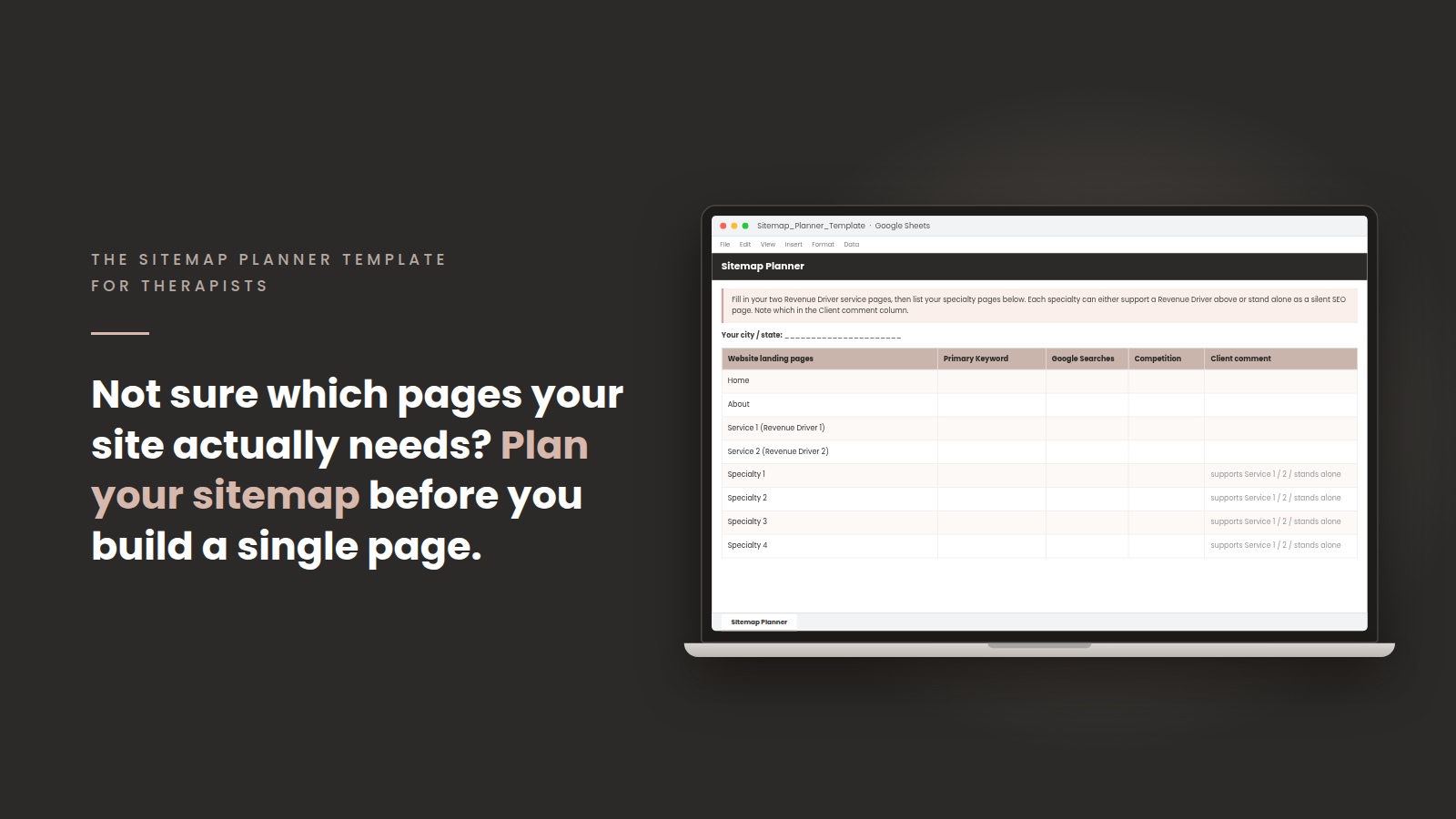
Get my free sitemap spreadsheet planner, list the pages you have and see where the gaps are.
How do you optimize your site for AI search visibility?
Work through these 10 steps in order. Each one tells you what to do and why.
Build a sitemap that gives AI something to quote
On therapist websites that stay out of AI recommendations, I see the same pattern every time: there is nothing to cite. A beautiful site with a short bio, a services list and a contact form is a brochure. It tells a human visitor enough to make a phone call and gives an AI model almost nothing to work with. AI tools recommend resources, so the fix is content depth: service pages, a blog and the language of lived experience.
The foundation is one page per major modality or population, such as anxiety, couples, EMDR and postpartum. Write each in client language with a geographic signal: your city, state or metro area. Picture a therapist in Denver with a service page, an EMDR specialty page, a blog post on EMDR in Colorado and a resource page for trauma survivors in the metro area. She becomes the resource, and Google and AI tools have a clear reason to choose her. I call that state level recognition, and SEO professionals call it topical authority. City visibility is the floor. See what pages a therapist website should have for what to build first.
Make sure Google can index your key pages
Google shows a page in AI Overviews or AI Mode when it is indexed and eligible to show with a snippet, and the same documentation lists no other requirement. That makes indexing your first technical job. Open Google Search Console, paste the address of a key page into the search bar at the top and read the result. Start with your homepage, your top 1 to 2 revenue pages (the service pages that make you the most money), your specialty pages and your contact page.
If a page is missing from Google, look for noindex or nosnippet rules on it. Site builders and plugins often add them during a build, and they stay on after launch. Ask whoever manages your site to remove them, then request indexing again. My guide to checking whether your therapy website is eligible for AI Overviews and ChatGPT covers the 4 settings that quietly block a page.
Check your robots.txt file
Your robots.txt file tells crawlers which parts of your site they may visit. Open yourdomain.com/robots.txt in a browser and read it line by line. Look for Disallow followed by a single slash, and for any rule that names OAI-SearchBot, ChatGPT-User or every crawler. OpenAI says sites opted out of OAI-SearchBot will not be shown in ChatGPT search answers, so a block there keeps your practice out of those answers.
Many site builders write this file for you, so ask who added each line before you change anything. If a rule blocks a crawler you want, ask your web person to change it, and allow about 24 hours for OpenAI's systems to adjust, which OpenAI states in its crawler documentation. I explain the file in what robots.txt is and how to check yours.
Submit your site to Google and Bing
Start with Google Search Console. Verify your site, submit your sitemap (most platforms publish it at yourdomain.com/sitemap.xml) and use URL Inspection to request indexing for your top pages. Then sign in to Bing Webmaster Tools, import your site from Google Search Console and confirm your sitemap is listed.
OpenAI says ChatGPT search sometimes partners with other search providers, and Claude searches the web too. Neither company names the index it uses, so submitting to both Google and Bing is the sensible move. A sitemap and an indexing request are invitations, so return to the Page indexing report in Search Console and confirm that each key page shows as indexed. My walkthrough on submitting your therapy site to Bing and Google also covers IndexNow.
Write each page so the answer comes first
Open each page with a direct answer to the question a client is asking, then add the detail. Write headings as the questions she types, such as "How does EMDR work?" Kevin Indig's study of ChatGPT citations found 44.2% of citations came from the first 30% of the text, and Microsoft's guidance recommends direct questions with clear answers. See the best content format for AI citations and how to write a citable paragraph.
Here is my approach to the content around those pages. Answer real questions with a FAQ section, what a first session looks like and signs someone might benefit from a type of therapy. Write 1 pillar post per specialty at 1,500 to 2,500 words, such as "What Is EMDR and Is It Right for You?" Add shorter posts and FAQ pages that link back to it. Put location modifiers on service pages and pillar posts, since not every post needs a city name. Publish every 2 to 4 weeks over a 6 to 12 month window and keep the rhythm steady.
Add schema to label your practice details
Schema is code that labels your practice details for crawlers, such as your name, address, phone number and hours. Add LocalBusiness schema to your homepage and contact page, add Organization schema for your practice, and keep every detail identical to the words on the page. For a group practice, a Person or ProfilePage label on each clinician bio page is a good next addition.
Google's AI features documentation says no special schema.org structured data is needed for its AI features, and Google's structured data introduction describes structured data as a way to help Google understand a page. That makes schema optional labeling that keeps your details consistent. Many site builders add basic schema for you, so check what yours outputs and fix any old phone number, address or hours. I rank 5 schema types for a practice in schema markup and AI citations for therapists.
Complete your Google Business Profile
In my opinion your Google Business Profile is the highest leverage local SEO asset you have. It puts you on the map, and it signals that you are a real, active, locally credible practice. I consider it one of the signals AI tools use to verify a therapist, and that is my view, since no AI company has confirmed it.
Complete every part: a specialty description written in client language, a services section listing every condition and population you work with, photos, active review collection and regular posts. A service based practice can hide its address, and the details you do show should match everywhere else. My Google Business Profile guide for therapists covers each section.
Build listings and earn outside mentions
Use identical name, address and phone details on Psychology Today, TherapyDen, Alma, Zencare, your website and your Google Business Profile. In my experience AI tools often name directories when someone asks for a therapist, and why ChatGPT recommends Psychology Today over your practice gives 5 fixes for your listings. Free directories are a should do in my book. Ask 1 to 2 professional peers or referral partners for an honest review, and I advise against asking clients.
Then earn mentions beyond directories: guest posts on mental health blogs, podcast appearances with show notes that name you, media quotes and professional association pages that list you. In my view each credible mention of your practice, specialty and location adds to the footprint AI tools read. SEO professionals call this E-E-A-T, short for experience, expertise, authoritativeness and trustworthiness.
Check monthly with a prompt log
Pick 6 to 10 prompts a future client would type, such as a specialty plus your city. Run each prompt 3 times in ChatGPT and in Google, and record whether the answer named you, whether it cited your site, where you appeared and which sources it showed. Keep the wording and the tools the same each month so you can compare, and take a first run before you change anything.
Pair the log with 4 numbers: impressions, clicks, click through rate and leads. Google says traffic from its AI features is included in overall Search Console traffic under the Web search type, so your regular numbers already contain it. When the log and your leads tell different stories, trust your leads. My guide to checking ChatGPT and AI Overviews for your practice has the template.
Use ChatGPT for the writing and keep the final read yourself
Use ChatGPT for language tasks: outlines, a warmer rewrite of a paragraph, meta description options and a plain summary of a report you upload. Use Search Console and an SEO tool for measurements, such as which pages Google indexed, where you rank and which phrases people search. ChatGPT works from the text and files you give it, so data about your site comes from those tools.
Read every word a prospective client will see before it goes live, and keep client details out of your prompts. To sort any task, ask where the answer comes from, what a mistake would cost and whether it has to sound like you. I sort 10 tasks in can ChatGPT do SEO for therapists.
What should you do first?
I rank SEO work by what blocks everything else, how little time the fix takes and how long it keeps paying off. Your sitemap and indexing win on all 3, because a page that Google has not indexed or a crawler cannot reach has no chance of being quoted.
Then turn to your top 1 to 2 revenue pages. Open each one with a direct answer, make the practice details match your listings and claim your first free directories while you wait for results. Run your first prompt log before you change anything, so you have a baseline to compare against.
Frequently asked questions
Does a small practice need all 10 steps?
Yes, and each step can stay light. A solo practice can confirm its key pages are indexed, build 1 clear page for each main service, claim the free listings that fit and run the prompt log monthly.
How long until AI tools recommend my practice?
Nobody publishes a timeline for AI recommendations. In my experience, with little local competition a site could reach page one in the first 90 days, sometimes 6 months, and a bigger metro takes longer. Track your prompt log monthly and look for movement over several months.
Should I block GPTBot?
That is a privacy choice. OpenAI says disallowing GPTBot indicates a site's content should not be used in training its models, and OAI-SearchBot is a separate crawler that controls ChatGPT search. Decide on purpose, and keep the OAI-SearchBot rule open if you want your practice in ChatGPT search answers.
Want this off your plate?
Everything in this guide can be done on your own, and it competes with your caseload, your family and your time.
As a therapist website designer who also runs the SEO, I build the sitemap so every page can be found and indexed from day one, and website management keeps the site healthy and current afterward. The search side sits in SEO for therapists for solo practices and SEO for private practices for group practices. If you would like to hand this over, apply to work with me. No pressure, just a conversation about what would take the most weight off your desk.
* AI Disclosure: This content may contain sections generated with AI with the purpose of providing you with condensed helpful and relevant content, however all personal opinions are 100% human made as well as the blog post structure, outline and key takeaways.
* Affiliate Disclosure: Some of the links on www.nataliamaganda.com may contain affiliate links meaning that I will get a commission for recommending products at no extra cost to you.

hello! i'm natalia maganda
The website manager for therapists and private practices that you didn't know existed.
We build and manage the 20+ page website that ranks in your city, reflects the depth of your work and books cash-pay clients with ease.
A done for you website management system that lets your practice grow without costing you your energy, your weekends, or your nervous system.