
Why ChatGPT recommends Psychology Today over your practice, and 5 fixes
In my read, ChatGPT recommends Psychology Today and large directories because they are the easiest sources for an AI tool to find, read and trust. Each listing is indexed, laid out the same way, consistent about names and locations, and linked to from all over the web. Your practice can earn a place in that mix, and most of the work happens outside your own website.
If we haven't crossed paths before, I'm Natalia, the founder of a boutique web design and SEO agency for therapists and private practice owners across the US. My mission is to help your website work as a 24/7 referral engine, so you can log off and still wake up to new inquiries. I have been in business for over 7 years, I have served 100+ clients, and I have managed over 900 URLs for other people's practices. We submit every client to directories, so I see which listings are worth the effort.
You probably typed "therapist for anxiety in my city" into ChatGPT to see what would happen. It named a directory or two and a few group practices, and none of them were you. That stings, especially when referrals and directories built the practice you have.
Key takeaways
- ChatGPT search uses third party search providers and partner content, and OpenAI says it ranks results using multiple factors. Sources that are easy to find and trust in search tend to feed the answer.
- Large directories appear often because they are indexed, structured, consistent and heavily linked. That is my read. I could not find a statement from OpenAI or Google saying directories are favored for therapist questions.
- Free directory listings are a should do. Paid directories build domain authority slowly and will not produce a spike in leads.
- Citations, press and reviews tell Google and AI tools that other people vouch for you.
- Your website and every listing should agree on name, license, location and services.
- Answers change between runs, so a monthly prompt log tells you more than a single screenshot.
Which sources do AI tools lean on when someone asks for a therapist?
They lean on whatever the underlying search systems return, plus partner data. OpenAI's announcement of ChatGPT search(October 2024) says the feature uses third party search providers as well as content provided directly by partners. OpenAI's help center article on ChatGPT search adds that it rewrites your question before sending it to those providers, uses approximate location for local results, and warns that citations can be incomplete or outdated.
Google describes its side in its documentation on AI features in Search. A page has to be indexed and eligible to show with a snippet, and AI Overviews and AI Mode may run several related searches across subtopics and data sources, which pulls in a wider set of links.
For a therapist query, that usually means a mix: directory profiles, practice websites, map listings, review sites and the occasional article. The exact mix is not published. I looked for a study of therapist queries that I could open and verify and did not find one, so this post has no percentages about which sites AI tools cite.
Why do large directories show up so often?
They hand an AI tool exactly what it needs in a form that is easy to use. This is my read based on how search works.
| Trait | What a large directory profile gives a machine | What a typical practice site gives it |
|---|---|---|
| Indexed | Large numbers of profile pages that search engines already crawl | A handful of pages, some never indexed |
| Structured | The same fields in the same place on every profile: name, credentials, location, specialties | Free form copy that changes page to page |
| Consistent | One version of each name and location | Slightly different names, old addresses, mixed credentials |
| Heavily linked | Links from across the web pointing at the directory | Few outside links, sometimes none |
The same pattern explains why a directory can outrank your site in Google. An AI answer built from search results is likely to inherit that pecking order. My guess is that a directory is also a comfortable thing to cite, because it lists many practices and the tool does not have to pick one.
If you are weighing which listings deserve your time, a full list saves you the research. I made a free directory list for exactly this.
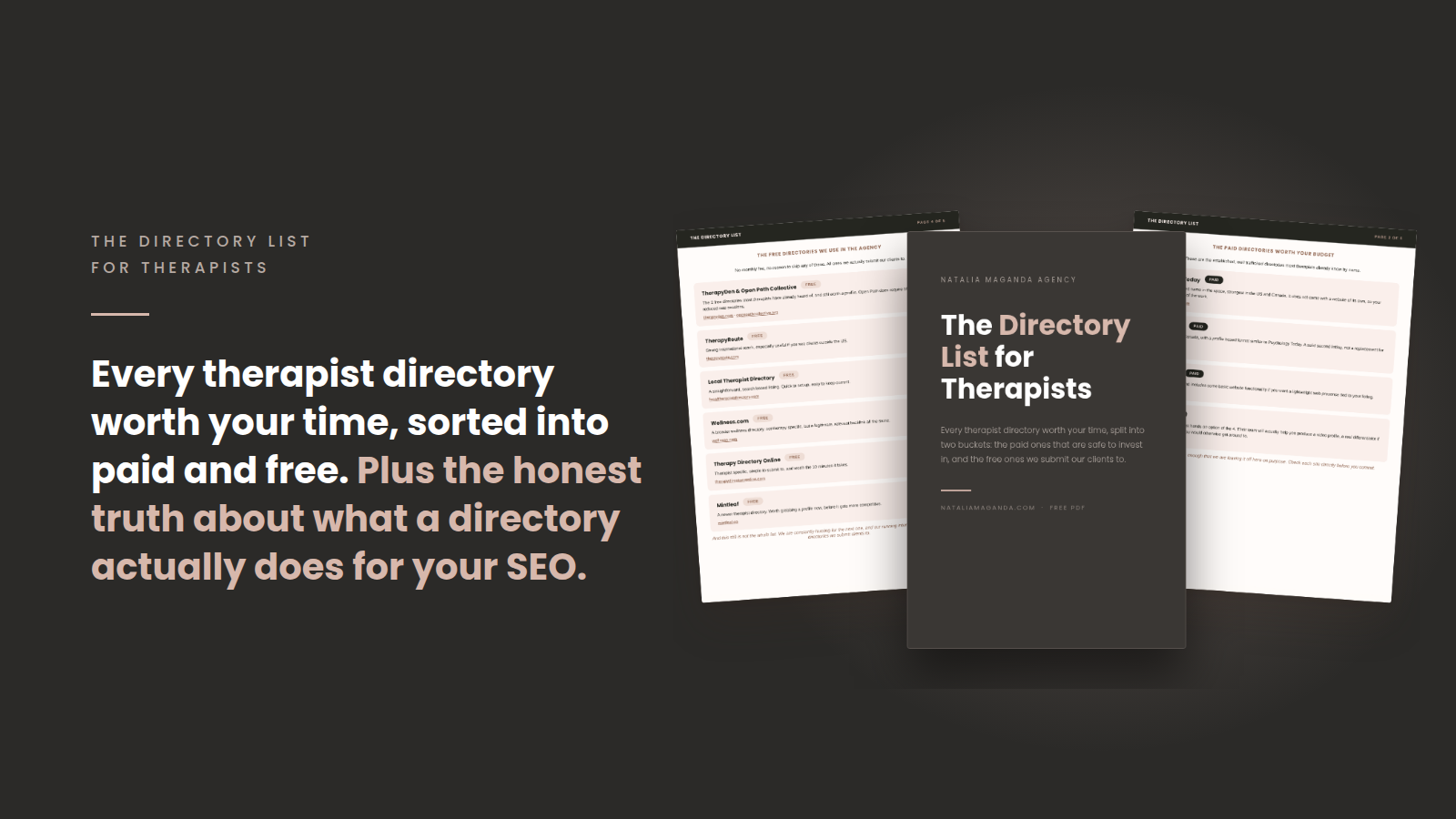
Get my free directory list for therapists, then score each listing with the criteria in the next section and cross off anything that fails.
Which directory listings are worth my time?
Do every free listing that passes 4 checks, and treat paid listings as a slow investment in trust. Here are the criteria I use, in order of weight.
- Real profile page. You get your own page with its own address on the web that search engines can index.
- A link to your website. The profile sends people and signals to your site.
- Verification or editorial standards. A listing that checks licenses carries more weight than an open list anyone can join.
- Fields you can match. You can enter your exact practice name, license, location and services.
- Cost against what it builds. A fee has to earn its place through authority and trust, since leads will not cover it.
| Listing type | My call | Why |
|---|---|---|
| Free directories that pass the checks | Do all of them | Free directories are a should do. They cost time only. |
| Google Business Profile | Do first | It is a free listing that every other source can cross check, and you can hide your address if you work remotely. |
| Professional association and licensing directories | Do if you qualify | They verify credentials and usually link to your site. |
| Psychology Today | Decide with your numbers | It is paid and widely seen. Weigh the cost before you renew or join. |
| Other paid directories and feature placements | Pick 1 or 2 at most | They build domain authority slowly and will not produce a spike in leads. |
For the Psychology Today numbers, read the cost, pros and cons. For a longer breakdown by directory, I keep a separate guide to the best therapist directories to list your private practice.
Here is the one first party example I can offer. I once paid $1,000 for a feature placement that moved my domain authority from about 12 to 20. It did not bring clients directly from that feature, and it added to my trustworthiness and to being recommended by AI to therapists who now book discovery calls with me. That is the return I expect from a paid placement: slow, with no spike in leads.
How do third party mentions, reviews and press build trust?
They show Google and AI tools that other people vouch for you, and your own website cannot say that about itself. Backlinks, citations, guest posts, press mentions and online reviews all point the same way. Two practices in the same city can run the same SEO strategy and get different results if one has the bigger online reputation. That is my opinion from running this work, which no AI vendor has confirmed. I cannot point to a vendor document that lists reviews or press as an AI ranking input.
Here is how I would build it, from the easiest start:
- Citations. Free directory listings and your Google Business Profile are the entry point.
- Peer reviews. I advise against asking clients. Ask professional peers, colleagues and referral partners, aim for 1 to 2 authentic reviews a month, and never do a review exchange.
- Press and podcasts. A feature, a quote or a guest spot earns a link from a site with its own reputation. At the agency we have real PR placements in motion for clients, and podcast guest spots are next on our roadmap.
Should my website and my listings say the same thing?
Yes, and this is the cheapest fix on the list. In my view, sources that agree on who you are give any system less to reconcile. Check these 4 details everywhere you appear:
- Practice name. Use one exact version, including any LLC or PLLC wording, on every listing.
- License. Use the same credential wording and the same license state and type.
- Location. Match your city, service area and address or hidden address setting.
- Services. List the same specialties and session formats, such as telehealth and in person.
This is the same discipline as NAP consistency, and I explain it in my post on NAP consistency for a therapy practice. Your site should state these facts in plain text, and your listings should repeat them word for word.
How do I run my own prompt test?
Run the same set of prompts in several tools, 3 times each, and log every source that appears. This post gives the method only. I have not run this test for my own practice for this article, so I am not reporting any results.
Which tools should I test?
- ChatGPT with search turned on
- Google AI Overviews and AI Mode, using a regular Google search
- Perplexity
- Gemini
Which prompts should I try?
Swap in your city, state and main specialty. Use these exact prompts:
- Who are the best therapists for [specialty] in [city, state]?
- Can you recommend a [specialty] therapist near [city]?
- Find me a therapist in [city] who offers telehealth for [specialty].
- Which therapy practices in [city] have the best reviews?
- What is [your practice name] and what does it do?
- Is [your name] a good [specialty] therapist in [city]?
The first 4 show who gets recommended to someone who does not know you. Prompts 5 and 6 show what the tools say when someone already has your name.
How do I log what I see?
Build a simple sheet with 1 row per run and these columns: date, tool, exact prompt, signed in or signed out, location, practices named, source domains shown, whether your practice appears, and whether your website is cited. In ChatGPT, open the Sources button under an answer. In the other tools, copy the cited domains. Run each prompt 3 times in a fresh chat or window, then repeat the whole set monthly. Keep the wording identical from month to month.
After a few runs, sort the source column. The directories that keep appearing are the listings to claim and polish first.
Why do results change between runs?
Because the tools rebuild the answer each time from a moving set of searches. OpenAI says in its help center article on ChatGPT search that ChatGPT rewrites your question before it sends it to search providers, and that it uses approximate location for local results. Google says AI Overviews and AI Mode may use different models and techniques, so the responses and links they show will vary. A single answer is a snapshot, and a pattern across many runs is the finding.
What can I do about it this month?
- Audit your details. Write down your exact name, license, location and services, then check every listing against it.
- Claim every free listing that passes the checks. Start with Google Business Profile, then your professional association.
- Decide on paid listings with a budget line for trust. Treat the fee as a slow investment in authority.
- Ask for 1 to 2 peer reviews. Colleagues and referral partners can speak to your work without touching anything client related.
- Pitch one outside mention. A podcast, feature or guest post gives others a reason to link to you.
Frequently asked questions
Will paying for Psychology Today get me recommended by ChatGPT?
I cannot confirm that. A paid profile can help your visibility and your domain authority over time, so weigh the cost against what it builds, using the criteria above.
Does ChatGPT use my Google Business Profile?
I cannot confirm that either. OpenAI says in its help center article on ChatGPT search that it uses approximate location for local results, and the article does not list the sources behind them. A complete Google Business Profile is free and supports your other signals.
How long until AI tools recommend my practice?
Nobody publishes a timeline. Authority builds slowly. Many of my clients start at a domain authority of 0 and grow to 6 to 8 within their first year, and leads can lag behind that number. Track your prompt log monthly and look for movement in the sources over several months.
Want this off your plate?
Everything in this post can be done on your own, and it competes with your caseload, your family and your time. Listings, peer reviews and monthly prompt logs add up to a real job.
As a therapist website designer who also runs the SEO, I build the site and keep its details consistent through my website management work. The directory submissions and outside authority work sit inside my SEO for therapists and SEO for private practices services, so the sources AI tools read all agree on who you are. If you are ready to hand it off, you can apply to work with me. No pressure, just a conversation about what would take the most weight off your desk.
* AI Disclosure: This content may contain sections generated with AI with the purpose of providing you with condensed helpful and relevant content, however all personal opinions are 100% human made as well as the blog post structure, outline and key takeaways.
* Affiliate Disclosure: Some of the links on www.nataliamaganda.com may contain affiliate links meaning that I will get a commission for recommending products at no extra cost to you.

hello! i'm natalia maganda
The website manager for therapists and private practices that you didn't know existed.
We build and manage the 20+ page website that ranks in your city, reflects the depth of your work and books cash-pay clients with ease.
A done for you website management system that lets your practice grow without costing you your energy, your weekends, or your nervous system.