
Can ChatGPT do SEO for your therapy website? 10 tasks compared
ChatGPT can do part of the SEO work for your therapy website, and it cannot replace an SEO tool. It is strong at language tasks like outlines, rewrites, meta descriptions and explaining a report, and it works from what you give it, so it has no view of your real Search Console, analytics, rankings or indexing on its own.
If we haven't crossed paths before, I'm Natalia, the founder of a boutique web design and SEO agency for therapists and private practice owners across the US. My mission is to help your website work as a 24/7 referral engine, so you can log off and still wake up to new inquiries. I have been in business for over 7 years, I have served 100+ clients, and I have managed over 900 URLs for other people's practices. I also built 2 websites of my own and got it wrong both times before I understood how SEO works, even after more than 80 keyword selections for each. That history is why I care so much about the research that happens before the writing.
You are probably somewhere between curious and tired. You have heard you can ask ChatGPT for an SEO audit, your caseload is full, and a free assistant that does the job sounds like exactly what a busy practice owner wants. I want you to get the real value out of it and skip the weeks of confident sounding advice that rests on no data at all.
Key takeaways
- ChatGPT is a strong assistant for outlines, rewrites, meta descriptions, report explanations and audit checklists.
- It works from what you give it. OpenAI's data analysis help article says its Python environment cannot make external web requests, and that uploaded spreadsheets are what it analyzes.
- It cannot confirm a page is indexed. Google's URL Inspection tool documentation describes a report on Google's indexed version of a specific page, which is the source for that answer.
- Pasting a prompt and asking for a blog post produces a draft. SEO optimization needs an outline, internal links and keyword research that shows what people actually search.
- My judgment: ChatGPT for words, an SEO tool for data, and you for decisions.
What does ChatGPT do well for a therapy practice owner?
It does well with anything that is mostly language, and those tasks save real time when your caseload is full. These are the five I would hand to it first.
- Brainstorming outlines. Ask for 3 outline options for a specialty page or a post, including a section for the question your ideal client is really asking. You get a starting structure in a minute.
- Rewriting copy. Paste a paragraph from your anxiety therapy page and ask for a warmer, clearer version. You keep the final say on what sounds like you.
- Drafting meta descriptions. Give it the page text and the main phrase, and ask for 3 options under 160 characters.
- Explaining a report. Upload a spreadsheet or CSV export and ask what it shows. OpenAI's data analysis help article lists spreadsheets as supported files and describes summaries of rows, columns, trends and outliers.
- Building an audit checklist. Ask for a list of what to review on a therapy website, then work through it yourself.
One habit goes with all five. OpenAI's guidance on whether ChatGPT tells the truth says it can sound confident even when it is wrong, and recommends treating it as a first draft and checking anything important. Everything it hands you is a first draft.
If you want ChatGPT to give you something useful today, start with who you serve, because every outline and rewrite gets sharper when it knows your client. I made a free ideal client avatar AI prompt for exactly this.
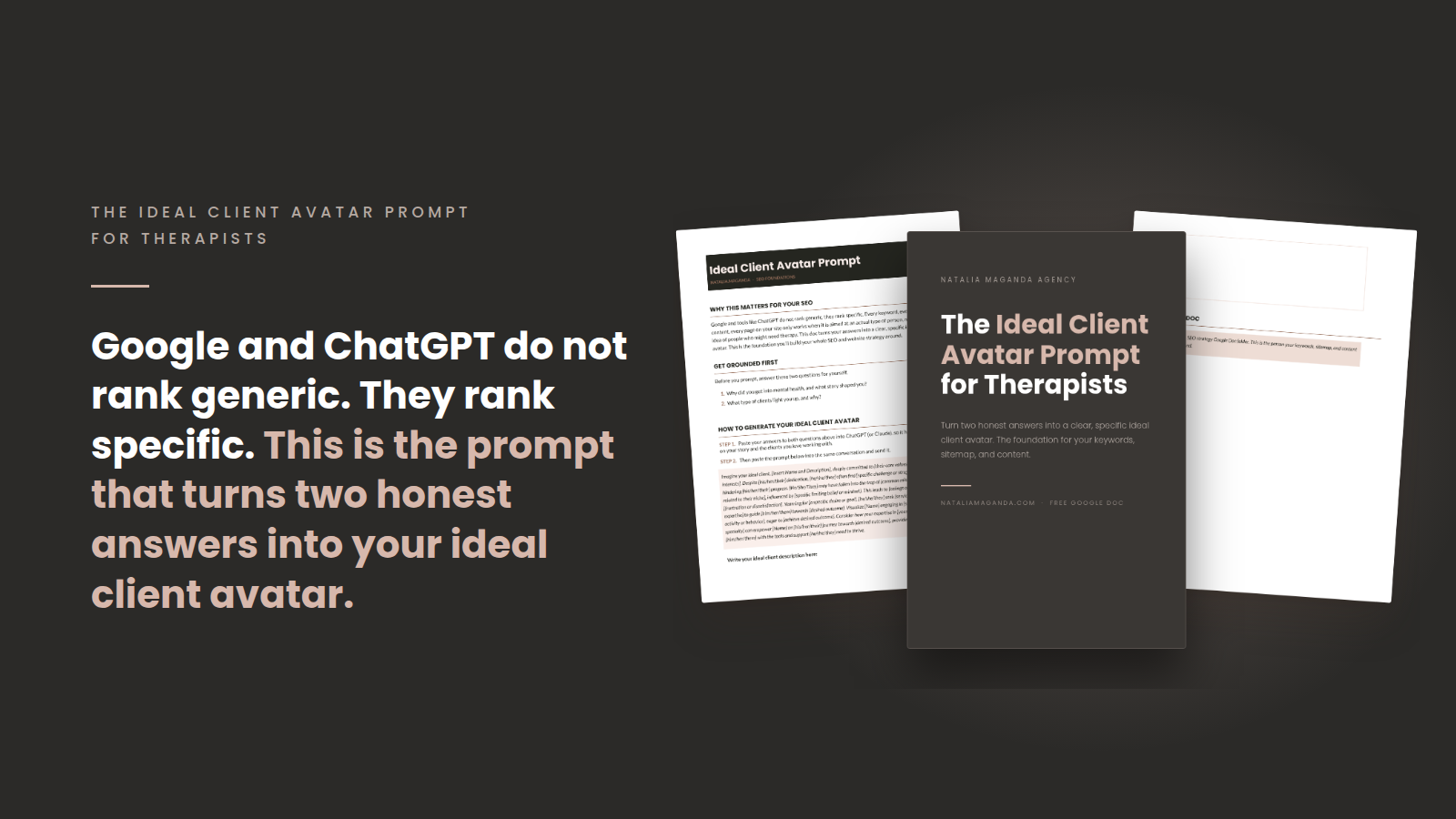
Get my free ideal client avatar AI prompt, paste it into ChatGPT, and keep the result open while you work on your next page or post.
Where does ChatGPT fall short on its own?
It falls short wherever the answer lives outside the chat window. These are the four gaps I see most often when a practice owner relies on it alone.
- It cannot see your real data unless you provide it. Your Search Console, analytics and rankings sit in other systems. OpenAI's connected apps article explains that you choose each app yourself and review the permissions it asks for, so nothing is visible by default.
- It cannot verify indexing. Whether Google has indexed a page is answered by Google's own report, the URL Inspection tool in Search Console, which shows information about Google's indexed version of a page. A page that is not indexed cannot be found, however good the copy is.
- It does not know your local competitors' real positions. ChatGPT can search the web, and OpenAI's ChatGPT search article warns that search results and citations can be incomplete, outdated or incorrect. That is a poor foundation for deciding which practices hold the top spots in your city.
- It does not replace keyword research tools. A list of phrases from ChatGPT is a brainstorm. Search volume, competition and the real questions people type come from a research tool, and OpenAI's own guidance says to verify data and references before relying on them.
If you want the full picture of how keyword research works for a therapy practice, I walk through it in my guide to keyword research for therapists.
Can ChatGPT do an SEO audit?
It can build the checklist and explain your findings, and it cannot run a trustworthy audit from a typed prompt alone. An audit needs evidence from your site, and a prompt like "audit my therapy website" gives it none.
Here is how I would use it for an audit you run yourself.
- Ask ChatGPT for an audit checklist that fits a therapy website, covering pages, titles, descriptions, internal links and indexing.
- Collect the evidence yourself: your Search Console reports, your page list and your analytics exports.
- Upload the spreadsheet versions and ask ChatGPT to summarize trends and outliers. OpenAI's data analysis help article warns that it may not reliably extract exact values from tables in images or scanned files, so use real spreadsheet exports and skip screenshots.
- Check anything important against the source before you act on it, especially indexing.
That workflow makes ChatGPT a fast reader of your data, and the data itself has to come from somewhere real.
What does a pasted ChatGPT prompt leave out of an SEO blog post?
You can absolutely use AI to write blog posts. A pasted prompt like "write me a post about anxiety therapy" gives you words, and the SEO work adds the rest. In my opinion, that work is a content outline built on best practices, internal links to your related pages, and keyword research tools that show the questions and related phrases people actually search.
Blogging without SEO tools is like writing with your eyes closed. You end up with a pile of content about what you want to share, and the questions people ask go unanswered. I cover this in more detail in my post on whether a therapist can use AI to write blog posts.
The agency publishes 24 blog posts per year for clients, so I know how much research a steady publishing rhythm takes. If you want a wider view of how AI fits into search for your practice, my SEO guide for therapists, ChatGPT and AI authority is the place to continue.
Which tasks go to ChatGPT, an SEO tool or a human?
Most tasks have a clear owner once you ask where the answer comes from. This table sorts 10 common tasks for a therapy website.
| Task | Do it with ChatGPT | Do it with an SEO tool | Needs a human |
|---|---|---|---|
| Brainstorm page and post outlines | Yes | Yes, shows real questions and related phrases | Choose what fits your ideal client |
| Rewrite copy | Yes | No | Approve voice, warmth and accuracy |
| Draft meta descriptions | Yes | Partly, flags missing or long ones | Confirm each matches its page |
| Explain a report | Yes, once you upload it | Produces the report | Decide what to act on |
| Build an audit checklist | Yes | Partly, runs a crawl | Judge which findings matter |
| Find keywords with real search data | No on its own | Yes | Pick by commercial intent |
| Check whether pages are indexed | No | Search Console answers this | Fix the cause |
| Track rankings over time | No | Yes | Read the trend with context |
| See local competitors' real positions | No | Yes | Decide how to respond |
| Plan internal links | Partly, if you give it your page list | Yes, shows your pages and gaps | Choose the links that help readers |
What is my judgment, and how did I reach it?
My judgment: use ChatGPT for words, an SEO tool for data, and yourself for decisions. If you could keep only one of the two tools, keep the SEO tool, because it supplies the information ChatGPT cannot see.
I sorted the tasks with 3 criteria.
- Does the answer come from outside the chat? Rankings, indexing and search volume do, so those go to a tool.
- What does a wrong answer cost? A wrong indexing diagnosis can leave a page invisible for months, so those get verified at the source.
- Does it need to sound like you? Anything a prospective client reads gets your final edit.
That is my opinion from building and managing therapist websites, and you may weigh the criteria differently. Run any task through those three questions and the owner usually shows up fast.
Frequently asked questions
Can ChatGPT do an SEO audit?
It can write an audit checklist and explain data you upload, such as spreadsheets and CSV files. It cannot check your live indexing or rankings from a prompt, so those findings need to come from Search Console or an SEO tool.
Can ChatGPT replace an SEO tool?
No. ChatGPT drafts and explains, while an SEO tool measures. Keyword volume, rankings and competitor positions are measurements, which is why keyword research starts in a research tool.
Does ChatGPT know where my practice ranks on Google?
Not unless you give it that data. OpenAI notes that ChatGPT search results can be incomplete, outdated or incorrect, so use your own Search Console and rank tracking for anything you plan to act on.
What should I leave out when I paste content into ChatGPT?
Leave out anything about your clients. Paste your own page copy, your page list and your report exports, and keep client details out of every prompt.
Want this off your plate?
Everything in this post can be done on your own, and it competes with your caseload, your family and your time. Using ChatGPT well, running the research tools, checking Search Console and keeping the site current is a part time job that rarely stays at the top of the list.
As a therapist website designer who also runs the SEO, I handle that job end to end. My website management keeps your site healthy and indexed, and my SEO for therapists and SEO for private practices work covers the research, the outlines and the posts, using the tools that show what your future clients actually search.
If that sounds like relief, you can apply to work with me. No pressure, just a conversation about what would take the most weight off your desk.
* AI Disclosure: This content may contain sections generated with AI with the purpose of providing you with condensed helpful and relevant content, however all personal opinions are 100% human made as well as the blog post structure, outline and key takeaways.
* Affiliate Disclosure: Some of the links on www.nataliamaganda.com may contain affiliate links meaning that I will get a commission for recommending products at no extra cost to you.

hello! i'm natalia maganda
The website manager for therapists and private practices that you didn't know existed.
We build and manage the 20+ page website that ranks in your city, reflects the depth of your work and books cash-pay clients with ease.
A done for you website management system that lets your practice grow without costing you your energy, your weekends, or your nervous system.