
How to Use AI for Therapist Blog Posts Without Hurting Your SEO
Yes, a therapist can use AI to write blog posts without hurting SEO, as long as the AI sits inside a process that starts with keyword research and ends with a human edit. Google says it does not automatically penalize AI content, and it also says that generating many pages without adding value for users can break its spam policy.
If we haven't crossed paths before, I'm Natalia, the founder of a boutique web design and SEO agency for therapists and private practice owners across the US. My mission is to help your website work as a 24/7 referral engine, so you can log off and still wake up to new inquiries. I have been in business for over 7 years, I have served 100+ clients, and I have managed over 900 URLs for other people's practices. I also wrote 80 blogs for my own site and was still stuck on page 6 with barely 100 clicks a month, so I know exactly what volume without direction looks like.
You are probably here because a blank page and a full caseload do not mix, and a tool that drafts a post in 2 minutes sounds like relief. It can be. Here is how I would use it so the post still earns its place on your site.
Key takeaways
- Google's guidance says AI generated content can rank when it meets the same quality bar as any other content. The risk sits in mass producing pages that add nothing for the reader.
- A prompt gives you words. SEO needs decisions made before the words: the phrase, the questions around it, the structure, and the pages it links to.
- Keyword research tools show the questions and similar phrases that surround a search, which lets the post answer what people actually ask.
- The human layer is the part AI cannot supply: your honest first party point of view, written for the person reading at 11pm.
- Keep client details out of AI tools. A blog post never needs them.
Does Google penalize therapists for using AI to write blog posts?
Google does not penalize content automatically because AI helped write it. Its page on generative AI content, last updated in December 2025, asks you to focus on accuracy, quality and relevance, and it warns that "using generative AI tools or other similar tools to generate many pages without adding value for users may violate Google's spam policy on scaled content abuse."
The spam policy itself defines scaled content abuse as many pages generated primarily to manipulate search rankings, with no help for the reader. That describes the "100 posts overnight" tools being sold to therapists right now.
Google's guidance on helpful, people first content adds 2 useful questions. Is it clear to visitors who wrote the content? Is it clear how it was made, including when AI helped, through a disclosure or another visible signal? That second question is why a short disclosure line is worth considering whenever AI helped with a post.
Why does one prompt not make a blog post SEO optimized?
Because a prompt like "write a blog post about anxiety therapy" returns fluent text about whatever the model guesses is relevant. SEO starts earlier: which phrase you are targeting, which questions people ask around it, how the headings answer those questions, and which of your pages the post connects to. None of that is in the prompt unless you did the work first.
Blogging without SEO tools is like writing with your eyes closed. You end up with a ton of content built around what you want to share, and the questions your future clients type into Google go unanswered. AI makes that faster, which makes the miss bigger.
If your posts usually fall apart at the outline stage, that is the best place to start. I made a free blog outline template for exactly this.
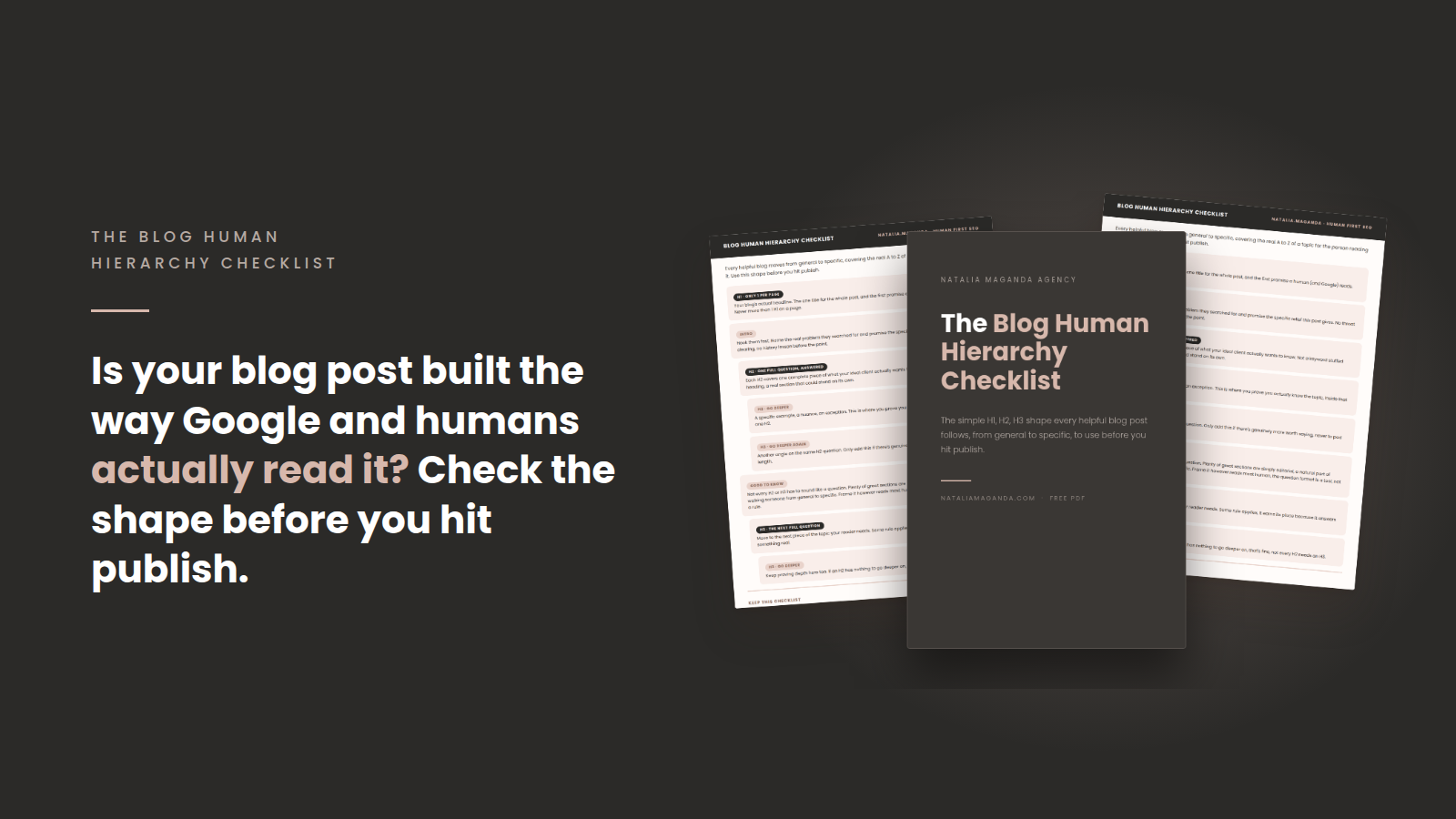
Get my free blog outline template, drop in your next topic, and see which headings and questions your post is missing before you ask AI to write a single sentence.
What does a process look like that uses AI without hurting SEO?
It has 6 steps, and AI touches only 2 of them in a major way. This is how I use AI inside research, outline, human editing and interlinking.
| Step | Who leads | What happens |
|---|---|---|
| Research the phrase | You and a keyword tool | Pick the phrase, then collect the questions and similar phrases around it |
| Build the outline | You, with AI as a sparring partner | Headings written as the questions people ask, each with a direct answer first |
| Draft | AI, from your outline | Section by section, using your research as the brief |
| Edit for humans | You | Add your point of view, your examples, your voice |
| Interlink | You | Connect the post to your service and specialty pages |
| Publish and track | You | Meta title, meta description, alt text, then watch impressions and clicks |
How do I research a phrase before asking AI to write?
Start with the phrase a client would type, then open a keyword tool such as Ubersuggest and look at the related questions and similar phrases around it. Those become the sections of your post. I walk through the full method in my keyword research guide for therapists, so I will keep it short here. The point for this post is that the research decides the outline, and the outline decides what AI is allowed to write.
How do I use AI once the outline exists?
Give it one section at a time, with the heading, the direct answer you want opened with, and the questions from your research. A section at a time keeps the draft tight. You can also ask AI to challenge your outline: what is missing, which question would a worried parent ask next. Treat the draft as raw material.
How should I interlink an AI assisted post?
Interlinking is how search engines travel from one page to the next and work out what your site is about. A finished post with no links pointing to it, and none pointing out, can sit invisible. Decide the 3 to 5 pages the post should connect to before you publish. AI does not know your sitemap, so this step is yours.
What does the human editing layer add that AI cannot?
It adds the honest first party layer: what you have actually seen, said and believe about this topic. Google's guidance asks whether content shows first hand expertise and depth of knowledge, and an AI draft has none of yours until you put it there.
Before anything goes live, I would ask 4 questions. Is this helpful and human, or does it only check a keyword box? Do the sections that deserve depth get it? Does it answer every question your ideal client has around this topic? Is there a question you are skipping because it feels uncomfortable to answer? The last one matters most. AI will happily skip an uncomfortable question, and so will you if you are rushing.
Then add what only you can: your view on what actually helps, how you frame a hard decision for a client, the myth you correct in session. Write it without client details, in general terms. Build the helpful post first and sprinkle the SEO through it.
Which parts of a blog post should AI write, and which should I keep?
I rank the jobs by how much the reader depends on your judgment. The more a section relies on your experience, the more of it you should write yourself.
| Job | Best handled by | Why |
|---|---|---|
| Choosing the phrase and the angle | You | This is a judgment call about what brings in clients |
| Your opinion and your examples | You | Nobody else has them, and readers can feel when they are missing |
| Interlinking and calls to action | You | Needs knowledge of your sitemap and your offers |
| First draft of explanatory sections | AI, then you edit | Saves time on structure and plain language |
| Alternative headlines, meta description options | AI, then you pick | Fast to generate, quick to judge |
How many AI assisted posts is too many?
Google's policy does not give a number, so I will give you my opinion as someone who has managed over 900 URLs. Quality beats quantity every time, and a strong sitemap of service pages and specialty pages matters more than blogging constantly. Publish only as many posts as you can research and edit properly. My piece on content strategy for therapist SEO shows how posts support the pages that earn you clients.
There is an AI search angle too. Tools like ChatGPT and AI Overviews quote specific, directly answered sections, and I cover how to write them in getting cited by ChatGPT and AI Overviews. A generic AI draft has nothing specific to quote.
Frequently asked questions
Will Google know my blog post was written by AI?
Google's guidance on generative AI content focuses on the quality and usefulness of the page, so the tool you used matters less than what the post delivers. Write the post so it would deserve to rank even if nobody asked how it was made.
Should I tell readers I used AI?
Google's helpful content guidance asks whether it is evident how the content was made, including AI, through disclosures or other signals. A short line near the bottom of the post is a simple way to do that.
Can AI do my keyword research?
AI can brainstorm seed phrases and group them by topic. Search volume, difficulty and the related questions around a phrase come from a keyword tool, so use both together. You can connect SEO tools to AI, but that's another technical detail for another blog post!
Can AI write my whole blog calendar at once?
It can produce the titles, and I would still pick each one yourself. Google's spam policy targets mass produced pages that add nothing for users, so plan a small number of posts that you will research, edit and interlink properly.
Want this off your plate?
Everything in this post is something you can do alone. It also competes with your caseload, your family and the few hours you have left in a week, and a blog is a long game that needs steady attention.
As a therapist website designer who also runs the SEO, I build the site and keep it working through website management, with SEO for therapists and SEO for private practices handling the research, outlines, editing and interlinking this post described. If you would like to apply to work with me, it is just a conversation about what would take the most weight off your desk, with no pressure.
* AI Disclosure: This content may contain sections generated with AI with the purpose of providing you with condensed helpful and relevant content, however all personal opinions are 100% human made as well as the blog post structure, outline and key takeaways.
* Affiliate Disclosure: Some of the links on www.nataliamaganda.com may contain affiliate links meaning that I will get a commission for recommending products at no extra cost to you.

hello! i'm natalia maganda
The website manager for therapists and private practices that you didn't know existed.
We build and manage the 20+ page website that ranks in your city, reflects the depth of your work and books cash-pay clients with ease.
A done for you website management system that lets your practice grow without costing you your energy, your weekends, or your nervous system.