
Topical Authority and Blogging for Therapists: The Most Comprehensive Guide You'll Find Online
Topical authority is how completely and credibly your website covers one subject, and a therapy blog builds it only when the blog sits on top of finished service and specialty pages, follows a plan, and has had months to earn trust. When a therapist blog stalls, the cause is almost always one of 3 things: the site underneath has no foundation, the posts have no plan, or the clock has not run long enough yet.
If we haven't crossed paths before, I'm Natalia, the founder of a boutique web design and SEO agency for therapists and private practice owners across the US. My mission is to help your website work as a 24/7 referral engine, so you can log off and still wake up to new inquiries. I have been in business for over 7 years, I have served 100+ clients, and I have managed over 900 URLs for other people's practices. I also built 2 websites of my own and got it wrong both times, and I wrote 80 blogs for my own site that left me stuck on page 6 with barely 100 clicks a month, so I know this topic from the inside.
You may be here because you have published posts and nothing has come back, or because someone told you to blog every week and your caseload will not allow it. This guide explains the whole picture in one place, answers each cause where it comes up, and links to the longer post that goes deep whenever one of them matches your site.
Key takeaways
- In my opinion, a strong sitemap of service and specialty pages matters more than blogging constantly, and the blog works best as the second floor of a building that already has a first floor.
- A therapy blog stalls when the site underneath is thin, when the posts have no plan, or when the clock has not run long enough, and each cause has its own fix.
- A plan lets every post strengthen one page on your site, so write the phrases closest to booking first, then the posts that show your specialty knowledge, then general educational tips.
- Choose a publishing pace you can keep for 12 months. My agency publishes 24 blog posts per year for clients, which is 2 a month, and a smaller pace works too.
- Results take months, and links from other websites build the trust that publishing alone cannot.
- Fix the sitemap first, then your Revenue Driver pages, then the blog, and let tracking and authority building run in the background from the start.
Why a therapy blog does not bring in clients on its own
A blog post is a supporting page. The person who lands on it is usually learning, and the person who inquires is the one who moves on to a service page that makes her feel seen. When the service pages are missing or thin, the posts send readers to a dead end. Google and AI tools also read the structure of your whole site before they read a single sentence of your writing, so the structure decides how much any post can do.
Your sitemap does more for you than a weekly blog
Service and specialty pages sit closest to the moment someone books, and they tell Google and AI tools what you are the go to person for. Blog posts earn authority and feed those pages, which is a different job and a slower one. In my opinion, a strong sitemap of service and specialty pages matters more than blogging constantly, and I have managed websites where the foundational sitemap alone, with no blog published yet, beat local competition and ranked for real commercial keywords.
The order that works for me is the sitemap first, then 2 Revenue Driver pages with real storytelling, then specialty and location pages, and then the blog. I compared pages and posts side by side in why service pages often beat blog posts for therapist SEO, and I wrote out the full order of work in how to grow your practice's SEO without blogging every week.
Topical authority comes from 4 layers working together
Topical authority is an SEO industry term for how completely and credibly a site covers one subject. Google's own people first content guidance asks whether your site has a primary purpose or focus, and a therapy website answers that question with 4 layers: service and specialty pages, location pages, blog posts, and interlinking.
In my opinion, those layers build on each other in that order, with the blog adding depth and fresh content to the pages above it and the links showing search engines how the pieces connect. In my experience, the same clarity that helps Google helps AI tools understand who you serve. The full breakdown, including the interlinking pattern I use, is in the 4 layers that build topical authority for a therapy website.
Most therapy blogs stall for 6 reasons, and all 6 can be fixed
When a blog brings in no clients, the cause is usually one of 6: no page foundation underneath it, the wrong kind of phrases, scattered topics, content that only checks a keyword box, no path that sends the reader to action, or a site that has not earned enough trust yet. Several can be true at once, which is why a fix aimed at only one of them can feel like it did nothing.
The one I see most often is a thin site underneath, because a post cannot send readers anywhere when the pages behind it are missing. All 6 causes are laid out in 6 reasons your therapy blog is not bringing in clients, and the fix.
If you are not sure your site has a first floor, start with your sitemap, meaning the list of pages your site needs and the main phrase each one targets. I made a free sitemap spreadsheet planner for exactly this.
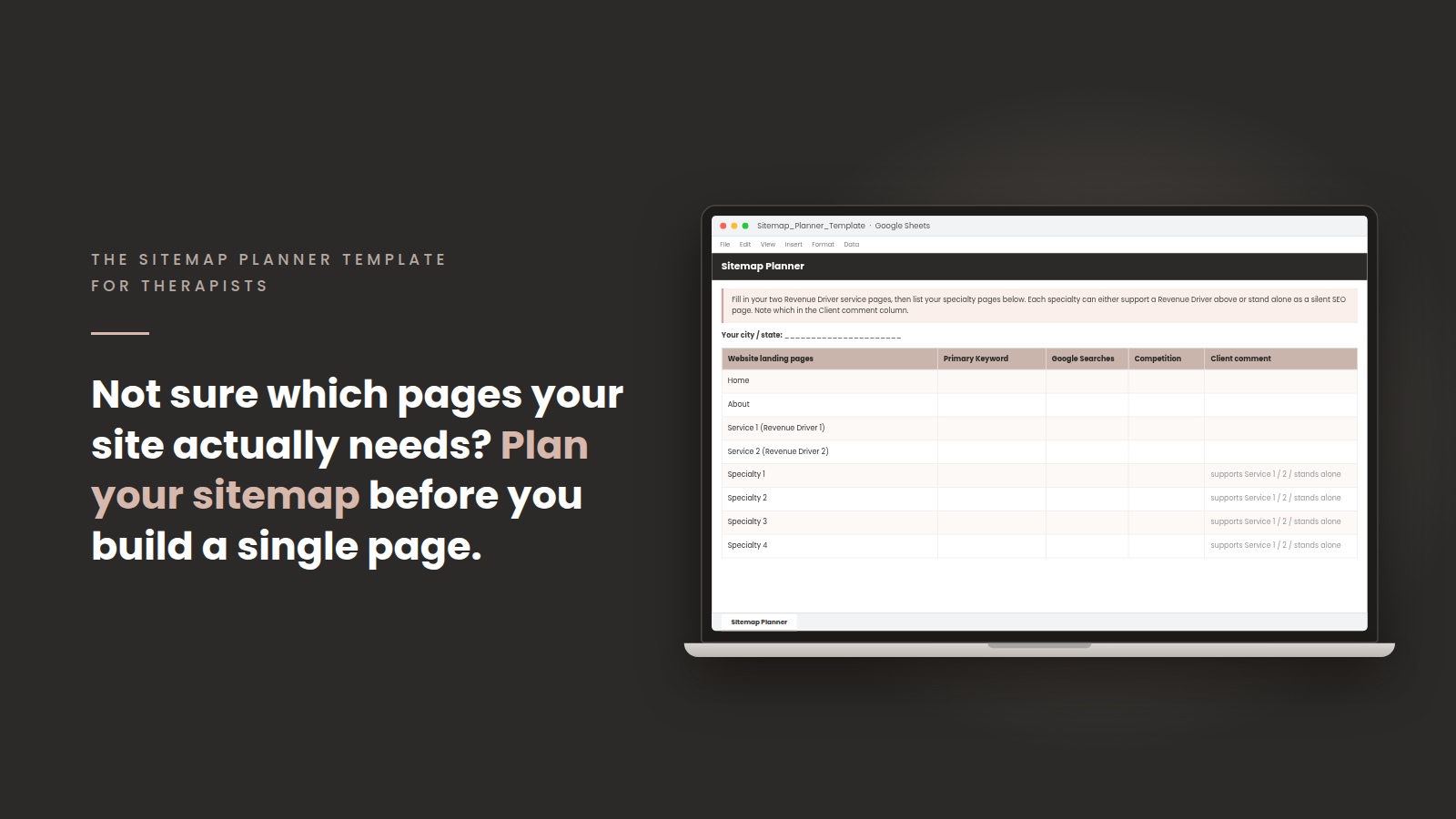
Get my free sitemap spreadsheet planner, list the pages you have today, and see how many gaps show up.
Why a blog with a plan builds authority and a blog without one scatters it
Every post either strengthens one page on your site or drifts toward a different subject. Google's content guidance cautions against producing lots of content on many different topics in hopes that some of it might perform well in search results, so a plan decides whether 20 posts add up to authority or to 20 loose ends.
Write the phrases closest to booking first
Blog topics fall into 3 buckets: commercial intent phrases from someone close to booking, topical authority phrases that show Google you know a specialty, and educational phrases that build trust but rarely book anyone the same day. I blog all 3 and write them in the order listed here. That runs against the common advice to start with easy educational tips, and my reasoning is that the first posts should be the ones most likely to support a page that earns money.
The order comes from 3 criteria: how close the reader is to booking, how directly the post supports a page that earns money, and how much of the post only you can write. Keyword research is the skill that makes this judgment possible, and what a therapist should blog about, with the 3 topic types ranked shows how I sort a first batch of topics.
A content cluster turns separate posts into one argument
A cluster is one commercial intent page plus about 7 to 9 posts, each answering one buyer question and linking back to that page. The planning is the hard part, and once the map exists the writing goes faster. I start from the page that makes the most money and let the questions come from that page, because a clinical overview exists everywhere and your angle on it exists only on your site.
Each post opens with the direct answer, adds your own view, and links to the service page once, at the point where the question turns into a decision. The full walkthrough is in how to build a blog content cluster without guessing what to write.
The right number of posts comes from 5 checks
There is no universal number of posts. I run 5 checks in order: the strength of your site foundation, the size of your local competition, how many service and specialty pages need support, which buyer questions deserve their own post, and your real capacity. The honest starting count for a brand new site that has no sitemap yet is 0 posts. Each check changes the answer, which is why 2 practices with the same caseload can land on different numbers.
Capacity decides the pace, and at my agency we publish 24 blog posts per year for clients, which is 2 a month. The checks, and how they translate into a monthly pace, are in how many blog posts a therapy website needs.
Pick a pace you can keep for 12 months
How often you publish matters less than whether you can keep going. Ask yourself 2 questions: how many uninterrupted writing blocks you can protect in a normal month, including a month with sick kids or a full caseload, and who in your city has been publishing for years and how much ground you need to cover to compete. A smaller cadence you keep up will build more authority over time than a big one you drop early.
My priority order is the sitemap first, a cadence you can keep second, and tracking third, and I reassess strategy every 6 to 12 months. The calendar and the tracking numbers are in how often a therapist should publish blog posts for SEO without burning out.
AI can draft, and you still make the decisions
Yes, a therapist can use AI to write blog posts, and the real question is where AI sits in the process. One prompt produces words, and an SEO optimized post needs decisions that come first: the phrase to target, the questions and similar phrases that show up around it, an outline that follows best practice, internal links, and a human edit. Blogging without SEO tools is like writing with your eyes closed, and you end up with a pile of content about what you wanted to share while the questions people are asking go unanswered.
In my process, AI helps with 2 of the 6 steps, the outline as a sparring partner and the first draft from your outline, while you do the phrase research, the human edit, the interlinking, and the publishing and tracking. The whole process is in how to use AI for therapist blog posts without hurting your SEO.
Why results take longer than your publishing calendar suggests
Google needs months to index and evaluate what you publish, and the trust a site earns compounds slowly. In the same city, 2 practices running the same strategy can get different results when one has built a bigger online reputation, so the clock matters as much as the content.
Your site also earns trust from other websites
Backlinks, directory listings, citations, and press mentions tell Google and AI tools that other people vouch for you, and no amount of publishing on your own site replaces them. Free directories are a should do. At my agency we submit every client to directories, we have real PR placements in motion, and podcast guest spots for clients are next on the roadmap.
Many of my clients start at a domain authority of 0 and grow to 6 to 8 within their first year. I once paid $1,000 for a feature placement that moved my own domain authority from about 12 to 20. It did not bring clients directly from that feature, and it added to my trustworthiness and to being recommended by AI to therapists who now book discovery calls with me. The slow build behind that number is explained in what domain authority is and why therapy websites start low.
Blog posts bring readers, and your pages turn readers into clients
The Ahrefs ranking time study found that only 1.74% of 1 million newly published pages reached Google's top 10 within a year, using data from September 2023. A second Ahrefs analysis of 2 million pages created in October 2023, limited to non empty English content, put that figure at 6.11%, and Ahrefs said that number might be the fairer one. Both cover all industries, so your own timeline depends on your local competition.
Where local competition is low, a site could reach page one in the first 90 days, sometimes 6 months, and a bigger metro area takes longer. Impressions with no clicks yet and a ranking on page 6 are signs your site is starting to get picked up. My honest timeline, and the 5 steps a reader takes from Google to your inbox, are in how long blog posts take to bring in therapy clients.
How do you tell which problem you have?
Sort yourself into one of 3 groups by asking what you can see today. If you cannot list your Revenue Driver pages and specialty pages from memory, you are in the first group and the foundation comes first. If you have those pages and your posts exist but you cannot say which page each one supports, you are in the second group and the plan comes first.
If the pages and the plan are both in place, you are in the third group, where the numbers tell the story. Open Google Search Console and read 4 numbers together: impressions, clicks, click through rate, and leads. Many impressions with few clicks point to titles and meta descriptions that need work, clicks with almost no service page visits point to missing internal links, and service page visits with no inquiries point to the page copy or the form.
Many sites sit in more than one group at once, and the group you land in first is the one to fix first. The post on the 6 reasons walks through a check you can run on your own site.
What should you fix first?
I rank the fixes by 3 criteria: how close the fix sits to a booked client, how much every later fix depends on it, and how little of your time it needs. By those criteria the sitemap comes first, because every page, post, and link you add later has to hang from it. If your site still has only a handful of pages, my guide to what pages a therapist website should have shows the structure to aim for.
Second come your 2 Revenue Driver pages, written with real story driven copy, since ranking earns the click and the words earn the reply. Specialty pages and location pages follow, kept lean and keyword forward, because each one either supports a Revenue Driver page or stands alone as a quiet SEO page.
Third comes the blog, and this is where keyword research earns its keep, which I cover in keyword research for therapists. Start with commercial intent phrases, build each cluster around one page, and set a cadence you can keep for a full year.
Tracking and authority building run in the background from the start, and they come last in this order because they are the slowest to pay off. Check impressions, clicks, click through rate, and leads, reassess your strategy every 6 to 12 months, and submit your site to the free directories. This is my ranking, built on 100+ clients and 900+ URLs, and a practice that already has a finished sitemap could reasonably start at the third step.
Frequently asked questions
Do therapists need a blog for SEO?
In my opinion a blog helps, and it ranks second to the sitemap. I have managed websites where the sitemap alone, with service and specialty pages and no blog published yet, ranked for real commercial keywords. The blog adds depth, fresh content, and room to answer the questions your ideal client types into Google.
What is the difference between topical authority and domain authority?
Topical authority describes how completely your site covers one subject. Domain authority is the slow, compounding trust score that reflects how many other websites vouch for you, and it grows when they link to yours.
Does topical authority matter for AI tools like ChatGPT?
In my experience, yes. The same clarity that helps Google helps AI tools, and both read the structure of your whole site to work out what you are an authority on, which is why the pages and the links matter as much as the posts.
How long should I wait before judging my blog?
I reassess strategy every 6 to 12 months, because Google needs months of runway to index everything you have built. With little local competition a site could reach page one in the first 90 days, sometimes 6 months, and a bigger metro area takes longer.
Should I publish more posts to build authority faster?
In my experience, more posts only help when each one has a purpose, and authority and depth carry more weight than volume. A post that wanders away from your Revenue Driver and specialty pages dilutes your focus.
Want this off your plate?
Everything in this guide can be done on your own, and it competes with your caseload, your family, and the rest of your time. Having a website is a job, and for many practice owners it is a job they would love to hand to someone else.
As a therapist website designer who also runs the SEO, I build the sitemap, the pages, and the structure first, then I keep the site growing through website management services and SEO for therapists or SEO for private practices, so your blog sits on a foundation built to hold it. If you would like a conversation about what would take the most weight off your desk, you can apply to work with me. No pressure, just a conversation.
* AI Disclosure: This content may contain sections generated with AI with the purpose of providing you with condensed helpful and relevant content, however all personal opinions are 100% human made as well as the blog post structure, outline and key takeaways.
* Affiliate Disclosure: Some of the links on www.nataliamaganda.com may contain affiliate links meaning that I will get a commission for recommending products at no extra cost to you.

hello! i'm natalia maganda
The website manager for therapists and private practices that you didn't know existed.
We build and manage the 20+ page website that ranks in your city, reflects the depth of your work and books cash-pay clients with ease.
A done for you website management system that lets your practice grow without costing you your energy, your weekends, or your nervous system.