
How to build a blog content cluster without guessing what to write
A blog content cluster is a small group of posts that each answer one buyer question and all link to the one service page that makes you money. A therapist builds one by choosing that page first, listing the questions her ideal client asks around it, writing one post per question, and connecting everything with descriptive links.
If we haven't crossed paths before, I'm Natalia, the founder of a boutique web design and SEO agency for therapists and private practice owners across the US. My mission is to help your website work as a 24/7 referral engine, so you can log off and still wake up to new inquiries. I have been in business for over 7 years, I have served 100+ clients, and I have managed over 900 URLs for other people's practices. I also built 2 websites of my own and got it wrong both times before I understood how SEO works, so I know exactly where the guessing happens.
You may have a blog with a handful of posts that were each a good idea on the day you wrote them. One on anxiety tips, one on self care, one on a book you loved. Nothing links to anything, and none of it points at the page where a client actually books. A cluster fixes that on paper, before you write another word. I covered why topical authority matters in content strategy for therapist SEO. This post is the build: one cluster, from one page, in order.
Key takeaways
- A cluster is one commercial intent page plus a set of posts that each answer a single buyer question and link to that page. Plan for 7 to 9 posts.
- Start from the page that makes you money, then let the questions come from that page.
- Sort the questions by type (what is, how to, cost, how to choose, timing, local) so the cluster covers the whole decision and avoids 8 versions of the same post.
- Each post answers its one question in the first 2 sentences, which is also the shape AI answers like to pull from.
- Every link uses descriptive anchor text, and Google's own guidance says every page you care about should have a link from at least one other page on your site.
- The planning is the hard part. Once the map exists, the writing goes faster.
What is a blog content cluster?
A blog content cluster is a service page plus the supporting posts that answer the questions someone asks before they book that service. The posts are called spokes, and each one answers a single question and sends the reader to the service page.
Picture the service page as the front desk where the inquiry happens and the spokes as the paths that lead people to it. A finished page with no links pointing at it can sit invisible, and a stack of posts with no destination attracts readers who have nowhere to go. The cluster gives every post a job.
You can add a broad overview post on top of the spokes later, one that links to each of them. The cluster works without it. The order I teach is the service page first, spokes second, overview third.
If you are ready to draft your first cluster, the best starting point is a clear outline that follows how a reader scans. I made a free blog outline template for exactly this.
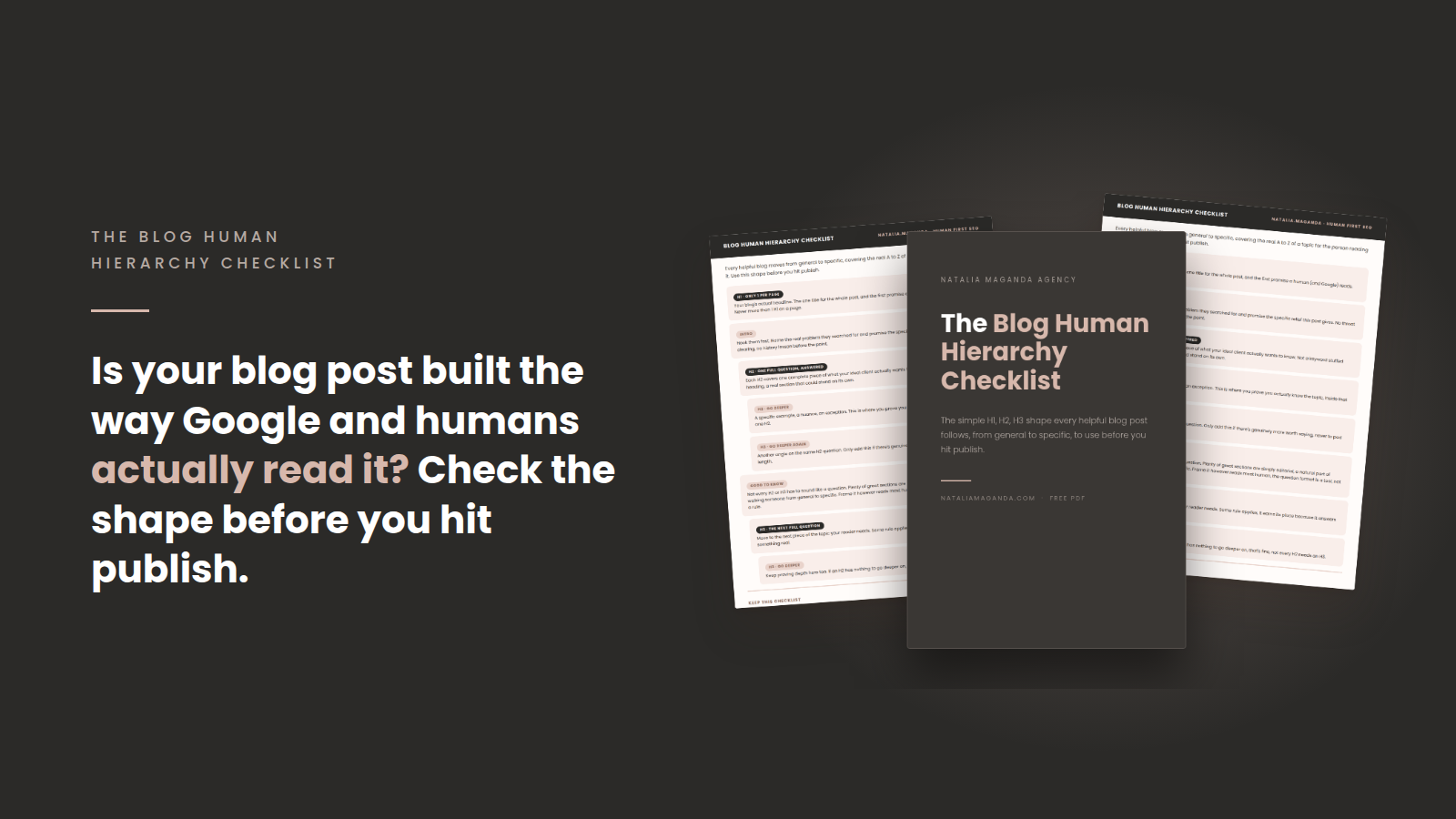
Get my free blog outline template, pick the first question from your list, and fill in the structure before you write a single paragraph.
How do I pick the page my cluster supports?
Pick the service page that earns the most for your practice, because every spoke will vouch for it. If two pages tie, take the one with the clearer commercial intent phrase, meaning words someone types when they are close to booking.
Here are the 4 criteria I use, in order:
- The page pays the most per client, or fills the part of your caseload you want to grow.
- A researched phrase near booking exists for it, such as "anxiety therapist in your city".
- You can speak about it from real experience, so your posts carry things a summary cannot.
- The page already has solid, human copy, since the cluster will send traffic there.
My opinion is that this beats starting from the topics you enjoy writing about. After writing 80 blogs of my own, I was still stuck on page 6 with barely 100 clicks a month, because the site had not earned enough trust yet. Posts that all point at the page that makes money give the site a clear reason to be trusted for that topic. I have also managed websites where the foundational sitemap alone, with service pages and specialty pages and no blog published yet, beat local competition and ranked for real commercial keywords. So if the page itself is thin, fix it first.
How do I list the buyer questions around that page?
List every question your ideal client asks between first noticing the problem and booking, then sort them by question type. Sorting is what keeps you from writing 8 variations of one post.
Your best sources are the questions you hear on consult calls, the emails you answer repeatedly, and the phrases from your keyword research. If you want a longer pool of topics to sort, the blogging basics and 140 blog post ideas post is a good raw list.
Say your service page is postpartum anxiety therapy. Here is a made up example of how the questions could be sorted:
| Question type | Example question a client might type |
|---|---|
| What is | What is postpartum anxiety and how is it different from baby blues? |
| How to | How do I know when to get help for postpartum anxiety? |
| Cost | How much does postpartum anxiety therapy cost? |
| How to choose | How do I choose a therapist for postpartum anxiety? |
| Comparison | Is therapy or medication better for postpartum anxiety? |
| Timing | How long does postpartum anxiety therapy take? |
| Local | Postpartum anxiety therapist in your city |
Seven rows give you 7 spokes. Plan for 7 to 9 spokes, a range that covers the topic without turning into a second job. Some questions are close to booking, like cost and how to choose. Others build trust, like what is. A healthy cluster has both.
Which question do I write first?
Write first the question you hear most often from the people who end up booking. It is the one you can answer with the most authority and the most detail, which makes the first spoke the strongest.
After that, alternate. Publish one question near booking, then one that builds trust, so the cluster stays balanced while you are still building it. The first spoke can go live before all 7 to 9 are ready. The cluster is finished on paper and grows live over time.
How do I write each content piece so it supports the cluster?
Each blog answers its one question in the first 1 to 2 sentences, then expands with your perspective, specifics, and a clear next step to the service page. One question per post keeps the post focused for the reader and easy for Google and AI tools to understand.
Here is the pattern I use:
- Open with the direct answer to the exact question, in plain words your client uses.
- Add your own view. A clinical overview exists everywhere, and your angle on it exists only on your site.
- Link to the service page once, at the point where the reader's question turns into a decision.
- Link to 1 or 2 sibling spokes where a reader's next question naturally lands.
- Finish with a soft invitation to the service page.
Before you publish, add an editorial layer. Is it helpful and human, or does it only check a keyword box? Does it answer every question your client has on this topic? Is anything missing because it feels uncomfortable to say? Build the helpful content first and sprinkle the SEO through it.
How do I link the posts together?
Link every spoke to the service page, link the spokes to each other where a reader's next question fits, and link the service page back to the cluster. Use anchor text that describes the destination.
| Link | Where it goes | Anchor text example |
|---|---|---|
| Spoke to service page | The page that makes money | postpartum anxiety therapy in Austin |
| Spoke to sibling spoke | The question the reader asks next | how much postpartum anxiety therapy costs |
| Service page to spokes | The questions that help a client decide | how to choose a postpartum anxiety therapist |
Google says that good anchor text is descriptive, reasonably concise, and relevant to the page that it's on and to the page it links to. When a client hears "how much postpartum anxiety therapy costs" in a link, they know what they get, and so does Google.
My practical advice is to link as you publish. After each new spoke goes live, go back to the earlier ones and add the link to the new sibling. It is a quick pass that keeps the paths connected.
How do I know the cluster is working?
Track impressions, clicks, click through rate, and leads for the service page and each spoke, and reassess every 6 to 12 months. Early on, impressions without clicks are the first sign that Google is starting to pick the pages up.
Timelines depend on local competition. With little competition a site could reach page one in the first 90 days, sometimes 6 months, and a bigger metro takes longer. Keep the cluster, review what is getting impressions, and sharpen the titles of the spokes that show up without getting clicked.
Frequently asked questions
How many posts are in a blog content cluster?
Plan for 7 to 9 blogs, each answering one buyer question. That range covers the full decision from curiosity to booking, and it is small enough to finish. You can add more later once the first set is live and linked.
How is a cluster different from a list of blog ideas?
A list of blog ideas gives you topics. A cluster gives each post a job: one question, one reader, and one page it points to. If you have a list already, sort it by question type and attach it to your service page.
Want this off your plate?
Everything in this post can be done on your own. It also competes with your caseload, your family, and the hours you really have. If you would like it handled, I'm a therapist website designer who also runs the SEO, so the service page, the cluster around it, and the links between them get built as one system. With website management, I keep the site updated and healthy after launch, and with SEO for therapists and SEO for private practices, I plan the questions, the structure, and the posts so your site keeps working while you are in session.
If you would like to talk it through, apply to work with me. No pressure, just a conversation about what would take the most weight off your desk.
* AI Disclosure: This content may contain sections generated with AI with the purpose of providing you with condensed helpful and relevant content, however all personal opinions are 100% human made as well as the blog post structure, outline and key takeaways.
* Affiliate Disclosure: Some of the links on www.nataliamaganda.com may contain affiliate links meaning that I will get a commission for recommending products at no extra cost to you.

hello! i'm natalia maganda
The website manager for therapists and private practices that you didn't know existed.
We build and manage the 20+ page website that ranks in your city, reflects the depth of your work and books cash-pay clients with ease.
A done for you website management system that lets your practice grow without costing you your energy, your weekends, or your nervous system.