
How often should a therapist publish blog posts for SEO without burning out
Pick a number of posts you can keep up for a full 12 months, and give every post in that number real depth. My agency publishes 24 posts per year for clients, which is 2 a month, and your number can be lower if that is what your calendar can hold.
If we haven't crossed paths before, I'm Natalia, the founder of a boutique web design and SEO agency for therapists and private practice owners across the US. My mission is to help your website work as a 24/7 referral engine, so you can log off and still wake up to new inquiries. I have been in business for over 7 years, I have served 100+ clients, and I have managed over 900 URLs for other people's practices. I also wrote 80 blogs for my own site and was still stuck on page 6 with barely 100 clicks a month, so I have lived through the volume trap myself.
You run a practice, you have a caseload, and you probably have a family that needs you at 5 pm. Someone told you to blog every week, you tried it for a month, and then the posts quietly stopped. Now you are wondering whether blogging was a waste of your time or whether you just need a schedule that fits your life.
Key takeaways
- The right cadence is the one you can maintain for 12 months with posts that still have depth.
- My agency publishes 24 posts per year for clients, which is 2 a month. I use that as a reference point for you.
- Google's own guidance on people first content lists producing lots of content on many topics, hoping some of it performs, as a warning sign.
- A cadence only works when it lives on a calendar with fixed dates and a plan for the month that falls apart.
- Check that each post is indexed, then track 4 numbers: impressions, clicks, click through rate, and leads. Reassess your cadence every 6 to 12 months.
How often should a therapist publish blog posts for SEO?
Publish at the pace you can sustain for a full year while keeping each post deep and useful. In my opinion, authority and depth carry more weight than volume, so the yearly total can be whatever lets you keep pushing quality content out the door.
For the clients I work with, my agency publishes 24 posts per year. That is 2 posts a month, every month, and the steady rhythm matters as much as the number. In my post on whether therapists need a blog for SEO, I land on 2 posts a month as the sustainable pace. This post adds the part that article leaves out: how to choose your own number, put it on a calendar, and prove it is working.
If 24 posts a year sounds like more than you can carry, you are allowed to start smaller. A smaller cadence you keep for 3 years will build more authority than a big one you drop in month 2.
If you want your cadence on one screen, the best next step is a database that tracks every post, its indexing, and its results. I made a free blog database and KPI template for exactly this.
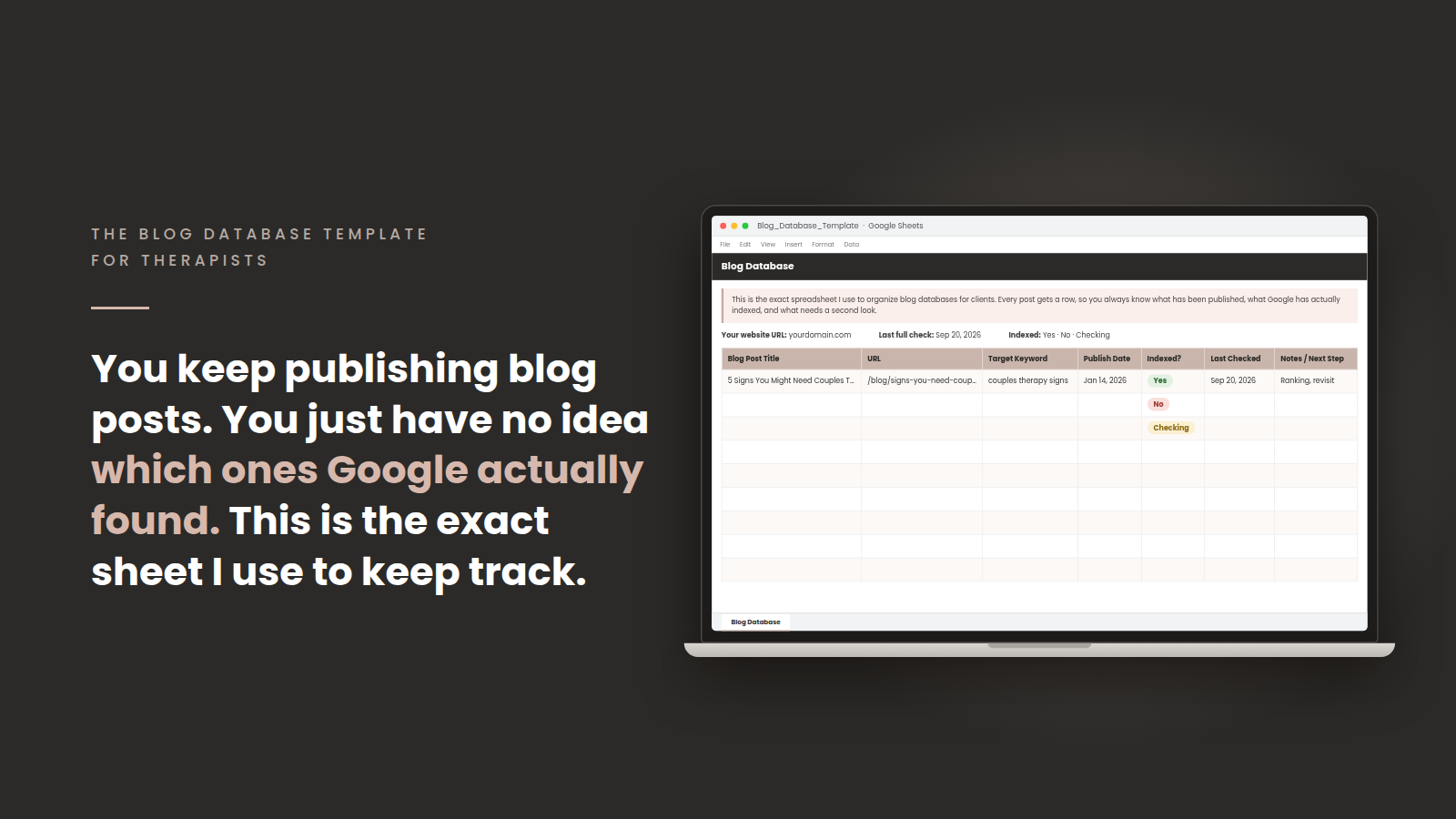
Get my free blog database and KPI template, add the number of posts you plan to publish this year, and see where each one will live on your calendar.
Does publishing more posts help a therapist rank faster?
In my experience, no. More posts only help when each one has a purpose, and I learned that by writing 80 blogs for my own site and sitting on page 6 with barely 100 clicks a month. The site had not earned enough trust yet, and no amount of extra volume could fix that.
Google's guidance points the same direction. Its page on creating helpful, reliable, people first content asks whether you are "producing lots of content on many different topics in hopes that some of it might perform well in search results." It also asks whether you are adding a lot of new content primarily because you believe it will make your site seem fresh. Both questions describe a schedule driven only by the calendar.
Here is my judgment call on where to spend your effort, in order:
- Your sitemap of service pages and specialty pages. I have managed websites where the foundational sitemap alone, with no blog published yet, beat local competition and ranked for real commercial keywords.
- A cadence you can keep. This is the subject of this post.
- Tracking. A schedule without numbers is a guess.
Once the sitemap exists, the posts have a job to do. Keyword research is a skill, and every phrase falls into 1 of 3 buckets: commercial intent (close to booking), educational (builds trust but will not convert today), and topical authority (shows Google you know the space). I blog all 3. If you want the structure behind that, my article on content strategy for therapist SEO shows how to build posts around a few specialties so each one adds to the same body of expertise.
How do I choose a cadence I can actually keep?
Count the focused writing blocks you can honestly protect each month, then set your cadence at the number you could hit in a rough month. Your best month will never be the one that decides whether you are still publishing in December.
Ask yourself 2 questions:
- How many uninterrupted writing blocks can I protect in a normal month, including a month with sick kids or a full caseload?
- Who in my city has been publishing for years, and how much ground do I need to cover to compete?
Local competition changes the math. If other practices in your city have been doing SEO for a while, they have a head start. That is a reason to choose your keywords with extra care, hunting for lower competition phrases with real commercial intent, and a reason to keep the schedule steady.
The table below is made up for illustration. These are not results from any practice, mine or a client's, apart from the 24 posts per year my agency publishes for clients.
| Posts per year | Posts per month | What it asks of your calendar |
|---|---|---|
| 6 | 1 every other month | 1 writing block every 2 months. Best when your caseload is full and you want something that survives a rough season. |
| 12 | 1 | 1 writing block a month. A manageable starting point for a solo practice owner. |
| 24 | 2 | 2 posts a month, every month. This is the pace my agency publishes for clients. |
If you pick the middle row, my blogging basics for therapists post covers batching, where you write several posts in one sitting and give writing one day a month. Batching protects your cadence on weeks when your energy is spent on clients.
What does a publishing calendar I can keep look like?
A publishing calendar has fixed dates, a topic and a keyword bucket assigned to each date, and a plan for what happens when you miss one. Write it once for the whole year so you are never staring at a blank page on the day a post is due.
Here is how I would build it:
- Pick the dates first. If you publish twice a month, choose 2 dates and keep them. Fixed dates turn publishing into a habit.
- Assign each date a purpose. Mix commercial intent, educational, and topical authority posts, and tie each one to a service or specialty page it supports.
- Plan an editorial layer. Before anything goes live, ask whether the post is truly helpful, whether the deep sections go deep enough, whether it answers every question your ideal client has, and whether you are dodging anything uncomfortable.
- Plan for the missed month. If a month falls apart, publish the next post on its scheduled date and move on. Stacking 3 posts into one week to catch up usually lowers the quality of all of them.
- Log every post. Record the URL, the keyword, the bucket, the publish date, the date it was indexed, and the results.
How do I know if my publishing schedule is working?
Check that each new post is indexed, then watch 4 numbers: impressions, clicks, click through rate, and leads. These numbers move together, and the pattern across all 4 tells you more than any single one.
Start with indexing. Google's URL Inspection tool in Search Console reports whether a specific page is on Google, when it was crawled, and which page Google picked as the canonical version. You can also request indexing there, though Google says a request does not guarantee the page will appear in its index, and there is a daily limit on requests.
Then give the numbers time. In my agency, I reassess strategy every 6 to 12 months, because SEO is slow and Google needs months of runway to index and trust what you build. Here is how I read the early signs:
- Impressions with no clicks yet is a normal early stage.
- Page 6 rankings mean your site is starting to get picked up. Keep building authority.
- Low local competition can put a site on page one within the first 90 days, sometimes 6 months.
- A bigger metro area takes longer, because you compete with practices that have been at this for years.
If 6 to 12 months pass and none of the 4 numbers move, take it as a real question about your strategy. Ask who can look at your keywords, your pages, and your authority with fresh eyes. The answer might be a different keyword mix, a stronger sitemap, or more off page authority.
Should I start blogging before my service pages are done?
I would build the sitemap first. A foundation of Revenue Driver pages, meaning your top 1 to 2 services, plus lean specialty pages, gives every blog post something to support. Posts published without that foundation have nowhere meaningful to send readers or authority.
Frequently asked questions
Is 1 blog post a month enough for SEO?
It is enough to start assuming you have a 20+ page site with foundational SEO, if you don't, no it's not enough.
Is it okay to publish a burst of posts and then pause?
I would avoid it. Topical authority builds through consistent publishing over time, and a burst followed by months of silence leaves the compounding effect on the table. If you have already paused, restart at a pace you can hold and keep the dates fixed.
How long until my new posts show up in Google?
Indexing can take a while, so check each URL in Search Console. Once a post is indexed, rankings and clicks build over months. I reassess every 6 to 12 months because Google needs that runway, and your local competition sets how fast you move.
Should I blog if I already post on Instagram?
I would pick 1 or 2 channels and go deep. Instagram gives you a quick window of attention. A blog compounds in search over years. A blog cadence you can keep is a strong anchor for long term search growth.
Want this off your plate?
Everything in this post is something you can do on your own. It also competes with your caseload, your family, and the evenings you were hoping to get back, and having a website is a job you never signed up for.
As a therapist website designer who also runs the SEO, I build the sitemap first, then publish on a calendar that keeps going. With website management services, I take the ongoing care of your site off your desk, and with SEO for therapists and SEO for private practices, I handle the keywords, the posts, and the tracking behind your cadence.
If you are ready for a conversation, apply to work with me. No pressure, just a conversation about what would take the most weight off your desk.
* AI Disclosure: This content may contain sections generated with AI with the purpose of providing you with condensed helpful and relevant content, however all personal opinions are 100% human made as well as the blog post structure, outline and key takeaways.
* Affiliate Disclosure: Some of the links on www.nataliamaganda.com may contain affiliate links meaning that I will get a commission for recommending products at no extra cost to you.

hello! i'm natalia maganda
The website manager for therapists and private practices that you didn't know existed.
We build and manage the 20+ page website that ranks in your city, reflects the depth of your work and books cash-pay clients with ease.
A done for you website management system that lets your practice grow without costing you your energy, your weekends, or your nervous system.