
How to grow your practice's SEO without blogging every week
Fix your sitemap first, build 2 core service pages with real storytelling, then add specialty pages and location pages. Blogging comes after that foundation, on a cadence you can keep for years.
If we haven't crossed paths before, I'm Natalia, the founder of a boutique web design and SEO agency for therapists and private practice owners across the US. My mission is to help your website work as a 24/7 referral engine, so you can log off and still wake up to new inquiries. I have been in business for over 7 years and have served 100+ clients, and I have managed over 900 URLs for other people's practices. I also built 2 websites of my own and got it wrong both times, so I know exactly how it feels to follow the "just keep blogging" advice and wonder why nothing moves.
You are probably here because someone told you SEO means a new post every week, you tried it for a month or two, and your calendar quietly won. Your caseload, your family, and your admin all compete for the same Tuesday evening. Good news: the foundation of SEO sits somewhere else, and you can grow your practice's SEO without that weekly post.
Key takeaways
- The order that works for me is sitemap, then 2 Revenue Driver service pages, then specialty pages and location pages, then blogging.
- I have managed websites where the foundational sitemap alone, with service pages and specialty pages and no blog published yet, beat local competition and ranked for real commercial keywords.
- Your top 1 to 2 service pages deserve emotional, story driven copy, because they are where a stranger decides to reach out.
- Specialty pages can stay lean and keyword forward, and each one either supports a Revenue Driver page or stands alone as a quiet SEO page.
- Location pages let you show up for the cities and neighborhoods where your future clients live.
- Blogging still matters. It works best after the structure exists, at a pace you can sustain.
What can I do instead of blogging every week to grow my practice's SEO?
Build the structure of your site first. Four moves, in this order, give you more SEO progress than a year of rushed weekly posts on top of a thin site.
| Step | What you build | What it does for you |
|---|---|---|
| 1 | A sitemap with every page and its main keyword | Tells Google and AI tools what you are the go to person for |
| 2 | 2 Revenue Driver service pages with story driven copy | Turns a click from Google into a message from a real person |
| 3 | Specialty pages and location pages | Captures specific searches and covers the areas you want clients from |
| 4 | A blog on a sustainable cadence | Builds topical authority around the pages you already have |
Notice that a blog shows up last. That is my opinion and it goes against a lot of common advice, so let me explain the reasoning.
Why does my sitemap matter more than a weekly blog?
Because a sitemap is the decision about what Google and AI tools should know you for, and a blog post cannot make that decision for you. In my experience, they read the structure of your whole site to work out what you are an authority on, long before they judge any single sentence.
Most therapists skip this step on the way to fonts and photography. Before I touch a word of copy on a new client's site, I look at how the pages are categorized. Every page needs a home, a main keyword, and a reason to exist.
Here is the first party proof I keep coming back to. I have managed websites where the foundational sitemap alone, with service pages and specialty pages and no blog published yet, beat local competition and ranked for real commercial keywords. Those are searches from people with their wallet out, ready to book. A blog can add to that, but the structure was doing the heavy lifting.
If you are ready to see which pages your site is missing, start with a sitemap, meaning the list of pages you need and the main phrase each one targets. I made a free planner for exactly this.
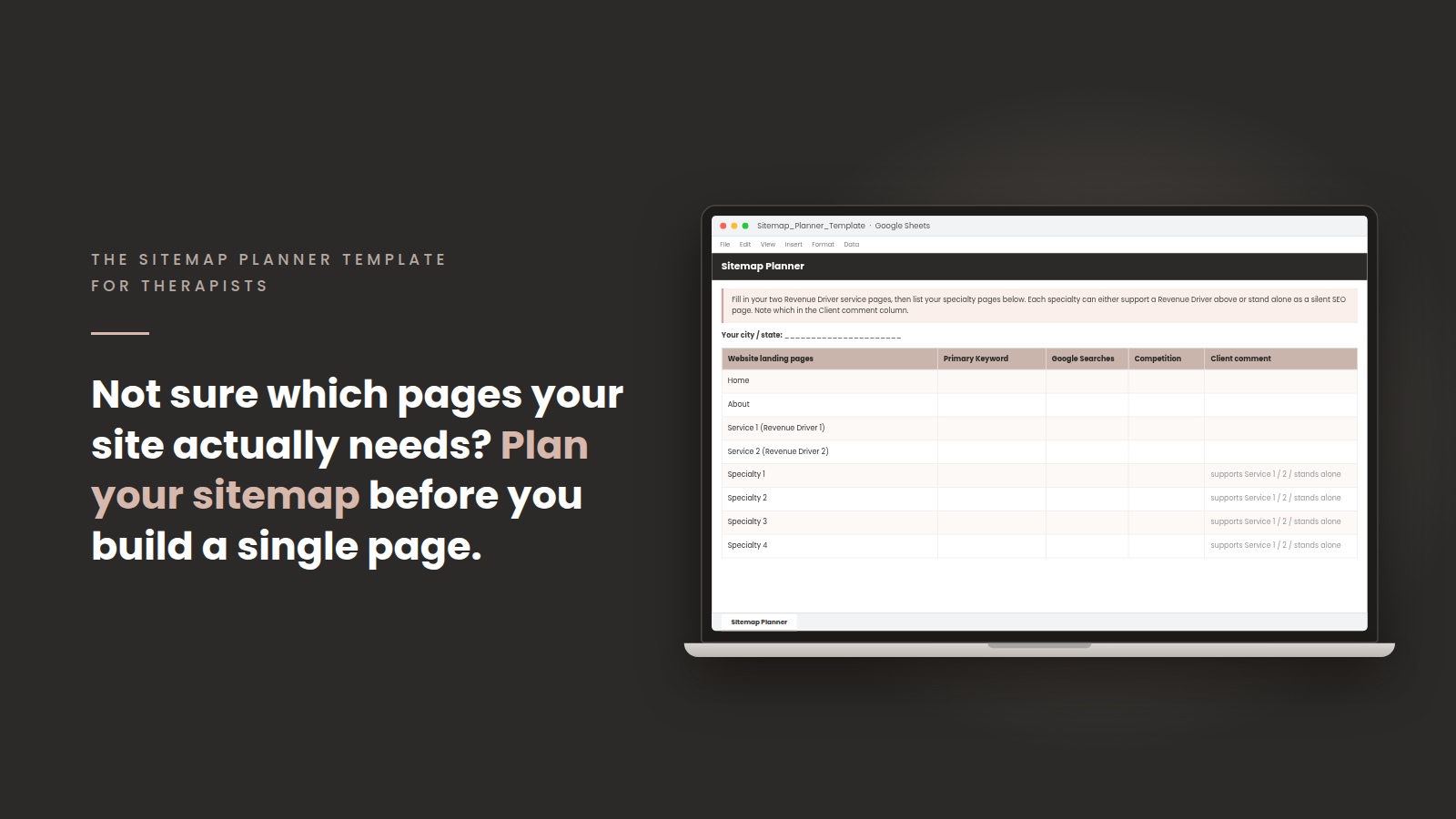
Get my free sitemap spreadsheet planner, list the pages you have today, and see how many gaps show up.
What are Revenue Driver pages, and why do they get the storytelling?
Revenue Driver pages are your top 1 to 2 service pages, the ones that make you the most money and light you up the most. They get the real, emotional, story driven copy because this is where a future client decides whether you understand her.
You can build a technically flawless, keyword perfect page, and if the words read like a form from a clinical office, visitors click over from Google and bounce right back. A page that ranks earns the click. The copy decides whether you get the inquiry.
So pick your 2 now. Ask which services you most want to fill your caseload with, and which ones pay the way you need them to. Write those pages the way you would talk to a scared, searching person in a first conversation, in plain words, with a little of your own story where it fits. Everything else on the site gets to be simpler.
What do specialty pages do for SEO?
Specialty pages are everything else you offer. Each one either supports a Revenue Driver page or stands alone as a quiet SEO page for other training you hold, such as EMDR, OCD, or perinatal work.
Here is the picture. Say your Revenue Driver is anxiety therapy for high achieving professionals. Burnout and perfectionism become specialty pages that support it. EMDR for trauma becomes a specialty page that stands on its own and speaks in the exact clinical phrase a researched client types into Google.
This is also where your language is allowed to change on purpose. Revenue Driver pages speak to someone searching in general terms. Specialty pages can use the clinical vocabulary, because a person searching "EMDR for OCD" has usually done the research already. I wrote about what to include on a therapy specialty page if you want the section by section breakdown, and this post adds the bigger question of where those pages sit in your whole site.
Do I need location pages if I already have a Google Business Profile?
Yes, a location page does a different job. Your Google Business Profile helps you show up in the map results, and a location page gives the main search results a page that matches a city or neighborhood search.
A homepage on its own cannot speak to every area you want clients from. Dedicated pages can, as long as each one carries real local detail. Copying a page and swapping the city name misses the point, and Google can read that pattern as thin content. Start with your home city and a couple of nearby areas, and add more over time. My post on location pages as a therapy SEO strategy covers what goes on each one.
When should I start blogging, and how often?
Start once your Revenue Driver, specialty, and location pages exist, and publish at a pace you can still keep in month 12. My default suggestion is 2 posts a month, because a steady trickle compounds over time and a burst of posts fades when life gets busy.
I do believe a blog helps a site over time. It feeds topical authority and gives you reasons to link to the pages that make money, which I explain in my post on whether therapists need a blog for SEO. The sitemap simply has to be there for those posts to link to.
When you do blog, sort every idea into 1 of 3 buckets:
- Commercial intent: someone close to booking, such as "anxiety therapist for high achievers."
- Educational: builds trust and brings clients later, such as "how to stop overthinking."
- Topical authority: shows Google you know the space deeply, such as "signs of high functioning anxiety."
You want all 3, and the judgment call about which bucket a phrase belongs in is the skill. I wrote 80 blogs for my own site and was still stuck on page 6 with barely 100 clicks a month, because the site had not earned enough trust yet. Volume gave me a pile of posts. Judgment and structure would have given me traffic sooner.
Before anything goes live, I run an editorial check. Is this helpful and human, or does it only check a keyword box? Does it answer every question my ideal client has, including the uncomfortable ones? Build something genuinely helpful on top of the keyword, then sprinkle the SEO through it.
How do I know the foundation is working without a weekly blog?
Track 4 numbers: impressions, clicks, click through rate, and leads. They move together, and I reassess them every 6 to 12 months.
Impressions without clicks is a good early sign, and so is a page 6 ranking, because both mean your site is starting to get picked up. Timelines depend on your local competition. With little competition a site could reach page one in the first 90 days, sometimes 6 months. A bigger metro takes longer, because you are up against practices that started years ago. In that case the answer is smarter keyword choices, with lower competition phrases that still have real commercial intent.
Frequently asked questions
Can I rank on Google without a blog?
Yes, especially for commercial searches in your city. A well built sitemap with service pages, specialty pages, and location pages can rank without a single blog post. A blog adds topical authority later, and it helps most when it supports pages that already exist.
How many service pages should I put the most effort into?
Put the most effort into 1 to 2. Those are your Revenue Driver pages, the services that make you the most money and that you most want to do. Give them story driven copy and let the rest of the site stay lean.
Is it too late to start SEO if other practices in my city already blog?
No, but in a competitive metro you will need sharper keyword choices. Aim for specific, lower competition phrases with real commercial intent, and build structure before volume. Authority from directories, reviews, and other sites that vouch for you also adds up over time.
Should I stop blogging if I already publish regularly?
Keep going if the pace feels sustainable, and check whether your posts link to specialty and service pages that exist. If your sitemap has gaps, fill those first and slow the blog down while you do.
Want this off your plate?
Everything in this post can be done on your own. It also competes with your caseload, your family, and the time you have left at the end of a full day. Having a website is a job, and it may be one you never signed up for.
As a therapist website designer who also runs the SEO, I build the structure first: the sitemap, your Revenue Driver pages, your specialty pages, and your location pages. Once the site is live, our website management services keep it updated and growing, and our SEO for therapists and SEO for private practices work covers the blog too, on a pace that fits your life.
If you would like to hand that over, you can apply to work with me. No pressure, just a conversation about what would take the most weight off your desk.
* AI Disclosure: This content may contain sections generated with AI with the purpose of providing you with condensed helpful and relevant content, however all personal opinions are 100% human made as well as the blog post structure, outline and key takeaways.
* Affiliate Disclosure: Some of the links on www.nataliamaganda.com may contain affiliate links meaning that I will get a commission for recommending products at no extra cost to you.

hello! i'm natalia maganda
The website manager for therapists and private practices that you didn't know existed.
We build and manage the 20+ page website that ranks in your city, reflects the depth of your work and books cash-pay clients with ease.
A done for you website management system that lets your practice grow without costing you your energy, your weekends, or your nervous system.