
What should a therapist blog about? 3 topic types ranked
A therapist should blog about the phrases a future client types when they are close to booking, then about the questions that prove you know your specialty, and only after that about general mental health tips. Commercial intent topics come first, topical authority topics come second, and educational topics come third.
If we haven't crossed paths before, I'm Natalia, the founder of a boutique web design and SEO agency for therapists and private practice owners across the US. My mission is to help your website work as a 24/7 referral engine, so you can log off and still wake up to new inquiries. I have been in business for over 7 years and have served 100+ clients. I also built 2 websites of my own and got it wrong both times, with more than 80 keyword selections for each, and I have managed over 900 URLs for other people's practices. That adds up to a lot of topic judgment calls, and this post is how I make them.
You probably have a blog already, or a folder full of ideas. You have written about anxiety tips, self care, and boundaries, and the posts collect a few visits and zero inquiries. You have a caseload and a family, so every post has to earn its place on your calendar.
Key takeaways
- Blog topics fall into 3 buckets: commercial intent, educational, and topical authority. Each bucket has a different job.
- Write commercial intent topics first, because the searcher is closest to booking.
- Write topical authority topics second. They back up the one service page you most want to rank and link to it.
- Write educational topics third. They build trust and rarely turn into an inquiry on the first visit.
- Google the phrase to find its bucket. Service pages ranking means commercial, and how to articles ranking means educational.
- In my experience a sitemap of service and specialty pages matters more than the blog, so every topic should serve a page you already have.
Why does general mental health advice stop bringing in clients?
A post of general tips attracts people who want relief today, and the post gives it to them and sends them on their way. They read it, feel a little better, and close the tab without ever learning that you take clients.
I know this firsthand. After writing 80 blogs of my own, I was still stuck on page 6 with barely 100 clicks a month, because my site had not earned enough trust yet. The volume of posts did nothing, because I had picked topics without asking what each one was for. Volume and quality have almost nothing to do with each other, and a big database of posts can sit there making you no money.
The fix starts before the blog. In my experience, a foundational sitemap of service pages and specialty pages matters more than blogging constantly. I have managed websites where the sitemap alone, with no blog published yet, beat local competition and ranked for real commercial keywords. So the question to ask about any topic is which page on your site it supports. If you want the bigger picture of how posts and pages work together, my guide to content strategy for therapist SEO covers it.
If you are writing posts and wondering why nobody finds them, the next step is checking the title, meta description, headers, and links around each one. I made a free on page SEO dictionary for exactly this.
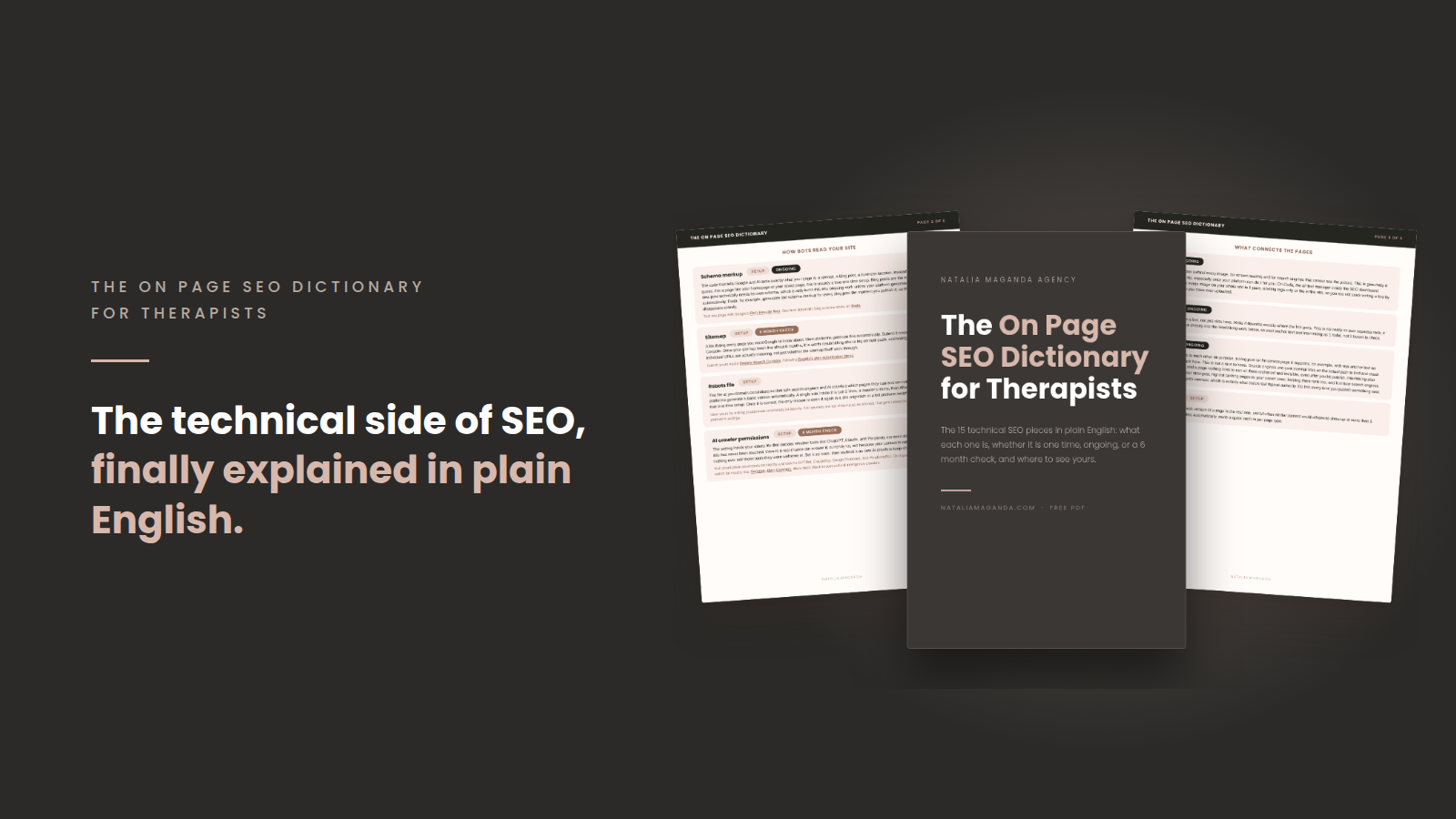
Get my free on page SEO dictionary, pick one finished post, and work through it item by item to see what is missing.
What are the 3 buckets of blog topics for a therapist?
The 3 buckets are commercial intent, educational, and topical authority. Every phrase a client might search belongs in one of them, and the bucket tells you what the post can realistically do for your practice.
| Bucket | What the searcher wants | Made up example | Its job on your site | Write it |
|---|---|---|---|---|
| Commercial intent | To find and compare a therapist | perfectionism therapist for working moms | Brings inquiries | 1st |
| Topical authority | To understand a symptom, term, or modality | signs of perfectionism that look like productivity | Shows Google and AI tools you know this specialty | 2nd |
| Educational | Relief or a skill today | how to stop redoing your work at midnight | Builds trust, rarely books the same day | 3rd |
How do I tell which bucket a topic belongs to?
Run the phrase through 3 tests, in this order. Most phrases get sorted by the second one.
The hiring test
Look for a word that signals someone is ready to hire help: therapist, counseling, near me, a city name, cost, what to expect, or a specific type of client. Any of those puts the phrase in the commercial intent bucket.
The search results test
Google the phrase and read who ranks. Practice service pages and directory listings mean commercial intent. A wall of articles and lists means educational or topical authority. Google has already told you what it thinks the searcher wants, so use that.
The specialist test
Ask whether a researched client would type it. Phrases like "signs of," "difference between," and the names of modalities or diagnoses tell Google you know the space, which makes them topical authority. A how to phrase asking for a quick fix is educational.
When two buckets seem to fit, pick the one closer to booking. Search volumes shift by city, so check yours in a keyword tool before you commit to a phrase, and my guide to keyword research for therapists shows how I do it.
Which bucket should a therapist write first?
Write commercial intent first, topical authority second, and educational third. I rank them with 3 criteria: how close the reader is to booking, how directly the post supports a page that earns money, and how much of the post only you can write.
- Commercial intent, 1st. It wins on all 3 criteria. The reader is closest to booking, the post points at your service page, and your own process, fees, and approach make it impossible to copy.
- Topical authority, 2nd. The reader is closer to researching than booking, but every post builds authority around one page of your site. It ranks above educational because it feeds your revenue page.
- Educational, 3rd. It builds trust, and it still deserves a place. The reader just wants the fix, so the post rarely converts today.
This runs against the common advice to start with easy educational tips. Easy topics are also the ones every other practice and every AI tool already covers. Commercial intent phrases ask for specifics about your practice, and that is what makes them hard to replace.
One adjustment: if a commercial phrase is strong enough to deserve its own page, build it as a service or specialty page on your sitemap. Blog posts take the commercial phrases that need explaining, like what to expect in a first session, how to choose a therapist for a specific concern, or what a type of therapy costs. You will write all 3 buckets eventually. Quality beats quantity every time, so order matters more than speed.
What does a first batch of blog topics look like?
A first batch is 6 topics built around one service page, split 2 and 2 and 2 across the buckets. Picture a therapist whose top service page is perfectionism therapy for working moms. These examples are made up to show the shape:
- Commercial intent: "perfectionism therapist for working moms" as a service page, plus a post on "what to expect in your first session of perfectionism therapy" and one on "how to choose a therapist for perfectionism and burnout."
- Topical authority: "signs of perfectionism that look like productivity" and "perfectionism vs high standards, what is the difference."
- Educational: "how to stop redoing your work at midnight" and "how to finish a task at 80% done."
Every post links to the service page, and the service page links back. Write the commercial intent posts first, then the topical authority posts, then the educational ones.
How do I keep blog topics human and helpful?
Build the helpful post first and sprinkle the SEO through it afterward. Google's own guidance on creating helpful, people first content says to create content primarily for people, and it warns against producing lots of content on many topics in hopes that some of it performs.
Before anything goes live, I run an editorial layer with 4 questions:
- Is this post helpful and human, or does it only check a keyword box?
- Do the sections that deserve depth get real depth?
- Does it answer every question my ideal client has about this topic?
- Am I avoiding a question because it feels uncomfortable to answer?
The fourth question matters most for therapists. Fees, how long therapy takes, and who you work best with are exactly the questions clients type at 11pm.
Where do I find more topic ideas once I know my buckets?
Start with your own caseload questions, then use a list for raw material. My blogging basics and 140 blog post ideas page gives you a long list of ideas sorted by specialty. Run every idea through the 3 tests above before you write it. The list gives you options, and the tests give you the order.
Frequently asked questions
Should a therapist blog about general mental health tips?
Only as educational posts tied to your specialty, and only after commercial intent and topical authority topics. Generic tips for everyone speak to nobody in particular, and they bring readers who want a fix and have no plan to book.
How do I know if my blog topics are working?
Track impressions, clicks, click through rate, and leads, and reassess every 6 to 12 months. Impressions with no clicks yet is an early sign, and page 6 means your site is starting to get picked up. Timelines depend on local competition, and a bigger metro takes longer.
Do I need a keyword tool to choose blog topics?
You can get most of the way with your own thinking, because how you imagine searching is usually how your clients search. A keyword tool then helps you spot which phrase is the money phrase and find a lower competition version of it.
Can I blog about topics outside my specialty?
Rarely. Topical authority comes from depth around the pages you want to rank, and a topic far from your service pages scatters that depth.
Want this off your plate?
Everything in this post can be done on your own. It also competes with your caseload, your family, and the evenings you were hoping to get back, and having a website is a job you never signed up for.
As a therapist website designer who also runs the SEO, I choose the topics, build the sitemap they support, and keep everything published and tracked through website management services. The search side of that is SEO for therapists and SEO for private practices, so your blog stops being a folder of guesses and starts bringing in inquiries while you are with clients.
If that sounds like relief, apply to work with me. No pressure, just a conversation about what would take the most weight off your desk.
* AI Disclosure: This content may contain sections generated with AI with the purpose of providing you with condensed helpful and relevant content, however all personal opinions are 100% human made as well as the blog post structure, outline and key takeaways.
* Affiliate Disclosure: Some of the links on www.nataliamaganda.com may contain affiliate links meaning that I will get a commission for recommending products at no extra cost to you.

hello! i'm natalia maganda
The website manager for therapists and private practices that you didn't know existed.
We build and manage the 20+ page website that ranks in your city, reflects the depth of your work and books cash-pay clients with ease.
A done for you website management system that lets your practice grow without costing you your energy, your weekends, or your nervous system.