
Topical authority for a therapy website: the 4 layers that build it
Topical authority is the trust Google and AI tools place in your site as a go to source on one subject, earned by covering that subject completely and connecting every page to the others. On a therapy website, it comes from 4 layers working together: service and specialty pages, location pages, blog posts around the right phrases, and interlinking.
If we haven't crossed paths before, I'm Natalia, the founder of a boutique web design and SEO agency for therapists and private practice owners across the US. My mission is to help your website work as a 24/7 referral engine, so you can log off and still wake up to new inquiries. I have been in business for over 7 years, I have served 100+ clients, and I have managed over 900 URLs for other people's practices. I also built 2 websites of my own and got them wrong before I understood how SEO works, and topical authority was a big piece of what I was missing.
You probably have a website with a warm about page, a few service pages, and maybe some blog posts you wrote on a free weekend. You have Googled a phrase like "anxiety therapist" plus your city and watched other practices show up while yours sits somewhere you have to scroll to find. This post explains the idea behind that gap and gives you a structure to build on.
Key takeaways
- Topical authority is an SEO industry term for how completely and credibly your site covers one subject.
- On a therapy website it shows up as a structure: Revenue Driver pages, specialty pages, location pages, supporting blog posts, and links between all of them.
- In my experience, a strong sitemap of service and specialty pages can start ranking before a single blog post is published.
- Blog phrases fall into 3 buckets (commercial intent, educational, and topical authority), and each bucket has a different job.
- Interlinking connects the pieces so search engines can read your site as one body of work.
- Off page signals like backlinks and directory listings make up the other half of authority.
What is topical authority in plain terms?
Topical authority means your site gives a complete, connected answer to one subject, so search engines and AI tools treat you as a reliable source for it. Picture two practices that both mention anxiety. One has a single paragraph on a services page. The other has an anxiety therapy page, specialty pages for burnout and perfectionism, and posts that answer the questions an anxious client asks before booking, all linked together. The second site has topical authority on anxiety. The first site mentions anxiety.
The term comes from the SEO industry, and the idea behind it comes down to focus and depth, which I cover next.
How does Google decide whether my site has a real focus?
Topical authority is an industry term, and the closest official wording I rely on sits in Google's guidance on creating helpful content, last updated in December 2025. It asks site owners, "Does your site have a primary purpose or focus?" It also asks, "Is this content written or reviewed by an expert or enthusiast who demonstrably knows the topic well?"
Those 2 questions describe topical authority from the outside. A site that covers 40 unrelated subjects answers the first question poorly. A site that covers a few connected subjects in depth answers it clearly, and the depth answers the second. For a private practice, that means choosing the services you want to be known for and building around them, one subject at a time.
If you are wondering where to start, begin with the vocabulary. I made a free on page SEO dictionary for exactly this.
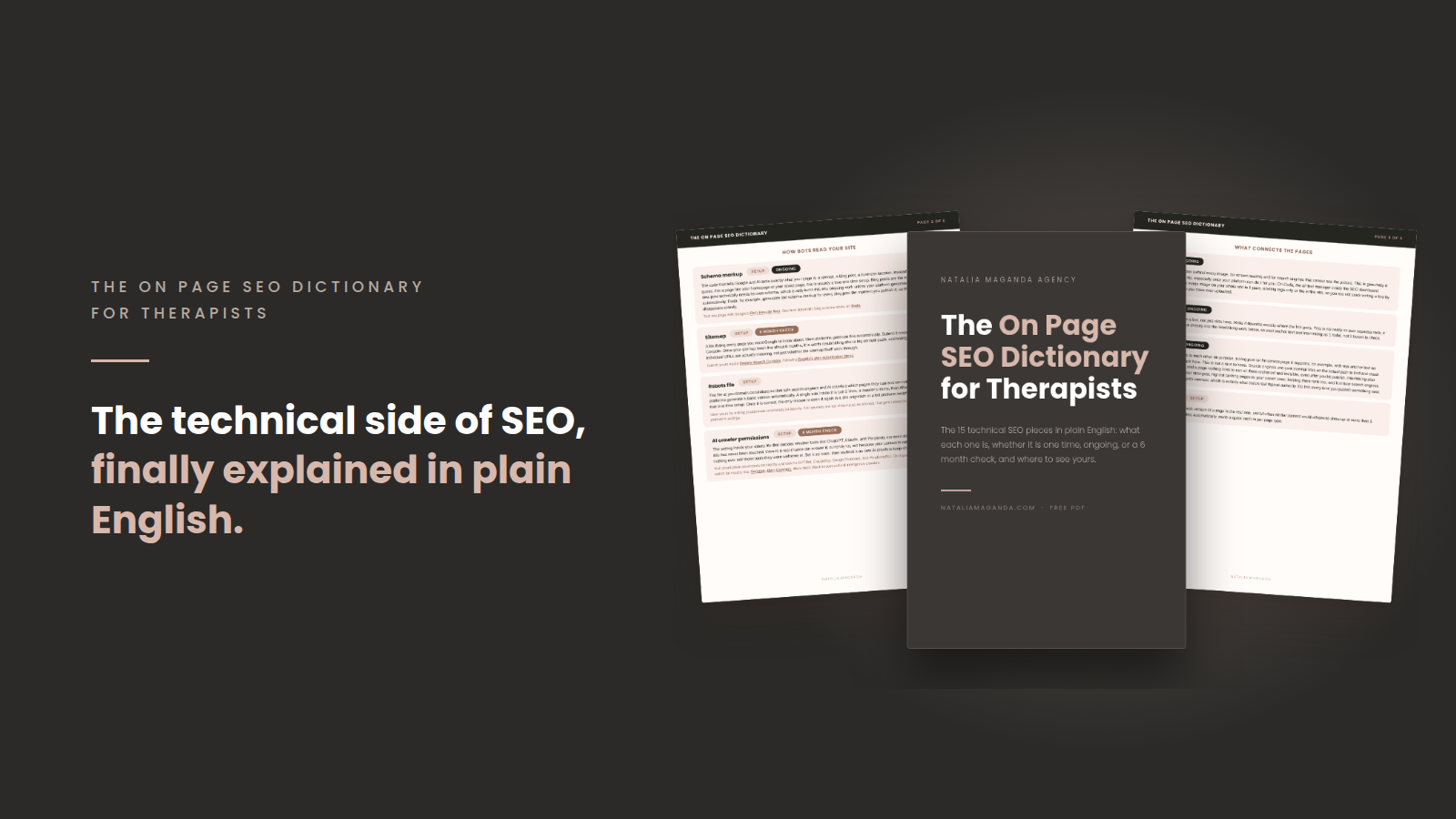
Get my free on page SEO dictionary, which explains meta titles, header tags, anchor text, schema markup, and the other pieces that help bots read your site, so every layer below makes sense as you build it.
How does topical authority work on a therapy website?
It works as a structure with 4 layers, and each layer has one job.
| Layer | What it is | Its job |
|---|---|---|
| Layer 1: Service and specialty pages | Your Revenue Driver pages plus lean specialty pages | Tell Google and AI tools what you are the go to person for |
| Layer 2: Location pages | One page per area you want clients from | Connect that expertise to a place |
| Layer 3: Blog posts | Posts built around 3 buckets of phrases | Support the pages above with depth and fresh content |
| Layer 4: Interlinking | Links between every related page | Show search engines how the pieces connect |
Layer 1: service and specialty pages
Revenue Driver pages are your top 1 to 2 services, the ones that make you the most money and light you up the most. They deserve real, story driven copy, because ranking gets the click and the words get the reply. Specialty pages cover everything else. They can stay lean and keyword forward, and they can use the clinical phrases a researched client types.
Picture a practice built around anxiety therapy for high achieving professionals. That is the Revenue Driver. Burnout and perfectionism are specialty pages that support it. EMDR for trauma is a specialty page that stands alone as a quiet SEO page for other training she holds. Google and AI tools read that whole structure before they read a single sentence of her writing.
This is where my strongest opinion lives. I have managed websites where the foundational sitemap alone, with service pages and specialty pages and no blog published yet, beat local competition and ranked for real commercial keywords. Blogging matters, and the sitemap comes first.
Layer 2: location pages
If you serve one core city, you can localize the pages you already have. If you serve several areas, each one gets its own page with real local detail, and each page points to the services it supports. Location pages that sit on top of thin service pages have little to rest on, so build layer 1 first.
Layer 3: blog posts
Blog posts are the layer most therapists start with, and I cover them in the next section because they deserve their own sorting system.
Layer 4: interlinking
Links hold the other 3 layers together, and I cover them in their own section below.
Which blog posts build topical authority?
The posts that build it come from sorting phrases into 3 buckets, and every bucket has a different job. This is a judgment call, and it takes practice.
- Commercial intent: the searcher is close to booking. Think "anxiety therapist for high achievers."
- Educational: the post builds trust and will not convert today. Think "how to stop overthinking as a high achiever."
- Topical authority: the post shows Google you know the space deeply. Think "signs of high functioning anxiety."
I blog all 3 buckets, and I tie every post to the page it supports. After writing 80 blogs of my own, I was still stuck on page 6 with barely 100 clicks a month, because the site had not earned enough trust yet. I now understand that blogs sit on top of a foundation, and my foundation was thin. Volume could not fix that.
If you want help sorting phrases, my guide to keyword research for therapists covers the tools and the process, and my list of mental health keywords shows 50 phrases sorted by what the searcher wants. Quality beats quantity here. A smaller set of posts that each support a specific page builds more authority than a long pile of loosely related ones.
How does interlinking tie the pieces together?
Interlinking is how search engines travel from one page of your site to the next, and how they work out what the whole site is about. A page with no links pointing to it can be finished and still invisible, because nothing leads there. Google says it uses links as a signal when determining the relevancy of pages and to find new pages to crawl, and the same guidance says, "The better your anchor text, the easier it is for people to navigate your site and for Google to understand what the page you're linking to is about."
Here is the pattern I follow:
- Every blog post links up to the service or specialty page it supports.
- Every specialty page links to the Revenue Driver page above it.
- Revenue Driver pages link down to their specialty pages and to the location pages that apply.
- Anchor text describes the destination in plain words.
My post on content strategy for therapist SEO goes deeper on choosing the few subjects worth building around, which is the decision every link in this pattern depends on.
Does off page authority count toward topical authority?
It counts, and it is the half people skip. Everything above happens on your site. The other half happens elsewhere: backlinks, domain authority, citations, guest posts, press mentions, and online reviews all tell Google and AI tools that other people vouch for you.
I once paid $1,000 for a feature placement that moved my domain authority from about 12 to 20, brought no clients directly, and added to my trustworthiness and to being recommended by AI to therapists who now book discovery calls with me. Many of my clients start at a domain authority of 0 and grow to 6 to 8 within their first year, and that slow build compounds.
It also explains why two practices running the same strategy can get different results. If one has the bigger online reputation, she gets recommended first. Free directories are a should do for every practice, and paid ones build authority slowly without producing a spike in leads.
How do I know topical authority is working?
Track 4 numbers: impressions, clicks, click through rate, and leads. They move together, and the pattern tells you more than any single figure. Impressions without clicks and page 6 rankings tell me a site is starting to get picked up, and both are a cue to keep building authority.
Timelines depend on local competition. With little competition, a site could reach page one in the first 90 days, sometimes 6 months. A bigger metro takes longer, because you are competing with practices that started years ago. I reassess strategy every 6 to 12 months. If nothing has moved by then, that is a real signal to change the plan.
Frequently asked questions
Is topical authority an official Google ranking factor?
Topical authority is an SEO industry term. Google's published guidance uses its own wording and asks whether your site has a primary purpose or focus. I treat topical authority as a useful name for that idea, and the structure in this post is my opinion on how to build it.
How many pages do I need before I have topical authority?
There is no magic number. In my experience, a sitemap with your Revenue Driver pages and the specialty pages that support them can start ranking before any blog exists. Start there, then add location pages and posts that connect to those pages.
Should I write about topics outside my specialties?
Posts that wander away from your Revenue Driver and specialty pages dilute your focus. Write about phrases that connect to a page you want to rank, and link each post to that page. My post on content strategy for therapist SEO shows how to choose those subjects.
Does topical authority matter for AI tools like ChatGPT?
In my experience, the same clarity that helps Google helps AI tools. A site with a clear subject, connected pages, and outside vouching gives them something specific to recommend. A generic site gives them nothing specific to say.
Want this off your plate?
Everything in this post can be done on your own, and it competes with your caseload, your family, and your time. If you would like to hand it over, I'm a therapist website designer who also runs the SEO, so the structure, the copy, and the links get built together from the start.
My website management services keep the site updated and healthy month after month, and my SEO for therapists and SEO for private practices work builds the topical authority we just walked through, layer by layer. If you are ready, apply to work with me. No pressure, just a conversation about what would take the most weight off your desk.
* AI Disclosure: This content may contain sections generated with AI with the purpose of providing you with condensed helpful and relevant content, however all personal opinions are 100% human made as well as the blog post structure, outline and key takeaways.
* Affiliate Disclosure: Some of the links on www.nataliamaganda.com may contain affiliate links meaning that I will get a commission for recommending products at no extra cost to you.

hello! i'm natalia maganda
The website manager for therapists and private practices that you didn't know existed.
We build and manage the 20+ page website that ranks in your city, reflects the depth of your work and books cash-pay clients with ease.
A done for you website management system that lets your practice grow without costing you your energy, your weekends, or your nervous system.