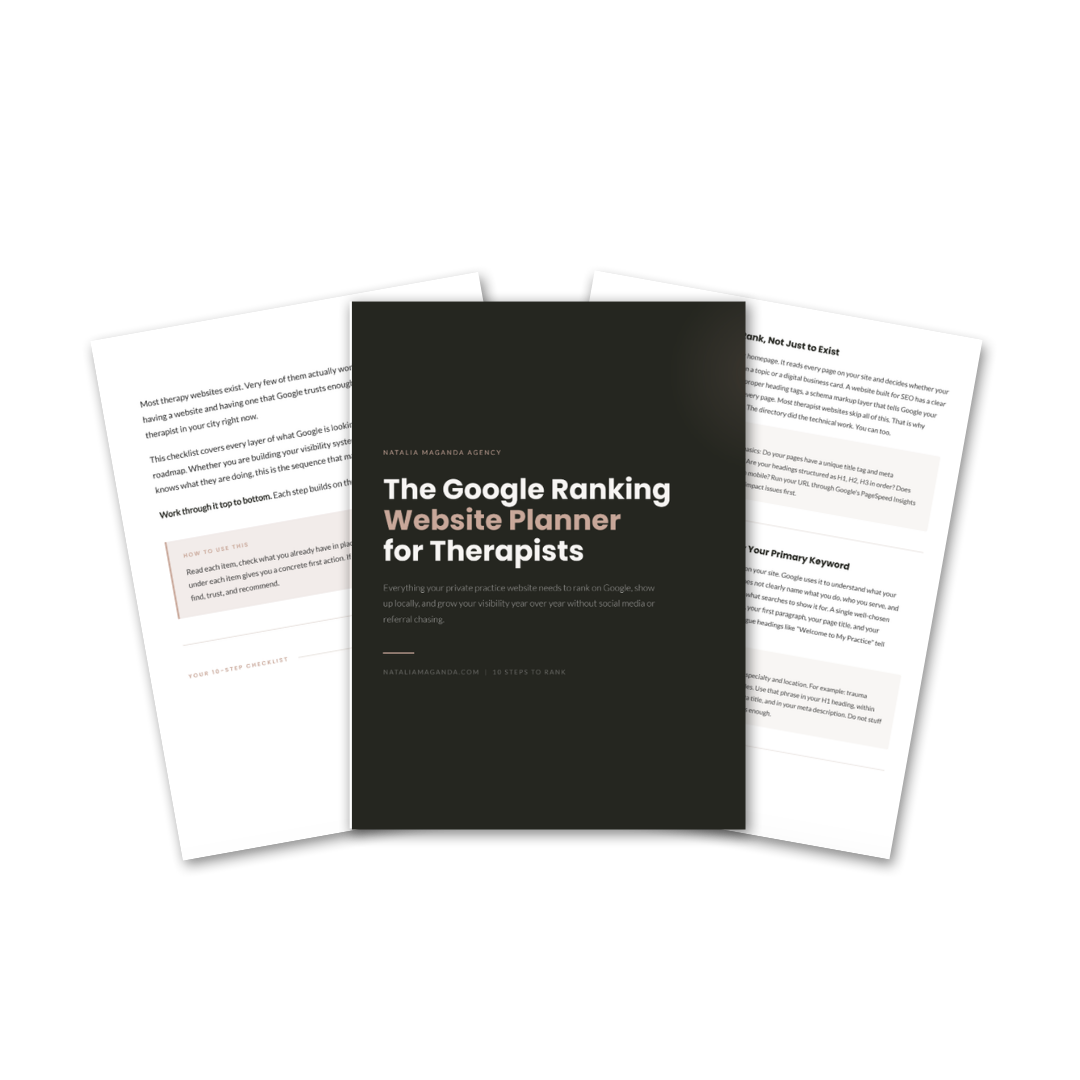

How long do blog posts take to bring in therapy clients? An honest timeline
Blog posts bring in readers, and your website decides how many of those readers become therapy clients. On a well built site, expect first signals around month 4 to 6 and steady inquiries from organic search around month 9 to 12, with little local competition shortening that and a weak site adding 3 to 6 months.
If we haven't crossed paths before, I'm Natalia, the founder of a boutique web design and SEO agency for therapists and private practice owners across the US. My mission is to help your website work as a 24/7 referral engine, so you can log off and still wake up to new inquiries. I have been in business for over 7 years, I have served 100+ clients, and I once wrote 80 blogs for my own site and still sat on page 6 with barely 100 clicks a month. That is why I look at the whole website before I judge any single post.
You have probably published a few posts, or you are about to start, and you want to know when the inquiry emails will show up. You cannot afford to wait a year for nothing, and you do not want your Sunday evenings eaten by writing for a site that never fills your caseload. Fair. Here is the honest timeline.
Key takeaways
- Blog posts bring in traffic. Your service pages, your copy, and the rest of your website turn some of that traffic into inquiries.
- On a well built site, meaningful organic movement starts around month 4 to 6 and compounding results show up around month 9 to 12.
- Only 1.74% of newly published pages reached Google's top 10 within a year in the Ahrefs ranking time study(September 2023 data), and a second analysis in that study gave 6.11%, so a new post needs patience.
- Impressions without clicks and rankings around page 6 mean your site is starting to get picked up.
- Local competition sets your clock, and a strategy review every 6 to 12 months keeps you honest.
Do blog posts actually bring in therapy clients?
Blog posts bring in traffic, and the rest of your website turns some of that traffic into clients. A reader who lands on your post about overthinking is curious. To become an inquiry, that person has to click through to a service or contact page, trust what the copy says, and fill out the form. Every one of those steps lives outside the blog post.
That is why I look at the whole path when someone asks how long a blog will take. A post can rank well and still produce nothing if the pages behind it are weak. I covered the copy side in how to improve your therapist website conversion rate without adding pages, so I will skip that here. What this post adds is timing: when each layer shows up in your numbers.
Here is the path a reader takes, with the place to check at each step.
| Step | What has to happen | Where to check |
|---|---|---|
| 1st | Google shows your post | Impressions in Search Console |
| 2nd | The reader clicks | Clicks and click through rate |
| 3rd | The reader moves to a service or contact page | Internal links in the post and page views in your analytics |
| 4th | The page makes them feel seen | The headline and copy on that service page |
| 5th | They send an inquiry | Contact form submissions from organic search |
When one step is weak, the blog cannot make up for it. Fixing the website layers is usually the fastest way to shorten your timeline.
If the pages behind your blog are the weak link, start with your sitemap, meaning the list of pages your site needs and the main phrase each one targets. I made a free sitemap planner for exactly this.
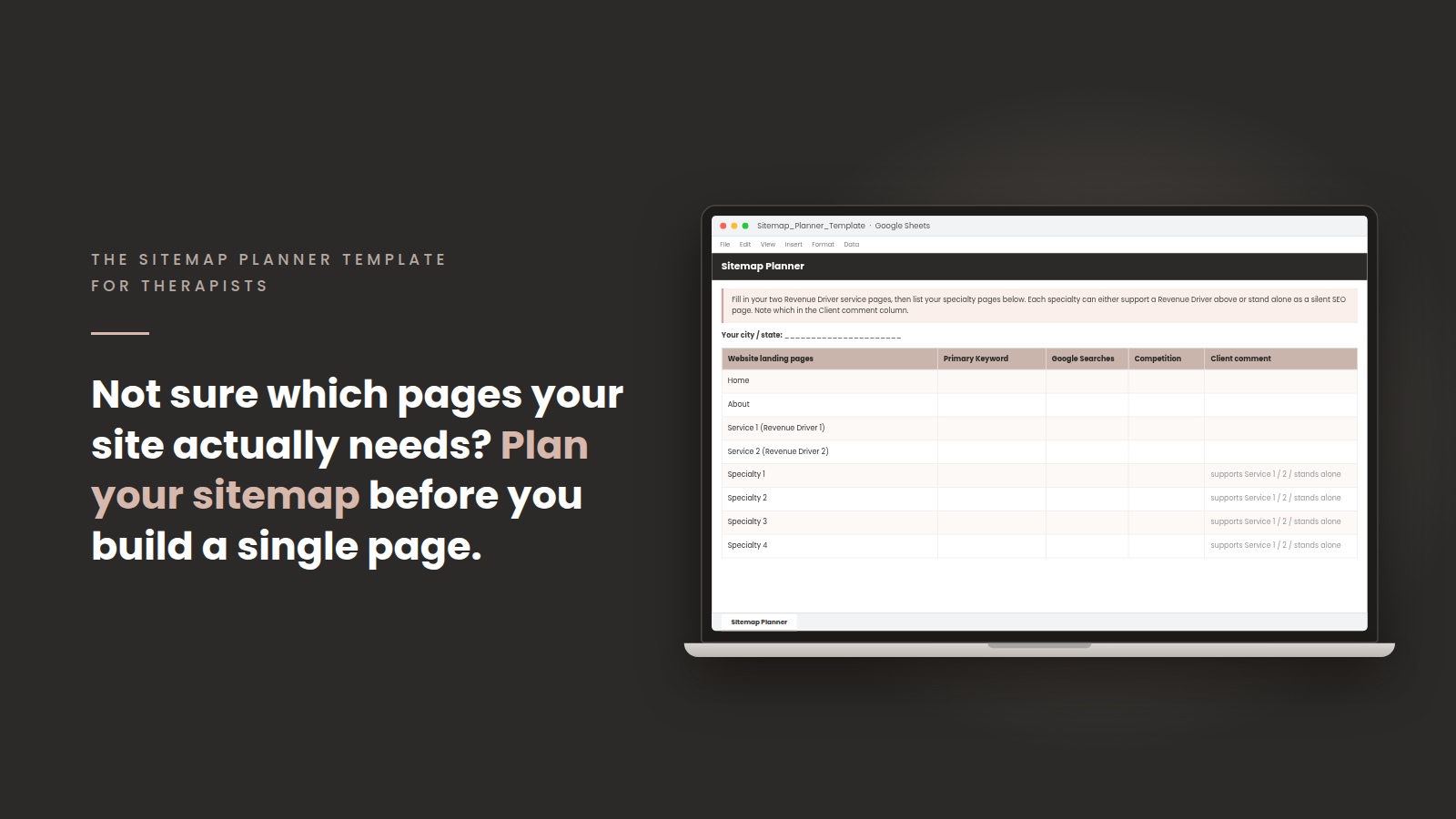
Get my free sitemap spreadsheet planner, list the pages you have today, and mark which ones a blog reader would land on next.
How long does it take for blog posts to bring in therapy clients?
For a well built site, my answer matches the one I give for SEO as a whole, which I lay out in how long SEO takes for therapists. Meaningful organic movement starts around month 4 to 6, and compounding results show up around month 9 to 12. A site with a weak structure needs another 3 to 6 months of repair before that clock really starts.
| Window | What you will see |
|---|---|
| Months 1 to 3 | Foundation work, with almost no visible ranking movement |
| Months 4 to 6 | Pages begin to appear for lower competition searches, and organic traffic starts a slow climb |
| Months 7 to 12 | Multiple pages ranking, steadier traffic, and new inquiries from organic search |
Those are my positions on timing, and they assume your website does its job. For outside context, the Ahrefs ranking time study(September 2023 data) took 1 million random URLs and found that only 1.74% reached the top 10 within a year. A second analysis of 2 million URLs created in October 2023, limited to non empty English content, gave 6.11%, which Ahrefs says might be a fairer number. Both cover pages across every industry, so treat them as a reality check and read your own timeline from the table above.
A blog is still worth building. I think of it as the engine that feeds authority and internal links to the pages that book clients, and steady publishing beats sporadic bursts. I have also managed websites where the foundational sitemap alone, with service pages and specialty pages and no blog published yet, beat local competition and ranked for real commercial keywords. Those pages reached people searching with a booking in mind long before a single post existed. When I build a site, the pages come first and the blog layers on top.
Is it normal to get impressions with no clicks, or to sit on page 6?
Yes. Impressions without clicks and rankings around page 6 mean your site is starting to get picked up. I know this from my own sites. I wrote 80 blogs for my own website and still sat on page 6 with barely 100 clicks a month, because the site had not earned enough trust yet.
Trust grows through authority, meaning other sites linking to yours, directory listings, and a consistent Google Business Profile. Many of my clients start at a domain authority of 0 and grow to 6 to 8 within their first year, and the leads do not appear the second that number moves. It compounds slowly.
Track 4 numbers together: impressions, clicks, click through rate, and leads. They correlate with each other, and the pattern across them tells you more than any single one. I walk through what healthy movement looks like in how to tell if your therapy practice SEO is actually working.
Why is my timeline different from another therapist's?
Local competition sets the pace. With little competition, a site could reach page one in the first 90 days, sometimes 6 months. In a bigger metro you compete with practice owners who have run this strategy for years, and the same work takes longer.
Online reputation shifts the pace too. Two practices in the same city can run the same strategy and see different results when one has the bigger reputation. I once paid $1,000 for a feature placement that moved my domain authority from about 12 to 20, which added to my trustworthiness and to AI tools recommending me to therapists who now book discovery calls with me, even though no clients came directly from that feature.
If your city is crowded, choose your topics with care. Here are the 3 types of phrases I plan blog topics around.
| Type of phrase | What it does for you |
|---|---|
| Commercial intent | The searcher is close to booking |
| Educational | Builds trust, and rarely converts the same day |
| Topical authority | Shows Google you know the space |
I blog all 3 types, because each one does a different job. A post aimed at a commercial phrase that links to the right service page does more for your timeline than a pile of posts on vague topics.
How do I read my numbers at month 6?
Say a practice reaches month 6 with 3,000 impressions, 60 clicks, 4 visits to a service page, and 0 inquiries. These numbers are made up, and they show the method. Read them from the top of the path down.
- Plenty of impressions, few clicks: the post ranks, and the title and meta description need a stronger reason to click.
- Decent clicks, almost no service page visits: the post has no clear internal link or invitation pointing to the page that books clients.
- Service page visits, no inquiries: the headline, the copy, or the contact form needs work.
Reassess every 6 to 12 months. If nothing moves in that window, that is the moment to ask who can look at the strategy with you and what to change.
Frequently asked questions
How long until a new blog post shows up on Google?
Getting indexed and ranking are two different events. A post can be indexed and still sit on page 6 for months, and the Ahrefs ranking time study(September 2023 data) found that only 1.74% of newly published pages reached the top 10 within a year. A second analysis of English pages with content created in October 2023 gave 6.11%. I treat the first 3 months as foundation time.
Is page 6 a bad sign for my therapy website?
No. Page 6 means your site is starting to get picked up. It is a sign to keep building authority and keep competing.
Why does it take longer in a big city?
You compete with practice owners who have been doing this for years. The same strategy plays out differently depending on where you practice, so slow progress can simply reflect your market.
Should I stop blogging if I have no inquiries after 6 months?
Check the path first. Look at impressions, clicks, service page visits, and form submissions, then fix the weakest step. If nothing moves after 6 to 12 months of steady work, change the strategy with someone who can read your numbers.
Want this off your plate?
Everything in this post can be done on your own. It also competes with your caseload, your family, and your time, and the timeline above runs on months of steady work. As a therapist website designer who also runs the SEO, I build the pages your blog readers land on and keep them working through website management services, so the layers behind your posts stay strong.
On the SEO side, I handle SEO for therapists and SEO for private practices, which means your sitemap, your posts, and your tracking sit with one person. If you would like to talk it through, apply to work with me. No pressure, just a conversation about what would take the most weight off your desk.
* AI Disclosure: This content may contain sections generated with AI with the purpose of providing you with condensed helpful and relevant content, however all personal opinions are 100% human made as well as the blog post structure, outline and key takeaways.
* Affiliate Disclosure: Some of the links on www.nataliamaganda.com may contain affiliate links meaning that I will get a commission for recommending products at no extra cost to you.

hello! i'm natalia maganda
The website manager for therapists and private practices that you didn't know existed.
We build and manage the 20+ page website that ranks in your city, reflects the depth of your work and books cash-pay clients with ease.
A done for you website management system that lets your practice grow without costing you your energy, your weekends, or your nervous system.