
How to Improve Your Therapist Website's Conversion Rate Without Adding More Pages
Most visitors do not read your website. They scan it. Research from the Nielsen Norman Group found that seventy nine percent of people always scan a new page rather than reading it word by word, which means your therapist website's conversion rate gets decided in the first few seconds of a scroll, not the third paragraph of your about page. If your site is not converting, the fix is rarely a missing page. It is almost always the words and the psychology sitting on the pages you already have.
This post is not about rebuilding your homepage or adding five new specialty pages before your next launch. It is about the specific psychological triggers, most of them copywriting decisions, that turn someone scanning your site into someone who books a consultation call. I am walking through every scroll your homepage, about page, and service page already need, section by section, and showing you exactly what generic copy looks like sitting next to copy built to convert.
In case you are new here, I am Natalia Maganda, a web design for therapists and private practice owner who believes your website should be doing the convincing while you are in session, not the other way around. Everything below is a copy and structure fix, not a redesign, which means you can act on most of it this week.
Why your therapist website might not be converting clients yet
If your website already gets traffic and still is not booking consultations, that is a different problem than the one this post solves. Getting found on Google in the first place is a SEO for therapists and private practice problem, and it deserves its own fix if your analytics show barely any visitors at all. What this post assumes is that people are already landing on your site, and the reason they are leaving without booking has much more to do with what they read in the first ten seconds than anything technical.
If you want the fuller picture of what makes a therapy website convert once traffic is already flowing, I covered that broader strategy in private practice website design: what actually makes a therapy website convert. This post goes narrower on purpose. It is a working list of the psychological triggers you can apply to the pages you already have, starting with the one that does the most damage when it is missing.
Lead with the clarity formula, not a clever headline
The generic headline problem: sounds nice, says nothing
Most therapist homepages open with a headline that could belong to any practice in the country. Compassionate, client centered care. A safe space to heal and grow. Support for life's challenges.
Every word in those headlines is true, and none of them tell a scanning visitor whether they are in the right place. A person deciding in five seconds whether to keep reading needs a headline that answers one question immediately. Is this for someone like me. A headline that could be copied onto ten other therapist websites without anyone noticing is not doing that job, no matter how warm it sounds.
The clarity formula: I help [target audience] overcome [pain point] to [desired outcome]
The fix is a formula, not a personality. I help [target audience] overcome [pain point] to [desired outcome].
Generic: compassionate therapy for individuals and families.
Specific: I help high achieving women move through anxiety without shutting down every night at nine, so they can lead their teams and their homes with the same energy.
Generic: support for couples going through hard seasons.
Specific: I help couples stuck in the same fight on repeat find their way back to each other before resentment becomes the whole relationship.
Generic: therapy for teens navigating life's ups and downs.
Specific: I help teenagers who have stopped talking to their parents find their voice again before high school ends.
Notice what changes between each generic and specific pair. The target audience narrows from everyone to a specific person.
The pain point moves from a vague feeling to an exact, recognizable moment.
The outcome stops being a mood, calm, peace, and starts being a concrete change in someone's actual life. That is the psychological trigger doing the work. Specificity reads as recognition, and recognition is what gets someone to keep scrolling instead of hitting the back button. I broke down the exact language patterns that make this kind of homepage and service copy convert in therapist website copy: the exact words each page needs to turn a stranger into an inquiry, if you want to carry this same formula through every page on your site, not just the header.
Use the space below your header to name the exact problem you solve
Generic empathy versus specific recognition: what actually makes someone feel seen
The scroll below your header is where most therapists either build trust or quietly lose it.
Generic empathy sounds like this: You do not have to face this alone. We are here to support you on your journey. It is warm, and it is also the exact sentence every wellness brand on the internet has already used on someone who was scrolling right past it without slowing down.
Specific recognition sounds like this instead: You are the one everyone else calls when they need to fall apart, and you have not had a place to do that yourself in years. Or, for a different specialty: You have read every parenting book, tried every strategy, and your child is still melting down every single morning before school. Neither sentence is more compassionate than the other.
The second version does something the first cannot. It proves you understand this specific person's exact situation before they have said a single word to you, and that proof is the trigger that gets someone to keep reading instead of closing the tab.
Make your differentiation impossible to miss
Why "personalized care" and "safe space" stopped being differentiators
If your differentiation block currently says something about personalized, judgment free, safe space care, you are describing the baseline expectation of therapy, not a reason to choose you over the next practice in the search results.
Every licensed therapist offers a safe, judgment free space. Saying so again does not separate you from anyone. Real differentiation names your actual mechanism, not what you offer, but how you get people there differently than someone else would.
Not I use a personalized approach, but I use EMDR specifically with high performing professionals who have already tried years of talk therapy without the change actually sticking.
Not I create a safe space for healing, but sessions are built around your nervous system's actual pace, not a fifty minute clock, which is why clients often need fewer months with me than they did with previous therapists.
A sentence like that cannot be copied and pasted onto a competitor's website without it being obviously untrue, and that is exactly what makes it a differentiator instead of a description. I go through what belongs in this exact section, along with every other homepage scroll, in what to include on your therapist homepage.

Frame your service offerings and freebie as one clear next step, not two separate asks
What you do versus what changes for them
Service offerings that list modalities, EMDR, CBT, somatic work, are written for other clinicians, not for the person trying to decide whether therapy will actually help them. The psychological trigger that moves someone from reading to booking is transformation language, not method language.
Instead of EMDR for trauma processing, try this: Leave sessions with the memory still yours, just without the grip it used to have on your nervous system. Instead of couples communication skills training, try this. Learn to have the hard conversation without either of you shutting down halfway through it. The method stays true in both cases. What changes is whether the reader can picture their own life on the other side of working with you.
Your freebie deserves the same treatment. A generic checklist offered as an afterthought in your footer reads as an afterthought, and visitors treat it that way too. Positioned as the lowest risk next step, a short, specific resource that solves one small piece of the same problem your paid work solves, it becomes the natural bridge for someone who is interested but not ready to book a consultation call today. The freebie and your main offer should feel like two steps on the same path, not two separate pitches competing for the same click.
Let your bio and social proof build trust, not just list credentials
Specific proof beats a five star badge
Credentials matter, and leading with them is not the same thing as burying the reason you earned them in the first place. A bio that opens with a list of certifications reads as a resume. A bio that opens with why you do this work, then lets the credentials serve as proof of that reason rather than the headline itself, reads as an actual person. Generic: Licensed therapist with over ten years of experience helping clients heal. Specific: I became a therapist because I spent my twenties watching high achieving women, myself included, burn out while looking completely fine from the outside. The ten years of licensure and training come after that sentence, as evidence, not as the introduction.
The same logic applies to testimonials. A five star badge tells a visitor nothing they could not have already assumed. A specific testimonial, in a client's own words, about the exact fear they had before their first session and what actually changed by the twelfth, does the psychological work a star rating cannot. It lets a new visitor see themselves in someone who already went first, which is a far stronger trigger than a number out of five.
Put your call to action above the fold, then close the loop without pressure
Repetition is not pushy, silence is what loses the client
A single call to action buried at the bottom of a long homepage assumes every visitor will scroll the entire page before deciding anything. Most will not. Your primary call to action belongs above the fold, worded as an invitation rather than a directive. Book a free consultation reads as a transaction. Let's talk about what is actually going on reads as the start of a conversation. Both lead to the same form. Only one feels like something a person in distress actually wants to click.
Repeating that same invitation, worded consistently, at the bottom of every major section is not pushy. It is simply meeting the visitor wherever they decided they were ready, instead of hoping they remember to scroll all the way back up to find it. The visitors who leave without booking rarely leave because you asked too many times. They leave because the ask was never there when they finally felt ready to say yes.
Check the technical foundation your psychology cannot overcome
Site speed, mobile experience, and what your analytics are already telling you
None of the copy above will convert a visitor who never gets to read it. Google's own guidance on page experience is direct about this, noting that good Core Web Vitals and a site that displays well on mobile devices are foundational to whether a page feels satisfying to use at all, regardless of how good the words on it are.
Most therapist website traffic arrives on a phone, often late at night after a hard day, and a slow load or a form that is difficult to fill out on a small screen will lose that visitor before your headline ever gets read.
Before you rewrite a single section, open your analytics and look at where visitors are actually leaving. If most of your traffic drops off on mobile specifically, the fix might be technical before it is ever about the words.
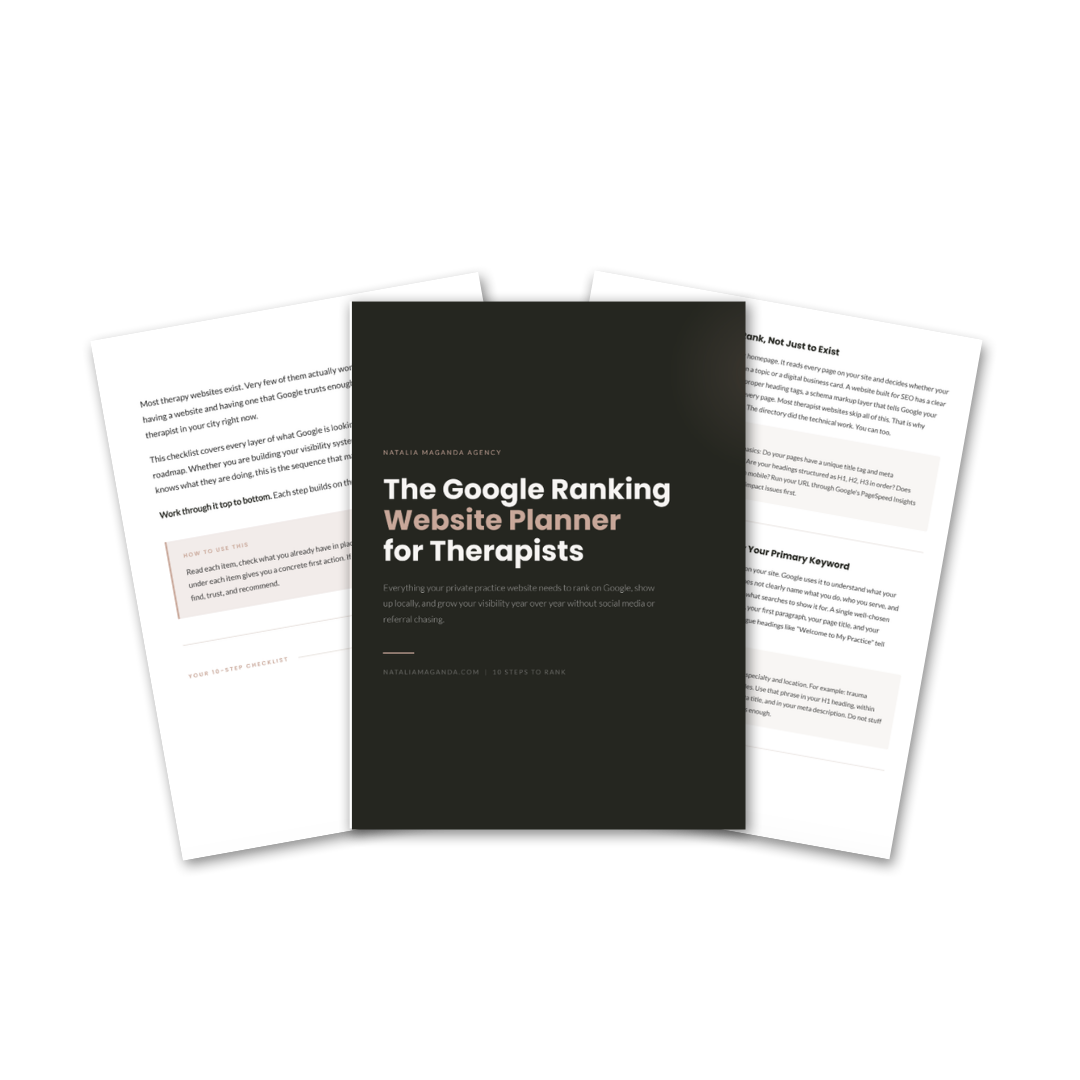
If you do not already have a simple, honest way to check this, I outlined exactly what to look at and in what order in therapist website design checklist: the ultimate planner you need to rank on page 1, so you spend your time fixing the section that is actually costing you inquiries, not just the one you assume is the problem.
You don't have to navigate your therapist website's conversion rate alone
Rewriting every scroll on your website while still running a full caseload is not a realistic ask, and you should not have to choose between seeing clients this week and fixing the words that are supposed to be working for you while you do.
I help therapists and private practice owners build websites where the psychology behind every section, the headline, the differentiation, the bio, the call to action, is doing the work of turning a stranger into an inquiry, paired with SEO for therapists and private practice so the right people are finding that website in the first place.
If your site already gets traffic and you are ready for someone else to handle the words, the structure, and the strategy behind all of it, that is exactly the work I do inside a full website and visibility system built around your specific practice.
* AI Disclosure: This content may contain sections generated with AI with the purpose of providing you with condensed helpful and relevant content, however all personal opinions are 100% human made as well as the blog post structure, outline and key takeaways.
* Affiliate Disclosure: Some of the links on www.nataliamaganda.com may contain affiliate links meaning that I will get a commission for recommending products at no extra cost to you.

hello! i'm natalia maganda
The go-to website designer and SEO manager for therapists and private practice professionals that you didn't know existed
After designing 100+ websites for women in many industries, I ended up in the healing world because I believe in the power of emotional work and in supporting the people who support everyone else. Now, I’ve built an online presence that allows me to have more
time to spend with my family, more
income working with fewer clients and
less stress with sustainable marketing systems! And that’s exactly what I want for you. We manage 20+ websites and I’m ready for you to be the next one.