
How many blog posts does a therapy website need? 5 checks
There is no universal number. A therapy website needs enough blog posts to answer the questions your future clients actually type, on top of a sitemap that already covers your services and specialties, and for most practices that works out to about 1 to 2 posts a month once the foundation is built.
If we haven't crossed paths before, I'm Natalia, the founder of a boutique web design and SEO agency for therapists and private practice owners across the US. My mission is to help your website work as a 24/7 referral engine, so you can log off and still wake up to new inquiries. I have been in business for over 7 years, I have served 100+ clients, and I have managed over 900 URLs for other people's practices. I also wrote 80 blogs for my own site and still sat on page 6 with barely 100 clicks a month, so I have strong opinions about what a post count can and cannot do for you.
You probably landed here because someone told you to blog every week, or because your blog has 6 posts from 2 years ago and a nagging voice says it should be more. You want a number you can put on a calendar and then stop thinking about. I am going to give you the criteria that produce your number, because a figure I made up would help nobody.
Key takeaways
- Your blog count comes after your sitemap. Service pages and specialty pages come first, and a site can rank for real commercial keywords before a single post is published.
- 4 things set your number: the strength of your site foundation, the size of your local competition, how many service and specialty pages need support, and how many buyer questions you can answer with real depth.
- At my agency we publish 24 blog posts per year for clients. I treat that as a default for a site with a finished foundation, and I adjust it with the checks in this post.
- Every numeric example below is labeled as made up. They illustrate the logic and nothing more.
- Writing 80 blogs left me stuck on page 6. Depth and a tie to your revenue pages do more work than volume.
What is the right number of blog posts for a therapy website?
The right number is the count of posts you can publish at real depth, aimed at questions your ideal client asks, and linked to pages on your site that bring in revenue. Any single figure you read online is a guess about someone else's practice, so I will skip the benchmark.
If you are still weighing whether to blog at all, I covered that in do therapists need a blog for SEO. This post starts after that decision, at the practical question of how many.
Here are the 5 checks I run, in order.
Should I build my sitemap before I write any blog posts?
Yes. Check 1 is your site foundation, and for a brand new site the honest starting count is 0 posts.
I have managed websites where the foundational sitemap alone, with service pages and specialty pages and no blog published yet, beat local competition and ranked for real commercial keywords. Those are people searching with their wallet out, ready to book. In my opinion, a strong sitemap matters more than blogging constantly.
Picture your sitemap as 2 layers. Your top 1 to 2 service pages are Revenue Drivers, and they deserve real, story driven copy. Everything else is a specialty page, lean and keyword forward, either supporting a Revenue Driver or standing alone as a quiet SEO page. If those pages are missing, a blog post has nothing to link to and nothing to support. I walk through the page list in what pages a therapist website should have, so finish that first.
If your sitemap is ready, the best next step is a system for tracking every post you plan and publish. I made a free blog database and KPI template for exactly this.
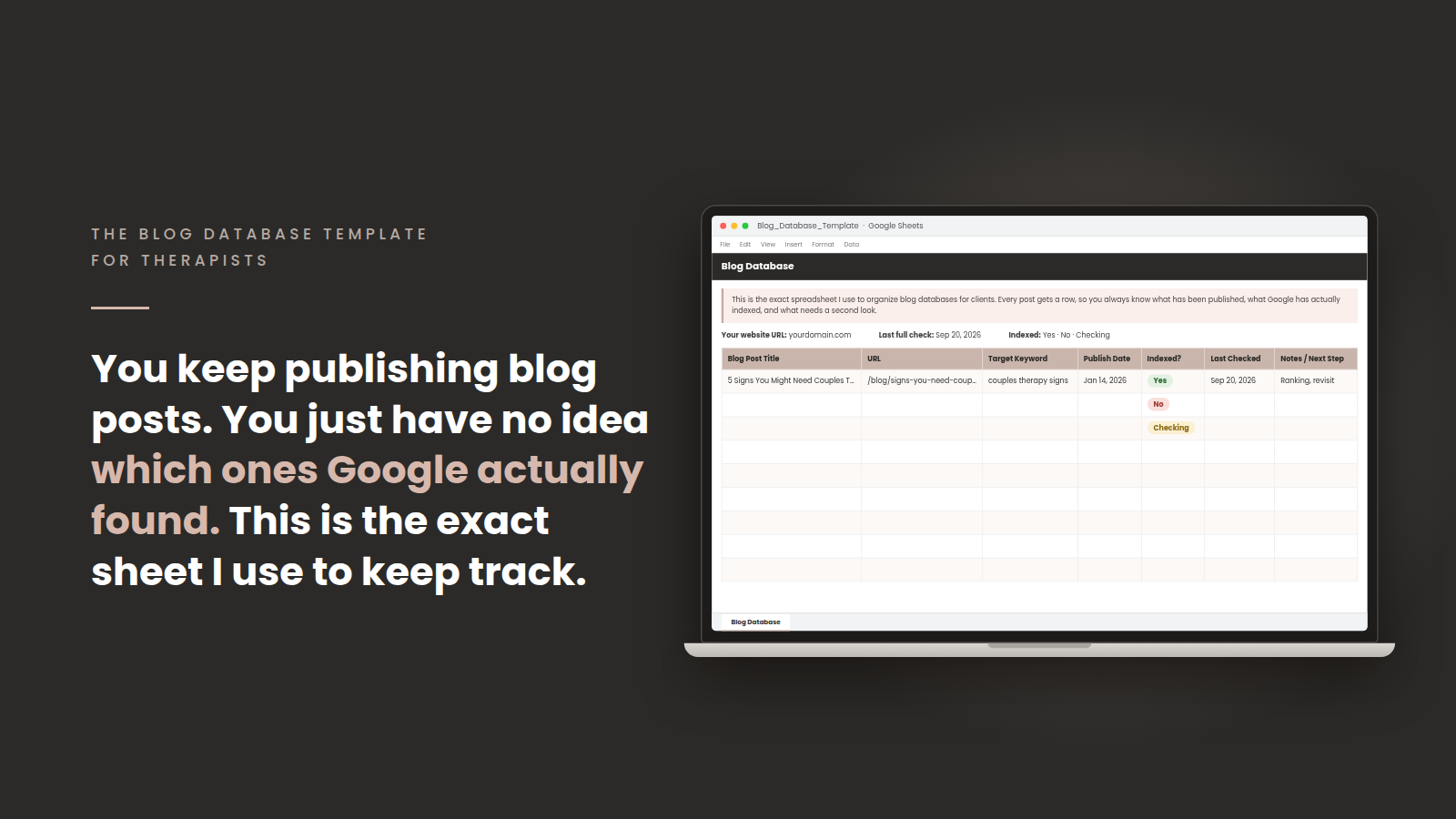
Get my free blog database and KPI template, list the posts you have today, and see how many questions are still unanswered on your site.
How does my local competition change the number?
Check 2 is the size of your competition, and it shapes how fast results show up and which phrases you pick first. With little local competition, a site could reach page one in the first 90 days, sometimes 6 months. In a bigger metro you are up against practice owners who have been building this for years, so the same work takes longer.
Here is the judgment call I make. Search the 3 phrases you most want to rank for, open the blogs of the practices that show up, and look at their depth and their dates. If a competitor has 40 posts that all skim the surface, 40 shallow posts are easy to beat. Pick the 5 or 6 phrases where you can go deeper than anyone else in your city, and publish those first.
If your competitors have been publishing consistently for years, expect to be behind on infrastructure. That is a reason to start with commercial intent phrases that have lower competition.
Which buyer questions deserve their own post?
Check 4 is your list of buyer questions. A question earns a post when your ideal client really asks it, when you can answer it in more depth than the first page of Google does today, and when no existing page on your site already answers it.
I sort every phrase into 3 buckets before it goes on a calendar:
- Commercial intent, where the searcher is close to booking.
- Educational, which builds trust but will not convert today.
- Topical authority, which shows Google you know the space.
Blog all 3 over time. The count of posts you need is the count of distinct questions that pass this filter. Your own consultation calls are a good source, because the questions people ask you out loud tend to be the questions they type at 11pm.
How many posts should I publish in a year?
Check 5 is your real capacity, and it decides the pace. A post you cannot finish at full depth is worse than a post you skip. Here is how the checks combine, with every number made up to show the logic and none of them a benchmark.
At my agency we publish 24 blog posts per year for clients, which is 2 a month. I treat that as a solid default once a site has its foundation, and I move it up or down with the 5 checks above.
What happens if I publish more posts than I can do well?
You build a large database of posts that never make money. I know because I did it. After writing 80 blogs of my own, I was still on page 6 with barely 100 clicks a month, because my site had not earned enough trust yet. Volume and quality have almost nothing to do with each other.
There is a whole industry selling autoblogging and prompt packs that promise 100 posts overnight. In my experience, a post that leads with a keyword and treats the human reader as an afterthought reads exactly like that. Before anything goes live, I ask 4 questions:
- Is this helpful and human, or does it only check a keyword box?
- Are the sections that deserve depth deep enough?
- Does it answer every question my ideal client has about this topic?
- Am I avoiding a question because it feels uncomfortable to answer?
If any answer is no, the post is not ready, and a smaller count with all 4 yeses will outperform a bigger count with none.
How will I know if my number is working?
Track 4 numbers: impressions, clicks, click through rate, and leads. They move together, and I read them as a set. Impressions with no clicks yet is a normal early sign. Page 6 means you are starting to get picked up, and it is a signal to keep building authority.
Reassess every 6 to 12 months. If impressions rise and your pages climb, hold your pace. If nothing moves after 6 to 12 months, revisit your keyword choices before you add volume, because the phrases are usually the culprit.
Frequently asked questions
Is 1 blog post a month enough for a therapist?
Not really but if each post answers a real buyer question in depth and links to a page that earns revenue. A single strong post a month keeps your site active, which matters because a site that publishes 5 pages and then goes quiet gives Google little to work with. For help planning those posts, see blogging basics for therapists. The best volume is minimum od 2 or more per month.
How many blog posts does it take to rank on page one?
There is no number. I have managed a foundational sitemap with no blog that beat local competition, and I have written 80 blogs and sat on page 6. Rankings follow trust, depth, and how crowded your city is.
Should I publish a batch of posts when I launch my website?
A launch batch works when every post targets its own distinct question and links to a page on your site. Finish the service and specialty pages first, then release posts on a schedule you can keep.
What if my competitors have far more posts than I do?
Their count tells you very little. Look at depth, dates, and whether their posts target phrases that bring clients. Pick the phrases where you can answer better than they do and start there. But a lot of people have no idea what they are doing with SEO so if you copy a bad strategy it won't get you anywhere. Build from data not from what others are doing.
Want this off your plate?
Everything in this post can be done on your own. It also competes with your caseload, your family, and the hours you have left in a day, and having a website is a job you probably never signed up for.
As a therapist website designer who also runs the SEO, I build the sitemap first and plan the blog around it, so every post has a page to support. Our website management keeps the site and the publishing calendar moving each month, and the SEO work for solo practitioners lives under SEO for therapists, while group practices can look at SEO for private practices. That is how your post count gets decided by your structure and your market, and you stop carrying the spreadsheet.
If that sounds like a relief, you can apply to work with me. No pressure, just a conversation about what would take the most weight off your desk.
* AI Disclosure: This content may contain sections generated with AI with the purpose of providing you with condensed helpful and relevant content, however all personal opinions are 100% human made as well as the blog post structure, outline and key takeaways.
* Affiliate Disclosure: Some of the links on www.nataliamaganda.com may contain affiliate links meaning that I will get a commission for recommending products at no extra cost to you.

hello! i'm natalia maganda
The website manager for therapists and private practices that you didn't know existed.
We build and manage the 20+ page website that ranks in your city, reflects the depth of your work and books cash-pay clients with ease.
A done for you website management system that lets your practice grow without costing you your energy, your weekends, or your nervous system.