
Does schema help therapists get cited by AI?
No. Google's documentation says there is no special schema.org structured data you need to add to appear in its AI features, so schema markup does not earn a practice a citation on its own. It still does a few useful jobs, and a short list of types is worth having on a therapy website.

If we haven't crossed paths before, I'm Natalia, the founder of a boutique web design and SEO agency for therapists and private practice owners across the US. My mission is to help your website work as a 24/7 referral engine, so you can log off and still wake up to new inquiries. I have been in business for over 7 years, I have served 100+ clients, and I have managed over 900 URLs for other people's practices, so I have seen structured data done well, done wrong and skipped entirely.
Maybe you read that you need schema so ChatGPT will recommend your practice. Maybe an SEO tool flagged "missing structured data" and it has been sitting on your to do list ever since. You have a full caseload, and you want to know if this deserves an afternoon of your week.
Key takeaways
- Google says there is no special schema.org structured data to add for AI Overviews or AI Mode. A page needs to be indexed and eligible to show in Google Search with a snippet.
- Schema still helps Google understand a page, and it is how a page becomes eligible for some rich results, according to Google's structured data introduction.
- For a therapy practice, my ranked pick is LocalBusiness first, then Organization, Breadcrumb, a Person or ProfilePage for each clinician, and Service for service pages.
- Markup has to match the visible text on the page. Mismatched details, hidden content and review markup you control are the traps.
- I could not confirm from a primary source that ChatGPT, Perplexity or Claude use schema markup, so I will not claim they do.
Does Google require schema markup to appear in AI Overviews and AI Mode?
No. Google's AI features documentation says "There's also no special schema.org structured data that you need to add," and that you "don't need to create new machine readable files, AI text files, or markup to appear in these features."
The same page spells out what a page does need. To be eligible as a supporting link in AI Overviews or AI Mode, a page must be indexed and eligible to be shown in Google Search with a snippet. Google adds that meeting every requirement does not guarantee a page will be crawled, indexed or served. It also says SEO best practices remain relevant for these features, and it lists two that matter here: making sure important content is available in textual form, and making sure your structured data matches the visible text on the page.
My read as someone who builds therapist sites: eligibility comes first, and the words on the page come second. A practice whose service page is indexed, written in plain text and answers a client's question directly has done the work Google describes. I wrote about that part in how to get cited by ChatGPT and AI Overviews with your therapist website, and the wider picture of AI and Google visibility is in my SEO guide for therapists, ChatGPT and AI authority.
What does schema markup still do for a therapy website?
Schema gives search engines explicit clues about what a page is. Google's introduction to structured data says you can help Google understand a page by including structured data, and that you must include all required properties for an object to be eligible for an enhanced display in Search. That is the honest case for schema: clearer labels for crawlers, and eligibility for the rich results Google supports.
For a local practice, the most relevant supported feature is Local Business. Google's local business structured data documentation says this markup can help pages appear in a unique Google Search result, with business details shown in the knowledge panel. Google's list of supported structured data features also names Organization, Breadcrumb and Profile page, which fit a practice site well.
Think of schema as a plain label on each room of your website. It tells a crawler "this is a practice, here is its name, phone and address" so nothing has to be guessed. A well labeled empty room still has nothing to cite, so the content and the authority around your site decide most of what happens.
If you want the plain language version of every on page detail, start with the dictionary. I made a free on page SEO dictionary for exactly this.
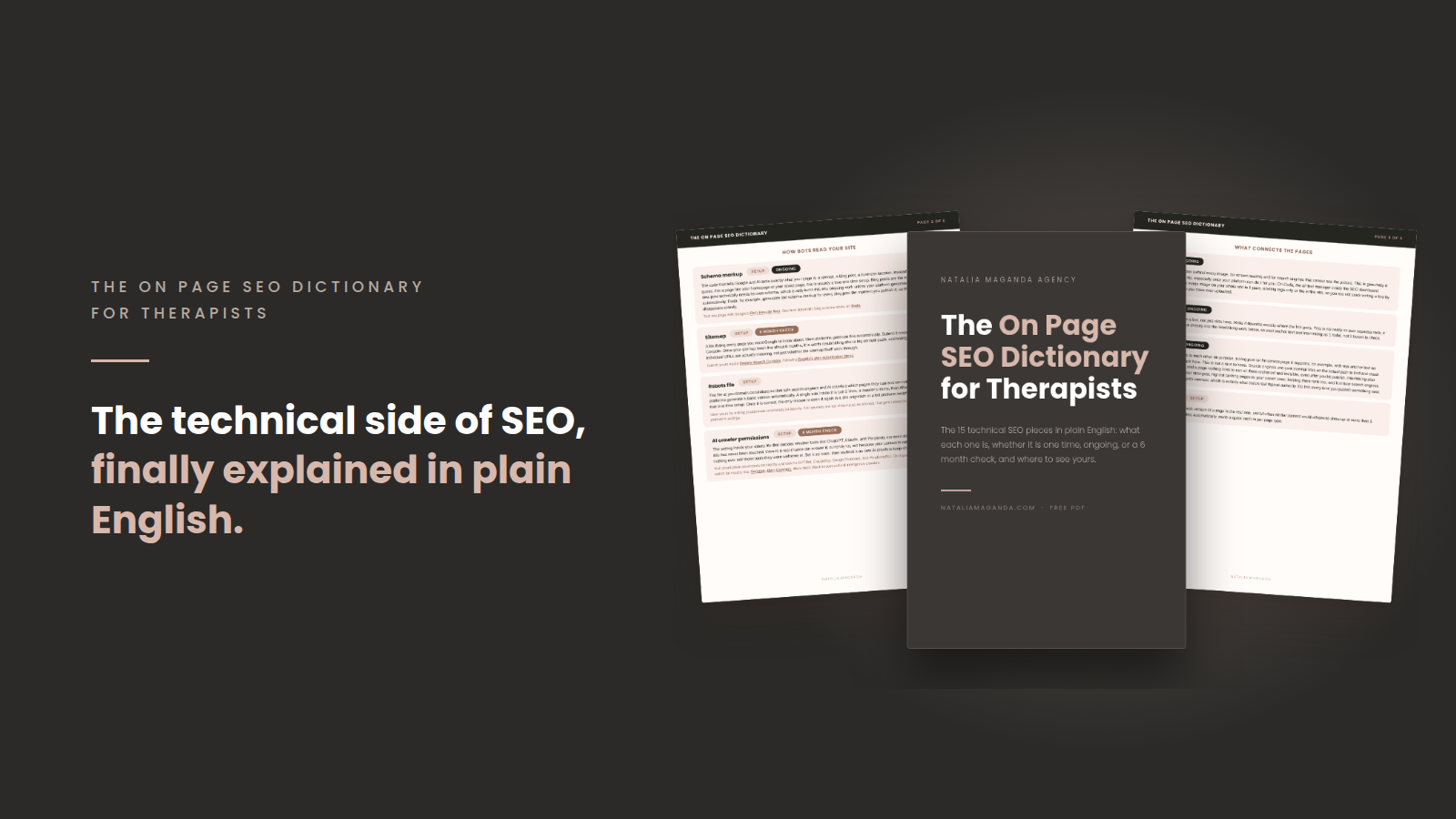
Get my free on page SEO dictionary, pick one page on your site, and check it item by item for schema, meta tags and header tags.
Which schema types are worth having on a therapy website?
Here is my ranked list, and the criteria behind it. A type earns a high rank when it meets 3 tests: Google documents a feature for it, the data in it matches something a visitor can see on the page, and it stays accurate with very little upkeep. This is my opinion from building therapist websites, and Google has published no such ranking.
| Rank | Schema type | Why it earns its spot | My verdict |
|---|---|---|---|
| 1st | LocalBusiness | Google documents a local business feature. Name, address, phone and hours already appear on your site and Google Business Profile. | Have it on the home page and contact page |
| 2nd | Organization | Google lists it for logo, legal name, address and contact details. It confirms who is behind the site. | Have it, usually alongside the first |
| 3rd | Breadcrumb | Google lists it for showing where a page sits in your site hierarchy. It reflects links already visible on the page. | Worth having if your platform adds it |
| 4th | Person or ProfilePage | Google lists Profile page for pages about one person or organization. A clinician bio page fits, as long as the bio is visible text. | Good for group practices with several bios |
For the first spot, LocalBusiness on schema.org covers properties such as name, address, telephone, url, openingHours and sameAs. Schema.org also has a MedicalBusiness type under LocalBusiness. When I read that page, I did not find a dedicated type for a counseling or therapy practice, so LocalBusiness is the safe, accurate choice for most owners.
What schema mistakes can hurt a therapy practice?
The mistakes come from markup that says something the page does not. Google's general structured data guidelines are clear on several of them.
Markup that does not match the page
Google says not to mark up content that is not visible to readers of the page. If your structured data code lists a service or a clinician, the visible page has to describe the same thing. This happens when a template gets copied from another site, or when a clinician leaves and the bio comes off the page while the markup stays.
Review markup on your own site
Google's guidelines say not to mark up irrelevant or misleading content, such as fake reviews, and they note that reviews or ratings not by actual users may lead to a manual action. Google's review snippet documentation adds that if the entity being reviewed controls the reviews about itself, pages using LocalBusiness or any other Organization markup are ineligible for the star review feature. For a practice, that means adding star ratings to your own site with schema is a dead end. I also advise practices against asking clients for reviews, and I point owners toward ethical reviews from professional peers on their Google Business Profile.
Outdated details
Google's guidelines ask for up to date information and say it will not show a rich result for time sensitive content that is no longer relevant. For a practice, the usual culprits are an old phone number, a moved office, changed hours or a telehealth update. Wrong details in markup also create the inconsistency you are trying to avoid across your site, your Google Business Profile and your directory listings.
FAQ markup that no longer shows
Google's FAQ rich result page now says the feature is no longer shown in Google Search. If your site has FAQ markup, it will not produce that rich result. Leaving it in place is a low stakes call, and I would not spend new time building it. I still write FAQ sections on pages because they help readers, and the visible text is what counts.
Do I need to hand code schema if my website is on Duda?
In my opinion, most practice owners do not need to hand code anything. I build every agency site on Duda because schema markup, the robots file, image compression and alt text generate automatically there, and that takes a job off the owner's list before she opens a single page. That is my platform opinion from building these sites, and I treat it as one. The part that remains yours is making sure the visible details on your site and Google Business Profile are correct.
If you are on another platform and want to add or check it yourself, my post on schema markup for therapist websites walks through how to add LocalBusiness, Service and FAQ schema. That post includes FAQ markup, which Google says is no longer shown as a rich result, so treat that part as optional. I will not rewrite that here. Use it as the how to, and use this post as the judgment on how much effort the topic deserves.
What about ChatGPT, Perplexity and Claude?
I have not run first party tests on this, and I did not open a primary source from OpenAI, Perplexity or Anthropic that says their tools read schema markup to choose citations. So I will say it plainly: that part is unconfirmed. Any article that tells you schema gets you cited by those tools is making a claim I could not verify.
What I can say with confidence comes from Google's documentation. Indexed, readable, accurate pages are the baseline for its AI features, and accurate structured data supports that baseline. If an AI tool does read your markup, the same rule applies: details that match your page and your listings can only help.
Frequently asked questions
Will schema markup make my therapy website rank higher on Google?
Google's structured data introduction describes schema as a way to give Google clues about a page and a requirement for rich result eligibility. The documentation I opened does not describe it as a ranking boost, so I would not promise one. Treat it as clarity and eligibility.
Should I delete the FAQ schema already on my site?
You do not have to. Google says the FAQ rich result is no longer shown in Search, so the markup will not produce it. If it matches the visible questions and answers on the page, it does no harm. I would simply stop investing time in it.
Can I add star ratings to my therapy website with schema?
Google says that when an entity controls the reviews about itself, its LocalBusiness or Organization pages are ineligible for the star review feature. Reviews that belong in front of the public live on your Google Business Profile, where peers and colleagues can leave them.
Which is better for a therapist, LocalBusiness or MedicalBusiness?
For most practices, LocalBusiness. MedicalBusiness is a subtype on schema.org, and I did not find a dedicated therapist type there. Pick the most specific type that accurately describes your practice, and keep the details identical to your Google Business Profile.
Want this off your plate?
Everything in this post can be done on your own, and it competes with your caseload, your family and your time. Schema is one small item on a long list of details that need to stay accurate on a site that runs all year.
As a therapist website designer who also runs the SEO, I build sites where the technical details are handled from day one, and my website management keeps them current afterward. The SEO side covers SEO for therapists and SEO for private practices, so the content, the listings and the markup all say the same true thing about your practice. If you would like to talk about it, apply to work with me. No pressure, just a conversation about what would take the most weight off your desk.
* AI Disclosure: This content may contain sections generated with AI with the purpose of providing you with condensed helpful and relevant content, however all personal opinions are 100% human made as well as the blog post structure, outline and key takeaways.
* Affiliate Disclosure: Some of the links on www.nataliamaganda.com may contain affiliate links meaning that I will get a commission for recommending products at no extra cost to you.

hello! i'm natalia maganda
The website manager for therapists and private practices that you didn't know existed.
We build and manage the 20+ page website that ranks in your city, reflects the depth of your work and books cash-pay clients with ease.
A done for you website management system that lets your practice grow without costing you your energy, your weekends, or your nervous system.