
Is SEO dead now that clients use ChatGPT? 4 things that still decide who gets found
SEO is still how a therapy practice gets found, and nothing has replaced it. Pew Research Center found that around 1 in 5 Google searches in March 2025 produced an AI summary. Indexed pages, clear site structure, and trust from other people decide who gets found.
If we haven't crossed paths before, I'm Natalia, the founder of a boutique web design and SEO agency for therapists and private practice owners across the US. My mission is to help your website work as a 24/7 referral engine, so you can log off and still wake up to new inquiries. I have been in business for over 7 years, I have served 100+ clients, and I have managed over 900 URLs for other people's practices, so I have watched search change from the inside. I also built 2 websites of my own and got it wrong both times before I understood how SEO works, which keeps me careful about any claim that sounds too tidy.
You are probably here because a colleague told you SEO is over, or because you asked ChatGPT about therapists in your city and your practice was missing from the answer. Your referrals and directory listings are slowing down, and you want to know whether your website still deserves your time.
Key takeaways
- Pew Research Center's browsing study found that around 1 in 5 Google searches in March 2025 produced an AI summary, so most searches in that sample still showed standard results.
- On visits with an AI summary, users clicked a traditional result link on 8% of visits, compared with 15% on visits without one(Pew, March 2025 data). Each click carries more weight.
- Google's AI features documentation(last updated December 10, 2025) says a page needs to be indexed and eligible to show with a snippet, with no special optimizations required.
- In my experience, a foundational sitemap of service and specialty pages matters more than blogging constantly.
- Authority and trust signals tell Google and AI tools that other people vouch for you, and no tool can fake that for you.
- Fix first what blocks everything else: indexing, then your core pages, then trust, then content.
Where does traditional search still send clients to a therapy practice?
It still sends them to the pages that match what a client types when she is close to booking: a specialty plus a city, a service plus a license, a phrase like anxiety therapist for high achievers. Those searches happen on Google, and many of them still show a regular results page. In Pew Research Center's study of 900 U.S. adults, around 1 in 5 Google searches in March 2025 produced an AI summary, which leaves roughly 4 in 5 searches in that sample with standard results only.
I could not find a published figure for therapy searches specifically, so I will not guess at one. What I can say from building these sites is that a practice owner who wants to be found for a specialty in her city still needs a page that matches that phrase. Local searches such as therapist near me have their own mechanics, which I break down in SEO vs local SEO for therapists.
What has actually changed with AI answers and AI Overviews?
People click less when an AI summary appears above the links. Pew's data from March 2025 found that users clicked a traditional result link on 8% of visits with an AI summary and 15% of visits without one. Clicks on links inside the summary itself happened on just 1% of visits to pages with such a summary, and users ended their browsing session after 26% of pages with a summary versus 16% of pages with only traditional results. Pew also reported that 88% of the summaries cited 3 or more sources, so more than 1 site gets named.
Google describes its side in its AI features documentation, last updated December 10, 2025. It says a page must be indexed and eligible to be shown in Google Search with a snippet to appear as a supporting link, and that "there are no additional requirements to appear in AI Overviews or AI Mode, nor other special optimizations necessary." It also describes these features as displaying a wider and more diverse set of helpful links.
Here is my read. Fewer clicks per search means each click matters more, so the page that receives it has to deliver fast: a clear service, a clear location, and an easy way to inquire. That is my opinion, and Pew did not measure it. How ChatGPT and other AI tools choose which practices to name is something I have not confirmed on a primary source for therapy searches, so I am describing only what Google documents.
If you cannot name the pages clients search for, start with your sitemap, which is the list of pages your site needs and the main phrase each one targets. I made a free sitemap spreadsheet planner for exactly this.
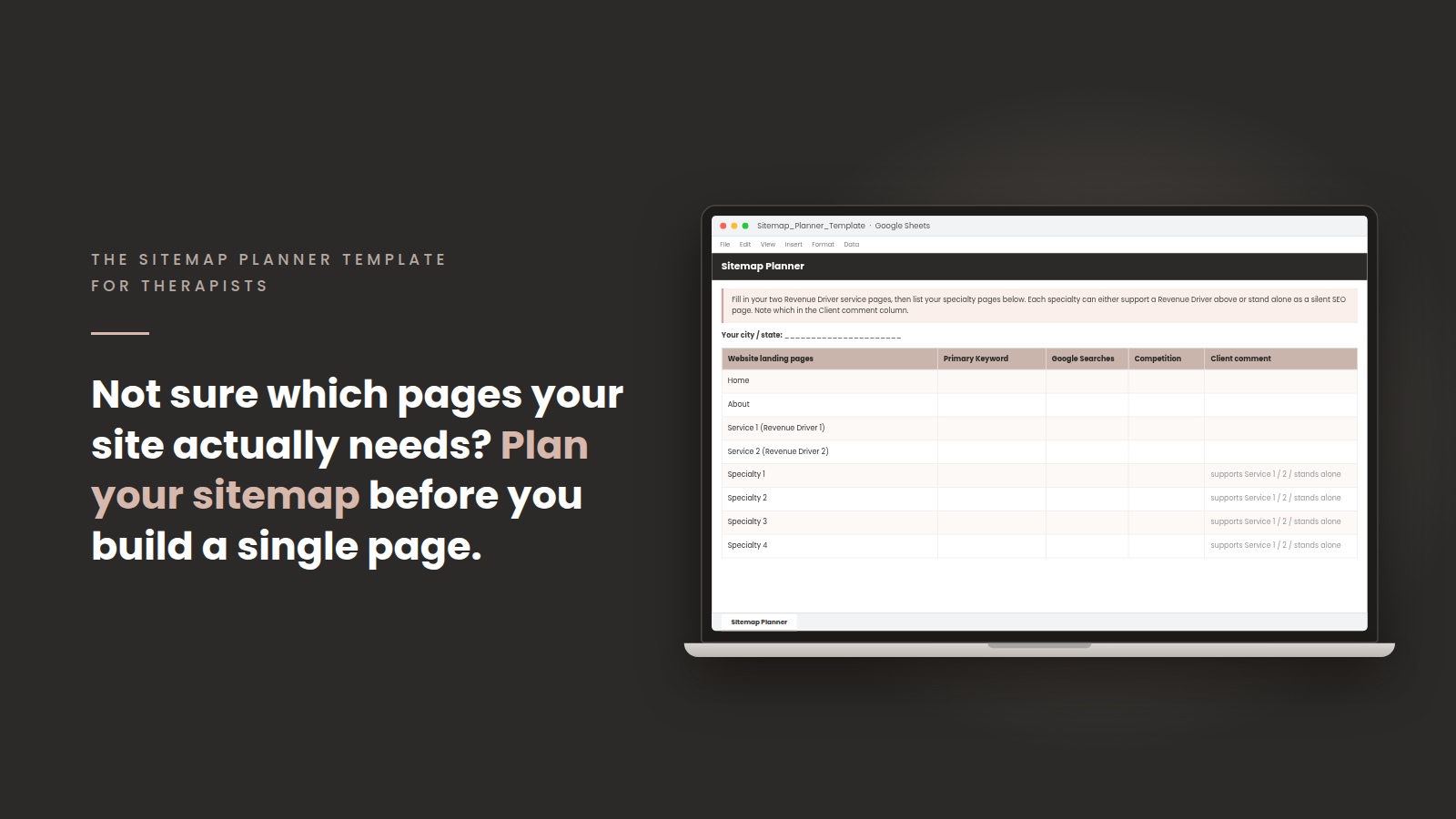
Get my free sitemap spreadsheet planner, list the pages you have, and see where the gaps are.
What has stayed the same?
These 4 things stay in place: being indexed, having a clear site structure, earning trust, and answering real questions. Each one shows up in Google's own AI documentation or in what I see building therapist sites.
Being indexed. Google ties eligibility for AI Overviews and AI Mode to a page being indexed and snippet eligible. A page Google has never indexed has no chance of being a supporting link, however well it is written.
Clear site structure. The same Google documentation lists internal linking, text based content, and structured data that matches visible text among its practices. My position is that a foundational sitemap of service pages and specialty pages matters more than blogging constantly. I have managed websites where the foundational sitemap alone, with service pages and specialty pages and no blog published yet, beat local competition and ranked for real commercial keywords. I cover which pages to build in what pages a therapist website should have.
Trust. Backlinks, directory listings, reviews from professional peers, and press mentions all tell Google and AI tools that other people vouch for you. I once paid $1,000 for a feature placement that moved my domain authority from about 12 to 20. It did not bring clients directly from that feature, and it added to my trustworthiness and to being recommended by AI to therapists who book discovery calls with me. Practices running the same strategy can get different results when one has the bigger online reputation.
Answering real questions. A page earns a place in a summary by answering something a client actually asks, clearly and early. I wrote about shaping a citable paragraph in how to get cited by ChatGPT and AI Overviews with your therapist website.
| Area | What the source says | Source |
|---|---|---|
| Indexing | A page must be indexed and eligible to be shown in Google Search with a snippet to appear as a supporting link | Google AI features documentation, last updated December 10, 2025 |
| Site structure | Making content easily findable through internal links is among the practices Google lists | Google AI features documentation, last updated December 10, 2025 |
| Supporting links | AI features display a wider and more diverse set of helpful links | Google AI features documentation, last updated December 10, 2025 |
| AI summaries | Around 1 in 5 Google searches in March 2025 produced an AI summary, and 88% of those summaries cited 3 or more sources | Pew Research Center, published July 22, 2025 |
| Clicks | Users clicked a traditional result link on 8% of visits with an AI summary and 15% of visits without one | Pew Research Center, published July 22, 2025 |
| Trust | A $1,000 feature placement moved my domain authority from about 12 to 20 | My own experience |
The sources behind the table are Google's AI features documentation and Pew Research Center's study of Google searches, which used March 2025 browsing data.
What is replacing SEO?
Nothing has replaced it. Labels for the work of being recommended by AI tools all point to the same tasks: indexed pages, clear structure, direct answers, consistent facts about your practice, and trust from outside your site. Google's documentation says no special optimization is required for its AI features, which matches what I see: the practices that get found are the ones with the basics done well.
Having a website is a job, and part of that job is checking how your practice appears in AI answers. Everything in this post is something you can do yourself, and at some point it competes with your caseload, your family, and your time.
What should I fix first?
Fix indexing first, because it blocks everything else. If Google has not indexed your service pages, no summary, link, or recommendation can include them. My criteria for the order are simple: what blocks everything else, how close to booking the searches are, and how little time the fix takes. Indexing wins on all 3.
Next, fix your sitemap. Build 1 page for each of your top 1 to 2 revenue service pages and give them real, story driven copy, because ranking earns the click and the words earn the reply. Then add a lean, keyword forward page for each specialty, using the clinical phrases a researched client types. This touches the searches closest to booking, and in my experience it can move rankings before a single blog post is published.
Third, build trust outside your site. Submit to free directories first, complete your Google Business Profile, and ask professional peers for 1 to 2 authentic reviews a month. This work compounds slowly, so it starts later in the order and should start soon. Paid placements are a judgment call about long term authority, and they will not produce a spike of leads.
Last, blog, and choose topics that answer questions your ideal client really asks. A blog adds the most to a site that already has a strong foundation and some earned trust. If you already have a full sitemap and a steady trickle of authority, your order may change with your site, and the criteria decide it.
Frequently asked questions
Is SEO still worth it for a therapist?
Yes. Your website is the one place you control, and the searches closest to booking still send people to pages that match their phrase. Indexed pages, clear structure, and trust decide who gets found, and Google's AI features documentation names indexing and snippet eligibility as the requirement for appearing as a supporting link.
Do AI Overviews show up on every Google search?
No. Pew Research Center found that around 1 in 5 Google searches in March 2025 produced an AI summary. That figure covers all searches in a sample of 900 U.S. adults, and I could not find one for therapy searches.
Do I need special optimization to appear in AI Overviews?
Google's AI features documentation(last updated December 10, 2025) says there are no additional requirements or special optimizations. A page needs to be indexed and eligible to show with a snippet, so check indexing in Search Console before anything else.
Will fewer clicks make my website pointless?
Fewer clicks make each visit more valuable. Pew's March 2025 data showed users clicking a traditional link on 8% of visits with an AI summary and 15% without, so a page that turns a visit into an inquiry matters more.
Want this off your plate?
Everything in this post can be done on your own, and it competes with your caseload, your family, and your time. Checking indexing, planning a sitemap, building authority, and tracking what happens next is a recurring job.
As a therapist website designer who also runs the SEO, I build the foundation first, then handle website management so the site stays indexed and current. The SEO work covers SEO for therapists and SEO for private practices, so the pages, the authority, and the tracking all have an owner. If you would like to talk it through, apply to work with me. No pressure, just a conversation about what would take the most weight off your desk.
* AI Disclosure: This content may contain sections generated with AI with the purpose of providing you with condensed helpful and relevant content, however all personal opinions are 100% human made as well as the blog post structure, outline and key takeaways.
* Affiliate Disclosure: Some of the links on www.nataliamaganda.com may contain affiliate links meaning that I will get a commission for recommending products at no extra cost to you.

hello! i'm natalia maganda
The website manager for therapists and private practices that you didn't know existed.
We build and manage the 20+ page website that ranks in your city, reflects the depth of your work and books cash-pay clients with ease.
A done for you website management system that lets your practice grow without costing you your energy, your weekends, or your nervous system.