
How to Submit Your Therapy Site to Bing and Google Without Guessing About ChatGPT
Verify your site in Google Search Console and Bing Webmaster Tools, submit your sitemap in both, request indexing for your key pages, and then confirm that each service page shows as indexed. Google's Page indexing report help describes indexed pages as the ones eligible to appear in search results, and which indexes ChatGPT and Claude draw on is unconfirmed.
If we haven't crossed paths before, I'm Natalia, the founder of a boutique web design and SEO agency for therapists and private practice owners across the US. My mission is to help your website work as a 24/7 referral engine, so you can log off and still wake up to new inquiries. I have been in business for over 7 years, I have served 100+ clients, and I have managed over 900 URLs for other people's practices, which means I have checked a lot of pages to see whether Google even knows they exist. Submitting a site and tracking its indexing is part of how I run every website I touch.
You published a new anxiety therapy page, searched for it a week later and found nothing. Now everyone says you should show up in ChatGPT, and you wonder where to even start. Start with a setup you can finish in a single sitting that puts your pages in front of the search engines AI answers may draw on.
Key takeaways
- Google says a page must be indexed and eligible to show with a snippet to appear as a supporting link in AI Overviews or AI Mode, and that no other special optimization is required ( Google Search Central, AI features documentation).
- OpenAI says ChatGPT search uses third party search providers plus content from its partners ( OpenAI, Introducing ChatGPT search).
- Anthropic's web search announcement, help center article and web search tool documentation say Claude can search the web and cite sources, and they name no search index. Which index Claude uses is unconfirmed.
- Submitting a sitemap and requesting indexing are requests. Google states that submitting a request does not guarantee the page will appear in the Google index.
- Indexing in both Google and Bing is good practice whatever the AI tools turn out to use, and the setup costs nothing.
Does getting indexed in Bing and Google actually get me into ChatGPT and Claude?
For Google's own AI features the answer is confirmed. For ChatGPT it is plausible and unconfirmed, and for Claude the index is unconfirmed. Being in both major indexes is still the sensible move.
Google. The AI features documentation says a page must be indexed and eligible to be shown in Google Search with a snippet to be a supporting link in AI Overviews or AI Mode, and that there are no additional requirements or special optimizations. So for Google, indexing is the entry ticket.
ChatGPT. A Yoast article on ChatGPT search says that if your site is not in Bing's index, it will not appear in ChatGPT's results. I opened it, and it states this without citing OpenAI or Microsoft. OpenAI's launch post says ChatGPT search uses third party search providers as well as content provided directly by its partners. OpenAI's help article says it sometimes partners with other search providers and sends them rewritten queries. Neither page tells you which provider that is, so I treat the Bing claim as a lead that I could not confirm.
OpenAI does confirm something you control. Its publishers and developers FAQ says to make sure you are not blocking OAI-SearchBot, and its bots documentation says sites opted out of OAI-SearchBot will not be shown in ChatGPT search answers, though they can still appear as navigational links.
Claude. I opened Anthropic's web search announcement, the help center article and the web search tool documentation. They describe Claude searching the web and citing sources, and none of them names a search provider or index.
My position is simple. I have not run my own tests on which AI tool leans on which index, so I will not pretend I have. Google describes indexed pages as the ones eligible to appear in search results, so I submit and track indexing on every site. Whichever index turns out to matter, you will already be in it.
If you are not sure which of your pages are indexed, a tracker will save you from guessing. I made a free blog database and KPI template for exactly this.
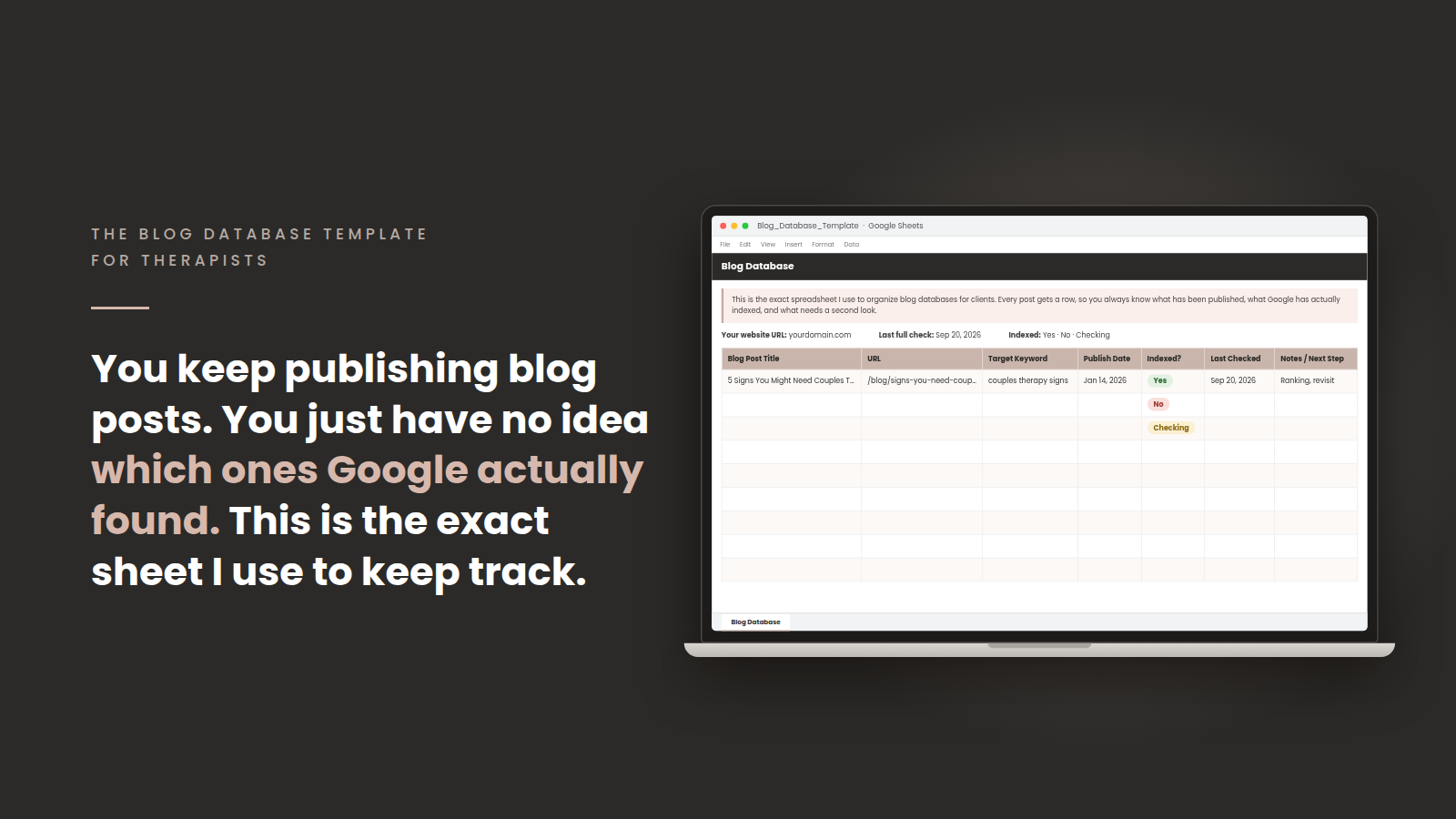
Get my free blog database and KPI template, list your service pages and specialty pages, and mark each one as indexed or not as you work through the steps below.
What do I need before I start, and how do the 2 tools differ?
You need access to your domain settings or your website's header code, and the address of your sitemap. Most platforms publish the sitemap at yourdomain.com/sitemap.xml, so open that in a browser and confirm it lists your service pages and specialty pages.
| Task | Google Search Console | Bing Webmaster Tools |
|---|---|---|
| Verify ownership | HTML file, meta tag, DNS record, Google Analytics or Tag Manager | Import from Google Search Console, or verify manually |
| Submit the sitemap | Sitemaps report | Imported with the site, or added in the sitemaps section |
| Ask for a page to be crawled | URL Inspection, then Request indexing | IndexNow |
| Check what is indexed | Page indexing report | IndexNow submission checks in the tool |
Do Google first, because Bing can import much of that work.
How do I verify my site in Google Search Console?
Add your site as a property in Search Console and prove you own it. Google lists several methods: an HTML file in your root directory, an HTML meta tag in your homepage head, a DNS record, Google Analytics or Google Tag Manager ( Google's ownership verification help).
If you can reach your domain's DNS settings, choose a Domain property, since Google says DNS verification is required for that property type. If you cannot, choose a URL prefix property and use the HTML tag or file. Add a second verification method as a backup. Google says verification lasts as long as it can confirm your token, and it checks periodically, so a website update that deletes the tag can quietly remove your access.
How do I submit my sitemap to Google?
Open the Sitemaps report in Search Console, enter your sitemap address and submit it.
Google describes a sitemap submission as merely a hint that does not guarantee Google will use the sitemap for crawling. I treat the sitemap as the foundation of a site. In my experience, a sitemap built from service pages and specialty pages is the part of a therapist site that earns its keep, so make sure every page you want found is listed in it.
How do I request indexing for my key pages?
Use the URL Inspection tool. Paste a full page address into the search bar at the top of Search Console, read the result and, if the page passes the checks, click Request indexing ( Google's URL Inspection help). If the page shows as unknown to Google, click Test live URL first so you can see whether it can be indexed.
Google applies daily quotas to these requests and does not publish the numbers, so spend them on pages that matter. My short list is the homepage, your top 1 or 2 revenue pages, which are the service pages that make you the most money, and any page you have just published or substantially rewritten.
How do I set up Bing Webmaster Tools and IndexNow?
The fastest route is to sign in to Bing Webmaster Tools and import your site from Google Search Console. Microsoft says imported sites are added and automatically verified, and that Bing shows the verified sites in your Search Console account along with their sitemaps.
After the import, open the sitemaps section and confirm your sitemap is listed. If it is missing, add it by hand.
Now IndexNow. This is a protocol that tells participating search engines when a page is new or changed. Bing's getting started page gives 4 steps: generate a key, host the key file at the root of your site, submit your URLs, and use Bing Webmaster Tools to verify they were received.
IndexNow has 2 honest limits. Its own documentation says submitted URLs are shared with all other participating search engines, and its FAQ lists Amazon, Bing, Naver, Seznam.cz, Yandex and Yep. Google is not on that list, so Search Console remains your route into Google. The FAQ also says a submission does not guarantee immediate indexing, because the search engine weighs its crawl quota and quality signals.
How do I confirm my service pages are actually indexed?
Open the Page indexing report in Search Console. It shows how many URLs Google has crawled and indexed, and lists the reasons other pages were left out ( Google's Page indexing report help). Then inspect each important page with URL Inspection and look for the status that says the URL is on Google.
Google says you should not expect every URL on your site to be indexed. Check the homepage, every service page, every specialty page, the contact page and your newest blog posts, start with the pages that earn you clients, and mark each one in your tracker.
Even a page marked as on Google can still stay out of search results, since Google states that the status does not guarantee the page will appear in Search results. Indexed is the minimum requirement and the beginning of the ranking work.
What should I do when an important page is not indexed?
Find the reason in the Page indexing report and fix that first. Google's list of common causes includes server errors, robots.txt blocks, noindex tags, 404 errors, redirects and duplicate pages.
- Check that the page is set to allow indexing and that robots.txt allows it.
- Confirm the page is in your sitemap and that other pages on your site link to it.
- Run Test live URL, then Request indexing again.
- Check your robots.txt for OAI-SearchBot too. OpenAI says it can take about 24 hours after a robots.txt update for its systems to adjust.
Once the pages are indexed, the next job is making them worth quoting. I cover that in how to get cited by ChatGPT and AI Overviews with your therapist website, and the wider picture of building trust with AI tools sits in my SEO guide for therapists, ChatGPT and AI authority.
Frequently asked questions
Do I need Bing Webmaster Tools if I only care about Google?
Yes, I recommend it. It takes a few minutes after the Google import, and it covers Bing and the engines that share IndexNow submissions. Whether ChatGPT depends on Bing is unconfirmed, and this setup covers you whichever way that turns out.
How long does it take to get indexed after I submit?
Nobody can give you a reliable number, and I will not invent one. Google says a request does not guarantee indexing, and the IndexNow FAQ says the search engine decides based on crawl quota, scheduling and quality signals.
Will submitting my site make ChatGPT recommend my practice?
Submitting your site puts your pages in the indexes that AI tools may draw on. None of the sources I opened says that submitting leads to ChatGPT or Claude recommending a practice. My SEO guide for therapists, ChatGPT and AI authority covers how I think about building trust with AI tools.
Want this off your plate?
Everything in this post can be done on your own, and it competes with your caseload, your family and your evenings. Search Console and Bing setup takes a single sitting, and the Page indexing report shows you what Google has indexed whenever you open it.
As a therapist website designer who also runs the SEO, I build the site so the sitemap is clean from day one, and our website management keeps the site healthy after launch. The SEO work sits on top of that, through SEO for therapists for solo practices and SEO for private practices for larger ones. If you would like to hand this over, you can apply to work with me. No pressure, just a conversation about what would take the most weight off your desk.
* AI Disclosure: This content may contain sections generated with AI with the purpose of providing you with condensed helpful and relevant content, however all personal opinions are 100% human made as well as the blog post structure, outline and key takeaways.
* Affiliate Disclosure: Some of the links on www.nataliamaganda.com may contain affiliate links meaning that I will get a commission for recommending products at no extra cost to you.

hello! i'm natalia maganda
The website manager for therapists and private practices that you didn't know existed.
We build and manage the 20+ page website that ranks in your city, reflects the depth of your work and books cash-pay clients with ease.
A done for you website management system that lets your practice grow without costing you your energy, your weekends, or your nervous system.