What is the best content format for AI citations as a therapist? What the sources show
No source I opened names 1 best content format for getting cited by AI tools. One ChatGPT study and Microsoft's guidance support putting the answer early and writing headings as the questions your client asks, and the sources leave many popular claims about lists, tables, and FAQ blocks without data.
If we haven't crossed paths before, I'm Natalia, the founder of a boutique web design and SEO agency for therapists and private practice owners across the US. My mission is to help your website work as a 24/7 referral engine, so you can log off and still wake up to new inquiries. I have been in business for over 7 years, I have served 100+ clients, and I have managed over 900 URLs for other people's practices. I also built 2 websites of my own and got it wrong both times, so I read format advice with a skeptical eye and I opened every source below before writing about it.
You have probably seen confident posts telling you to add FAQs, tables, or bullet points because AI tools love them. This post sets out what Google, Microsoft, and the published studies say about format, and where the sources disagree or stay silent.
Key takeaways
- Google's AI features documentation says there are no additional requirements to appear in AI Overviews or AI Mode, and no special optimizations are necessary.
- Wix Studio's AI Search Lab study, published in March 2026, found that query intent predicted which page type got cited better than industry or AI model did.
- Kevin Indig's February 2026 study of ChatGPT citations found 44.2% of citations came from the first 30% of the text, which supports answer first writing for ChatGPT.
- The sources conflict on schema and have no study I could open that isolates tables, bullet lists, or FAQ blocks.
- My position is human first, helpful content with an editorial layer, and answers to every question your ideal client has.
What does Google say about content format for AI search?
Google says no special format is required. Its AI features documentation states: "There are no additional requirements to appear in AI Overviews or AI Mode, nor other special optimizations necessary." The same page says you don't need new machine readable files, AI text files, or markup, and that no special schema.org structured data is required. Pages need to be indexed and eligible to show a snippet.
Google's helpful content guidance asks whether content is created primarily for people and says Google has no preferred word count. Google's marketer's guide to SEO in AI search says to focus on unique, non commodity content and to break up long text into paragraphs and sections with headings to help users navigate. Its structured data advice is to implement schemas relevant to the tasks your site supports. Search Engine Land's report on Google's May 2025 guidance adds that structured data should match the visible content.
OpenAI's publishers and developers FAQ says any public website can appear in ChatGPT search and tells publishers to allow OAI-SearchBot, its search crawler. The parts I read give no format guidance. Microsoft does publish format advice, covered below.
If you want to put this into practice, the best starting point is your outline, meaning your H2s and H3s written as the questions your client asks. I made a free blog outline template for exactly this.
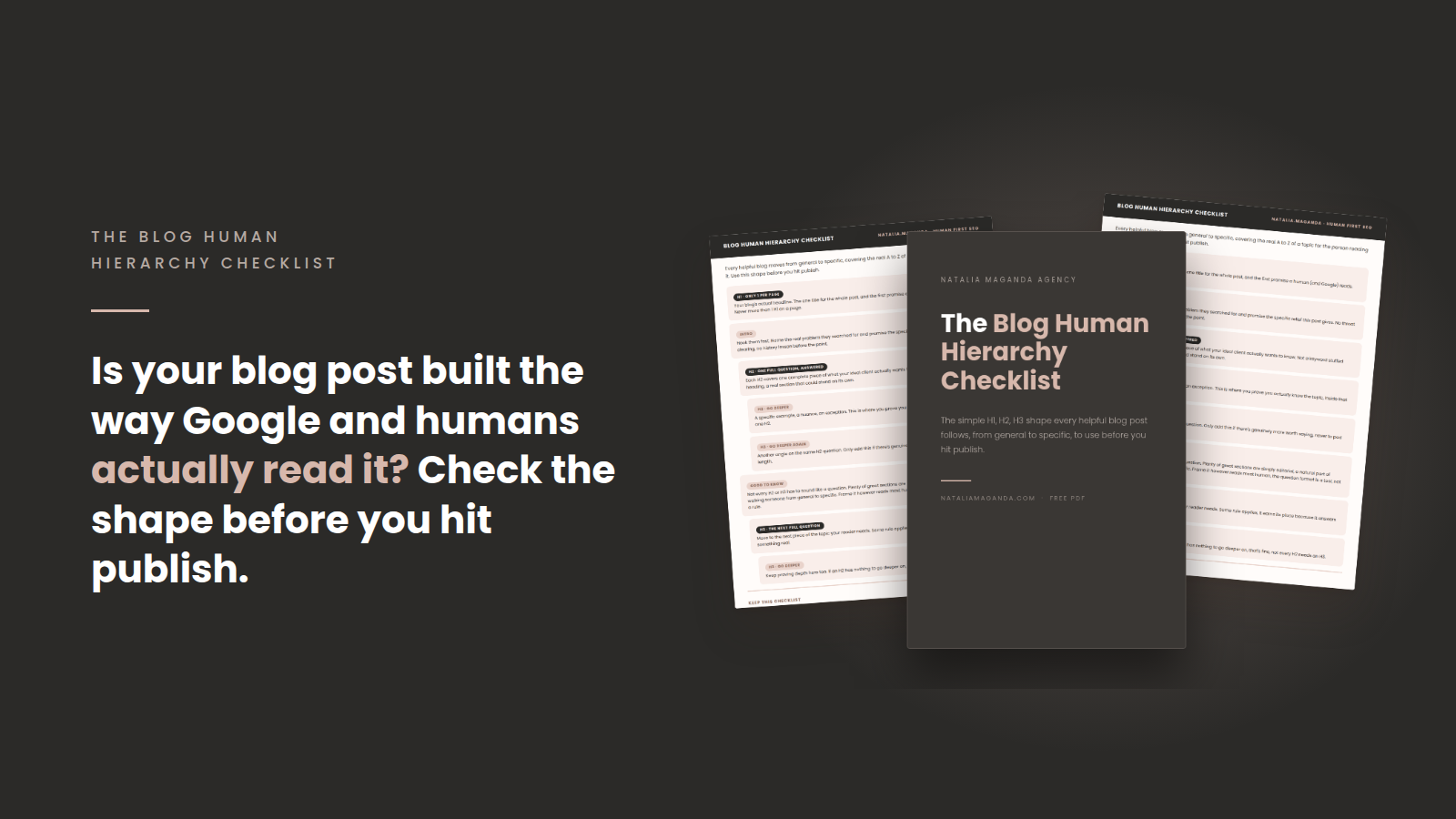
Get my free blog outline template, list the questions your ideal client asks, and see which headings still need a direct answer.
What does the research on AI citations say about format?
The table below lists each source I opened, its scope, and what it reports about format, with the study's own wording of its result.
| Source | Date and scope | What it measured | What it reports |
|---|---|---|---|
| Google AI features documentation | Official guidance, updated December 2025 | Eligibility for AI Overviews and AI Mode | No special format, markup, or AI text files required |
| Microsoft Advertising blog | October 2025, guidance from a Microsoft Bing product manager | Recommendations; I found no dataset in the post | Recommends headings, direct question and answer pairs, lists, and tables |
| Wix Studio AI Search Lab | March 2026, 75,000 AI answers and 1,056,727 citations from ChatGPT, Google AI Mode, and Perplexity | Share of citations by page type | Articles led informational queries at 45.48%, listicles led commercial queries at 40.86% |
| Kevin Indig, Search Engine Journal | February 2026, 18,012 verified ChatGPT citations used for positional analysis | Where in a page and what wording got cited | 44.2% came from the first 30% of text |
| Ahrefs | Published December 2025, 174,048 pages with valid data across 560,346 AI Overviews | Word count against citation position | Correlation of 0.04 |
| Search Atlas | December 2025, sample size not stated, OpenAI, Gemini, and Perplexity | Schema coverage against visibility | No measurable effect reported |
| AirOps 2026 State of AI Search | 2026, sample not disclosed | Page structure of cited pages | Sequential headings with a single H1 were cited 2.8x more often |
| GEO paper on arXiv | First posted November 2023, accepted to KDD 2024 | 9 text level methods on a research benchmark and Perplexity | Quotations, statistics, and cited sources ranked among the stronger methods, keyword stuffing offered little to no improvement, and efficacy varied across domains |
Sources in table order: Google AI features documentation, Microsoft Advertising blog, Wix Studio AI Search Lab, Kevin Indig in Search Engine Journal, Ahrefs, Search Atlas, AirOps, and the GEO paper.
Each study measured its own sample of engines and queries, several come from companies that publish research alongside SEO or AI visibility products, and I did not find a study of therapist content among the sources I opened.
Which page types do AI answers cite most, and does it apply to therapists?
The page type that gets cited depends on the intent behind the query. Wix Studio's AI Search Lab study sorted citations into 11 page types across 4 query intents and 5 industries, using data from the Peec platform with non branded prompts. Across all citations, listicles made up 21.9%, articles 16.7%, and product pages 13.7%. For informational queries, articles led at 45.48%, with listicles at 21.68% and how to guides at 9.21%. In the study's health and wellness industry group, articles were the top page type at 19.66%.
A client asking "how does EMDR work" sits in the informational group, and articles lead that group in this data. The study does not isolate therapy practices, so treat it as a pointer.
Peec's own February 2026 analysis of more than 1 million citations found that ChatGPT leaned toward listicles, that no single type dominated in Google AI Mode, and that Perplexity was extremely selective. Its authors recommend benchmarking each engine separately, and the page notes that a later ChatGPT model shifted retrieval toward product pages, a sign that format findings expire quickly.
Do answer first openings and question headings have evidence behind them?
Yes for ChatGPT, with 1 large study behind it, and Microsoft gives the same advice. Kevin Indig's analysis started from 1.2 million search results and AI answers, isolated 18,012 verified ChatGPT citations, and found 44.2% came from the first 30% of the text, 31.1% from the middle 40%, and 24.7% from the last 30%. Cited text was 2x more likely to contain a question mark(18% against 8.9%), and 78.4% of the cited text that contained a question came from headings. Cited text also used definitive language more often (36.2% against 20.2%). The study covers ChatGPT only, so it says nothing about Google or Perplexity.
Microsoft's guidance describes H2s and H3s as "chapter titles that define clear content slices" and recommends concise answers of 1 to 2 sentences. AirOps reports that pages with sequential headings and a single H1 were cited 2.8x more often, though it does not disclose a sample size on the page I read.
Do lists, tables, and FAQ blocks have evidence behind them?
Only Microsoft's recommendation, and no study I opened isolates them. Microsoft states that "Bulleted lists, numbered steps, and comparison tables break complex details into clean, reusable segments." It also recommends "direct questions with clear answers" that assistants can often lift word for word. This is vendor guidance, and I could not find a dataset behind it in the post.
The closest data points are indirect. The Wix study shows listicles earning the most citations on commercial queries. AirOps reports that FAQ schema appeared on 10.5% of cited pages. That describes how common it was on cited pages. I found no figure on whether it helped. Google's AI features documentation names no format at all. So choose lists, tables, and FAQ blocks when your content is a list, a fee schedule, or a set of real client questions, and know that the sources offer no proof they raise your odds of being cited.
Do statistics, quotations, and sources help, and does schema matter?
Statistics, quotations, and cited sources had the strongest results among the methods tested in a study of content changes. The GEO paper, first posted in November 2023 and accepted to KDD 2024, tested 9 text level changes on a research benchmark and on Perplexity. Adding quotations, statistics, and cited sources ranked among the stronger methods, and keyword stuffing offered little to no improvement. The abstract says the efficacy of these strategies varies across domains.
On schema, the sources conflict. Search Atlas reported no measurable effect of schema coverage on visibility in OpenAI, Gemini, and Perplexity, without stating its sample size. AirOps reported that 61% of cited pages used 3 or more schema types, with a 13% higher citation likelihood. Google's AI features documentation says no special schema is needed. None of these results promises a citation.
How do you apply this on a therapy page?
Start with the questions your ideal client types, answer each one in the opening lines of its section, and keep what you publish human and helpful.
- Answer early. Supported for ChatGPT by Indig's study and recommended by Microsoft.
- Write headings as questions. Supported by the same 2 sources, and my live post on content strategy for therapist SEO shows how I choose which questions deserve a page.
- Use lists and tables where the content is a list or a fee schedule. Recommended by Microsoft only, so this is a readability call.
- Cite real sources for any number. The GEO paper supports cited sources and statistics, and the number has to be real.
- Skip keyword stuffing. The same paper reports little to no improvement from it.
My opinion, and the one I build every therapist site around, is human first, helpful content with an editorial layer before anything goes live. Before publishing, I ask whether the post is helpful and human or only checks a keyword box, whether the deep sections go deep enough, and whether it answers every question the ideal client has, including the uncomfortable ones. I have run no AI citation tests of my own, so none of this is a result. If you are planning which posts to write, my blogging basics and 140 blog post ideas covers that side.
Frequently asked questions
Do FAQ blocks help a therapist get cited by AI tools?
Does schema markup help a therapist get cited by AI tools?
The sources conflict. Search Atlas found no measurable effect, AirOps reported a 13% higher citation likelihood for pages with 3 or more schema types, and Google's AI features documentation says no special schema is needed.
Does a longer post get cited more often?
Ahrefs found a Spearman correlation of 0.04 between word count and citation position in AI Overviews, which it calls essentially zero. Google's helpful content guidance says it has no preferred word count. Write as much as the question deserves.
Do all AI tools favor the same format?
The data says no. The Wix Studio study reported that Perplexity drew 17.35% of its citations from discussions against a 7.52% average, and Peec found no dominant page type in Google AI Mode.
Want this off your plate?
Everything in this post is something you can do on your own, and it competes with your caseload, your family, and your evenings. As a therapist website designer who also runs the SEO, I build pages that answer the questions your ideal client types, written human first and checked with an editorial layer. Your website management keeps those pages current after launch, and the search side lives in SEO for therapists and SEO for private practices.
If you would like that handled, apply to work with me. No pressure, just a conversation about what would take the most weight off your desk.
* AI Disclosure: This content may contain sections generated with AI with the purpose of providing you with condensed helpful and relevant content, however all personal opinions are 100% human made as well as the blog post structure, outline and key takeaways.
* Affiliate Disclosure: Some of the links on www.nataliamaganda.com may contain affiliate links meaning that I will get a commission for recommending products at no extra cost to you.

hello! i'm natalia maganda
The website manager for therapists and private practices that you didn't know existed.
We build and manage the 20+ page website that ranks in your city, reflects the depth of your work and books cash-pay clients with ease.
A done for you website management system that lets your practice grow without costing you your energy, your weekends, or your nervous system.