
Is Google Meet HIPAA compliant for therapists? Everything you need to know
If you are a therapist offering telehealth, you have probably asked this question more than once. Is Google Meet HIPAA compliant, or am I putting my clients privacy at risk by using it?
The confusion makes sense. Google Meet is familiar, easy, and already part of many clinicians daily workflows. But familiarity does not equal compliance. And when the stakes involve client confidentiality, ethical practice, and your professional license, vague answers are not enough.
This post is here to give you clarity. Not legal fear. Not tech overwhelm. Just a grounded explanation of when Google Meet can be HIPAA compliant, when it is not, and what responsibility actually falls on you as a provider.
Because choosing the right tools for your practice should feel supportive, not stressful.
In case you are new here, I am Natalia, and I support therapists and private practice owners through strategic website design, SEO, and systems that are built to work quietly in the background of your life. If you want to understand who we are and what guides our work, you can explore our approach to website design for private practice here.
Why HIPAA compliance matters for telehealth sessions
HIPAA exists to protect your clients, but it also protects you.
When you offer therapy online, you are responsible for safeguarding protected health information. That includes anything shared verbally, visually, or digitally during a session. Video platforms are not neutral. They are part of how information is transmitted and stored, even if it does not feel that way in day to day use.
What HIPAA actually protects in virtual therapy
HIPAA is designed to protect electronic protected health information. In telehealth, that can include names, faces, voices, diagnoses, session content, and even metadata related to appointments.
If a platform does not meet HIPAA requirements, or if it is used incorrectly, you are exposed to risk. Not because you had bad intentions, but because the system itself was not designed or configured to support healthcare use.
Where therapists unintentionally put PHI at risk
Most compliance issues do not come from negligence. They come from assumptions.
Assuming a popular platform is compliant by default.
Assuming encryption alone is enough.
Assuming free tools are held to the same standards as healthcare software.
These assumptions are common, and they are understandable. But they are also where risk quietly enters the picture.
Why convenience alone is not enough
Ease matters. Especially for therapists. But convenience cannot be the only deciding factor when client privacy is involved.
HIPAA compliance is not about finding the hardest tool. It is about choosing tools that are appropriate for your role as a healthcare provider and using them intentionally.

Is Google Meet HIPAA compliant?
This is where most answers online become frustratingly vague. So let’s be very clear.
The short answer therapists need
Yes, Google Meet can be HIPAA compliant.
But only under specific conditions.
It is not HIPAA compliant by default, and it is not compliant when used casually through a free Google account.
When Google Meet can be HIPAA compliant
Google Meet may be used in a HIPAA compliant way when all of the following are true:
- You are using a paid Google Workspace account that is eligible for healthcare use.
- You have a signed Business Associate Agreement with Google.
- Your account and meeting settings are configured correctly.
- You are using the platform intentionally for telehealth, not general use.
- When these requirements are met, Google Meet can support compliant telehealth sessions.
When Google Meet is not HIPAA compliant
Google Meet is not HIPAA compliant if:
- You are using a free Gmail account.
- You have not signed a Business Associate Agreement.
- You have not reviewed or adjusted security settings.
- You assume Google manages compliance for you.
This distinction is critical. The platform does not automatically make you compliant. The responsibility still rests with you. Learn more about Google Meet HIPAA compliance here and their Google HIPAA compliance documentation.
Can therapists legally use Google Meet for telehealth?
Yes, therapists can legally use Google Meet for telehealth, but legality and compliance are not the same thing.
What Google allows vs what HIPAA requires
Google allows many use cases. HIPAA requires safeguards.
Google may provide secure infrastructure, but it does not manage how you use the tool, who has access, or how information is handled outside of the session itself.
Therapist responsibility in compliance decisions
As a therapist, you are the covered entity. That means you are responsible for ensuring that any tool you use meets HIPAA requirements and is configured appropriately.
This includes understanding what your platform does and does not cover.
Why Google does not manage HIPAA for you
Even with a paid account and a BAA, Google does not take responsibility for your clinical workflows, documentation practices, or session environments.
HIPAA compliance is shared, but it is never fully outsourced.
What makes a video platform HIPAA compliant
Understanding this helps you evaluate any platform, not just Google Meet.
Business Associate Agreements explained simply
A Business Associate Agreement is a legal contract that outlines how a company will handle protected health information on your behalf.
Without a BAA, a platform cannot be considered HIPAA compliant for healthcare use, even if it is encrypted or secure.
Encryption and access controls
HIPAA compliant platforms must protect data in transit and at rest. But encryption alone is not enough.
Access controls, user permissions, and administrative oversight matter just as much.
Why configuration matters more than the tool itself
Many platforms can be used compliantly or non compliantly depending on how they are set up.
HIPAA compliance is often less about the brand name of the software and more about the choices you make inside it.
How to make Google Meet HIPAA compliant
If you choose to use Google Meet, these steps are essential.
Google Workspace plans that qualify
You must be on a paid Google Workspace plan that offers HIPAA eligible services.
Required admin and meeting settings
You must review and configure security settings, including meeting access, recording permissions, and account level controls. This is not optional. Default settings are not designed for healthcare.
Internal policies therapists should document
HIPAA also expects providers to document policies around technology use.
That includes how sessions are conducted, how access is managed, and how incidents would be handled if something went wrong.
Here is a video we referenced from Youtube to help with Google HIPAA setup
Common HIPAA mistakes therapists make with Google Meet
These mistakes are common, and none of them mean you are careless. They simply mean you were not given clear guidance.
Assuming free tools are compliant
Free tools are built for consumers, not healthcare providers. This is one of the most common missteps.
Skipping configuration
Even paid tools require setup. Skipping this step is where compliance often breaks down.
Not aligning tech with long term practice growth
Telehealth tools should support your practice as it evolves. What works for one client a week may not work for a full caseload or group practice.
Google Meet vs Zoom for HIPAA compliant therapy sessions
This comparison comes up often.
Key differences therapists should understand
Both platforms can be used in HIPAA compliant ways under the right conditions. Neither is compliant by default.
Ease vs control tradeoffs
Google Meet integrates easily with existing Google tools. Zoom offers more granular controls in some healthcare plans.
The right choice depends on your workflow, not just features.
Which platform fits which practice model
Solo clinicians, group practices, and hybrid models may have different needs. There is no single correct answer, only informed ones.
Exlore my article on Zoom HIPAA compliance and Zoom for healthcare here.
HIPAA compliant video alternatives therapists consider
Some therapists choose platforms designed specifically for healthcare, such as Doxy.me or integrated telehealth tools within practice management systems.
These tools often reduce configuration burden, but may trade flexibility or cost.
The best choice is the one that fits your capacity, not the one that promises perfection.
How to integrate your meeting platform with a HIPAA compliant CRM
Choosing a HIPAA compliant meeting platform is only one part of the equation. Where many therapists unknowingly create risk is in what happens before and after the call.
Discovery calls, contact forms, email follow ups, and lead management all involve sensitive information. If those systems are disconnected or handled across multiple tools, things get messy quickly.
This is where integration matters.
Why your CRM matters just as much as your video platform
Your CRM is where inquiries live. It is where names, email addresses, intake details, and communication history are stored. If your CRM is not HIPAA compliant, it does not matter how secure your video platform is. The system as a whole is still vulnerable.
A HIPAA compliant setup allows you to:
Route discovery calls safely
Store and manage lead information securely
Send compliant email follow ups
Reduce manual work and human error
Instead of juggling tools, everything flows through one protected system.
How I structure HIPAA compliant website systems for therapists
The websites I design are hosted on https://www.duda.co/, a secure website platform that allows for strong infrastructure, reliability, and clean integrations.
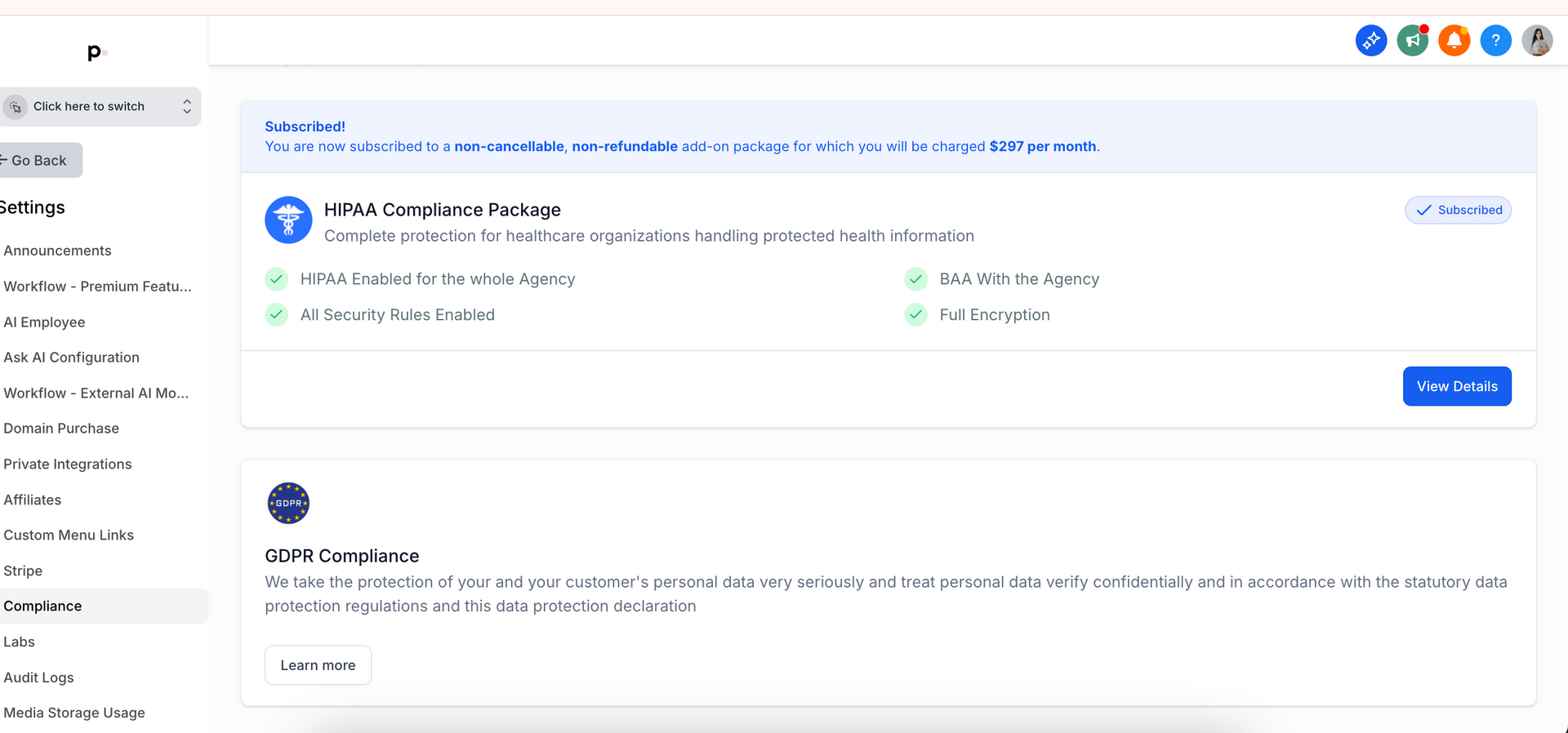
All contact forms, discovery call requests, and lead capture points on the website are connected directly to Go High Level , which is a HIPAA compliant CRM platform.
This means that when someone reaches out through your website, their information does not live in random inboxes or unsecured tools. It is routed into one protected system where you can manage communication, scheduling, and follow up safely.
Connecting discovery calls to your website without creating risk
When your meeting platform is integrated with a HIPAA compliant CRM, discovery calls can be booked directly through your website and tracked inside the same system that manages your leads and email communication.
This creates a clean, compliant workflow:
- Website inquiry
- Secure CRM capture
- Discovery call scheduling
- HIPAA compliant email follow up
No copying and pasting.
No missed messages.
No uncertainty about where information lives.
Why this matters for sustainable practice growth
HIPAA compliance should not feel like a constant mental load. When your website, CRM, and meeting platform are connected intentionally, your systems start working quietly in the background.
You spend less time managing tech.
Your clients experience a smoother process.
Your practice grows without adding chaos.
This is why I do not approach websites as standalone marketing tools. I design them as part of a complete, HIPAA compliant system that supports discovery calls, lead management, and email communication in one place.
When your systems are aligned, compliance feels easier. And ease is what allows your practice to grow without burnout.
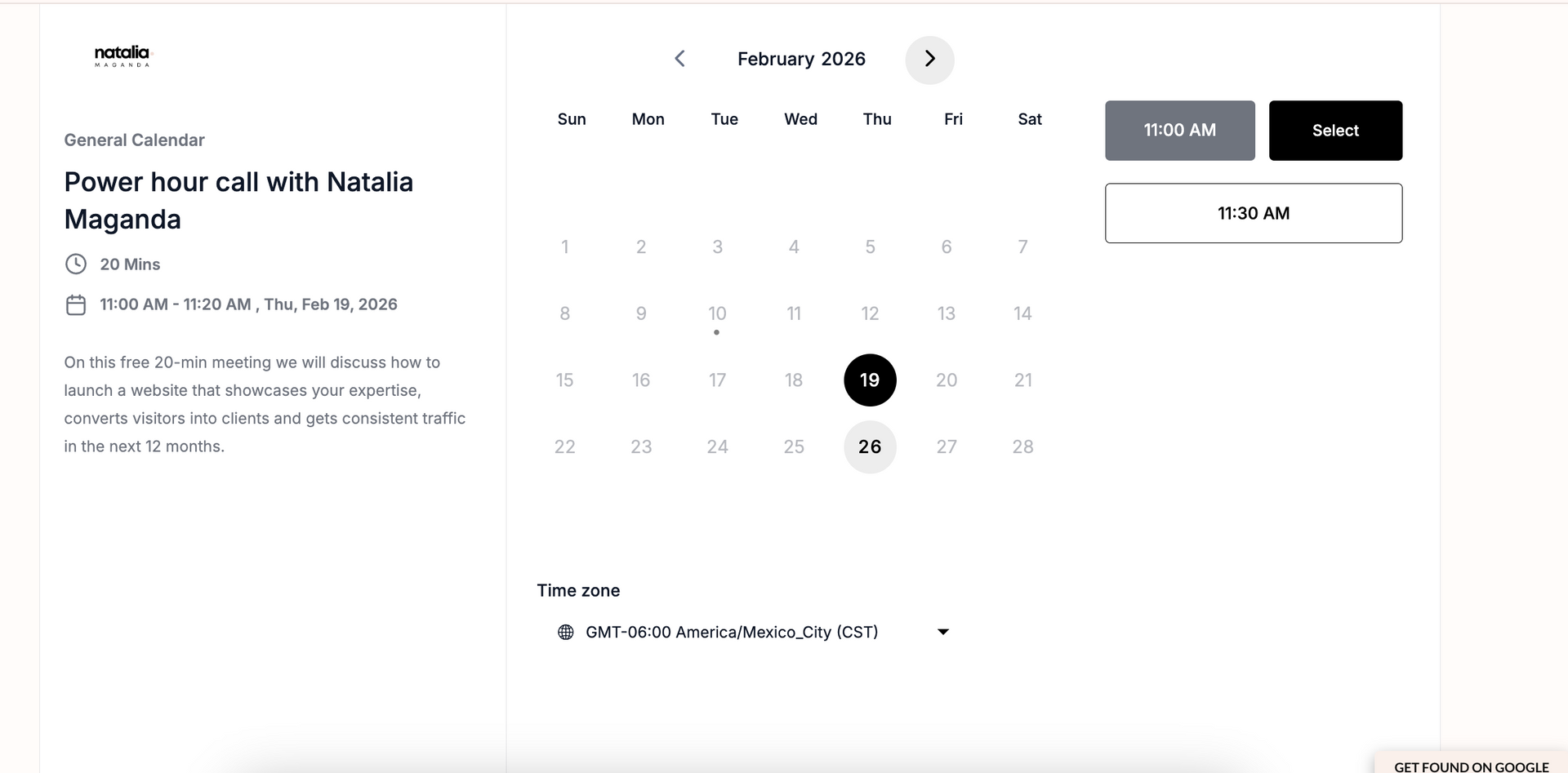
These type of calendars can be connected to Google Meet and on a HIPAA compliant CRM
Why your website and systems matter as much as your video platform
HIPAA compliance does not exist in isolation. It is part of a larger ecosystem that includes your website, intake forms, scheduling tools, and communication systems.
When your systems are fragmented, risk increases. When they are intentional and aligned, everything feels easier.
This is why so many therapists eventually realize that their website is not just a marketing tool. It is an operational one.
A well built website becomes a quiet support system. It sets expectations, routes clients appropriately, and reduces the need for manual work. It also supports ethical, compliant growth without burnout.
This is exactly why we approach website design for private practice as part of a larger visibility and systems strategy, not a standalone aesthetic project.
If you're ready to explore a HIPAA compliant website, book a call with me today.
Related reads:
- Zoom for healthcare explained and What I recommend for HIPAA compliance and website systems
- Is Zoom HIPAA compliant for private practice- What you need to know about your tech systems
- HIPAA compliant website for therapists- How to stay secure without overcomplicating your systems
- What to consider for SEO services for therapists
* AI Disclosure: This content may contain sections generated with AI with the purpose of providing you with condensed helpful and relevant content, however all personal opinions are 100% human made as well as the blog post structure, outline and key takeaways.
* Affiliate Disclosure: Some of the links on www.nataliamaganda.com may contain affiliate links meaning that I will get a commission for recommending products at no extra cost to you.

hello! i'm natalia maganda
The website manager for therapists and private practices that you didn't know existed.
We build and manage the 20+ page website that ranks in your city, reflects the depth of your work and books cash-pay clients with ease.
A done for you website management system that lets your practice grow without costing you your energy, your weekends, or your nervous system.