
SEO for Holistic Practitioners | NM Agency
Someone who already decided they want your exact protocol, a specific bodywork technique, a named herbal formula, a particular certification level, is not shopping around anymore. She is searching for a credible practitioner to say yes to what she already wants, and a site that only ranks for "holistic wellness near me" never shows up for that far more specific, far more valuable search.
SEO for holistic practitioners means building a dedicated page for every modality you actually practice, specific enough that Google can tell exactly what you do and specific enough that a skeptical reader can tell you know what you are talking about. Credentials and training become real content, not a single sentence on an about page.
Below, we look at why most holistic sites undersell the modality that makes them credible, and how that structure feeds into a website built for both trust and visibility.
What SEO for holistic practitioners actually means
Real SEO for a holistic practice is not about ranking for "holistic wellness near me." It is about ranking for the exact modality, protocol, or technique a person already decided they want, whether that is a specific herbal formula, a named bodywork technique, a certification level, or a functional medicine protocol most doctors have never heard of. That person is not shopping around anymore. They are looking for a credible practitioner to say yes to what they already want, and your site either shows up with a page built around that exact term or it does not show up at all.
Done poorly, SEO for this space looks like a single services page that names five modalities in one paragraph, none of them explained, none of them individually searchable, sitting next to stock photography of stones and candles that says nothing about training or results. Done well, it means a dedicated page for every modality you actually practice, written in language specific enough that Google can tell what you do and specific enough that a skeptical reader can tell you know what you are talking about. Credentials, training lineage, and your actual approach become structural content, not a paragraph buried on your about page. That is the difference between a site that gets found and a site that also gets believed.
Why most holistic practitioner websites undersell the modality that makes them credible
- One page, five modalities, none of them named. A single "services" section lists acupuncture, reiki, herbal medicine, and functional nutrition in a paragraph, so none of them has a page built to rank for its own exact term.
- The specific protocol never gets its own page. Someone searching a named technique or certification finds a competitor's dedicated page before they find yours, because yours does not exist.
- Credentials and training sit in one sentence on the about page. The exact signals that build trust with a first time visitor, and that a search engine reads as expertise, are treated as an afterthought instead of real content.
- The language stays vague on purpose. Copy leans on soft, spiritual phrasing instead of the plain, structural explanation a skeptical reader actually needs before they book.
- Every modality reads the same. If your practice offers more than one approach, a visitor cannot tell what makes each one different, so nothing stands out enough to rank or to convert.
Most of these trace back to the same handful of structural mistakes, the ones we break down in the most common private practice website mistakes.
Signs your SEO isn't pulling its weight
- Does your site rank for your practice's name but not for the actual modality you built your practice around?
- When someone searches your exact technique, protocol, or certification, do they find a competitor's page before they find yours?
- Do the people who land on your site tend to leave, because the page reads vague instead of credible?
- Have you found yourself explaining, again, why your modality actually works, to someone your website could have already convinced?
That gap usually comes down to fundamentals more than anything mysterious, the same ones we cover in ranking your practice higher on Google Maps.
Who this is for
This is a strong fit if you:
- Have a specific modality, protocol, or certification you want to be known and found for, not just "holistic wellness"
- Are ready for your training and credentials to do real convincing on the page, not sit quietly in an about paragraph
- Want your site treated as a credibility document as much as a marketing one
- Are ready to hand the strategy to someone else and trust it, rather than keep writing your own way around the skepticism
This may not be the best fit if you:
- Are looking for SEO as its own standalone project, separate from a new website. We do not offer it that way. It comes bundled with a new website management engagement.
- Would rather keep your language general and soft than name your exact modality and stand behind it in plain terms
- Need to approve every word and pixel yourself rather than trusting a strategy you have signed off on
How we approach SEO for holistic practitioners
We do not write around your modality. We write directly about it, by name, with the specificity a search engine needs to understand what you do and the specificity a skeptical reader needs to believe you. Your training, your certifications, your philosophy, and your actual protocol become the content, not decoration around it. That is what separates a practice that ranks and gets believed from one that reads like every other wellness site in your city.
On our strategy call, we walk through every modality and protocol you offer, the exact language your patients use when they search for you, and the credentials and training that need to show up as real content rather than a single sentence. From there we map which pages need to exist, one for each modality that deserves its own audience, and how your credibility signals get built into the structure of the site itself.
That strategy becomes the backbone of your web design for holistic practitioners engagement. The site we build is not a container we drop generic wellness copy into afterward. The pages, the structure, and the SEO strategy get built together from day one, so every modality page is doing its job as soon as your site goes live.
How it works:
Onboarding, strategy, copy, design, tech and foundational SEO
Most template builders will hand you a nice looking wellness site with a stock photo of stones and candles and no real plan for how a specific protocol, technique, or certification is supposed to be found, let alone trusted. We start with the strategy first, mapping every modality you practice to its own page and its own search terms, then build the copy, design, and technical foundation around that plan, not after it.
20+ page website launch with copy that reflects your depth and design that magnetizes your clients
Your site launches with a dedicated page for every modality and credential that deserves one, written specifically enough that a search engine can tell what you do and a skeptical reader can tell you know what you are talking about. The design carries the same credibility, so nothing about your site undersells the depth of your training.
Transition to management. Review a blog batch. Approve it. Get back to your life. That is the whole assignment.
Once your site is live, we keep building on the foundation, new content that reinforces each modality, new pages as your practice grows, ongoing technical upkeep. You review a batch of blog posts, approve them, and go back to the part of your work only you can do.
Meet your private practice website manager - Natalia Maganda

Natalia Maganda has built more than 100 websites and manages SEO for more than 30 therapy and wellness practices. She has spent almost a decade in this exact space, and her focus is specific: a brand identity and voice that actually match the practice you have grown into, not the one you started with. A website manager in your life, so marketing never becomes your full-time job again.
What this includes
- A dedicated page for every modality, protocol, or certification you practice, each built to rank on its own specific term
- Credential and training content built into the structure of your site, not left to one sentence on an about page
- Copy that names your approach directly instead of leaning on soft, generic wellness language
- Local SEO built to help your practice show up for the exact searches your community is already running
- A 20 plus page site with design that reflects the depth and legitimacy of your training
- Ongoing blog content that keeps reinforcing your specific modalities and credibility over time
- Monthly management and reporting, so you always know what your SEO is actually doing
What working together looks like
We start with a strategy call where we map every modality, protocol, and credential your practice needs represented, and the search terms your future patients are actually using. From there we build your full site around that strategy, page by page, with copy written in your voice and structure built for both a search engine and a skeptical first time reader. Once your site launches, we move into ongoing management, where your SEO keeps compounding through new content, and you review it rather than write it.
Tips while you get started
- Name your modality directly in your page titles and headings instead of hiding it behind general wellness language. See how this plays out in what to include on your specialty pages.
- Make sure your practice shows up for local searches tied to your specific modality, not just your practice name. Here is how to rank your practice higher on Google Maps.
- If you serve more than one city or community, give each one its own page built around your modality. Read the secret SEO strategy behind location pages.
- Before you touch another page yourself, get familiar with the most common private practice website mistakes, most of them are easy to avoid once you know what to look for.

hello! i'm natalia maganda
The website manager for therapists and private practice you didn't know existed
We build and manage the 20+ page website that ranks in your city, reflects the depth of your work and books cash-pay clients with ease.
A done for you website management system that lets your practice grow without costing you your energy, your weekends, or your nervous system.
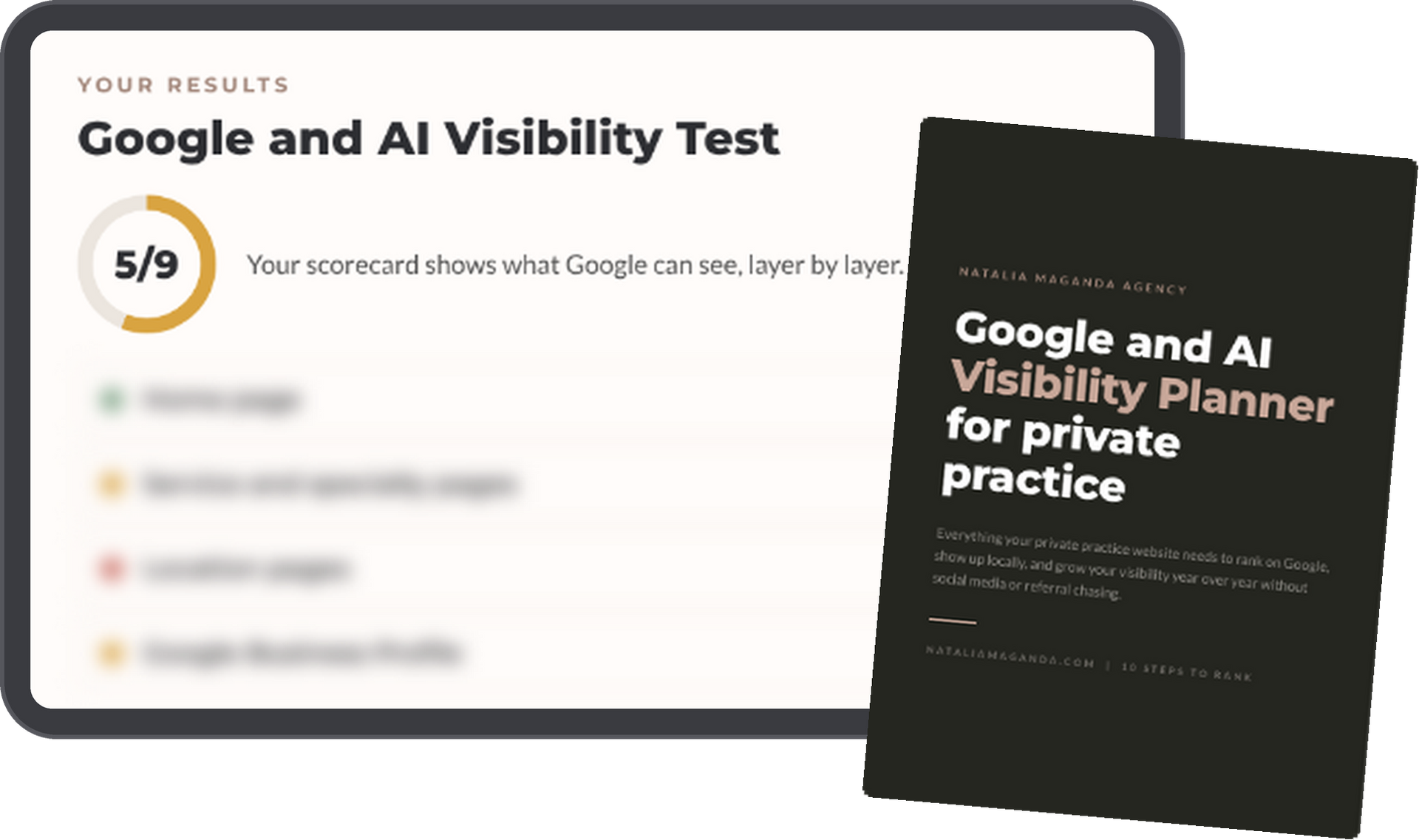
THE 10 THINGS NO ONE IS DOING FOR YOU RIGHT NOW
Your website exists. It is just not the one Google or AI shows when someone in your city searches at 11 at night.
What your next 12 months can look like
One of these comes with a to do list. The other comes with a website manager.You become the web designer, copywriter and SEO
One monthly price. Everything handled.
$597/mo for 12 months, then $350/mo Year 1 price goes up in 2027Lock in current pricing


Client results we're obsessed with...
61 inquiries 27% from Google & AI year 1 of SEO
37 inquiries 51% from Google & AI year 2 of SEO
28 leads in 6 months with a 60+ page custom site re-launch
Multi state ranking & 100%+ traffic increase after 12 months of SEO
96 inquiries 35% from Google & AI + 532% traffic increase first 6 months of SEO (Squarespace re-launch)

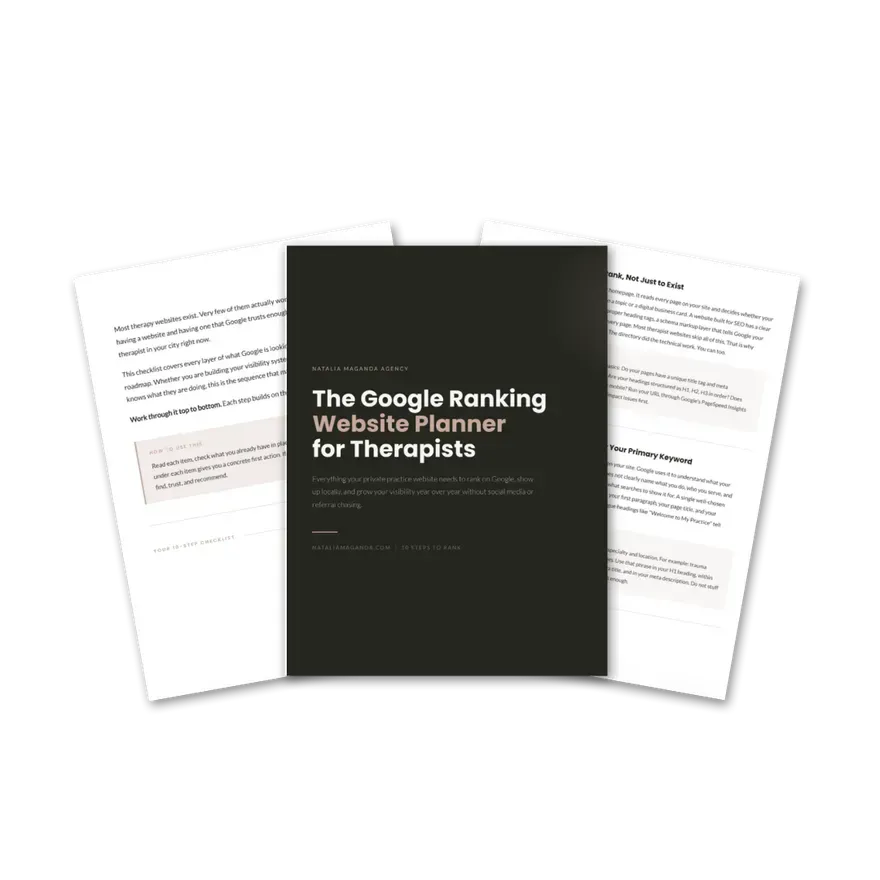
For a limited time claim a custom 12-month private practice SEO roadmap by Natalia Maganda valued at
$97 for FREE
Tell me about your practice and I'll build you a custom PDF roadmap, your local keyword opportunities, a content batching rhythm, and quick wins specific to your niche and location. I build this by hand and walk you through it live on a 20-min call, and you keep the document either way.
We manage 30+ websites and we're ready for your practice to be the next one
Frequently Asked Questions
How long does SEO take to show results?
The honest answer is it really depends. We have had clients 8 months in and still haven't gotten their first inquiry, while others had a very different result in their first 6 months. One strategy is not fundamentally different than the other. There are many factors Google and AI consider when recommending your site: in most cases it's demand in the local area, niche, specialty, competition, domain authority, domain age, relevance, and more. As someone who's been doing SEO for almost a decade, I will always encourage you to start. The sooner you start, the faster you can start watering your SEO garden. Starting is better than waiting while other practices catch the traffic that could be yours.
Are holistic practitioners in demand?
Yes, and that demand is exactly why specificity matters so much. More people are actively searching for the modality you practice, by name, than at any point before. The demand is already there. What most holistic practices are missing is a site built to be found for the exact thing people are searching for, instead of a generic wellness page that never shows up for it at all.
Is a naturopathic doctor a real MD?
This is exactly the kind of question your website needs to answer before anyone has to ask it out loud. A naturopathic doctor is not the same credential as a medical doctor, and pretending otherwise online does not build trust, it erodes it. The practices that rank and convert well are the ones that state their credentials plainly, explain their actual scope of training, and let that honesty do the convincing, rather than leaving a skeptical reader to wonder and click away.
Which is better, a holistic or naturopathic doctor?
The honest answer is that it depends entirely on what someone is looking for, which is exactly why generic comparisons hurt you more than they help. A page that clearly explains your specific modality, what it treats, and who it is genuinely a good fit for will always outperform a page trying to be everything to everyone. Specificity is what lets the right person recognize you as the answer to their exact question.
What are the disadvantages of naturopathy?
Every modality has real limits, and a website that pretends otherwise reads as untrustworthy to both a search engine and a careful reader. The practices that build the most credibility online are the ones willing to say plainly what their approach does well, what it does not replace, and when a client should also be working with a conventional provider. That honesty is not a weakness in your SEO. It is often the exact thing that makes a skeptical visitor finally trust you enough to reach out.
Ready to get this off your desk?
You did not spend years training in a specific modality so you could spend your evenings explaining, page by page, why it is legitimate. If you are ready to hand that off, we invite you to apply for a strategy call.
If you would like to see what this has done for practices like yours first, you are welcome to read more about what website management actually includes before you reach out.
And if your brand hasn't caught up to your practice yet, take a look at branding for holistic practitioners.