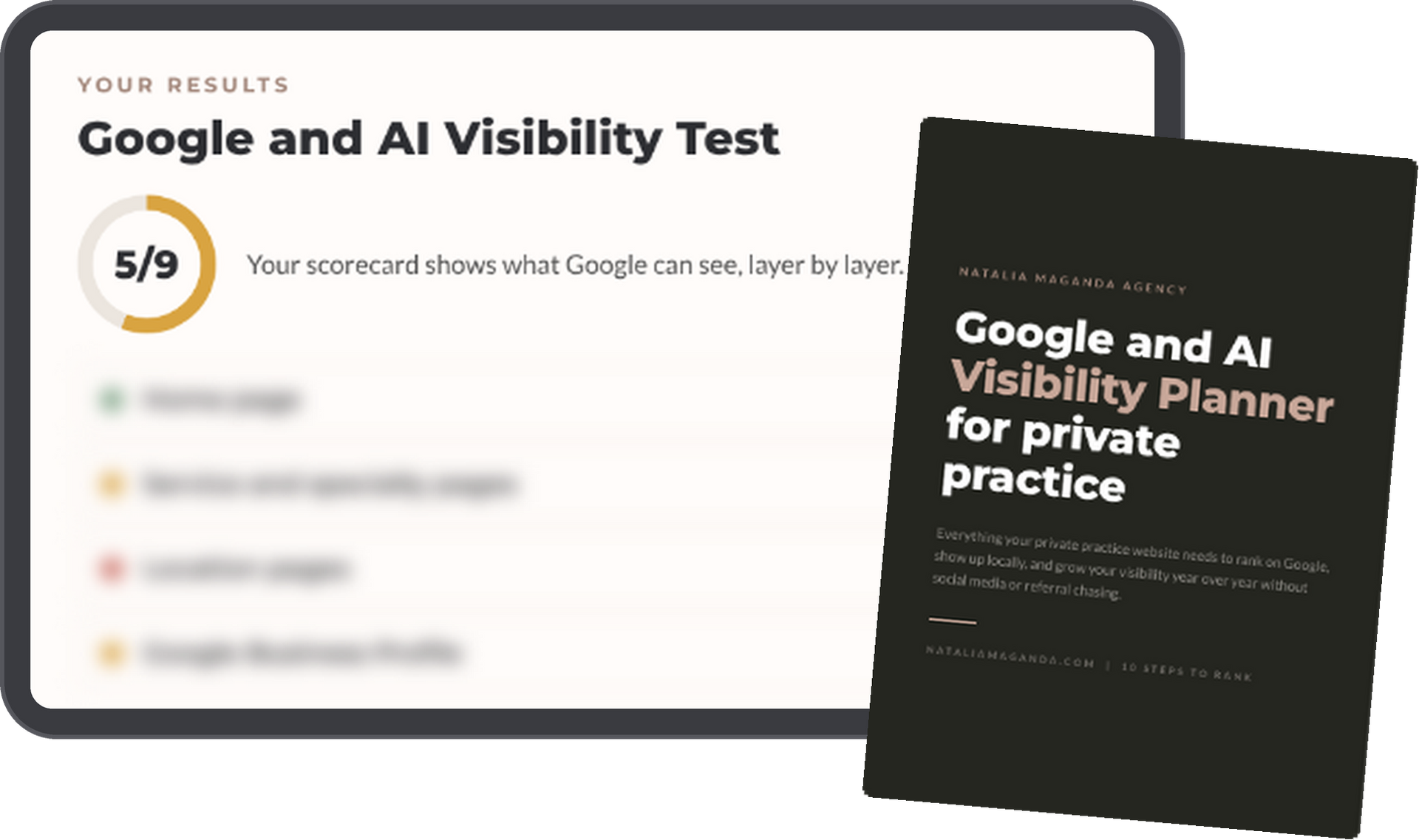

Holistic Practitioner Website Design | NM Agency
You trained for years to hold both the clinical and the intuitive sides of healing, and somewhere along the way your website landed on only one of them. Either it reads so clinical that none of your actual warmth comes through, or it reads so soft that a skeptical new client cannot tell you know what you are doing. Neither version is bringing in the clients who are ready to trust you with both.
In case you are new here, we are Natalia Maganda, the website manager for therapists and practice owners. If you are looking for a site that holds your credibility and your care in the same breath, you are in the right place. Below we will walk through why most holistic practitioner websites undersell what they offer, what a site built for integrative work actually needs, and how working together looks from the first call to launch.
What web design for holistic practitioners actually means
Web design for holistic practitioners is not a softer version of a clinical site, and it is not a spiritual template with a bio pasted in. Your clients are often deciding between you and a conventional provider, and the website has to earn trust on both fronts at once, your training and credentials on one side, and the felt sense that you actually see the whole person on the other.
Done well, the site names your modalities plainly, gives each one its own page built to rank for what it addresses, and lets your training speak for itself instead of over explaining it. Done poorly, it is either a wall of clinical language that could belong to anyone, or a mood board with no substance underneath it.
Why most holistic practitioner websites undersell what they offer
- The credibility gap: the site never states your actual training and certifications clearly, so a skeptical visitor has no reason to trust you over a conventional provider.
- The warmth gap: the opposite problem, a site so clinical or generic that none of the presence you bring into a session comes through before someone ever books.
- Modalities live in one paragraph: a site that lists everything you offer, acupuncture, herbs, energy work, nutrition, in a single sentence instead of dedicated pages never ranks for any of it individually.
- Referral dependency: new clients arrive because someone already trusted you personally, which means growth is capped at how many introductions you can generate by hand.
- Growth outpaces the site: you added a modality or a certification since the site was built, and the site never caught up.
Most of these trace back to the same handful of structural mistakes, the ones we break down in the most common private practice website mistakes.
Signs your holistic practitioner website isn't pulling its weight
- Does your site state your actual training and certifications clearly, or does a visitor have to take your word for it? If they have to guess, many will not book.
- When someone searches for a specific modality you offer, does your practice show up, or does a generic directory listing show up first?
- Can a new client tell within one page view whether you take a clinical approach, an energetic one, or both? If not, that ambiguity is costing you the booking.
- Do you know which modality actually brings in the most inquiries through your website itself, or are you guessing?
That gap usually comes down to fundamentals more than content, the same ones we cover in ranking your practice higher on Google Maps.
Who this is for
This is a strong fit if you:
- Are a holistic or integrative health practitioner offering one or more modalities
- Want your site to state your training clearly enough to earn trust from a skeptical visitor
- Have more than one modality that deserves its own page, not a shared paragraph
- Want the job of visibility off your desk permanently, not patched for another season
This may not be the best fit if you:
- Are a licensed therapist without an integrative or holistic component to your work (our therapist and private practice pages are built for you instead)
- Want a lower cost, lighter version of a website rather than a full system built to rank
- Need to approve every word and pixel yourself rather than trusting a strategy you have signed off on
How we approach web design for holistic practitioners
We start with your actual training, not a generic wellness aesthetic, and build the site to state it plainly before it ever reaches for mood or feeling. Every modality gets its own page built to rank for what it addresses, so a client searching for one specific thing you offer can find it directly instead of wading through everything you do to get there.
Sessions with us are strategy and approval, not homework. We map your modalities, your training, and how your own clients tend to describe what they are looking for on an initial call, build the full site around that structure, and bring you in to review and approve copy and design rather than produce any of it yourself.
Growth typically shows up first as impressions and rankings across your individual modality pages, then as inquiries that already understand the kind of practitioner you are, credentialed and intuitive at once, before they ever pick up the phone.
How it works:
Onboarding, strategy, copy, design, tech and foundational SEO
Most Squarespace and Showit designers charge even more than me, but they deliver a pretty site and leave you to figure out the rest. I don't do that. I literally do everything for you, mapped around your actual training and every modality you offer.
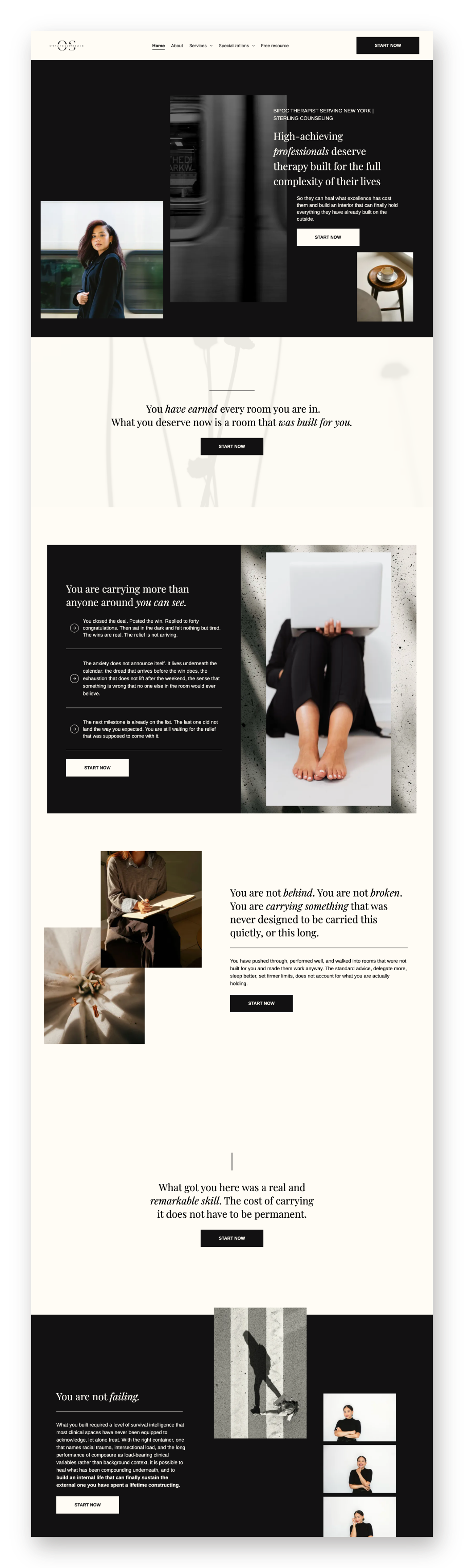
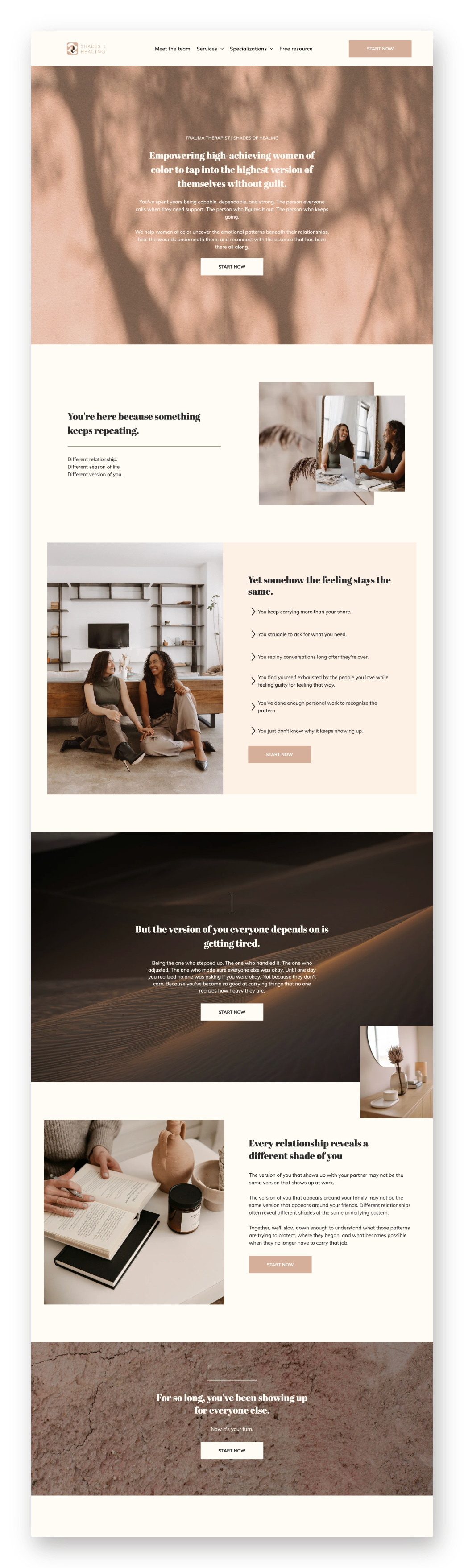
20+ page website launch with copy that reflects your depth and design that magnetizes your clients
It's time for your website to become the most powerful and energetic match for the clients who are meant to find you, with a page for every modality strong enough to rank on its own.
Transition to management. Review a blog batch. Approve it. Get back to your life. That is the whole assignment.
You see clients. We handle the rest. Monthly SEO and ongoing optimization so your practice keeps getting found without you lifting a finger.
Meet your private practice website manager - Natalia Maganda

Natalia Maganda has built more than 100 websites and manages 30+ sites for therapy and wellness practices, including holistic and integrative practitioners whose work blends clinical training with a more intuitive approach to care. She has spent almost a decade in SEO for this exact space, and her focus with holistic practitioners is specific: a site that earns trust from a skeptical visitor and still feels like you. A website manager in your life, so marketing never becomes your full-time job again.
What this includes
- A dedicated, ranking page for every modality you offer
- Credential focused messaging that states your training plainly
- Practice wide brand messaging that holds both credibility and warmth
- Ongoing SEO, including keyword strategy and technical health
- A quarterly blog batch you review and approve, never write
- Reporting tied to rankings and inquiries, not vanity metrics
What working together looks like
We open with a strategy call to map your modalities, your training, and how you want your practice represented. From there we build the full site structure, write every page in your voice, and bring you in to review before anything goes live. Once the site is live, we hold it, meaning ongoing SEO, new pages as your practice grows, and a blog batch you review a few times a year rather than write yourself.
Curious what that ongoing SEO actually includes? Take a look at SEO for holistic practitioners.
Tips while you get started
- Before anything else, list every modality you offer in the plain language a client would search for it, not the term you would use with a fellow practitioner. If you are narrowing your focus, picking a profitable niche is worth reading first.
- Check whether your Google Business Profile reflects the actual categories your practice falls under. Many holistic practitioners are only listed under one, which quietly caps who finds them.
- If you are close to bringing on another practitioner, start the roadmap conversation now. A page built and indexed before their start date gives them a real head start.

hello! i'm natalia maganda
The website manager for therapists and private practice you didn't know existed
We build and manage the 20+ page website that ranks in your city, reflects the depth of your work and books cash-pay clients with ease.
A done for you website management system that lets your practice grow without costing you your energy, your weekends, or your nervous system.
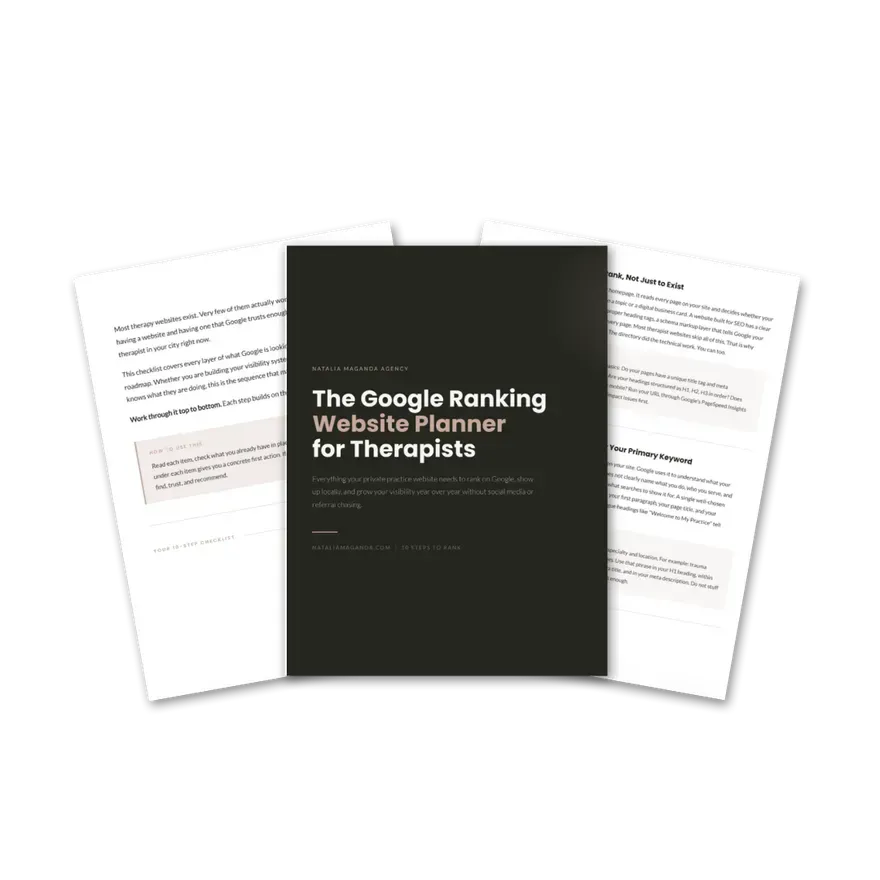
THE 10 THINGS NO ONE IS DOING FOR YOU RIGHT NOW
Your website exists. It is just not the one Google or AI shows when someone in your city searches at 11 at night.
What your next 12 months can look like
One of these comes with a to do list. The other comes with a website manager.You become the web designer, copywriter and SEO
One monthly price. Everything handled.
$597/mo for 12 months, then $350/mo Year 1 price goes up in 2027Lock in current pricing


Client results we're obsessed with...
61 inquiries 27% from Google & AI year 1 of SEO
37 inquiries 51% from Google & AI year 2 of SEO
28 leads in 6 months with a 60+ page custom site re-launch
Multi state ranking & 100%+ traffic increase after 12 months of SEO
96 inquiries 35% from Google & AI + 532% traffic increase first 6 months of SEO (Squarespace re-launch)

For a limited time claim a custom 12-month private practice SEO roadmap by Natalia Maganda valued at
$97 for FREE
Tell me about your practice and I'll build you a custom PDF roadmap, your local keyword opportunities, a content batching rhythm, and quick wins specific to your niche and location. I build this by hand and walk you through it live on a 20-min call, and you keep the document either way.
We manage 30+ websites and we're ready for your practice to be the next one
Frequently Asked Questions
What makes a great website design?
A great design is one built around a clear structure first, a client can find exactly what they need in one or two clicks, and the visuals reinforce trust rather than replace it. For a holistic practitioner, that means your training is stated plainly and every modality has its own page, before a single color or font decision gets made.
What are the 7 C's of website design?
The classic list covers things like clarity, consistency, and credibility, and credibility is the one holistic practitioners most often underbuild. Your site needs to earn trust from a visitor who may be comparing you to a conventional provider, which starts with stating your training clearly, not just your philosophy.
What is the best website design for therapy?
The same principle carries over to holistic and integrative practices, the best design is not a look, it is a structure built to rank every service you offer individually while still sounding like one consistent practice. A beautiful homepage that tries to explain everything at once rarely does any of it well.
What makes a website look professional?
Professional does not mean clinical or cold, it means the site is clear about who you are, what you offer, and why you are qualified to offer it. For holistic practitioners, that credibility signal matters even more, since it is often the deciding factor for a visitor who is still deciding whether to trust an integrative approach.
What are common website red flags?
Vague credentials, a single page trying to describe every modality at once, and no clear next step for booking are the three we see most often on holistic practitioner sites. Each one is a structural fix, not a design overhaul, and each one is costing you inquiries right now.
Ready to get this off your desk?
If you are ready to stop being the one holding your practice's visibility together, we invite you to apply for a strategy call.
If you would like to see what this has done for practices like yours first, you are welcome to read more about what website management actually includes before you reach out.
And if your brand hasn't caught up to your practice yet, take a look at branding for holistic practitioners.