
5 reasons your Squarespace therapy website isn't ranking on Google (and the fixes)
Your Squarespace therapy website is usually not ranking because a few backend basics were never set up: unique page titles and descriptions, compressed images, structured data beyond the defaults, and a site structure that tells Google what you do. Squarespace can rank a therapy website. In my opinion it simply leaves more of that technical work on your plate than other platforms do.
If we haven't crossed paths before, I'm Natalia, the founder of a boutique web design and SEO agency for therapists and private practice owners across the US. My mission is to help your website work as a 24/7 referral engine, so you can log off and still wake up to new inquiries. I have been in business for over 7 years and have served 100+ clients. I built 2 websites of my own and got it wrong both times before I understood how SEO works, and I have managed over 900 URLs for other people's practices. Most of what I fix on a site that will not rank is unglamorous work in the layer behind the page that nobody sees.
If you built your site yourself on a weekend between clients, it probably looks lovely. You searched your own name, found the site on page 6 or nowhere, and wondered whether the platform is the problem. Sometimes it contributes. More often a handful of small gaps stack up, and each one is fixable.
Key takeaways
- Squarespace does not block you from ranking. It does leave page titles, descriptions, image compression, and most structured data decisions to you.
- Google says to make sure every page on your site has a title specified in the title element, and that titles should be descriptive and distinct for each page.
- Squarespace's own SEO checklist advises keeping images under 500 KB and overall page size under 5 MB.
- Structured data gives Google clues about a page, and Google says it might lead to richer search results. It will not rescue a thin site.
- A site with 5 pages and no sitemap plan will struggle on any platform, so check your structure before you blame your builder.
Why is my Squarespace therapy website not ranking on Google?
Check these 5 gaps in this order, because the first ones take minutes and the last ones take months.
| The gap | What Google sees | First fix |
|---|---|---|
| Blank, repeated, or vague page titles | Pages it cannot tell apart | Write a unique title for every page with the main phrase in it |
| Missing or copied page descriptions | A weak reason to click your result | Write a short description for each page in plain language |
| Large, uncompressed images | A slow page | Shrink every photo before you upload it |
| Only the default structured data | Few labels on your service pages | Add structured data where the defaults stop |
| A handful of pages with no sitemap plan | A site with no clear topic authority | Map your Revenue Driver and Specialty pages |
Notice that 3 of the 5 live in the backend, where you only see them if you go looking. That is why a website can look finished and still be invisible.
The last row matters most, and it is the one almost nobody starts with. I made a free sitemap planner for exactly this.
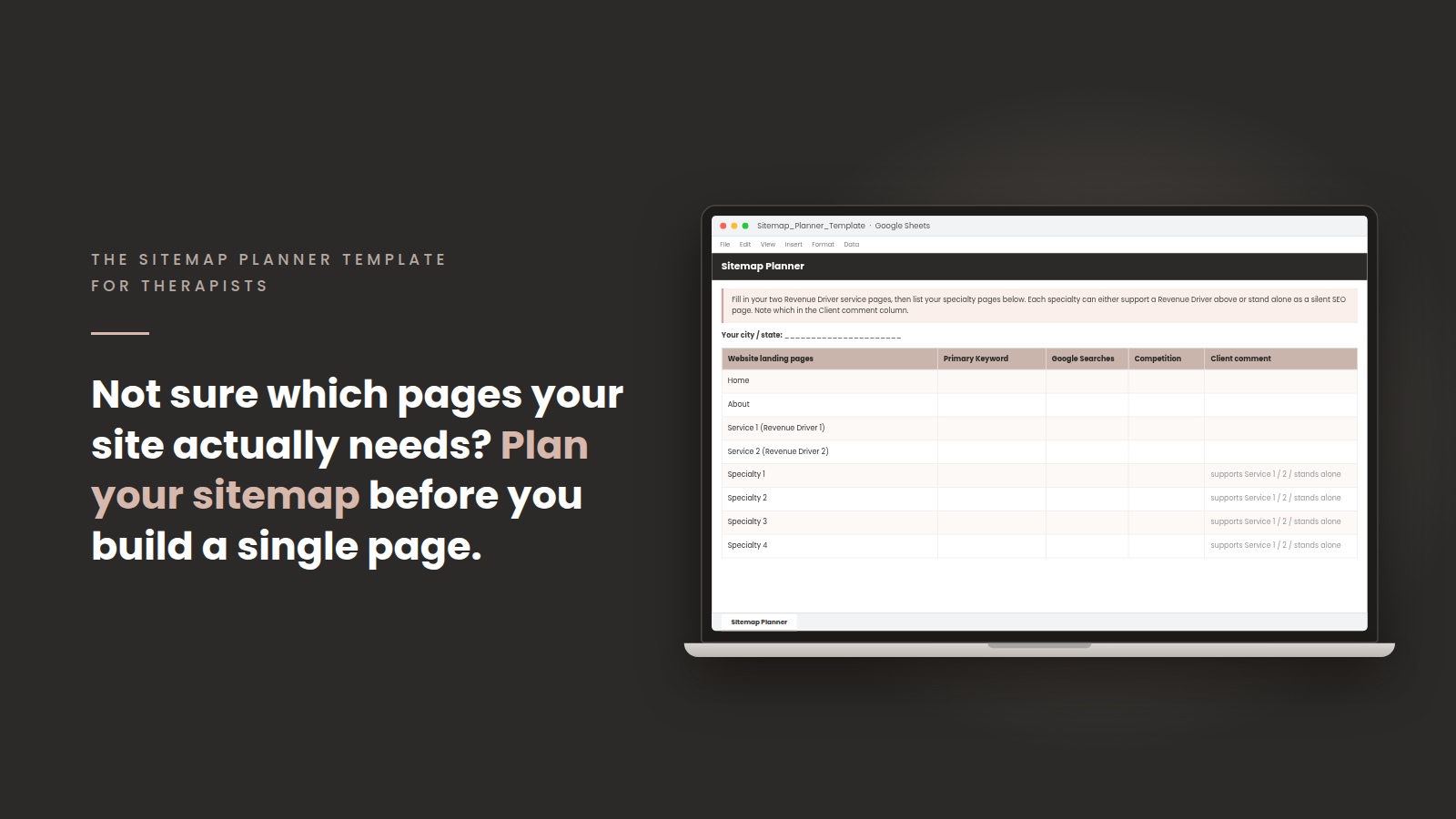
Get my free sitemap spreadsheet planner and use it to choose your 2 Revenue Driver pages and your specialty pages, each with its own main phrase. Once every page has a job, writing its title and description gets much easier.
Do page titles and descriptions really affect rankings on Squarespace?
Yes, because they tell Google and searchers what each page is about. Google's guidance on title links says to give every page a title in the title element, to write descriptive and concise text, and to avoid vague titles like "Home." It also recommends distinct text for each page and warns against repeated or boilerplate titles.
A common pattern on self built therapy sites is a homepage title that says only "Home," or one practice name repeated across every page. Squarespace's SEO checklist tells you to keep the site title under 60 characters with one or more keywords, and to give each page its own short, readable SEO description of 50 to 300 characters. I use a tighter standard for my own sitemaps, with titles under 55 characters and descriptions of 150 to 160 characters, because that keeps the full text visible in results.
Write the title for the page you are actually on. A specialty page for anxiety therapy should carry that phrase and your city, and your contact page should say what you help with.
Does Squarespace add structured data for therapists?
It adds some, and it stops early. According to Squarehead's breakdown of schema on Squarespace, version 7.1 adds basic markup from your business details, article markup on blog posts, and markup for products and events. The same article says breadcrumb markup and markup for other page types needs to be added manually. That article does not show a year, so look at what your own pages carry rather than trusting any summary, mine included.
The manual route is code injection. Squarespace says code injection is available on its Core, Plus, and Advanced plans, site wide or on a single page. Squarespace also says its support team cannot help you add or troubleshoot custom code, so you would be on your own if something breaks.
Keep your expectations honest here. Google describes structured data as explicit clues about the meaning of a page, and says it might encourage richer results. It does not promise them. I think of schema as a plain label on each room of your website, so nothing has to guess. That helps bots and AI tools read your site, and it will not make up for a thin one. My post on schema markup for therapist websites explains which types matter.
Are my images slowing down my Squarespace website?
Very possibly. In my experience, Squarespace leaves image compression to you, so every photo you upload from a photoshoot at full size adds weight to the page. Squarespace's SEO checklist says to keep images under 500 KB and overall page size under 5 MB. A single unedited headshot can exceed that limit on its own, so compress before you upload and add alt text and readable file names while you are there.
Is Squarespace the problem, or is my site structure the problem?
Start with structure, because no platform fixes a site with 5 pages. Google and AI tools read the structure of your whole site to work out what you are an authority on. I have personally managed websites where the sitemap alone, with service pages and specialty pages and no blog published yet, beat local competition and ranked for real commercial keywords. Your 2 Revenue Driver pages carry your top services with story driven copy, and your specialty pages stay lean and use the clinical phrases a researched client types.
After structure, you need ongoing content and authority. Google and AI search reward sites that keep showing up, and a site that stays frozen loses to a practice that keeps publishing. My checklist post on the complete SEO checklist for therapists covers the full list.
Platform does matter at the margins, and this is my opinion. On Squarespace, image compression is manual. WordPress is open source and needs constant patching. Showit needs a separate WordPress blog. I build every agency site on Duda, where schema markup, the robots file, image compression, and alt text generate automatically. If you ever rebuild, choose the platform that takes work off your plate.
How long before my Squarespace site starts ranking after these fixes?
It takes months, and it depends on your competition. With little local competition you could reach page one in your first 90 days, sometimes 6 months. In a bigger metro you are up against practice owners who have done this for years, so it takes longer. Track impressions, clicks, click through rate, and leads in Google Search Console, and reassess every 6 to 12 months. Impressions without clicks, or a page 6 ranking, means Google is starting to pick you up. For the wider picture of why therapy websites stall, I wrote a full breakdown in why your therapist website is not getting clients.
Frequently asked questions
Is Squarespace bad for therapist SEO?
No. A Squarespace site can rank when the basics are in place. In my opinion the platform leaves more manual work on your plate, such as image compression and structured data beyond the defaults, so a site owner without time for that work falls behind.
What should my Squarespace page titles say?
Each title should describe that page in concise, specific words and differ from every other page. Google advises against vague titles like "Home" and against repeated boilerplate. Include the main phrase and your city where it fits.
Can I add schema markup to Squarespace myself?
Yes, through code injection on the Core, Plus, and Advanced plans, according to Squarespace's help page. Squarespace support will not troubleshoot custom code, so test carefully and keep a copy of anything you add.
Do I need to leave Squarespace to rank on Google?
Not as a first step. Fix your page titles, descriptions, image sizes, and sitemap structure first, then measure. If the work keeps piling up, moving to a platform that handles more of it automatically is worth considering.
Want this off your plate?
Everything in this post is something you can do yourself. It also competes with your caseload, your family, and the evenings you would like back. Having a website is a job, and it is probably one you never signed up for.
This is the work I do every day. As a therapist website designer who builds on Duda, I plan your sitemap first and let the platform handle the schema, image compression, and alt text behind the scenes. Our website management keeps the site updated after launch, and SEO for therapists and SEO for private practices cover the ongoing content and authority work that turns a site that looks finished into one that gets found.
If you would rather hand this to someone who has served 100+ clients, apply to work with me and we can talk about your practice. No pressure, just a conversation about what would take the most weight off your desk.
* AI Disclosure: This content may contain sections generated with AI with the purpose of providing you with condensed helpful and relevant content, however all personal opinions are 100% human made as well as the blog post structure, outline and key takeaways.
* Affiliate Disclosure: Some of the links on www.nataliamaganda.com may contain affiliate links meaning that I will get a commission for recommending products at no extra cost to you.

hello! i'm natalia maganda
The website manager for therapists and private practices that you didn't know existed.
We build and manage the 20+ page website that ranks in your city, reflects the depth of your work and books cash-pay clients with ease.
A done for you website management system that lets your practice grow without costing you your energy, your weekends, or your nervous system.