
Why your therapy practice doesn't show up on Google in your city (and 5 fixes)
Your therapy practice does not show up on Google in your city because Google does not have enough clear signals about what you do and where you do it. For most private practices the gap sits in 2 places: a Google Business Profile that is thin or missing, and a website with no sitemap that tells Google which service and which city each page is about.
If we haven't crossed paths before, I'm Natalia, the founder of a boutique web design and SEO agency for therapists and private practice owners across the US. My mission is to help your website work as a 24/7 referral engine, so you can log off and still wake up to new inquiries. I have been in business for over 7 years and have served 100+ clients. I built 2 websites of my own and got it wrong both times, with over 80 keyword selections for each, and I have managed over 900 URLs for other people's practices. Local visibility is where I see the same fixable gaps again and again.
It stings when you search "therapist in your city" and find a practice with a dated website ranking above you. That does not mean she is a better therapist. It usually means her local signals are clearer than yours, and signals can be built.
Key takeaways
- Local results run on 2 lists: the map results at the top and the regular website results below them. You need to work on both.
- Google says local ranking comes from 3 factors: relevance, distance, and prominence. You can influence 2 of them.
- In the Whitespark 2026 Local Search Ranking Factors report, 47 local SEO experts put your primary Google Business Profile category at the top of the map ranking factors.
- A sitemap with clear Revenue Driver pages and Specialty pages tells Google what you are the go to person for, before it reads a single sentence of your writing.
- Reviews still matter, and you can earn them ethically from professional peers without asking clients.
Why doesn't my therapy practice show up when someone searches for a therapist near them?
Start by separating the 2 places you can show up. The first is the map results, the 3 listings with pins that appear above everything else for searches like "therapist near me." Those come from Google Business Profiles. The second is the regular website results below, which come from your actual pages. A practice can rank in one and be invisible in the other, and the fixes are different.
Google's own help page on local ranking says local results are based mainly on relevance, distance, and prominence. Relevance is how well your profile matches what someone is searching for. Distance is how far you are from the person searching. Prominence is how well known your business is, including links to your website and your reviews. The same page says there is no way to request or pay for a better local ranking on Google.
You cannot change distance, because you cannot move your office closer to every searcher. That leaves relevance and prominence, and both are in your hands. Relevance comes from your profile setup and from how clearly your website is organized. Prominence comes from reviews, directory listings, and links from other sites.
If you want the website half handled first, start with the sitemap. I made a free planner that walks you through choosing your 2 Revenue Driver pages and your specialty pages.
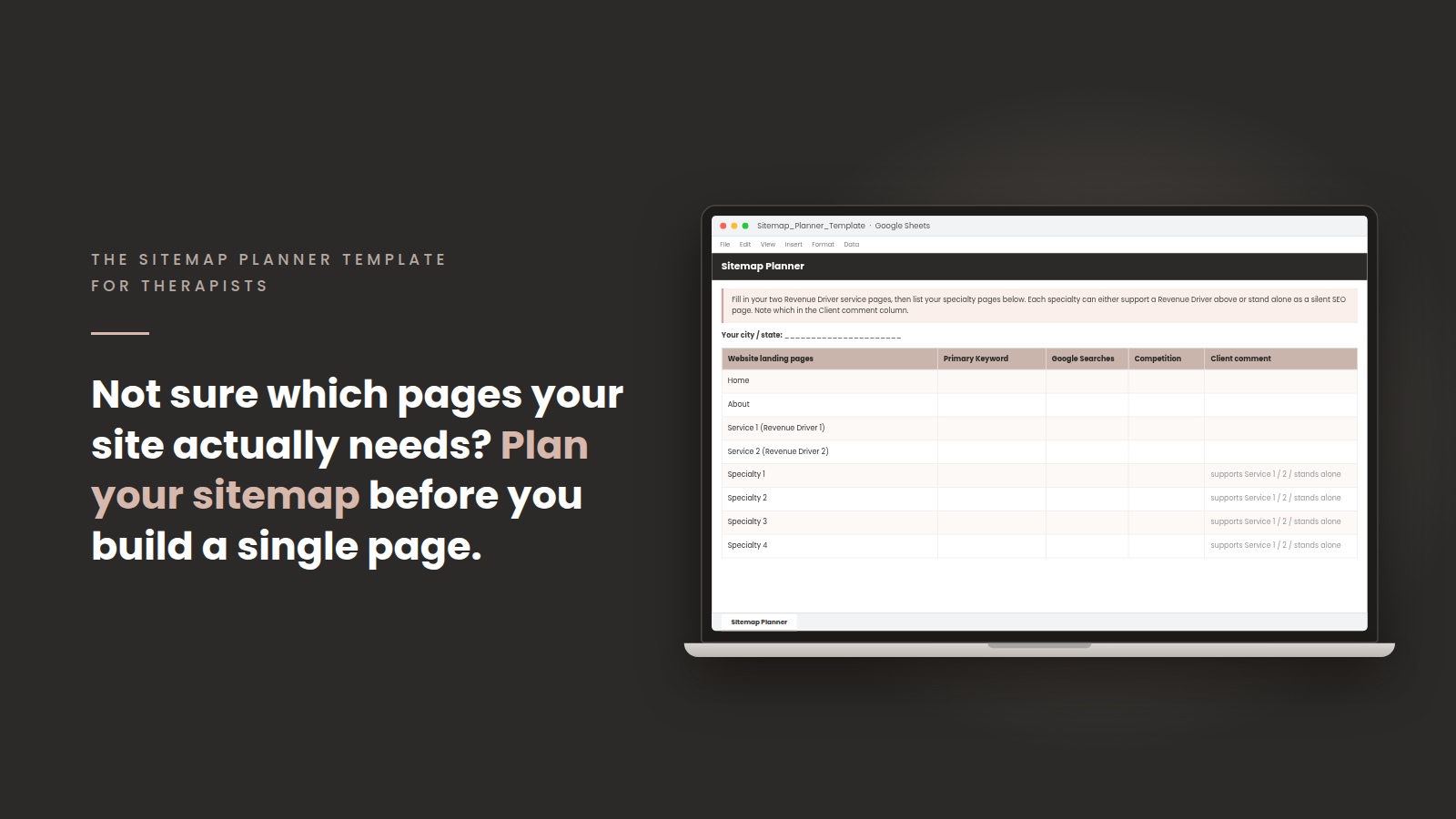
Get my free sitemap spreadsheet planner, fill in your city and state, and keep it in your SEO strategy folder.
What makes a Google Business Profile show up in the map results?
Your profile is the biggest lever for map results. In the Whitespark 2026 report, the top 5 factors were the primary Google Business Profile category, the proximity of your address to the searcher, keywords in the business title, a physical address in the city of search, and being open at the time of the search. The same report says review signals and behavioral signals gained importance this year, while citations lost some ground.
A lot of private practice owners no longer have a physical office, and that is fine. You can set up your profile as a service based business with no storefront and hide your address completely. You still need the profile, because it sends a real signal to Google and to the AI platforms that now pull from search results.
Here is what I check on every profile, in this order:
- Your primary and secondary categories. This matters more than most people realize, so pick the most specific category that matches your main service.
- Every section filled in: services, business description, attributes, and hours.
- Real photos added regularly, beyond your logo.
- Updates posted on the profile itself every so often, because Google rewards profiles that stay active.
- Your name, address, and phone number identical everywhere they appear online, from the free directories to your website footer. This is called NAP consistency.
For the full setup, my guide on Google Business Profile for therapists goes through each field.
How do I get reviews if I cannot ask my clients?
Many therapists feel they cannot ask clients for reviews because of confidentiality, and that caution is reasonable. You still need reviews, just from other people. I have my own clients ask professional peers, colleagues, and referral partners who can speak to their work without touching anything client related. Aim for 1 to 2 authentic reviews a month and put a recurring reminder on your calendar. Never do a review exchange. Google catches reciprocal reviews and will take them down. I also put together a free swipe file for asking peers for ethical reviews if you want the wording done for you.
Why does my website structure matter for local searches?
Google and AI tools like ChatGPT do not read one page at a time. They read the structure of your whole site to figure out what you are an authority on, before they read the writing. I have personally managed websites where the sitemap alone, service pages and specialty pages with no blog published yet, beat local competition and started ranking for real commercial keywords. Those are people searching with their wallet out, ready to book.
I think of a therapy website as 2 categories of pages. Revenue Driver pages are your top 1 or 2 services, the ones that earn you the most and light you up the most. Specialty pages are everything else, and each one either supports a Revenue Driver or stands alone as a quiet SEO page for other clinical training you have, such as EMDR or perinatal work.
Here is what that looks like for a practice in a single city:
| Page type | Example | Job |
|---|---|---|
| Revenue Driver | Anxiety therapy for high achieving professionals in Austin, TX | Story driven copy that turns a searcher into an inquiry |
| Specialty, supports a Revenue Driver | Burnout therapy in Austin, TX | Lean, keyword forward support for the page above it |
| Specialty, stands alone | EMDR for trauma in Austin, TX | Matches the clinical phrase a researched client already types |
Once that foundation exists, you localize it. You can localize what you already have to rank for 1 core city. If you want to show up in several areas, add location pages that describe genuine local knowledge instead of copying the same page with a new city name. My post on location pages for therapy practices covers how to build them without creating thin, duplicate content.
What are the 5 most common reasons a therapist does not show up locally?
These are the gaps I find most often when I look at a practice that is invisible in its own city. You can check yourself against each one in about 15 minutes.
| The gap | What Google sees | First fix |
|---|---|---|
| No Google Business Profile, or an unfinished one | No local signal for the map results | Claim it, set the primary category, fill every section |
| Generic category like "counselor" for a specific service | A weak match for specific searches | Choose the most specific primary category, add secondary ones |
| No city or state anywhere on your key pages | A page with no location to match | Add your core city to your Revenue Driver pages and meta titles |
| No sitemap plan, just a handful of pages | A site with no clear topic authority | Map 2 Revenue Drivers plus Specialty pages |
| Few reviews and few listings compared with competitors | A smaller online reputation | 1 to 2 peer reviews a month and free directory listings |
That last row is the quiet variable behind most local results. Two practices in the same city running the same strategy can get different results if one has been building her online reputation longer. Google and AI tools recommend her first. The practice with the dated website 3 blocks from you may simply have a stronger Google Business Profile and a steady trickle of real reviews.
How long before I show up in local results?
It depends on where you practice, and I cannot promise a date. With little local competition, you could land on page one in your first 90 days, sometimes 6 months. In a bigger metro area you are competing against practice owners who have been doing this for years, so it takes longer and you need sharper keyword choices, creative lower competition phrases with real commercial intent.
Track 4 numbers in Google Search Console: impressions, clicks, click through rate, and leads. Impressions with no clicks yet is not a bad sign, and neither is page 6. Both mean Google is starting to pick you up, and that is the moment to keep building authority. For the bigger picture of why therapy websites stall, I wrote a full breakdown in why your therapist website is not getting clients.
Frequently asked questions
Why doesn't my therapy practice show up on Google Maps?
The most common causes are a missing or unfinished Google Business Profile, a generic primary category, inconsistent name, address, and phone details across the web, and fewer reviews than the practices around you. Start with your primary category, because the Whitespark 2026 report ranked it as the top map factor.
Can I use Google Business Profile if I work from home or only offer telehealth?
Yes. You can set the profile up as a service based business and hide your address completely. The profile still sends a real signal to Google, your website, and the AI platforms that pull from search results.
Does my therapy website need a blog to show up locally?
Not as a first step. A clear sitemap with 2 Revenue Driver pages and Specialty pages can start ranking before you publish a single post. Blogging helps later, once the structure is in place.
Can I pay Google to rank higher in local results?
No. Google states there is no way to request or pay for a better local ranking. Google Ads is a separate channel from your local rankings.
Want this off your plate?
Everything in this post is something you can do yourself. It also competes with your caseload, your family, and the evenings you would like back. Having a website is a job, and it is probably one you never signed up for.
This is the work I do every day. As a therapist website designer who also runs the SEO, I build your sitemap around your Revenue Driver pages and your city. Our website management keeps that site working after launch, so updates and structure stay handled. Then SEO for therapists and SEO for private practices cover the local side, from your profile and directory listings to the ongoing work of building authority.
If you would rather hand this to someone who has served 100+ clients, apply to work with me and we can talk about your practice. No pressure, just a conversation about what would take the most weight off your desk.
* AI Disclosure: This content may contain sections generated with AI with the purpose of providing you with condensed helpful and relevant content, however all personal opinions are 100% human made as well as the blog post structure, outline and key takeaways.
* Affiliate Disclosure: Some of the links on www.nataliamaganda.com may contain affiliate links meaning that I will get a commission for recommending products at no extra cost to you.

hello! i'm natalia maganda
The website manager for therapists and private practices that you didn't know existed.
We build and manage the 20+ page website that ranks in your city, reflects the depth of your work and books cash-pay clients with ease.
A done for you website management system that lets your practice grow without costing you your energy, your weekends, or your nervous system.