
6 reasons your therapy practice website traffic dropped (and how to check each one)
Your therapy practice website traffic dropped for one of a few reasons: a normal seasonal dip, a tracking or site change, pages that Google never indexed, a technical problem, competitors who kept publishing while your site stayed still, or an authority gap that nobody was measuring. Check Google Search Console first, because the cause decides the fix, and guessing usually makes things worse.
If we haven't crossed paths before, I'm Natalia, the founder of a boutique web design and SEO agency for therapists and private practice owners across the US. My mission is to help your website work as a 24/7 referral engine, so you can log off and still wake up to new inquiries. I have been in business for over 7 years and have served 100+ clients. I wrote 80 blogs for my own site and still sat on page 6 with barely 100 clicks a month, so I know how discouraging a flat or falling chart feels. I have also managed over 900 URLs for other people's practices, which means I have seen most of the ways a traffic line can go wrong.
If you opened your analytics this week and the line points down, take a breath. Most traffic drops have an ordinary explanation, and you can find it in about 20 minutes without paying for a tool.
Key takeaways
- Google lists algorithm updates, technical issues, security problems, spam violations, changes in user behavior, and site migrations as the main causes of a drop in search traffic.
- According to Search Console Help, mixing up http and https is probably the most common reason for "missing" search traffic.
- The same help page says it can take a week or more to recrawl a site, so a dip right after a change may not be the final picture.
- A page that is not indexed cannot bring traffic, and most owners never check which of their URLs Google actually has.
- In my experience, a site that stays frozen loses ground to a practice that keeps publishing and building authority.
How do I find out why my therapy website traffic dropped?
Start in the Performance report in Search Console and work from the big picture down to single pages. Google's guide to debugging traffic drops suggests setting the date filter to the last 16 months so you can see yearly patterns, using the Compare feature to line up the drop against an earlier period, and reading the Pages table to see whether the drop is sitewide or limited to a few pages.
Then check 3 things in this order:
- Your property. Search Console Help says mixing up http and https is probably the most common reason for missing traffic, so confirm you are looking at the right version of your site.
- Your pattern. The same page advises checking whether the drop follows a weekly, monthly, or yearly pattern, because much web traffic has seasonal dips.
- Your indexing. Open the Page indexing report and look for a fall in indexed pages or a rise in errors and excluded URLs around the date the traffic dropped.
That third check is where I find the most surprises, because it is the one nobody is tracking. I built a free spreadsheet for it. My free blog database template helps you track if urls are being indexed or not.
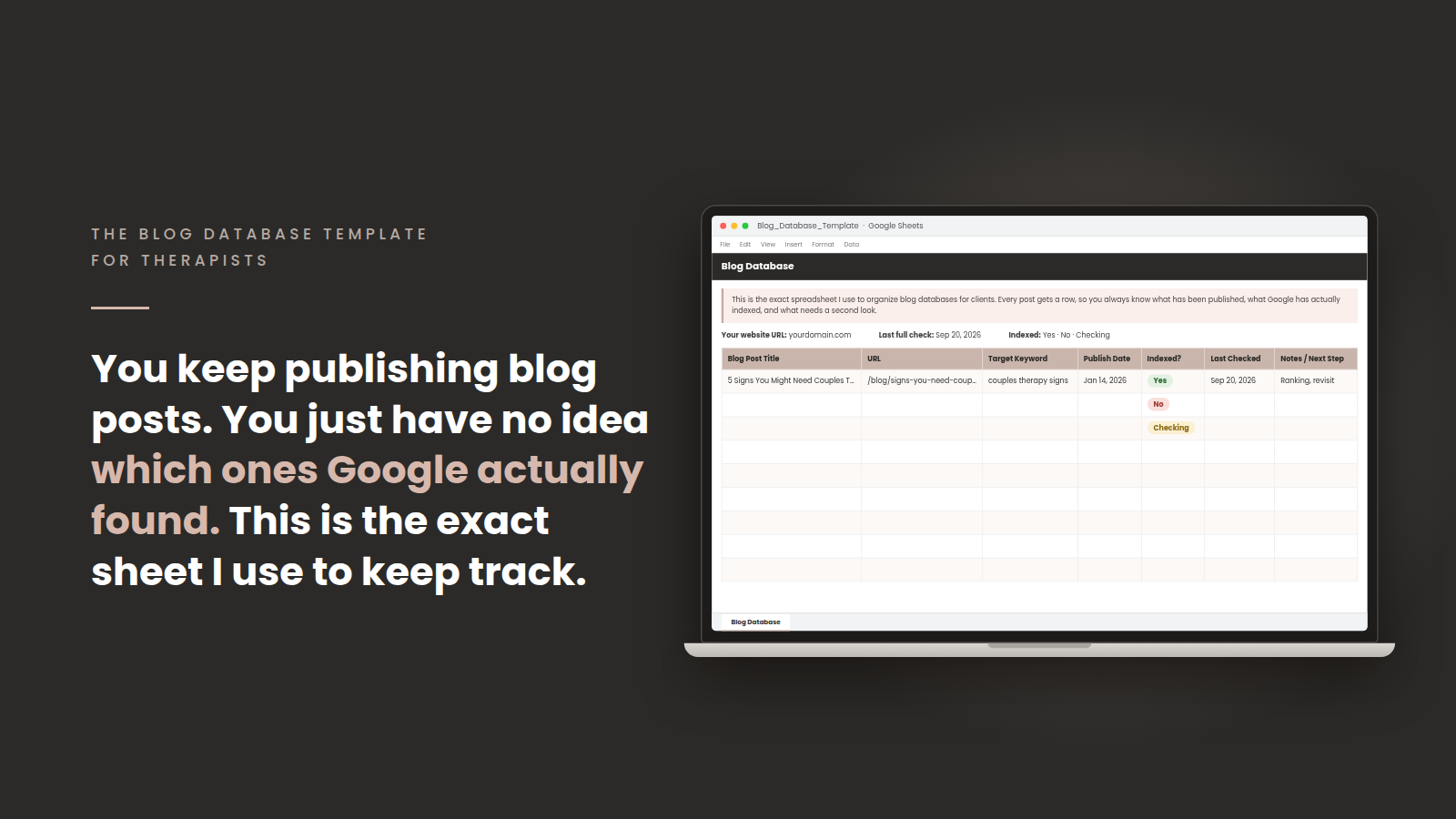
Get my free blog database template. It gives every post a row with its URL, target keyword, publish date, whether Google has indexed it, and when you last checked, so you always know what is live and what Google can actually see.
What are the most common causes of a traffic drop on a therapy website?
Here are the 6 I check, from the quickest to rule out to the slowest to fix.
| The cause | How to spot it | First fix |
|---|---|---|
| Seasonal or weekly dip | The same dip appears in earlier years on the 16 month view | Wait, and compare against last year |
| Wrong property or tracking change | Data stops on a specific date in one property only | Check http and https versions and your analytics setup |
| A site change or migration | The drop follows a redesign, URL change, or move | Give Google time to recrawl and confirm redirects work |
| Pages not indexed | Pages report shows excluded URLs or a falling count | Fix the cause, resubmit, and log each URL |
| Competitors publishing while you stay static | Impressions hold but average position slips | Start a steady content plan built around your sitemap |
| No authority building and no tracking | Flat trust signals, and nobody is checking the numbers | Directories, real mentions, and a regular KPI check |
The first 3 rows are quick to rule out. The last 3 are where the real work lives, so the rest of this post spends its time there.
What if Google never indexed my pages?
Then those pages cannot bring you any traffic, and no amount of tweaking will change that. Google describes technical issues as errors that can prevent it from crawling, indexing, or serving your pages, with examples like server availability and pages not found. On a therapy website this often hides in plain sight, because the pages look fine to you when you visit them.
To check a single page, search for your domain followed by the page's address in Google, or open the Page indexing report in Search Console. If the page shows up, mark it as indexed in your database. If it does not, give it a few weeks, check again, and look into the cause if it still will not appear. A page that has gone out to the void and never been checked is one of the most common reasons a blog seems to do nothing. Revisit the list each time you publish, and again every few months.
Did competitors outrank me because they kept publishing?
It is very possible, and in my opinion it is one of the most underrated causes. Google and AI search reward sites that keep showing up with real, consistent content. A site that published 5 pages years ago and never touched them again loses ground to a practice that keeps adding to its site. The era of the static website is over.
Publishing alone is not enough, and this matters more than people expect. Two practices in the same city can run the same strategy and get different results if one has the bigger online reputation. Free directories are a should do, paid directories build domain authority slowly, and real mentions from other sites tell Google that other people vouch for you. Structure your content around your sitemap so each post builds authority for one page and does not scatter across a dozen topics. My guide on content strategy for therapist SEO shows how to plan it.
How long should I wait before I worry about a traffic drop?
Wait long enough for the data to mean something, but no longer than your next check. Search Console Help says it can take a week or more to recrawl a site, so a dip right after a change often needs a couple of weeks before you can judge it. SEO as a whole is slow, and I reassess strategy every 6 to 12 months.
Track 4 numbers: impressions, clicks, click through rate, and leads. They move together, and they matter more as a set than any single number does. Impressions with no clicks yet is not a bad sign, and a page 6 ranking is not failure. Both mean Google is starting to pick you up. If you are not sure whether your numbers are healthy, my post on how to tell if your therapy practice SEO is actually working gives you a simple way to read them. For the wider picture, I wrote a full breakdown in why your therapist website is not getting clients.
Frequently asked questions
Why did my therapy practice website traffic suddenly drop?
Start with the Performance report in Search Console and compare the drop against an earlier period. The most common explanations are a seasonal dip, a property or tracking mismatch, a recent site change, or pages that fell out of Google's index. Google's debugging guide walks through each one.
Is a traffic drop after a website redesign normal?
Often, yes. Google says site migrations and URL changes can cause ranking fluctuations while it recrawls and reindexes your site. Confirm your pages are indexed, check that old addresses point to the new ones, and compare the numbers again after a few weeks.
How often should I check whether my blog posts are indexed?
Check each post after you publish it, and review the full list every few months. Searching for the post's address in Google or opening the Page indexing report in Search Console will tell you. Keep the result in a simple database so you can see what Google has found and what needs a second look.
Did a Google update cause my traffic drop?
It might have. Google lists algorithm updates among the causes of traffic changes, so line up the date of your drop with the timing of any announced update. Rule out the simpler causes first, because those are far more common on a small practice site.
Want this off your plate?
Everything in this post is something you can do yourself. It also competes with your caseload, your family, and the evenings you would like back. Having a website is a job, and it is probably one you never signed up for.
Watching indexing, publishing consistently, and building authority is slow, repeatable work, which is why it usually slips off the to do list.
As a therapist website designer who also runs the SEO, I build the sitemap and the pages that your traffic lands on, and our website management keeps the site healthy after launch. Then SEO for therapists and SEO for private practices cover the ongoing content and authority building that keeps a traffic line moving in the right direction.
If you would rather hand this to someone who has served 100+ clients, apply to work with me and we can talk about your practice. No pressure, just a conversation about what would take the most weight off your desk.
* AI Disclosure: This content may contain sections generated with AI with the purpose of providing you with condensed helpful and relevant content, however all personal opinions are 100% human made as well as the blog post structure, outline and key takeaways.
* Affiliate Disclosure: Some of the links on www.nataliamaganda.com may contain affiliate links meaning that I will get a commission for recommending products at no extra cost to you.

hello! i'm natalia maganda
The website manager for therapists and private practices that you didn't know existed.
We build and manage the 20+ page website that ranks in your city, reflects the depth of your work and books cash-pay clients with ease.
A done for you website management system that lets your practice grow without costing you your energy, your weekends, or your nervous system.