
5 website copy problems that cost your therapy practice inquiries (and the fix)
Your therapy website gets traffic but no inquiries because the people who land on it cannot tell, within a few seconds, that you are the right therapist for them. In my experience that is a copy problem far more often than a design, speed, or ranking problem.
If we haven't crossed paths before, I'm Natalia, the founder of a boutique web design and SEO agency for therapists and private practice owners across the US. My mission is to help your website work as a 24/7 referral engine, so you can log off and still wake up to new inquiries. I have been in business for over 7 years and have served 100+ clients. I also built 2 websites of my own and got it wrong both times before I understood how this works, and I have managed over 900 URLs for other people's practices. That is why I can tell you which fixes matter and which ones just feel productive.
If you have opened Google Analytics or Search Console and seen real visits next to an empty contact form inbox, you are in a frustrating spot, because the usual advice is to get more traffic. More traffic into a page that does not convert just gives you a bigger number on a report. Here is how to find what is actually happening on your pages.
Key takeaways
- Check which searches bring visitors before you touch the copy, because visits from curiosity searches were never going to book.
- Visitors decide fast. Nielsen Norman Group's analysis of 45,237 page views found people read about 20% of the text on an average page.
- 5 copy problems do most of the damage: a headline about you, clinical language on pages that need warmth, copy aimed at everyone, no clear next step, and thin copy on your 2 highest value service pages.
- Your main service pages and your specialty pages need different voices. Warm and human on the first, exact clinical phrases on the second.
- Rewrite before you redesign. A new design wrapped around the same words gets the same result.
How do I know if the problem is my website copy or my traffic?
Start with the searches, because traffic only counts when the right person is behind it. Open Google Search Console, filter to your homepage and your top service pages, and read the queries. Searches like "anxiety therapist in your city" or "therapist for high achieving women" come from people ready to book. Searches like "therapy quotes" or "what is EMDR" come from people who are curious, and they were never going to fill out your contact form. If most of your traffic looks like the second group, you have a traffic intent problem, and the fix starts with your keyword targets.
If the right people are landing on your pages and still leaving, look at what happens after the click. Count how many visitors reach your contact page and how many of those submit the form. Visitors who never reach the contact page were not convinced. Visitors who reach it and leave ran into friction in the form or in the ask.
It also helps to know what normal looks like. The Unbounce 2024 Conversion Benchmark Report for healthcare, wellness, and medical services, built on more than 57 million landing page conversions, puts the median conversion rate at 5.1%, and 8.2% for the wellness subcategory. Those numbers describe landing pages with a single goal, so treat them as a rough direction for your site. The point still holds. A few hundred visits from the right searches over several months with zero inquiries deserves a closer look, whichever benchmark you use.
If you want to fix the copy, start with the person you are writing to. I built an ideal client avatar AI prompt that turns your answers about why you became a therapist and which clients light you up into a specific avatar you can write every page for.
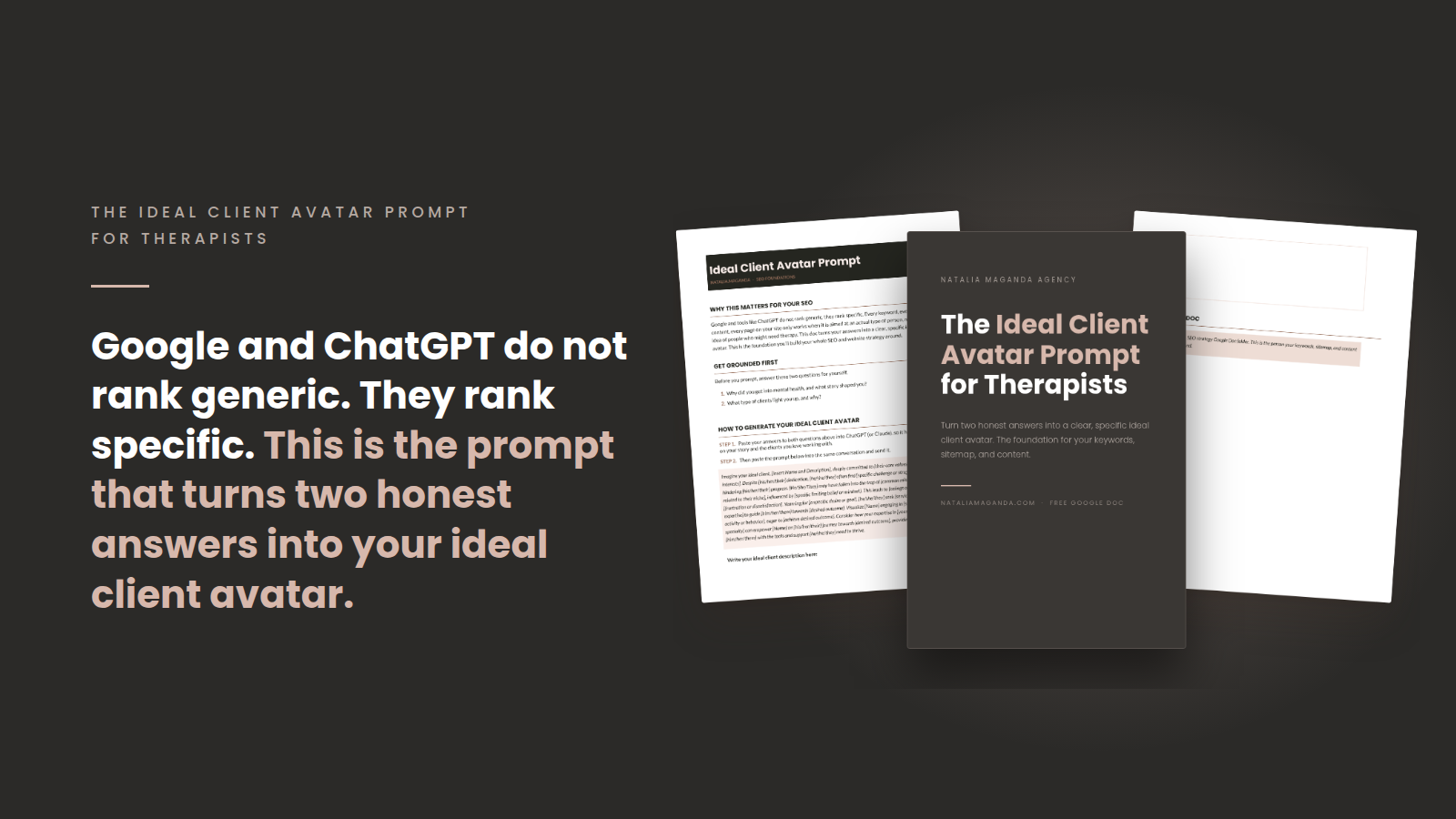
Get my ideal client avatar AI prompt and save it in your SEO strategy folder before you rewrite a single headline.
What does a website copy problem look like on a therapy website?
It looks like 5 patterns. You can check your own site against each one in about 10 minutes.
Your headline talks about you instead of her
A homepage that opens with "Welcome to Maple Counseling" and a list of credentials answers a question nobody asked. A visitor arriving from Google has 1 question: is this person for someone like me? Name her and her struggle in the first line. "Therapy for high achieving women who look fine on the outside and feel stretched thin" gives her something to recognize. A credential line gives her nothing to recognize.
Your copy reads like clinical paperwork
Words like modalities, presenting concerns, evidence based approaches, and treatment planning are accurate, and they keep a scared reader at arm's length. On your main service pages, write the way you would talk to a client who is searching in general terms at 11pm.
There is 1 place where clinical language earns its keep. On a specialty page, such as EMDR for OCD, the person searching has usually done her research and types the clinical phrase herself. In my opinion those pages should match her exact words, and your main pages should match her feelings.
You speak to everyone
A line like "I help adults, teens, couples, and families with anxiety, depression, trauma, and life transitions" is true for so many practices that it works for none of them. Google and AI tools rank specific pages, and readers respond to specific pages the same way. Pick the client you most want more of and write to her. You can still serve other clients. Your copy does not need to list all of them.
Nothing tells her what to do next
Many therapy sites offer 5 contact options, a form buried at the bottom, and a button that says "Submit." Choose 1 primary next step, such as a free consultation call, and repeat it in the same words on every page, including the first screen. Keep the tone low pressure, because overwhelmed readers close the tab when they feel pushed. Clear is kinder than clever.
Your 2 highest value pages got the thinnest copy
I think of a therapy website as having 2 kinds of pages. Revenue Driver pages are the 1 or 2 services that earn you the most and that you most want to grow. They deserve real, story driven copy, because this is where a future client decides whether you understand her. Specialty pages are everything else, and they can stay lean and keyword forward. If your top 2 service pages read like your FAQ, rewrite those first.
| What is on your site | What the visitor concludes | First fix |
|---|---|---|
| Headline starts with your practice name | This is about the therapist, not me | Name her and her struggle in the first line |
| Modalities and credentials lead the page | This sounds cold and clinical | Use her words on main pages, clinical words on specialty pages |
| A list of everyone you serve | This might not be for my situation | Write to 1 client you want more of |
| 5 contact options and a buried form | I am not sure what happens next | 1 primary next step, repeated on every page |
| Thin copy on your top 2 service pages | I do not feel understood | Story driven rewrite of those 2 pages first |
How do I rewrite my therapy website copy without starting over?
Work in this order, because each step makes the next one easier.
- Write your ideal client avatar. Every headline after this gets easier, because you are writing to 1 person instead of a category.
- Rewrite the first screen of your homepage with 3 pieces: a headline that names her and her struggle, 1 sentence on what changes when she works with you, and 1 button with your primary next step.
- Rewrite your top 2 service pages with story driven copy. Describe what her days feel like now and what they feel like after.
- Trim your specialty pages so each one matches the exact phrase a researched client would type.
- Put the same next step on every page, in the same words.
The Nielsen Norman Group study of how little users read found that people read about 20% of the text on an average page, and at most 28%. The data was collected in 2005 and published in 2008, so use it as a rough direction. It still explains why the first screen of your homepage carries so much weight. For the section by section detail, my posts on what to include on a therapist homepage and the exact words each page needs walk through it page by page.
Should I redesign my therapy website if the copy is the problem?
Not yet. Rewrite first, then decide. A gorgeous website can look professional and still bring in nothing, because visitors respond to the words and the clarity on the page long before they respond to the color palette. If you redesign around the same copy, you pay for a new look and keep the same result.
If you rewrite and the structure is still holding you back, that is the moment to rebuild. Once your key pages turn visitors into inquiries, SEO has something worth pointing people at. For the wider picture of why therapy websites stall, I wrote a full breakdown in why your therapist website is not getting clients.
How long before new copy brings inquiries?
I cannot promise a timeline, and anyone who does is guessing. What I can tell you is how to measure it. Change your homepage first, then your top 2 service pages, and give each change enough traffic to mean something. 10 visits tell you nothing. A few hundred visits from the right searches tell you a lot. Check your contact page visits and form submissions once a month, and change 1 thing at a time so you know what moved.
Frequently asked questions
Why is my therapy website getting traffic but no contact form submissions?
Either the wrong people are visiting or the right people are leaving. Check your Search Console queries first, then count how many visitors reach your contact page. In my experience the most common cause on therapy sites is copy that does not name a specific client or a clear next step.
How many inquiries should a therapy website get each month?
There is no universal number, because it depends on your traffic, your city, and your services. The Unbounce 2024 benchmark for healthcare and wellness puts the median landing page conversion rate at 5.1%, but those are single goal landing pages. Use it as a rough reference and track your own trend month over month.
Does my therapy website need a redesign to get more inquiries?
Usually not as a first step. Rewrite your homepage and your top 2 service pages first and measure the change. If the structure still gets in the way, a rebuild makes sense, and the last section of this post covers what that looks like.
Can I write my therapy website copy with ChatGPT?
Yes, if you feed it your story, your ideal client avatar, and your specific services. A generic prompt returns generic copy that sounds like every other practice, which brings you back to the "you speak to everyone" problem. Edit everything it writes until it sounds like you talking to 1 client.
Want this off your plate?
Everything in this post is something you can do yourself. It also competes with your caseload, your family, and the evenings you would like back. Having a website is a job, and it is probably one you never signed up for.
This is the work I do every day. As a therapist website designer who also runs the SEO, I write the copy around your ideal client and build a sitemap Google can read. Our website management keeps that site working after launch, so the copy, structure, and updates stay handled. Then SEO for therapists and SEO for private practices bring the right searchers to pages that are ready to turn them into inquiries.
If you would rather hand all of this to someone who has served 100+ clients, apply to work with me and we can talk about your practice. No pressure, just a conversation about what would take the most weight off your desk.
* AI Disclosure: This content may contain sections generated with AI with the purpose of providing you with condensed helpful and relevant content, however all personal opinions are 100% human made as well as the blog post structure, outline and key takeaways.
* Affiliate Disclosure: Some of the links on www.nataliamaganda.com may contain affiliate links meaning that I will get a commission for recommending products at no extra cost to you.

hello! i'm natalia maganda
The website manager for therapists and private practices that you didn't know existed.
We build and manage the 20+ page website that ranks in your city, reflects the depth of your work and books cash-pay clients with ease.
A done for you website management system that lets your practice grow without costing you your energy, your weekends, or your nervous system.