
Why Psychology Today outranks your therapy website (and 4 ways to close the gap)
Directories like Psychology Today outrank your practice website because Google sees them as more trusted sources, and trust comes from years of links pointing at them from other respected sites. A newer practice website starts with almost none of that, which makes this an authority gap. Authority can be built, and you can start this week.
If we haven't crossed paths before, I'm Natalia, the founder of a boutique web design and SEO agency for therapists and private practice owners across the US. My mission is to help your website work as a 24/7 referral engine, so you can log off and still wake up to new inquiries. I have been in business for over 7 years and have served 100+ clients. I wrote 80 blogs for my own site and still sat on page 6 with barely 100 clicks a month, because the site had not earned enough trust yet. Many of our clients start at a domain authority of 0 and grow to 6 to 8 within their first year, so I have watched this slow build from both sides.
If you have Googled "therapist in your city" and found directories, larger group practices, and everyone except you, you are probably wondering what you did wrong. Most likely nothing. You are competing against sites with a head start that no amount of good writing closes on its own.
Key takeaways
- Google says that one of the factors in judging quality is whether other prominent websites link to or refer to your content. Directories have collected those links for years.
- Domain authority and domain rating are third party scores. Ahrefs defines Domain Rating as a measure of the relative strength of a website's backlink profile, on a scale from 0 to 100.
- Ahrefs also points out that Google ranks pages, not websites, so treat these scores as a rough read of your online reputation and never as a goal in themselves.
- Free directories are a should do. Paid directories are a budget decision that builds authority slowly and does not produce a spike in leads.
- You will not outrank Psychology Today on the broadest searches overnight. You can outrank it on specific searches by building a clear sitemap and steady authority.
Why do directories like Psychology Today outrank my own practice website?
They outrank you because of the links pointing at them. Google looks at whether other trusted sites link to a page, and treats that as a sign the information is reliable, according to the Google page on how search ranks results. A large directory has been collecting links from other sites for years, and in my experience every profile on it borrows some of that trust.
Your website starts from the other end. A new practice site has few links, no history, and a handful of pages. That is where the domain authority numbers come in. Ahrefs describes its Domain Rating as the relative strength of a site's backlink profile, from 0 to 100. The same article says Google ranks pages, not websites, and that you should not chase the number itself. I agree with that, and I still watch the number, because in my experience it is a decent read on how much trust a site has earned compared with the sites around it.
Here is the part most therapists never hear. Two practices in the same city can run the same SEO strategy and get very different results. If one has a bigger online reputation, Google and AI tools recommend her first. That does not mean she is better at her work than you. She has been investing in her brand longer.
If you want to start closing that gap today, I put together a free list of directories.
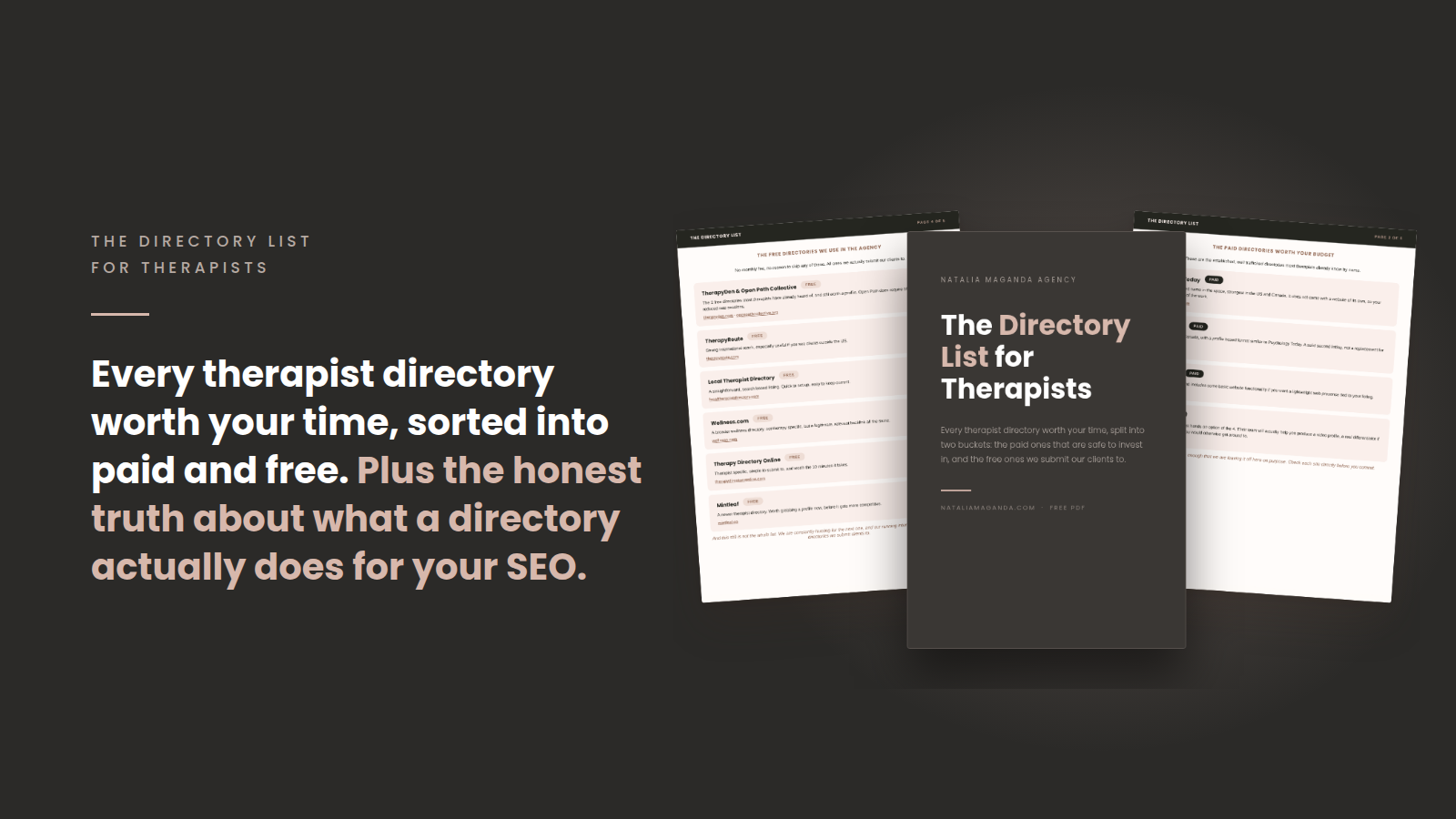
Get my free directory list for therapists. It covers the paid directories worth your budget, the free ones we submit our agency clients to, an honest note on what a paid listing does for your SEO, and one small assignment to start this week.
Can my practice website ever outrank Psychology Today?
Yes, on specific searches and over time. On the broadest searches, like "therapist in your city," a large directory is very hard to beat, and I would not build your whole plan around that one phrase.
Specific searches are a different story. A directory profile is a general page. Your website can have a page built for exactly what a client is typing, such as anxiety therapy for high achieving professionals in your city, or EMDR for trauma. I have personally managed websites where the sitemap alone, with service pages and specialty pages and no blog published yet, beat local competition and started ranking for real commercial keywords. Structure gives your authority somewhere useful to land.
A directory profile and your own website also do different jobs. The directory puts you in front of someone already browsing for a therapist. Your website is the place you control, where the client decides whether you understand her. That is why I suggest doing both and expecting the right thing from each.
What is the difference between free and paid directories?
Free directories cost 10 minutes each and build a base of links. Paid directories cost a recurring fee and build authority more slowly than people expect. The table shows what each one realistically does.
| Free directories | Paid directories | |
|---|---|---|
| Cost | No monthly fee | Monthly or yearly fee |
| What it does for you | Adds real, relevant backlinks and consistent listings | Adds backlinks and helps your authority build over time |
| What to expect | A steady base layer of trust | No spike in traffic and no flood of leads |
| My take | A should do, every time | A budget decision that does not generate leads on its own |
I once paid $1,000 for a feature placement that moved my domain authority from about 12 to 20. That backlink did not bring me clients directly. It did add to my trustworthiness, and to being recommended by AI to therapists who now book discovery calls with me. Every business needs a marketing budget for things that do not tie to a sale, and in my view this is one of them.
How do I build authority so my website can compete?
Build it in layers, starting with the cheapest and most certain. Work through these in order:
- Submit your site to free directories. Start with 3 this week. Use the same name, address, and phone number everywhere, because inconsistent details weaken the signal.
- Decide on a paid directory as a budget line, with the right expectations. It builds trust slowly and will not fill your caseload by itself.
- Build your sitemap so your authority has pages worth landing on: your 2 Revenue Driver pages, plus specialty pages for the clinical phrases researched clients type.
- Earn real mentions from other people. That means guest posts, press mentions, podcast guest spots, and reviews from professional peers. This is the slower, more boring work that AI cannot fake for you.
- Track impressions, clicks, click through rate, and leads, and reassess every 6 to 12 months.
For the mechanics of links, my posts on what a backlink is and how therapists build them and on why therapy websites start with low domain authority go deeper on each piece.
How long does it take to build authority?
It takes months, and it compounds over years. A lot of our clients start at a domain authority of 0 and reach 6 to 8 in their first year. The leads do not show up the second that number moves. It is the slow build of an online reputation.
Where you practice changes the timeline. With little local competition you could reach page one in your first 90 days, sometimes 6 months. In a bigger metro you are up against practice owners who started years ago, so it takes longer and your keyword choices need to be sharper. Impressions without clicks, or a page 6 ranking, is not failure. It means Google is starting to pick you up, and it is a sign to keep building. For the wider picture, my guide on why your therapist website is not getting clients shows where authority fits among the other causes.
Frequently asked questions
Should I cancel Psychology Today if it outranks my website?
I would keep doing both. A directory listing reaches people already browsing for a therapist, and your website builds the trust that turns them into inquiries. Judge a paid listing as a budget decision for authority and visibility, and do not expect it to fill your caseload on its own.
Does a paid directory listing help my SEO?
It can, slowly. A listing adds a backlink, and Google says links from prominent sites are a sign of trustworthy content. It will not give you a spike in traffic, so expect a gradual gain in authority and not a flood of leads.
Is domain authority a Google ranking factor?
No. Domain authority and Ahrefs' Domain Rating are scores made by third party tools to estimate the strength of a backlink profile, and Ahrefs notes that Google ranks pages, not websites. I use the score as a rough gauge of reputation compared with the sites around you.
How many directories should I submit my practice to?
Start with 3 this week, beginning with the free ones. Each takes about 10 minutes, and they build a base layer of consistent listings. Add more over time as your budget and bandwidth allow.
Want this off your plate?
Everything in this post is something you can do yourself. It also competes with your caseload, your family, and the evenings you would like back. Having a website is a job, and it is probably one you never signed up for.
Authority building is slow, repetitive work, which is exactly why most owners never finish it. As a therapist website designer who also runs the SEO, I build the sitemap first so your authority has somewhere to land, and our website management keeps that site updated after launch. Through SEO for therapists and SEO for private practices, we submit every client to directories, and we have real PR placements in motion, with podcast guest spots for clients next on our roadmap.
If you would rather hand this to someone who has served 100+ clients, apply to work with me and we can talk about your practice. No pressure, just a conversation about what would take the most weight off your desk.
* AI Disclosure: This content may contain sections generated with AI with the purpose of providing you with condensed helpful and relevant content, however all personal opinions are 100% human made as well as the blog post structure, outline and key takeaways.
* Affiliate Disclosure: Some of the links on www.nataliamaganda.com may contain affiliate links meaning that I will get a commission for recommending products at no extra cost to you.

hello! i'm natalia maganda
The website manager for therapists and private practices that you didn't know existed.
We build and manage the 20+ page website that ranks in your city, reflects the depth of your work and books cash-pay clients with ease.
A done for you website management system that lets your practice grow without costing you your energy, your weekends, or your nervous system.