
Best way to audit a therapy website with traffic but no inquiries: 5 methods ranked
The best way to audit a therapy website that gets traffic but no inquiries is to start with 3 free checks: read the searches bringing visitors in, test your contact form, and run a 5 second test on your top pages. Add recordings and a speed check after that, and bring in a professional when you cannot interpret what you find.
If we haven't crossed paths before, I'm Natalia, the founder of a boutique web design and SEO agency for therapists and private practice owners across the US. My mission is to help your website work as a 24/7 referral engine, so you can log off and still wake up to new inquiries. I have been in business for over 7 years and have served 100+ clients. I built 2 websites of my own and got it wrong both times, and I have managed over 900 URLs for other people's practices, so I have audited a lot of sites that looked fine and brought in nothing.
If you can see visitors in your analytics and nothing in your inbox, the usual advice is to run a site audit, and the tools will hand you a score and a long list of warnings. Most of those warnings have nothing to do with your silent contact form. Here is how I would rank the options, so you start with the ones that answer your question.
Key takeaways
- I rank audit methods by 3 criteria: how fast you get an answer, what it costs, and how directly it explains missing inquiries.
- A technical score is the weakest explanation for a quiet inbox. Check who your visitors are and what they see first.
- Visitors scan. A Nielsen Norman Group analysis of 45,237 page views found that users read about 20% of the text on the average page, a 2008 study based on 2005 data, so judge your pages in seconds.
- Google says lab data may not capture real world bottlenecks, which is why a speed score is a starting point and never a verdict.
- In my experience, a site with 5 pages and no sitemap plan has a structure problem that no score will show you.
What is the best way to audit a therapy website that gets traffic but no inquiries?
Run the audits in order of how directly they explain missing inquiries, and stop when you find the cause. Here is my ranking of 5 methods.
| Rank | Method | Time | Cost | What it tells you |
|---|---|---|---|---|
| 1 | Read your Search Console queries | 20 minutes | Free | Whether the right people are visiting |
| 2 | Test your contact form | 2 minutes | Free | Whether inquiries can reach you at all |
| 3 | Run a 5 second test on your top pages | 30 minutes | Free | Whether a visitor knows what to do next |
| 4 | Watch recordings and heatmaps | 1 hour | Varies by tool | Where visitors stop and leave |
| 5 | Check speed and mobile experience | 15 minutes | Free | Whether the site works on a phone |
A professional audit sits outside this ranking, because it is the option for when you have done the checks and cannot read the results. More on that below.
Once you know which pages need work, you need a place to log them. I made a free blog database template for exactly this.
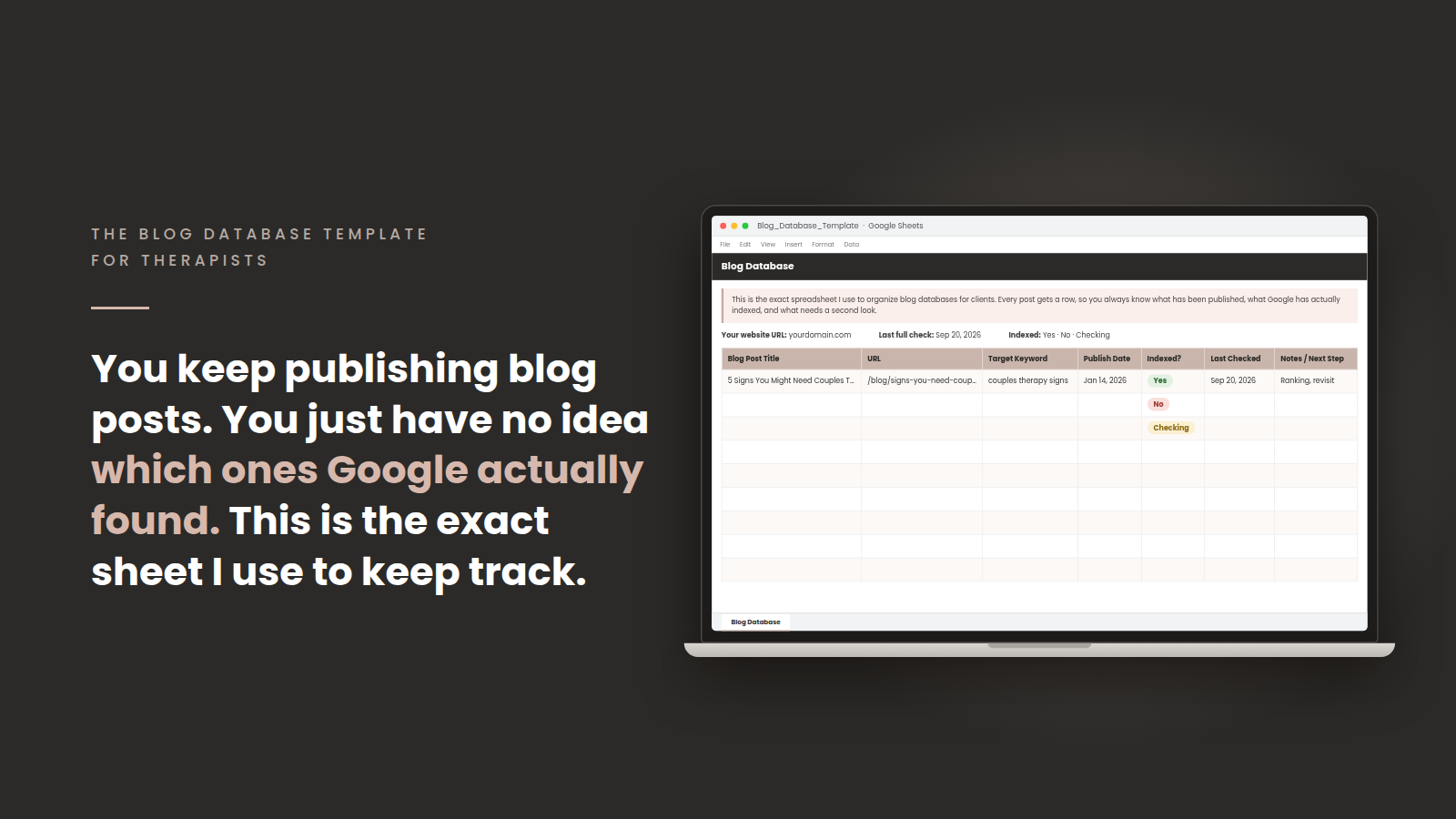
Get my free blog database template and give every page a row with its URL, target keyword, and whether Google has indexed it, so your audit notes have somewhere to live.
How do I check whether the right people are visiting?
Open Google Search Console and read the queries, because traffic only counts when the right person is behind it. Filter to your homepage and your top service pages. Searches like "anxiety therapist in your city" or "therapist for high achieving women" come from people ready to book. Searches like "therapy quotes" or "what is EMDR" come from curious visitors who were never going to fill out your form.
Google's guide to debugging traffic changes suggests using the Performance report and its Pages table to see where traffic lands, which works for this check too. If most of your visitors are the curious kind, the fix is your keyword targets, and no amount of copy polish will change that. If the right people are arriving, move to the next checks.
Does my contact form actually work?
Test it before anything else that costs time, because a broken form looks exactly like a lack of interest. Submit a message yourself from your phone and from a computer. Check that the notification reaches the right inbox, look in spam, and confirm the thank you message appears.

I have seen forms that looked perfect and sent their notifications to an old email address for months. It takes 2 minutes, it is free, and it is the cheapest way to rule out the worst explanation. That is why it ranks second even though it is the fastest check.
Can a visitor tell what to do in 5 seconds?
Open your top 2 pages on your phone, look away, then look back for 5 seconds. Ask whether you can say who the page is for, what you help with, and what to click next. Most therapy websites miss this test in my experience, because the top of the page talks about the practice and skips the visitor's problem.
Because visitors scan, the answer has to sit near the top. The Nielsen Norman Group analysis of 45,237 page views found users read about 20% of the text on the average page. The study was published in 2008 and used data from 2005, so treat the figure as a rough guide. I covered the fixes in my post on therapist website conversion rate without adding pages, including clear headlines and a call to action above the fold.
Are recordings and heatmaps worth adding to an audit?
They are worth adding when the first 3 checks do not explain the problem. A behavior tool shows what visitors do on the page instead of what you assume they do. Microsoft's documentation describes Clarity as a behavioral analysis tool that helps you understand user experience, with session recordings and heatmaps among its features.
Watch 10 to 15 recordings of visitors landing on your Revenue Driver pages. Look for people who scroll past your call to action, tap something that is not a link, or leave before they reach the form. Keep your expectations realistic, because with a small number of visitors, patterns take a while to show. I would not start here, which is why it ranks fourth.
How much does site speed matter for a quiet inbox?
It matters when the site is slow enough to lose visitors on a phone, and it explains the silence less often than owners expect. PageSpeed Insights reports on the user experience of a page on mobile and desktop and suggests improvements. Google also notes that lab data is useful for debugging but may not capture real world bottlenecks, while field data captures real user experience with a more limited set of metrics.
Run your top 2 pages through it, look at the mobile results first, and fix anything flagged as poor. Then move on. A perfect speed score on a page that never tells the visitor what to do still gets no inquiries. In my experience, this is the audit that owners spend the most time on and the one that explains the least.
When should I hire someone to audit my therapy website?
Hire someone when you have done the checks and cannot tell what the results mean, or when the list of problems is longer than your time. A professional audit looks at the whole picture in one pass, from copy and calls to action to SEO foundations, local SEO, specialty pages, speed, trust signals, and authority.
The free checks above are also the best preparation for one, because you will know what you saw. If structure is the issue, it helps to know that I have personally managed websites where the sitemap alone, with service pages and specialty pages and no blog published yet, beat local competition and ranked for real commercial keywords. For the wider picture of why therapy websites stall, I wrote a full breakdown in why your therapist website is not getting clients.
How long before fixes from an audit show up?
It depends on what you fix. A repaired contact form works the same day. Copy changes can show up in your inquiry rate within weeks once enough visitors arrive. Ranking changes take months. With little local competition you could reach page one in your first 90 days, sometimes 6 months, and a bigger metro takes longer. Track impressions, clicks, click through rate, and leads, and reassess every 6 to 12 months.
Frequently asked questions
How do I audit my therapy website for free?
Read your Search Console queries, test your contact form, run a 5 second test on your top 2 pages, and check your mobile speed with PageSpeed Insights. All four are free and take about an hour together.
Why does my therapy website get traffic but no inquiries?
The common causes are visitors who are not ready to book, a form that does not work, or pages that do not tell a visitor what to do next. Check them in that order, because each one is faster to rule out than the next.
What should a therapy website audit include?
A full audit looks at brand clarity, client focused copy, calls to action, SEO basics, local SEO signals, specialty pages, location pages, speed and mobile experience, trust signals, and authority. The free checks in this post cover the first steps of that list.
How often should I audit my therapy website?
Reassess every 6 to 12 months, and check your contact form and top queries more often. A quick monthly look at impressions, clicks, click through rate, and leads catches most problems early.
Want this off your plate?
Everything in this post is something you can do yourself. It also competes with your caseload, your family, and the evenings you would like back. Having a website is a job, and it is probably one you never signed up for.
This is the work I do every day. As a therapist website designer who also runs the SEO, I can build the fixes from an audit into your site, and our website management keeps the site healthy after launch. Then SEO for therapists and SEO for private practices cover the ongoing content and authority work that turn visitors into inquiries.
If you would rather hand this to someone who has served 100+ clients, apply to work with me and we can talk about your practice. No pressure, just a conversation about what would take the most weight off your desk.
* AI Disclosure: This content may contain sections generated with AI with the purpose of providing you with condensed helpful and relevant content, however all personal opinions are 100% human made as well as the blog post structure, outline and key takeaways.
* Affiliate Disclosure: Some of the links on www.nataliamaganda.com may contain affiliate links meaning that I will get a commission for recommending products at no extra cost to you.

hello! i'm natalia maganda
The website manager for therapists and private practices that you didn't know existed.
We build and manage the 20+ page website that ranks in your city, reflects the depth of your work and books cash-pay clients with ease.
A done for you website management system that lets your practice grow without costing you your energy, your weekends, or your nervous system.