
Do Google reviews help a therapist rank locally? Yes, and here are the 2 reasons why
Yes. Google reviews help a therapist rank locally, and Google says so in plain language on its own help page. Reviews feed the prominence part of local ranking, and in my experience they also do a second, quieter job: they get you the click once you are visible.
If we haven't crossed paths before, I'm Natalia, the founder of a boutique web design and SEO agency for therapists and private practice owners across the US. My mission is to help your website work as a 24/7 referral engine, so you can log off and still wake up to new inquiries. I have been doing this for over 7 years and have served 100+ clients, and I have managed over 900 URLs for other people's practices, which means I have watched a lot of Google Business Profiles move up and down the map pack with and without reviews.
You are probably here because you Googled "therapist near me" in your own city, saw practices with 30 reviews sitting above you, and wondered whether that is the reason. Or you have been told reviews are off limits for therapists and want to know if skipping them is quietly costing you.
Key takeaways
- Google names 3 local ranking factors on its own help page: relevance, distance, and prominence. It says prominence is based on things like how many websites link to you and how many reviews you have, and that more reviews and positive ratings can help your local ranking, per Google's guide to improving your local ranking.
- The 2026 Whitespark Local Search Ranking Factors report, published in November 2025 from a survey of 47 local search experts, puts 4 review signals in its top 15 factors for map pack rankings: high numerical ratings, quantity of Google reviews with text, review recency, and a sustained flow of reviews over time.
- Reviews do not replace the basics. A profile with the wrong primary category or an address that does not match your website can still lose to a practice with fewer reviews.
- Reviews also work on the human reading the map pack, alongside the algorithm. Two practices side by side in the map pack, one with 2 reviews and one with 25, do not get the same click.
- My position: therapists should get reviews from professional peers, colleagues, and referral partners, never clients, at a pace of 1 to 2 a month, and never through an exchange.
What does Google actually say about reviews and local ranking?
Google says reviews are part of prominence, and prominence is 1 of the 3 factors that decide who shows up in local results. That is the whole answer, straight from the source.
Here is how Google lays it out on its How to improve your local ranking page. Relevance is how well your profile matches what someone is searching for. Distance is how far you are from the person searching. Prominence is how well known your practice is, and Google says it is based on info like how many websites link to your business and how many reviews you have. Then comes the sentence that matters for this post: more reviews and positive ratings can help your business's local ranking.
Notice the word "can." Google is saying that review count and rating are inputs it looks at, without promising that 10 more reviews move you 3 spots. In my experience, reviews are 1 lever among several, and they pull hardest when the rest of the profile is already in order.
If you are nodding along but have never asked anyone for a review because you assumed you could not, I made a free resource for exactly this.
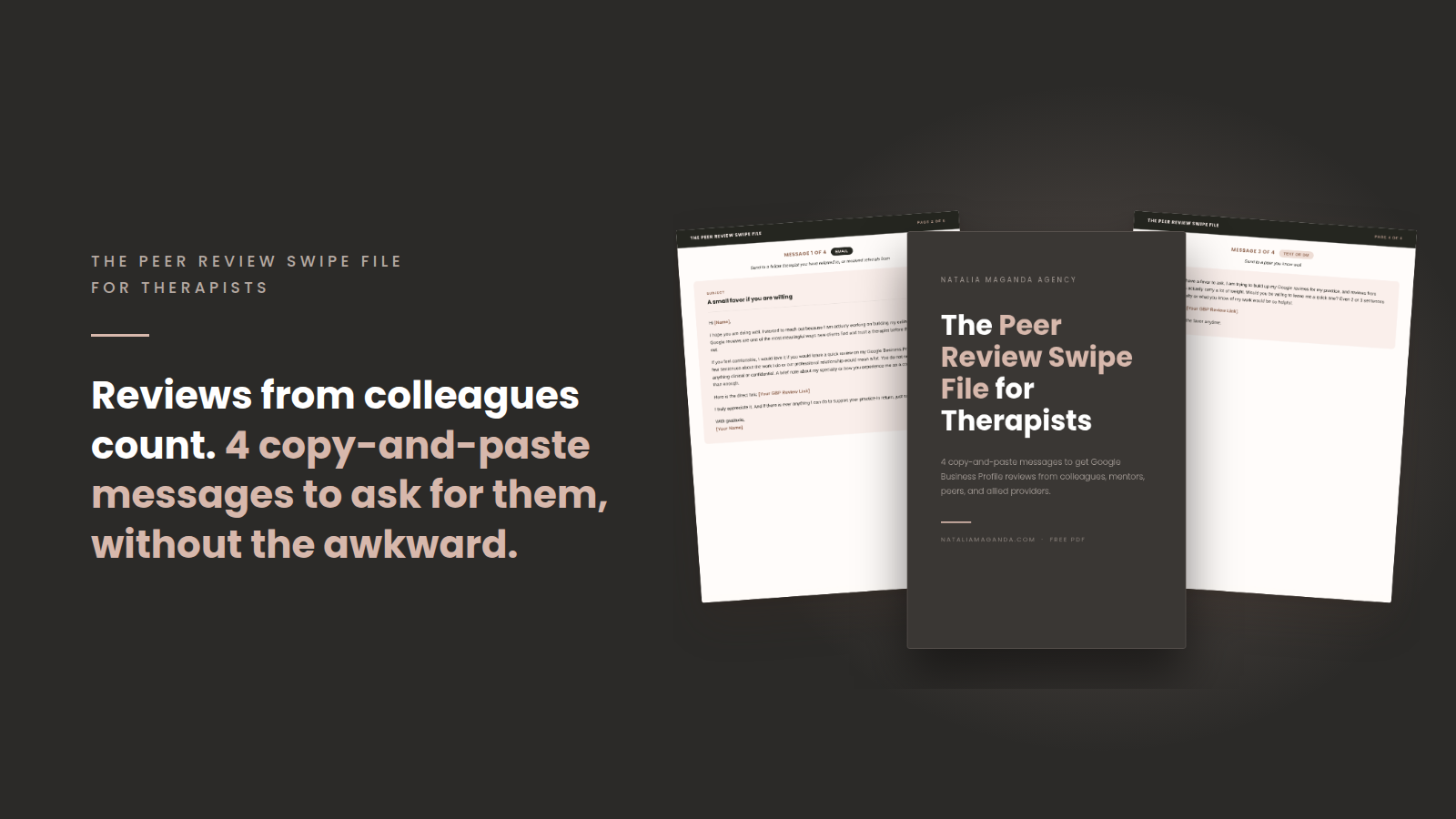
Get my free peer review swipe file, pick 1 colleague or referral partner you have actually worked with, and send the first ask this week. I also cover the full local SEO guide for therapists what it is, what you need and where to start.
What does the 2026 Whitespark local search ranking factors report say?
It says review signals got more important this year, and it ranks 4 specific review factors inside the top 15 for map pack results. Google's help page gives you the "yes." The Whitespark report gives you the "how much."
Some context. The 2026 Local Search Ranking Factors report was published by Whitespark on November 6, 2025. Each edition asks a panel of local SEO experts, 47 of them this time, to score which signals they believe move local rankings, then aggregates those scores. It is a survey of experienced practitioners rather than a leaked Google document, and it is the best outside read we have.
Here are the review factors that made the top 15 for local pack and map rankings in that edition, and what each one means for a therapy practice.
| Rank in the 2026 report | Review factor | What it means for your practice |
|---|---|---|
| 6th | High numerical Google ratings (4 to 5 stars) | Your average matters, and a handful of genuine 5 star reviews from peers moves the average fast when you are starting from 0. |
| 9th | Quantity of native Google reviews with text | Reviews with a written sentence or 2 count for more than a bare star rating. Ask people to say something specific. |
| 11th | Recency of reviews | A profile whose last review is from 2023 reads as inactive. A steady trickle beats a burst. |
| 14th | Sustained influx of reviews over time | This is the one most practices miss. Google seems to reward a steady pattern of reviews over a large total. |
The report's own summary line is the one I would remember: for 2026, the biggest changes are an increased importance of review signals and behavioral signals. Behavioral signals means what people do after they see your listing, like clicking, calling, or requesting directions. That connects to the conversion point below.
Two of those 4 factors, recency and sustained influx, are about rhythm. That is why my advice has never been "go get 40 reviews this month." It has always been 1 to 2 a month, kept up for as long as you run the practice, because that is the only pace a busy practice owner will actually sustain.
Why do reviews move rankings at all?
Because Google has to decide which of 40 therapists in your metro deserves the 3 map pack spots, and reviews are 1 of the few signals it can measure that comes from someone other than you. Everything on your website is you talking about you. A review is a third party saying, in public, that you are real and good at what you do.
That is also why reviews do not work alone. In my experience, a profile with the right primary category, every section filled, real photos, and a name, address, and phone number that match the website exactly will beat a profile with more reviews and sloppy basics more often than you would expect. Reviews amplify a solid profile, and a neglected profile still needs its basics fixed first. If you want the full checklist of what a strong profile looks like, my post on ranking your therapy practice higher on Google Maps walks through it category by category.
And here is the part that surprises people. The map pack does not grade on design. A practice with a complete profile and a steady stream of real reviews can sit above a practice with a far better website, and I have watched it happen more than once.
What else do reviews do besides help you rank?
They get you the click. Ranking puts you on the screen, and reviews are a big part of what makes a stressed person at 11pm pick your listing over the 2 next to it.
Picture the map pack the way your future client sees it. Three names, 3 star ratings, 3 review counts, all within a few inches on a phone. Practice A has 4 reviews. Practice B has 26 and a 4.9 average. Practice C has none. Nobody is weighing categories at that moment. They tap the one that feels safest, and that conversion decision happens before anyone reaches your website.
This links back to the behavioral signals the Whitespark report flagged. If reviews make more people click and call your listing, and Google notices, then reviews feed rankings twice: once directly through prominence, and once indirectly through human behavior. I cannot prove the second loop with a Google quote, so take it as my opinion from watching profiles over the years.
Should therapists ask clients for Google reviews?
No. This is my firm position and how I run it for every client in the agency. Ask professional peers, colleagues, supervisors, and referral partners, never the people you treat.
The ethics conversation around soliciting testimonials from current clients is real. I covered what is and is not allowed in my post on Google reviews for therapists and what is actually allowed. The short version for this post is that you do not need client reviews to benefit from everything above. A colleague who has referred to you for 3 years can speak to your work. A supervisor can speak to your training. None of that touches a client relationship, and all of it counts as a Google review.
Three rules I give every client, and I would give you the same ones.
- 1 to 2 a month, kept steady. A slow pace protects you from looking like a spike, and it matches the recency and sustained influx factors above. Put a recurring reminder in your task manager and keep it going until your count holds up next to the competitors in your area.
- Never a review exchange. "I'll review you if you review me" is exactly the reciprocal pattern Google has gotten good at catching, and the reviews come down. Google's own tips for getting more reviews page also states that offering incentives in exchange for reviews is considered fake and misleading content and is strictly prohibited. Keep every ask clean.
- Ask for a written sentence. Reviews with text weigh more, and a specific line about how you work does more for the reader than a rating ever will.
The people who can review you are already in your phone. In my experience, review counts stay low because nobody ever asked, and asking feels awkward without the words.
How much do reviews matter compared to the rest of local SEO?
A lot, and I treat them as the second layer that sits on top of the foundation. My order for a therapy practice trying to show up in its own city is: first the profile basics, because relevance and distance are decided there and no amount of reviews fixes a wrong category. Second, a website with a real service page and specialty pages that name your city, because Google reads your site to decide what you are an authority on. Third, the steady flow of peer reviews, which is where you separate from the other correctly set up practices. Fourth, citations, directories, and backlinks, which build the same prominence more slowly and compound year over year.
If you have the first 2 in place and your reviews are stuck in the single digits, reviews are your highest return task this quarter. If your profile is half filled, reviews are not what is holding you back yet.
Frequently asked questions
Do Google reviews affect organic rankings or only the map pack?
Mostly the map pack. Google's prominence language lives on its local ranking help page, and the Whitespark factors above are scored for local pack and map results specifically. Reviews can support your regular organic rankings indirectly, through trust and click behavior, but the direct effect is on the map.
Does a 5 star average matter more than the number of reviews?
Both matter, and they show up as separate factors in the 2026 Whitespark report, with high ratings ranked 6th and quantity of text reviews ranked 9th, per the 2026 Whitespark report. When you are starting from 0, a small number of genuine 5 star reviews with text does more than either one alone.
What if I only have a virtual practice with no office?
You can still have a Google Business Profile as a service based business and hide your address, and reviews work the same way. My Google Business Profile guide for therapists covers the setup for a practice with no storefront.
Want this off your plate?
Everything in this post is doable on your own. You can audit your profile, set the reminder, and send the asks. It just competes with your caseload, your family, and the hours you would rather not spend inside Google's dashboard.
As a therapist website designer who also runs the SEO, I build the site that Google reads as the authority behind your profile, and then I keep it working through ongoing website management so nothing goes stale while you are in session. The SEO for therapists and SEO for private practices work covers the whole prominence side we talked about here, from the profile to the directories to the reviews rhythm, so the map pack stops being something you check with a wince.
If that sounds like the weight you want off your desk, apply to work with me. No pressure, just a conversation about where your practice shows up today and what would move it.
* AI Disclosure: This content may contain sections generated with AI with the purpose of providing you with condensed helpful and relevant content, however all personal opinions are 100% human made as well as the blog post structure, outline and key takeaways.
* Affiliate Disclosure: Some of the links on www.nataliamaganda.com may contain affiliate links meaning that I will get a commission for recommending products at no extra cost to you.

hello! i'm natalia maganda
The website manager for therapists and private practices that you didn't know existed.
We build and manage the 20+ page website that ranks in your city, reflects the depth of your work and books cash-pay clients with ease.
A done for you website management system that lets your practice grow without costing you your energy, your weekends, or your nervous system.