
How many Google reviews does a therapist need to rank locally? 3 numbers to check
A therapist needs roughly as many Google reviews as the practices already sitting in the map pack for their main keyword in their city, and the way to find that number is to count theirs. The target is set by your local competitors, and the pace that gets you there without breaking any rules is 1 to 2 authentic reviews a month from professional peers.
If we haven't crossed paths before, I'm Natalia, the founder of a boutique web design and SEO agency for therapists and private practice owners across the US. My mission is to help your website work as a 24/7 referral engine, so you can log off and still wake up to new inquiries. I have been doing this for over 7 years, I have served 100+ clients, and I have managed over 900 URLs for other people's practices, so I have watched a lot of Google Business Profiles compete for the same 3 map spots.
You are probably here because you looked at your profile, saw 4 reviews, then looked at the group practice across town with 60 and felt your stomach drop. This post is about that gap, how big it needs to be, and how to close it without asking a single client.
Key takeaways
- There is no fixed review count that gets a therapy practice into the map pack. The target is relative to the top 3 profiles ranking for your keyword in your city.
- In the 2026 Local Search Ranking Factors survey, the quantity of Google reviews with text ranked 9th among local pack factors, recency ranked 11th, and a sustained influx over time ranked 14th, ahead of bursts.
- BrightLocal's 2026 Local Consumer Review Survey found 47% of consumers will not use a business with fewer than 20 reviews, and 74% look for reviews written in the last 3 months.
- My rule for clients: ask professional peers, colleagues and referral partners, aim for 1 to 2 real reviews a month, never trade reviews, and keep going until you are within reach of your local competitors.
- Check 3 numbers before you call it done: your count against the lowest of the top 3, your rating, and the date of your newest review.
Is there a minimum number of Google reviews to show up in the map pack?
No. Google has never published a review threshold. Picture a small city where the whole map pack has single digit review counts, then a large metro where every profile in the pack has passed 40. The same practice with 15 reviews is comfortable in the first and buried in the second. The number is competitive rather than absolute.
Quantity is a real signal that sits behind the fundamentals. In the 2026 Local Search Ranking Factors survey, local SEO practitioners ranked a high numerical rating 6th, the quantity of native Google reviews with text 9th, recency 11th, and a sustained influx of reviews over time 14th. All of those sit below your primary category and the basics of your profile, which is why a profile with a pile of reviews and the wrong primary category can still lose to a leaner profile that Google reads correctly.
So before you chase a number, make sure the profile itself is set up the way Google reads it. I walk through categories, the services section, photos and address settings in my post on setting up a Google Business Profile as a therapist. Reviews stack on top of that foundation.
People also read reviews before they call. BrightLocal's 2026 survey found that 47% of consumers will not use a business with fewer than 20 reviews, and 68% will only use a business rated 4 stars or higher. Those are general consumer numbers, and I think someone choosing a therapist is more forgiving on volume. Still, a profile with 2 reviews reads as new, and new reads as risky to someone already nervous.
How do I figure out the right number for my city?
Search your main keyword in your city, write down the review counts of the 3 profiles in the map pack, and aim for the lowest of the 3 first. The median of the 3 is your second target.
Here is how I do it in a client's local SEO audit.
- Open Google in a private window and search the phrase your ideal client would type, for example "anxiety therapist Austin" or "couples counseling Chicago." Use the city you want to rank in rather than the suburb you live in.
- Note the 3 practices in the map pack, their rating, their review count, and the date of the newest review on each.
- Repeat for your second revenue driver keyword, since the pack changes with the phrase.
- Take the lowest count across those packs. That is where you need to be to be in the conversation. The median is where you compete on reviews alone.
Say the pack for a specialty keyword in your city shows 18, 27 and 44 reviews. Your first target is 18. Now say a broad phrase like "therapist near me" in a large metro shows 90, 130 and 210. That is a signal to stop competing on that phrase and pick a specialty keyword with a smaller pack. I would rather see a practice own "EMDR therapist" in their city with 15 reviews than lose "therapist" with 40.
Write those numbers down with today's date. In 6 months you will run the same search.
If your count is below the lowest profile in your map pack, the fastest ethical route is a steady ask to the professionals who already know your work. I made a free swipe file for exactly this.
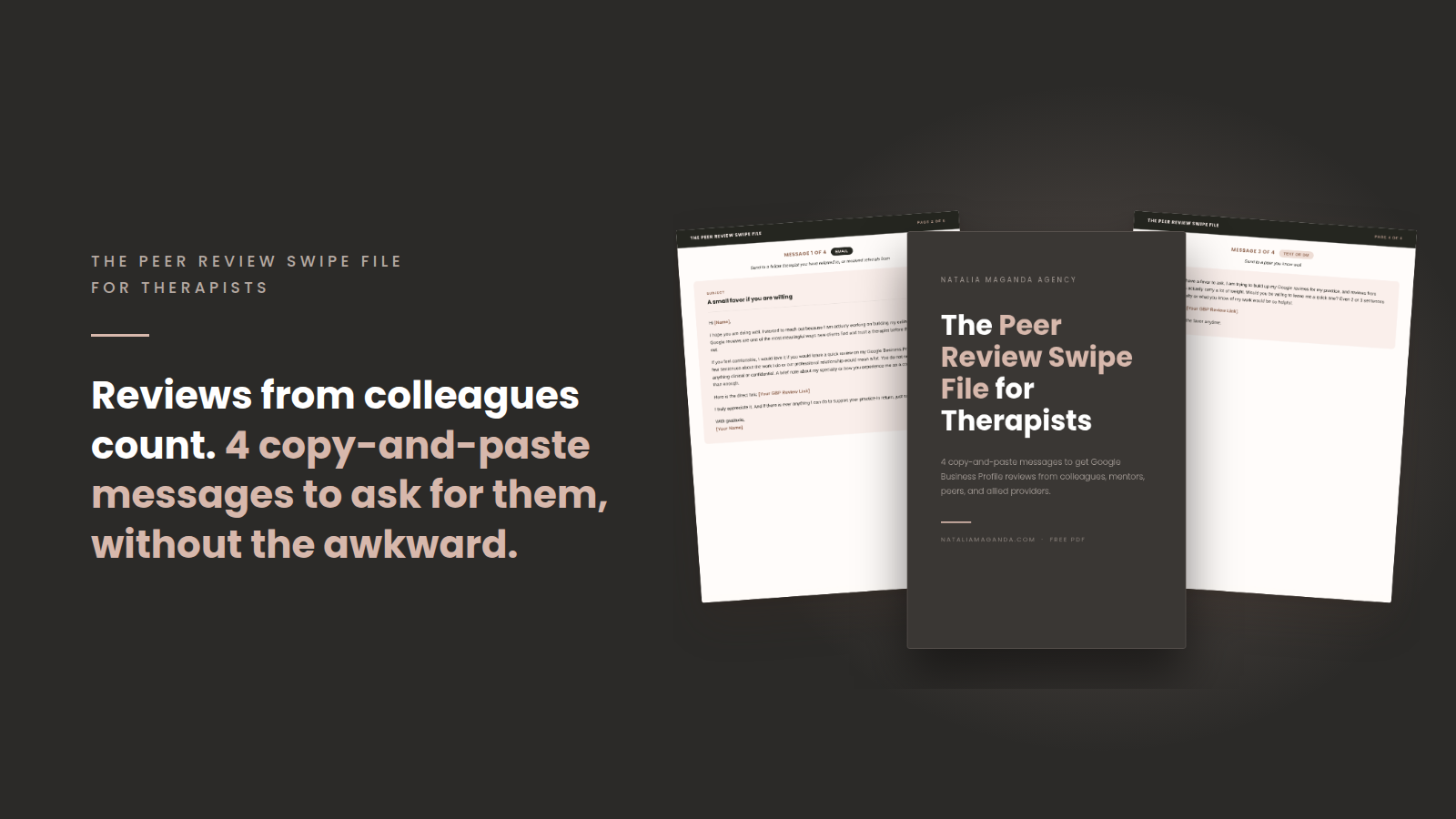
Get my free peer review swipe file, pick the 2 colleagues you would ask first, and send the first message this week. I also cover the full local SEO guide for therapists what it is, what you need and where to start.
Why do I say never ask clients, and who should you ask instead?
Because a client review puts that person on the record as someone in therapy, and you cannot control what they write or who reads it. I covered the ethics and privacy side in my post on what is actually allowed with Google reviews for therapists, so this one stays on the numbers.
Who I have my clients ask instead:
- Colleagues who have consulted with you on cases, co led a group, or worked alongside you in a practice.
- Referral partners, meaning the psychiatrist, pediatrician, school counselor, doula or attorney who has sent people your way and heard how it went.
- Supervisees and supervisors, past and present.
- Professionals who attended a training, workshop or talk you gave.
- Peers in your consultation group or association who know your specialty firsthand.
Every one of those people can describe a real experience with you as a professional without touching anything clinical. The review is about something they genuinely experienced, in their own words, with no script from you. Google's Maps content policy prohibits reviews that are paid for directly or in kind, and content based on a conflict of interest, so a review that is really a favor for a favor is exactly the kind Google is built to remove. Ask people who can speak honestly, and let them.
How fast should a therapy practice get reviews?
1 to 2 authentic reviews a month. That is the pace I set for every client, and I have a strong opinion about why it should not be faster.
A burst of 15 reviews in a week from a mass email looks, to Google, exactly like what it is. The 2026 Local Search Ranking Factors survey ranked a sustained influx of reviews over time, rather than bursts, as the 14th strongest local pack factor, and recency as the 11th. A slow, even cadence hits both. A burst hits neither, then goes quiet for a year.
How do I know when I have enough?
You have enough when 3 numbers line up: your count is at or above the lowest profile in your map pack, your rating is 4.5 or higher, and your newest review is less than 90 days old.
Your count against the lowest of the top 3. Once you are level with the weakest profile in the pack, reviews stop being what holds you back, and the profile setup and the website become the levers that move you.
Your rating. In BrightLocal's 2026 data, 31% of consumers said they will only use a business rated 4.5 stars or higher. Peer reviews tend to protect this number, because the people you ask know your work.
The date of your newest review. BrightLocal found 74% of consumers look for reviews written in the last 3 months, and 32% look for one from the last 2 weeks. A profile whose last review is from 2024 tells a nervous prospect the practice might be closed. This is the number most practices fail, and it is why the monthly cadence never really ends. It just gets lighter.
What if my competitors have hundreds of reviews?
Change the keyword you are competing on. A group practice with 200 reviews on "therapist" in a large metro has been at this for years, and matching that at 2 reviews a month is a 7 year project.
What I do for clients in that position is move the fight to a phrase the big profile is not built for. Specialty keywords, the ones a researched client types, like "perinatal therapist" or "OCD therapist," usually pull a much smaller pack. Your primary category, your services list, your specialty pages and the words your peers naturally use in their reviews all point Google toward that phrase.
The other move is to stop treating the map pack as the only prize. A specialty page on your site can rank in the regular results directly under the pack, where review counts are not displayed at all. Reviews help you get into the pack. Your website earns the reply.
Frequently asked questions
Do therapists need Google reviews to rank in the map pack?
Not strictly. In a small market a practice can rank with a handful of reviews when its category and website are stronger than the competition. In most metros, though, all 3 profiles in the pack have reviews, so a profile with 0 starts a step behind. The steps that go with reviews are in my post on ranking a therapy practice higher in Google Maps.
How many Google reviews should a new therapy practice aim for in the first year?
12 to 24, meaning 1 to 2 a month for 12 months, all from professional peers and referral partners. Compare that against the lowest count in your local map pack before deciding whether it is enough. In most mid sized cities it gets a solo practice into the conversation for a specialty keyword.
Can I ask other therapists to review my practice on Google?
Yes, as long as the review reflects a real professional experience with you and nothing is offered in return. Google's Maps content policy prohibits incentivized reviews and content based on a conflict of interest, so a swap where you both review each other is the one thing I tell clients never to do.
Want this off your plate?
Everything in this post is doable on your own. Run the map pack search, write down the numbers, set the monthly reminder, send the 2 messages. It is simple work, and it competes every month with your caseload, your family and the hour you hoped to keep for yourself.
As a therapist website designer who also runs the SEO, I take the whole picture off your desk, including the review cadence, the profile setup and the website underneath it. My website management keeps the site current and connected to your profile month after month, and my SEO for therapists and SEO for private practices work builds the specialty pages and local signals that make a modest review count enough to compete.
If you would rather hand this over than track it yourself, apply to work with me. No pressure, just a conversation about what would take the most weight off your desk.
* AI Disclosure: This content may contain sections generated with AI with the purpose of providing you with condensed helpful and relevant content, however all personal opinions are 100% human made as well as the blog post structure, outline and key takeaways.
* Affiliate Disclosure: Some of the links on www.nataliamaganda.com may contain affiliate links meaning that I will get a commission for recommending products at no extra cost to you.

hello! i'm natalia maganda
The website manager for therapists and private practices that you didn't know existed.
We build and manage the 20+ page website that ranks in your city, reflects the depth of your work and books cash-pay clients with ease.
A done for you website management system that lets your practice grow without costing you your energy, your weekends, or your nervous system.