
Best Psychology Today alternatives for local searches: 4 compared
Instead of Psychology Today, the 4 things that actually get a therapy practice into local searches are your own Google Business Profile, a short list of free directories, location and specialty pages on your own website, and a steady trickle of reviews from professional peers. The one you start with depends on how your practice runs, which is what I compare below.
If we haven't crossed paths before, I'm Natalia, the founder of a boutique web design and SEO agency for therapists and private practice owners across the US. My mission is to help your website work as a 24/7 referral engine, so you can log off and still wake up to new inquiries. I have been doing this for over 7 years, have served 100+ clients, and have managed over 900 URLs for other people's practices, so I have watched a lot of owners try to leave Psychology Today and learn which replacements bring inquiries and which just look busy.
You probably know the feeling. Your directory profile gets fewer clicks than it did 3 years ago, and when you Googled "therapist in [your city]" your own website was nowhere. You do not want your caseload to depend on a platform you rent.
Key takeaways
- Google's guidance on how local ranking works names 3 factors: relevance, distance, and prominence. You cannot control any of them from inside a directory profile.
- A Google Business Profile is free, works with a hidden address, and is the closest thing to a direct replacement for the map results.
- Free directories are a should do. Paid ones build domain authority slowly and will not hand you a spike in leads.
- Location and specialty pages on your own site are the only option here you fully own, and the one that compounds.
- The BrightLocal Local Consumer Review Survey 2026 found 47% of consumers will not use a business with fewer than 20 reviews. You can build those ethically from peers.
Why does Psychology Today show up for local searches when my site does not?
Psychology Today ranks locally because it has spent years earning links, reviews, and trust at a scale your site has not had time to match. Google reads that difference as prominence, 1 of the 3 factors in Google's local ranking guidance.
Here is the part that stings. When you pay for a profile, you are helping the directory rank for "therapist in [your city]" and then competing with 200 other therapists inside that page for the click. The directory wins the search, you win a lottery ticket. And Google Maps, ChatGPT, and AI Overviews all prefer a real business with a real address, real reviews, and a real website over a listing on someone else's domain. So the question underneath "what can I use instead" is really "what can I build that Google treats as mine." Every alternative below passes that test.
What are the alternatives to Psychology Today for local searches?
| Alternative | What it costs | Setup effort | Who it suits best | What it does for local search |
|---|---|---|---|---|
| Your own Google Business Profile | Free | 1 afternoon, then 20 minutes a month | Every practice, including telehealth with a hidden address | Gets you into the map pack and "therapist near me" results |
| Free therapist directories | Free | 1 to 2 hours total for a short list | Newer domains that need trust signals fast | Citations that confirm your name, address, and phone, plus slow authority |
| Location and specialty pages on your site | Your time, or a designer | The biggest lift on this list | Group practices, multiple offices, competitive metros | Ranks your own domain for city and specialty searches, and compounds |
| Peer reviews on your Google Business Profile | Free | 10 minutes a month, ongoing | Established practices with a referral network | Raises prominence and the click through rate on your listing |
None of these has a monthly fee. The cost is time and judgment, which is exactly why so many owners keep paying the directory instead. The paid option feels like doing something.
If your first move is submitting to a few free directories, the hard part is knowing which ones are worth the form. I made a free directory list for exactly this.
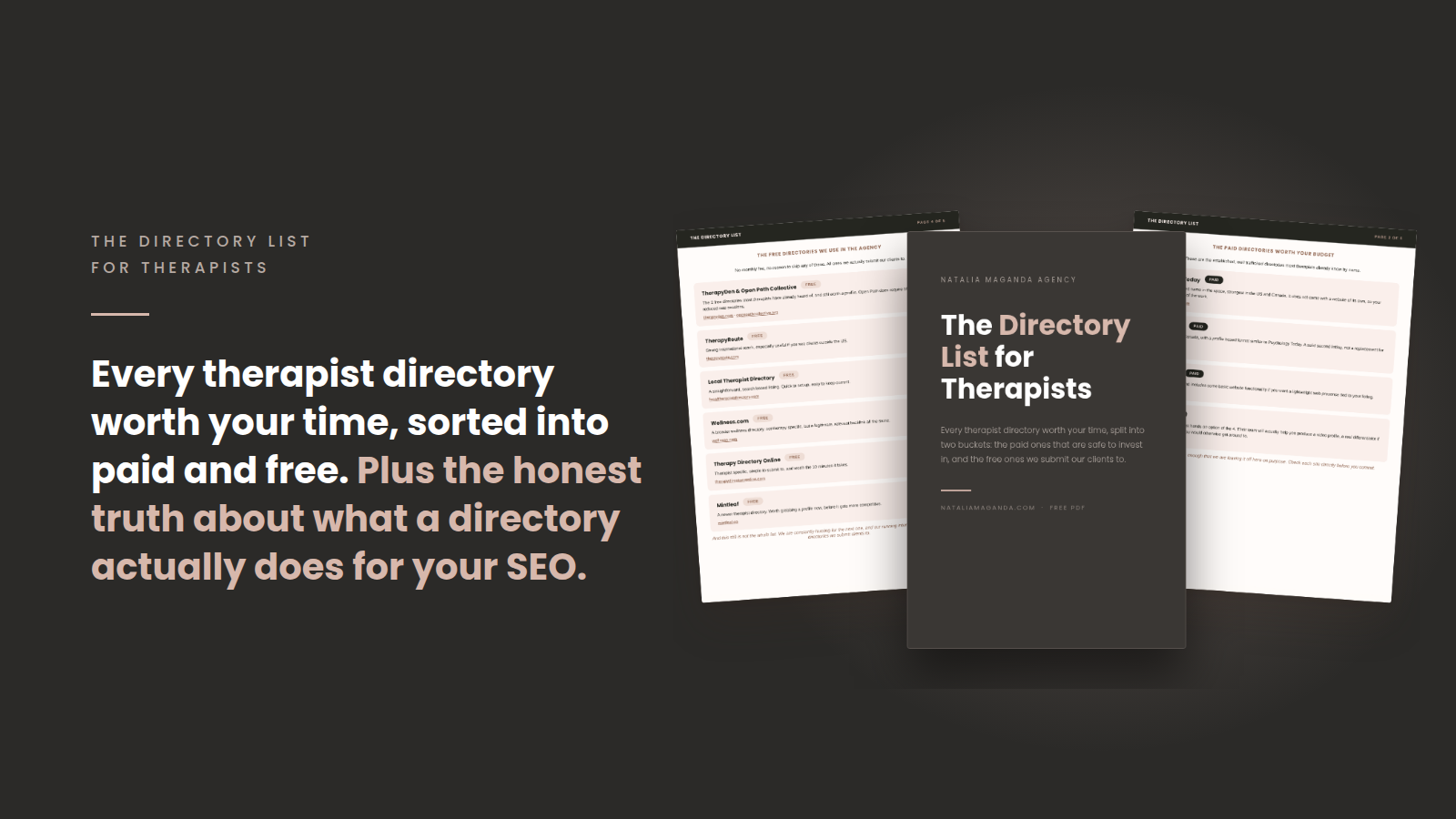
Get my free directory list for therapists, submit your practice to 3 of them this week, and use the exact same name, address, and phone number on every one. I also cover the full local SEO guide for therapists what it is, what you need and where to start.
Is a Google Business Profile enough to replace Psychology Today?
For the map results, yes, a well built Google Business Profile does the job Psychology Today used to do, under your own name. For everything else, it is the front door, and the rest of this list is the house behind it. And if you no longer have an office, you can set it up as a service based business and hide the address completely. Here is what I have found actually moves a profile, in the order I would do it:
- Pick the right primary category first, then the secondary ones. In my experience this single choice matters more than most owners realize.
- Fill out every section. Google says outright that complete and accurate profiles are more likely to show up.
- Add real photos regularly, meaning your office, your face, or your waiting room rather than your logo, and post a short update every so often.
- Keep your name, address, and phone number identical everywhere.
I wrote a full walkthrough on setting up a Google Business Profile for therapists if you want the category choices spelled out. Who this suits: everyone. If you only do 1 thing from this post, do this one.
Which free directories are worth listing my practice in?
Free directories are worth it because each one is a citation, a public record that a practice with your name, address, and phone number exists, and Google uses those records to confirm your profile is legitimate. Paid directories are a different decision. A paid listing will not hand you a flood of leads. What a good paid placement does is raise domain authority, the slow trust score search engines and AI tools use to decide who gets recommended. I once paid $1,000 for a feature placement that took my own domain authority from about 12 to 20. It did not bring me clients from that feature directly, and it did add to my trustworthiness and to being recommended by AI to therapists who now book discovery calls with me.
Free ones are a should do, every time. In the agency we submit every client to directories, and many start at a domain authority of 0 and grow to 6 to 8 within their first year. Two rules: only list where your name, address, and phone number can match your profile exactly, and skip any directory that swaps your phone number for a tracking number. My rundown of the best therapist directories to list your private practice sorts free from paid.
Who this suits: newer domains, practices that have never done any SEO, and anyone whose profile is set up but not ranking yet.
Do location and specialty pages on my own site help me show up locally?
Yes, and this is the alternative I would fight for, because it is the only one you own outright. A profile lives on Google. A listing lives on a directory. A page that says "anxiety therapy in Austin" lives on your domain and earns trust nobody can take away.
My opinion, which goes against a lot of common advice: a strong sitemap of service, specialty, and location pages matters more than blogging. I have managed websites where the foundational sitemap alone, with no blog published yet, beat local competition and ranked for real commercial keywords, because Google and AI tools read the structure of your whole site to decide what you are an authority on. Here is how I think about the pages:
- Revenue driver pages. Your top 1 or 2 service pages. These deserve real, story driven copy, because ranking gets the click and the words get the reply.
- Specialty pages. Everything else you are trained in. Lean, keyword forward, using the clinical phrases a researched client actually types.
- Location pages. One per city or area you want inquiries from, each written for that place instead of copied with the city name swapped.
A solo practice in 1 city might need 6 to 10 pages. A group with 3 offices and 8 specialties needs a lot more, which is exactly where this pays off fastest. I broke down what goes on each page in my post on location pages as an SEO strategy for therapy practices. Who this suits: group practices, multiple offices, telehealth practices licensed in several states, and any solo owner in a crowded metro.
How do peer reviews help me show up in local searches without asking clients?
Peer reviews raise the prominence of your profile, and prominence is what separates 2 practices with equally complete profiles. Google says plainly that more reviews and positive ratings can help local ranking, and the BrightLocal Local Consumer Review Survey 2026 found that 97% of consumers read reviews for local businesses, 47% will not use a business with fewer than 20 reviews, and 68% will only use a business rated 4 stars or higher.
You cannot ask clients, and you are right to be careful there. The reviews you need come from people who can honestly speak to your work without touching anything confidential: the psychiatrist who refers to you, the colleague you consult with, the school counselor who sends you families. The rhythm I give my own clients:
- Aim for 1 to 2 authentic reviews a month. Do not blast your whole network in a week.
- Never do a review exchange. Google spots reciprocal reviews and removes them.
- Reply to every review, and mention your specialty and city in the reply.
If a nearby practice with a plain website, every profile section filled in, and 30 peer reviews is sitting above you in the map pack, this is usually why. Who this suits: established practices with a referral network that need the last push into the top 3.
Which Psychology Today alternative should I start with?
Start with the Google Business Profile, then pick your second move based on the shape of your practice. Here is the ranking I would give a client:
- Google Business Profile first, always. It is free, it takes an afternoon, and it is the only option that gets you into the map pack directly.
- Solo telehealth practice or newer domain: free directories second. You need citations and a little authority before your own pages can compete.
- Group practice, more than 1 office, or a big metro: location and specialty pages second. The map pack in a big city is too crowded to win on the profile alone.
- Peer reviews last, but start them the same month, because they take the longest to accumulate and cannot be rushed without breaking Google's rules.
The criteria behind that order are ownership, time to results, and local competition. A practice with little competition could land on page 1 in the first 90 days, sometimes 6 months, with a profile and a handful of directories. A bigger metro means competing with owners who have been doing this for years, and the pages are how you catch up.
And no, none of this means canceling Psychology Today tomorrow. Keep it as long as it pays for itself, and stop treating it as the plan. The owners I have watched leave successfully built the 4 things above first, and then noticed the renewal email one day and shrugged.
Frequently asked questions
Is Google Business Profile better than Psychology Today for therapists?
For local Google results, yes. A Google Business Profile puts your practice in the map pack under your own name, while a Psychology Today profile only gets you a spot inside a page the directory ranks for. It is free and works with a hidden address.
Do I need a physical office to show up in local searches?
No. You can set up a Google Business Profile as a service based business and hide your address, and Google will still show your practice for searches in your service area. Location pages on your own website do the same job, as long as each one is written for that place.
How many Google reviews does a therapy practice need?
The BrightLocal Local Consumer Review Survey 2026 found that 47% of consumers will not use a business with fewer than 20 reviews, so 20 is a reasonable first goal. At 1 to 2 ethical peer reviews a month, that is roughly a year of consistent asking.
Want this off your plate?
Everything in this post is something you can do yourself. The catch is that it competes with your caseload, your family, and the version of your week where you are not doing SEO at 9pm on a Tuesday. That is the part I take on. As a therapist website designer who also runs the SEO, I build the location and specialty pages that replace the directory as your main source of local traffic, and my ongoing website management keeps those pages, your profile, and your citations consistent month after month. For a solo practice, my SEO for therapists work covers the profile, the directory submissions, and the peer review rhythm from this post. For a group, my SEO for private practices approach scales the same system across every clinician, office, and specialty.
If you would rather hand the whole thing over than learn it, you can apply to work with me here. No pressure, just a conversation about what would take the most weight off your desk.
* AI Disclosure: This content may contain sections generated with AI with the purpose of providing you with condensed helpful and relevant content, however all personal opinions are 100% human made as well as the blog post structure, outline and key takeaways.
* Affiliate Disclosure: Some of the links on www.nataliamaganda.com may contain affiliate links meaning that I will get a commission for recommending products at no extra cost to you.

hello! i'm natalia maganda
The website manager for therapists and private practices that you didn't know existed.
We build and manage the 20+ page website that ranks in your city, reflects the depth of your work and books cash-pay clients with ease.
A done for you website management system that lets your practice grow without costing you your energy, your weekends, or your nervous system.