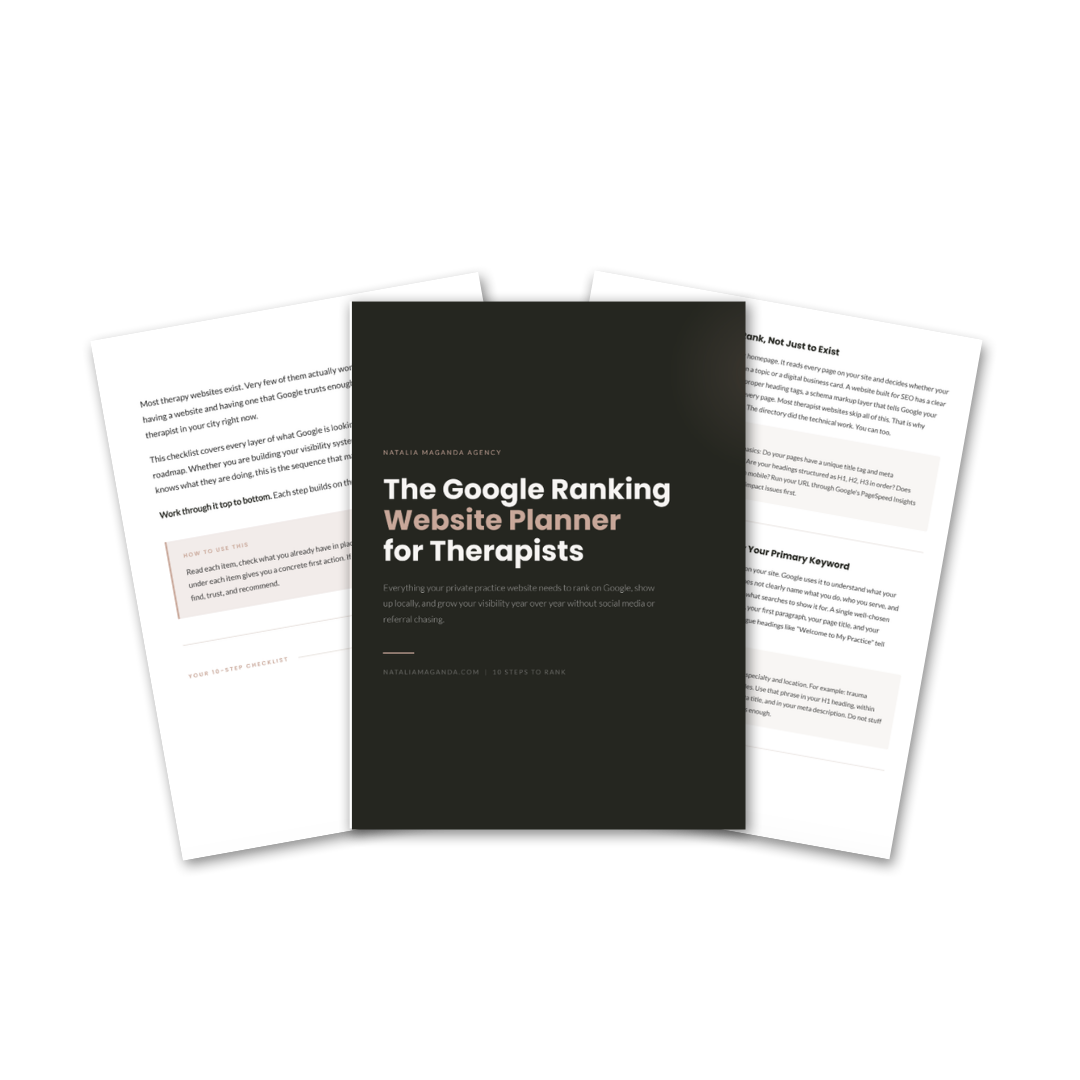

Why your professional looking therapy website still gets no contact form submissions (5 checks)
Your therapy website looks professional but gets no contact form submissions because looking good and getting found are 2 separate jobs. Design earns trust after someone lands on your site. A small, static site with 5 pages, no new content, and no clear structure gives Google very little reason to send anyone there in the first place.
If we haven't crossed paths before, I'm Natalia, the founder of a boutique web design and SEO agency for therapists and private practice owners across the US. My mission is to help your website work as a 24/7 referral engine, so you can log off and still wake up to new inquiries. I have been in business for over 7 years and have served 100+ clients. I built 2 websites of my own and got it wrong both times, and I have managed over 900 URLs for other people's practices, so I have seen a lot of beautiful sites that never got a single form submission.
If you paid for a lovely site, or spent a weekend making one yourself, and your inbox is still quiet, it is easy to feel embarrassed and wonder what you missed. You missed nothing obvious. Most of the time the gap sits in a place you cannot see by looking at the homepage.
Key takeaways
- A quiet contact form has 4 possible causes: too few visitors, visitors who do not click, visitors who do not act, or a form that does not work. Each one shows up in a different number.
- Google asks whether content provides a substantial, complete, or comprehensive description of its topic. A 5 page site rarely does that for more than a few phrases.
- Google describes structured data as explicit clues about the meaning of a page and says it might lead to richer search results. It labels a site. It does not replace a site with real depth.
- In my experience, a practice site needs 20 or more pages to compete, made of Revenue Driver pages, Specialty pages, and supporting content.
- Testing your own form takes 2 minutes and should be the first thing you do.
Why does my therapy website look professional but get no inquiries?
Start by finding out which of the 4 causes you have, because the fix for each is different. Open Google Search Console, set the date range to the last 3 months, and look at impressions, clicks, click through rate, and then count the form submissions you actually received.
| What you see | What it usually means | Where to fix it |
|---|---|---|
| Very few impressions | Google does not show your site for many searches yet | Site structure, page count, and authority |
| Impressions but almost no clicks | Your titles and descriptions do not earn the click | Meta titles and descriptions |
| Clicks but no form submissions | Visitors land and do not know the next step | Page copy and calls to action |
| Clicks and people say they tried to reach you | The form is broken or the emails go to spam | Form setup and notifications |
Most of the private practice sites I look at land in the first row. They look finished, they are finished, and Google has almost nothing to work with. That is the case the rest of this post spends its time on.
If you are in that first row, the best starting point is your sitemap, meaning the list of pages your site needs and the main phrase each one targets. I made a free planner for exactly this.
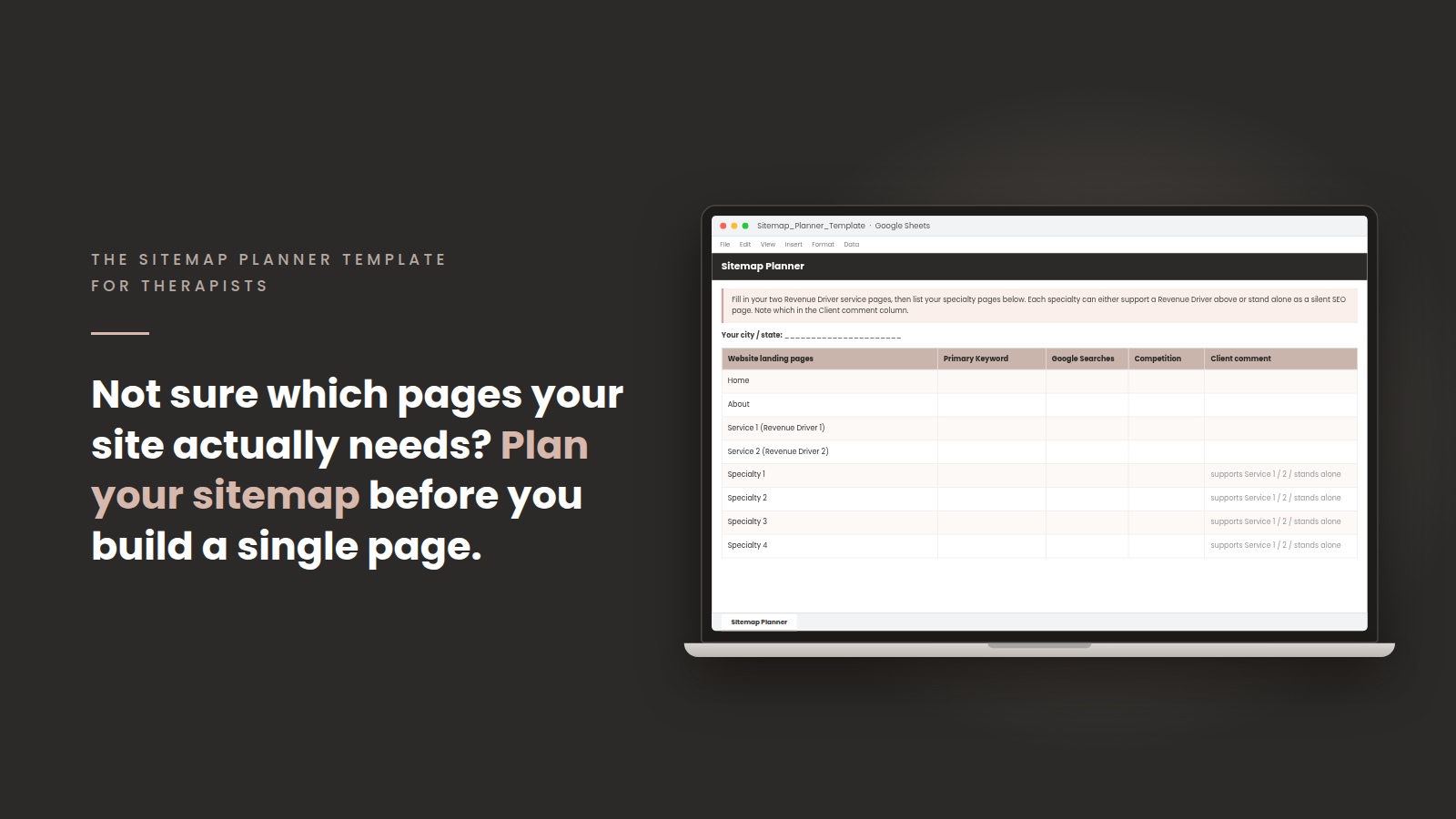
Get my free sitemap spreadsheet planner, list the pages you have today, and see how many gaps show up.
Is my form broken, or is nobody filling it out?
Test it before you change anything else, because a broken form looks exactly like a lack of interest. Submit a message yourself from your phone and from a computer. Check that the notification reaches the right inbox, and look in your spam folder too. Then check that the thank you message appears, so a real visitor knows it worked.
I have seen forms that looked perfect and sent their notifications to an old email address for months. Fixing that takes minutes, and it is the cheapest win in this entire post. If the form works and the notification arrives, you can rule this cause out and move on.
Do visitors read my page or leave before they act?
Most visitors scan, and a scanning visitor needs one clear next step in view. A Nielsen Norman Group analysis of 45,237 page views found that users read about 20% of the text on the average page. That study was published in 2008 and used data from 2005, so treat the exact figure as a rough guide, and notice how the habit has only gotten stronger with phones.
If you have clicks but no submissions, the problem is on the page. Your homepage and your Revenue Driver pages need to say who you help and with what, and then show a contact button above the fold and again lower down. I covered that side in detail in my post on therapist website conversion rate without adding pages, so I will not repeat it here. The short version is that clear, specific copy beats warm, generic copy every time.
Why does a 5 page therapy website struggle to get found?
A 5 page site struggles because Google and AI tools read the structure of your whole site to work out what you are an authority on, and 5 pages cannot cover much. A typical small site has a home page, an about page, one services page, a contact page, and maybe a blog with a couple of posts. That is enough to introduce you to someone who already knows your name. It is not enough to be found by someone who has never heard of you.
Google's guidance on helpful content asks whether a page gives a substantial, complete, or comprehensive description of its topic and whether it offers original information. One services page covering anxiety, trauma, couples work, and teens cannot do that for any of them. A practice with a dedicated page for each one can.
Here is how the same practice looks at 5 pages and at 20 or more.
| The site | What Google can tell | Searches it can match |
|---|---|---|
| 5 pages, 1 services page | A therapist, somewhere, who helps with several things | Mostly your name and a few broad phrases |
| 20 or more pages with Revenue Driver and Specialty pages | A therapist in your city who is the go to person for specific concerns | The specific phrases a researched client types |
I have personally managed websites where the sitemap alone, with service pages and specialty pages and no blog published yet, beat local competition and ranked for real commercial keywords. That is the part most owners never hear. You may not need to write 80 blog posts. I wrote 80 blogs for my own site and still sat on page 6 with barely 100 clicks a month, because the site had not earned enough trust yet. Structure and authority came first, and the posts only paid off after that.
What pages should a therapy website have to get contact form submissions?
Build in this order. First, your 1 or 2 Revenue Driver pages, which are the services that earn you the most, written with story driven copy that turns a searcher into an inquiry. Second, Specialty pages for everything else, lean and keyword forward, each supporting a Revenue Driver or standing alone for a clinical phrase a researched client types. Third, location pages if you want to show up in more than 1 city. My guide on what pages a therapist website should have walks through the full list.
Does structured data make a difference for a small therapy website?
It helps Google and AI tools read your pages, and it will not make up for a thin site. Google describes structured data as explicit clues about the meaning of a page, and says it might lead to richer results. There is no promise in that sentence, and I agree with that framing.
Think of schema as a plain label on each room of your website, so nothing has to guess. The sites that beat a small static one usually have that labeling and a lot more rooms. I build every agency site on Duda, where schema markup, the robots file, image compression, and alt text generate automatically, which is one less job on the owner. That is my opinion as someone who has managed the alternatives. The labels only help when there is something worth labeling, which brings it back to depth.
Why does a site that stopped growing lose to one that keeps publishing?
Google and AI search reward sites that keep showing up, and a frozen site slowly loses ground to a practice that keeps adding to its own. The era of the static website is over. A site you launched 2 years ago and never touched is competing against practices that have published dozens of pages since then.
That does not mean you need to post every week. It means your site needs a plan for what comes next after launch: which Specialty page, which supporting post, which location page. Track impressions, clicks, click through rate, and leads, and reassess every 6 to 12 months. Impressions without clicks, or a page 6 ranking, means Google is starting to pick you up, and it is a sign to keep building. For the wider picture, I wrote a full breakdown in why your therapist website is not getting clients.
Timelines depend on where you practice. With little local competition you could reach page one in your first 90 days, sometimes 6 months. In a bigger metro you are up against practice owners who have done this for years, so it takes longer and your keyword choices need to be sharper.
Frequently asked questions
Why does my therapy website get traffic but no contact form submissions?
Test the form first, because a broken form looks like no interest. If it works, the page is probably missing a clear next step. Say who you help and with what near the top, and add a contact button above the fold and again lower on the page.
How many pages should a therapy website have?
In my experience, 20 or more pages gives a practice enough depth to compete. That count covers your Revenue Driver pages, Specialty pages, and supporting content. A 5 page site can introduce you to people who know your name, and it covers very few search phrases.
Do I need a blog to get more inquiries?
Not as a first step. A clear sitemap of service pages and specialty pages can start ranking before you publish a single post. Blogging helps later, once that structure is in place and you have a plan for which phrases to target.
How long does it take to get contact form submissions from a new page?
It depends on your competition. With little local competition you could see results in 90 days, sometimes 6 months, and a bigger metro takes longer.
Want this off your plate?
Everything in this post is something you can do yourself. It also competes with your caseload, your family, and the evenings you would like back. Having a website is a job, and it is probably one you never signed up for.
Growing a 5 page site into a 20 page one is exactly the work I do every day. As a therapist website designer who also runs the SEO, I plan the sitemap around your Revenue Driver pages first, and our website management keeps the site growing after launch so it never goes static again. Then SEO for therapists and SEO for private practices cover the ongoing content and authority work that turns a nice looking site into one that brings in inquiries.
If you would rather hand this to someone who has served 100+ clients, apply to work with me and we can talk about your practice. No pressure, just a conversation about what would take the most weight off your desk.
* AI Disclosure: This content may contain sections generated with AI with the purpose of providing you with condensed helpful and relevant content, however all personal opinions are 100% human made as well as the blog post structure, outline and key takeaways.
* Affiliate Disclosure: Some of the links on www.nataliamaganda.com may contain affiliate links meaning that I will get a commission for recommending products at no extra cost to you.

hello! i'm natalia maganda
The website manager for therapists and private practices that you didn't know existed.
We build and manage the 20+ page website that ranks in your city, reflects the depth of your work and books cash-pay clients with ease.
A done for you website management system that lets your practice grow without costing you your energy, your weekends, or your nervous system.